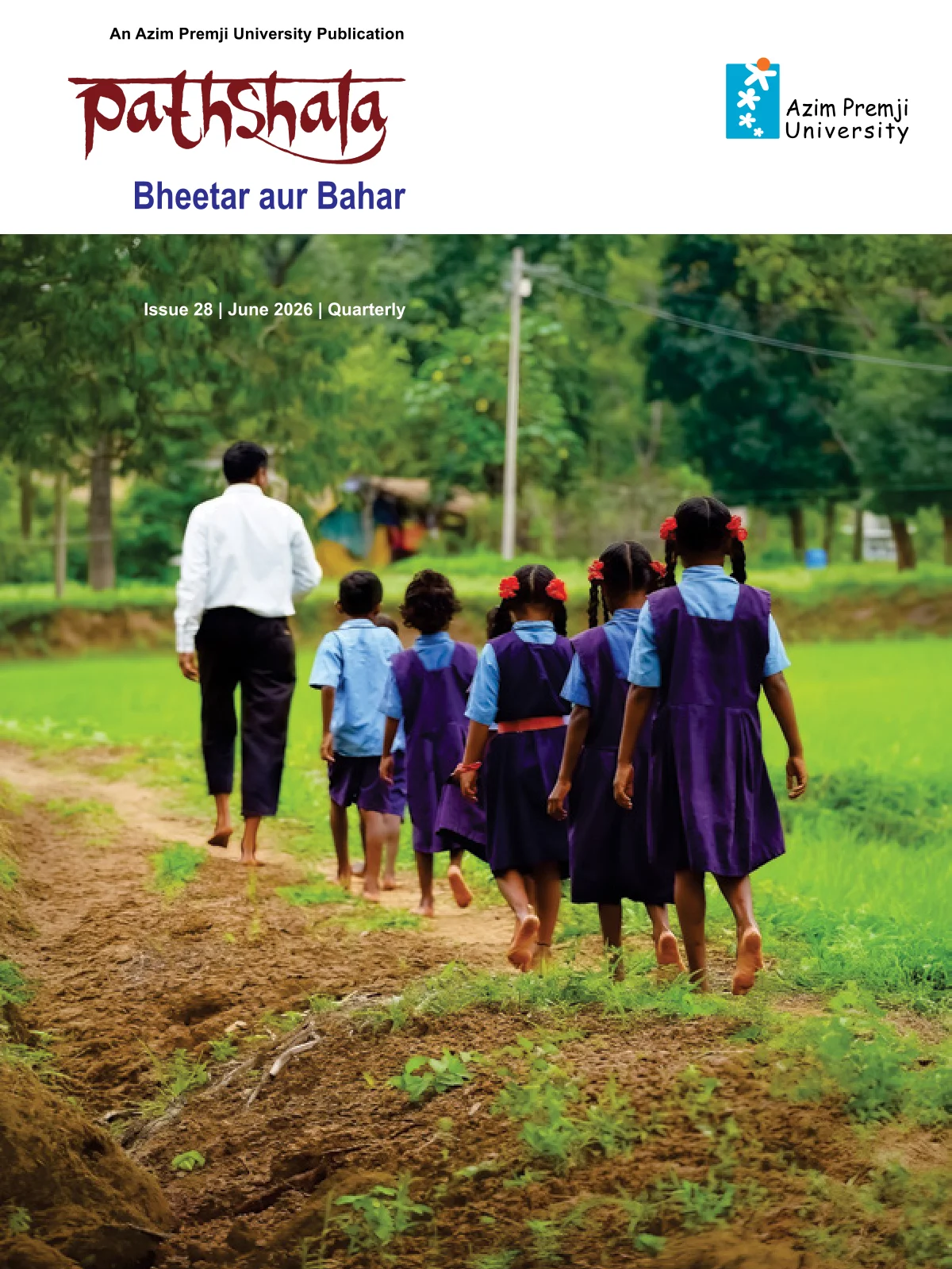
June 2026Bheetar aur Bahar i Issue 28 | June 2026 | Quarterly An Azim Premji University Publication
Write to us at: pathshala@apu.edu.in (Editorial) Pathshala Bheetar aur Bahar is Azim Premji University’s quarterly publication on school education. The publication seeks to provide practice-based content for pre-primary, primary and upper-primary government school teachers across the country. It is a platform for them to share perspectives, experiences, reflections and classroom processes that reflect effective pedagogy aligned with NEP 2020, NCF-SE and NCF-FS. First published in Hindi, it is also translated into English and Kannada. y Names have been changed to protect children’s identities. y Opinions expressed in this magazine are those of the authors and do not necessarily reflect the views or positions of the Azim Premji Foundation. y All articles in this magazine are licensed under the Creative Commons-Attribution-NonCommercial 4.0 International License. To republish articles, please write to us. June 2026 | Issue 28 Editorial Team Pratibha Katiyar (Chief Editor) pratibha.katiyar@azimpremjifoundation.org Shefali Tripathi Mehta (Associate Editor) shefali.mehta@azimpremjifoundation.org Gautam Pandey gautam@azimpremjifoundation.org Sunil Kumar Sah sunil@azimpremjifoundation.org Jagmohan Singh Kathait jagmohan@azimpremjifoundation.org Siddharth Kumar Jain siddharth.jain@azimpremjifoundation.org Raghavendra Herle Raghavendra.herle@azimpremjifoundation.org Dashrath Kumar Pareek dashrath.pareek@azimpremjifoundation.org Bhaskar Upreti bhaskar.upreti@azimpremjifoundation.org Gurbachan Singh gurbachan.singh@azimpremjifoundation.org Rajni Dwivedi rajni.dwivedi@azimpremjifoundation.org Shobha Lokanathan Kavoori shobha.kavoori@azimpremjifoundation.org Managing Editor Sudheesh Venkatesh Publications Team Meera Prabhu Shahanaz Begum Lokram V G Sambit Mahapatra publications@apu.edu.in Publications Office Azim Premji University Survey No. 66, Burugunte Village Bikkanahalli Main Road, Sarjapura Bengaluru – 562125, Karnataka Translation Editors Madhukara S Putty (Kannada) Rajesh Utsahi (Hindi) Shefali Tripathi Mehta (English) English Translations Eklavya Foundation, Bhopal Coordinator: Sonam Kumari Layout Layout (Hindi) – Ganesh Graphics, Bhopal, Madhya Pradesh Layout (English) – MAP Systems, Bengaluru, Karnataka Design Design Team, Azim Premji University Photos: Azim Premji Foundation Archives, Authors Cover photo: Purusottam Singh Thakur Printing Lakshmi Mudranalaya Bengaluru, Karnataka
EditorialEditorial The entire school education, in fact, education itself, is a journey towards the holistic development of students through paths of diverse subjects. It is not enough to say that the goal of education is the holistic development of students. It is important that we patiently unravel and understand the layers of this holistic development and look at the textbooks and the curriculum in relation to it. It is important to understand that whether it is turning the pages of history or discussing the concepts of science and mathematics, or any other subject, the immediate objective may be to enable children to understand those concepts. However, the larger objective of all subjects is to make students rational, sensitive and better citizens, who are free from any form of prejudice. Therefore, in the process of classroom teaching, it is not just the explanation of concepts that matters; the manner in which they are explained and the kind of learning environment provided are equally important. This is how the National Education Policy (NEP) 2020 this issue: The purpose of education will not be only cognitive development, but also building character and holistic personality, equipped with key skills of the 21st century. (NEP 2020, 4.4) With this very objective of education in mind, Pathshala Bheetar aur Bahar endeavours to bring together the experiences of people working in the field of education and spread their ideas and processes to a wider audience. We bring to you the June issue of the magazine with this very objective in mind. In this issue, you will read about school culture, specifically, how to foster a culture within schools that encourages students to grow into better human beings. You will explore how children’s literature and reading periods can extend beyond language exercises to support understanding in various subjects and shape students’ personalities. One teacher used an article published in an earlier issue of Pathshala (Issue 20) in their own classroom and documented the process; that account is published here. You will also read what steps a teacher took to enable students to learn without fear and the resulting changes observed in the classroom. The challenges associated with learning first and second languages, and the strategies adopted to overcome them, discussed in another article, may be beneficial in your classroom practice. In addition to these articles, the issue features our regular columns: pages from teacher diaries from various states; discussions on significant books, and in ‘In the spotlight’ column, the story of a teacher who implemented reading and writing activities so effectively that their students’ literacy skills improved significantly. There are also several interesting and useful activities included. We hope you find this issue as valuable as always. As you already know, the December issue of Pathshala is a special edition. This year, the special issue will focus on English language teaching. Among all the ground realities of school education, teaching English appears to be a major challenge. Since most students do not have an English-speaking environment at home, they face considerable difficulty in learning English. Not knowing, or knowing very little, a different and new language also creates fear and hesitation. At times, teachers themselves experience this hesitation. Keeping these challenges in mind, this special issue will focus on classroom-based experiences, practices and approaches that address such challenges. Whichever part of the country you are in, if you are associated with teaching and have experiences or methods which you have used in classrooms to overcome these challenges, do send us your stories by August 30, 2026. Best regards, Pratibha Katiyar Chief Editor Translated from Hindi Translator: Sumati PK Vetter: Sonam Kumari
CONTENTS Editorial 1. Creating a Culture Through School Processes 3 Ardhendu Shekhar Das 2. A Corner to Read is a Window to Learning 6 Tahira Khan 3. How to Weigh Appukuttan? A Journey Through Logic and Science 11 Arvind Kumar Singh 4. Place Value Step by Step in My Classroom 14 Abhay Kumar 5. Setting up a Reading Corner: Its Impact on Students’ Speaking Skills 18 Anshika Sharma 6. Teaching Reading at Foundational Stage: Effective Strategies 21 Akash Shandilya 7. Teaching-Learning Materials: Small Efforts, Big Impact 27 A Kavitha 8. How I Created a Fear-Free Classroom 30 Rakesh Shivnath Rajput 9. Understanding Timelines in History 34 Himanshu Khole 10. Building Foundational Literacy while Teaching Social Science 38 Kalpana Bisht Columns 1. Pages from teachers’ diaries 41 Pavitra Santosh, Priyanka Chopra, Satyavati Bhagat, Vijay Nirala 2. In the spotlight – Sushma Xaxa 47 Guru Prasad 3. In the company of books 51 Bachpan Mein Samvidhan: Priya, It’s My Colour: Shefali Tripathi Mehta 4. Let’s do some activities! 54 Bhavna Nayak, Chandrika Murlidhar, Krithika 5. We’ve got mail! 57
June 2026Bheetar aur Bahar 3 During lunch break, I was standing in the corridor of the second floor of the school, watching the students play on the field in front of me. My attention went to two students of class I who were playing together. While playing, one student accidentally bumped his foot against another's. The latter began crying and went back to the classroom. A few minutes later, two senior students from class IV brought the crying student back from the classroom to the field. From where I stood, I observed the incident. At first, I was concerned when I saw the senior students arrive. I was unsure about how they would handle the situation and was ready to intervene if necessary. However, what I witnessed filled me with happiness and deep satisfaction because it reflected the values and culture that we strive to develop in our students. The two senior students from class IV were seen talking to both the students of class I. After a brief conversation, the two students shook hands with each other, and everyone returned to their classrooms. Since I could not hear their conversation, I was curious to know what had been discussed. The next day, I spoke to both the students from class IV. They told me that when they saw the class I student crying, they first asked him what had happened. Then they went to the other student on the field and spoke to him about it. The second student explained that he had hit the other student unintentionally while playing. The senior students explained to the class I students that such mistakes can happen during games, and since they were friends, they should trust one another, play together, and learn together. The senior students also advised them to take care of one another during games so that no one gets hurt. Then they asked the class I students to shake hands and go back to their classroom happily. I asked the class IV students where they had learnt to handle difficult situations with such patience and calmness. They replied, ‘We learnt it in school.’ They explained that teachers resolve conflicts through School plays an important role in the development of values and culture among students. Small yet meaningful processes practised in school can bring about significant changes in students. This article shares positive experiences of such practices adopted in one school. Creating a Culture Through School Processes Ardhendu Shekhar Das Figure 1: A culture of trust and unity is built through classroom discussions.
June 2026Bheetar aur Bahar4 discussions and class meetings, and they had learnt ways of solving problems peacefully from them. I appreciated both of them for demonstrating strong values and for practising a culture of trust and unity. At the same time, I began trying to understand that this was not only about those two students or a single incident, but also about the educational processes that are a part of the school culture and which gradually become part of students’ lives. This, in fact, is a key objective of education. In this context, I would like to highlight two important processes in our school – class meetings and cleaning and checking of plates after meals – as good practices. These processes help students understand the culture of togetherness, practise positive conflict resolution, develop responsibility, and learn self-discipline. Organising class meetings Class meetings are organised in every class to discuss rules, students’ concerns, and cultural values. Sometimes, senior students, with teachers as mentors, are given the responsibility of conducting discussions in junior classes. The approach adopted in these discussions is a democratic one. Every student gets an opportunity to participate and share their views. The role of the teacher is to steer the discussion in the right direction through reasoning and reflection. I would like to share an incident from a class I meeting. During the session, a conflict between two students was discussed. One student had hit his friend. When the teacher asked the student whether he had done so, he initially denied it. However, when the teacher explained that everyone makes mistakes and accepting them is a step towards growth, the student admitted his mistake. This moment itself became a lesson in honesty and accountability. After this, the teacher invited the remaining students to share their thoughts on how the situation should be resolved. Two kinds of responses emerged. One group suggested that the student who had hit should be hit back, while the other proposed guiding him and giving him a chance to improve. The idea of retaliation reflected things that students had seen around them, where elders often responded to wrongdoing through punishment. To challenge this thinking, the teacher initiated a dialogue by asking the students a few reflective questions: If we hit him back, what will happen? Will this increase his anger or reduce it? If you were in his place, would you expect such punishment? These questions encouraged the students to think critically instead of reacting emotionally. The discussion provided insight that revenge could worsen the situation, the student might become angrier, seek revenge outside the school, and the friendship could break, affecting their ability to learn and work cooperatively. Through this reflection, the students understood that hitting back was not a constructive solution. After this, the discussion shifted to the second option. Students agreed that the student who had hit should apologise and publicly promise not to repeat the behaviour. The student did so – apologised to his friend – and resolved to do it again. This public acknowledgement, along with the appreciation shown by classmates towards the one accepting responsibility, proved helpful in making the student Figure 2: Dialogues encourage students to think critically instead of reacting emotionally. The role of the teacher is to steer discussions in the right direction through reasoning and reflection.
June 2026Bheetar aur Bahar 5 something extraordinary. Some students are given the responsibility of checking whether the plates have been cleaned properly, and if not, they are returned for cleaning again. This responsibility rotates among the students so that almost all students from classes V to XI get an opportunity to perform this role. This rule applies equally to both teachers and students. Even if a teacher’s plate is not completely clean, it is returned, and the teacher respectfully cleans it again. This routine reflects the values of equality and respect. Regardless of roles or status, everyone participates in the prescribed processes. It also challenges traditional beliefs, for example, at home, cleaning plates is often considered the responsibility of mothers, women, and girls. By practising shared responsibility, our school promotes fairness, mutual respect, and the belief that such hierarchies have no place in community life. It reinforces the idea that all of us are equal and that we should collectively respect the rules of shared responsibility. Beyond meals, similar practices are embedded in other aspects of school life as well. Along with teachers, students take up responsibilities of maintaining cleanliness, organising learning materials, and supporting peers in group activities. These routines develop a sense of ownership, teamwork, and responsibility. They also encourage students to reflect on broader questions. For example, who is responsible for keeping our environment healthy? How do our actions affect others? Such reflections help students connect everyday actions with larger values, such as cooperation and social responsibility. Essentially, these practices are not merely routines but powerful lessons in values and in building school culture. They help students internalise fairness, empathy, and respect, enabling them to grow into responsible individuals. This is the true purpose of education—not merely academic excellence, but also the development of culture, values, and character. reflect on his actions. It also reinforced the importance of accountability for other students. Of course, it is uncertain whether the student who had hit will actually change his behaviour or not. He may or may not repeat his mistake. However, the important aspect lies in the process followed in the school. Behavioural change takes time, and positive encouragement accelerates it. Moreover, the other students also learn to make decisions from a constructive perspective, which is the most important learning. Such practices develop the skills of empathy, problem-solving, and ethical reasoning. These practices help in the development of values and culture among students, which is an essential part of school education. Cleaning one’s plate after meals In our school, both students and teachers share responsibilities for the mid-day meals. The responsibilities include serving food, arranging seating, and ensuring that everyone eats properly. One notable practice developed here is that every person cleans their own plate after lunch. While doing this work, it is important not to carry the feeling of having done Figure 3. Shared responsibility in the school promotes fairness and mutual respect. Ardhendu Shekhar Das heads the Azim Premji School, Dhamtari, Chhattisgarh. He plays an important role in organising workshops related to conceptual understanding and the pedagogy of mathematics teaching. He has also been associated with the writing of textbooks prepared for the state of Chhattisgarh. He enjoys solving mathematical problems together with children. Contact: arddhendu@azimpremjifoundation.org Translated from Hindi Translator: Shabnam Sengupta Vetter: Simran Luthra
June 2026Bheetar aur Bahar6 In school education, reading is not only a medium for language learning. Rather, it is the foundation for the holistic development of the student. Reading entails forming of ideas through texts, learning about one’s own surroundings, relating to society and its circumstances, reasoning, being able to decide between right and wrong, being able to develop values in life, and so on. We work with different types of textbooks for the development of such competencies. This task can be carried out more easily with the help of a ‘Reading Corner’. The National Education Policy (NEP) 2020 emphasises developing a reading culture and foundational literacy. As part of this, it recommends setting up public and school libraries.* A Reading Corner is not just a corner with books; instead, it is an attractive and inspiring opportunity in the journey of learning. Students’ horizon of knowledge and understanding expands as they go through a variety of books. Through systematic exposure to children’s literature, they begin to make sense of complex issues of the external world and environment as well as the contexts from their textbooks. Some aims of a Reading Corner: y To set aside a regular period for reading in the Reading Corner y To give students the freedom to select and read stories of their choice y To create opportunities for students to have discussions on the stories y To make the students proficient readers with the help of children’s literature y To develop participation of students in running the ‘Reading Corner,’ etc. A Corner to Read is a Window to Learning Tahira Khan When teachers use Reading Corners with a clear understanding of the learning objectives, students not only learn language but also develop skills across different subjects. This article shares some experiences that illustrate how these processes unfold. Figure 1: Students engrossed in reading books in the school library. A Reading Corner is not just a corner with books; instead, it is an attractive and inspiring opportunity in the journey of learning.
June 2026Bheetar aur Bahar 7 Figure 2: The teacher using TLM in the discussion on circles. Reading Corner management At the beginning of the session itself, I make all the arrangements required for the management of the Reading Corner. For example, making a register in which all records of issuing and receiving books can be maintained; categorising books and displaying them properly, ensuring all books are accessible to students; grouping students based on their learning levels; assigning responsibilities for the smooth functioning of the Reading Corner; creating suitable seating arrangements, and so on. Working on mathematical concepts Suresh picked up a book of his choice and began reading it to Anshika: ‘A tiny cloud came flying to the middle of the sky.’ Anshika, too, was happy to look at the pictures in the book as two beautiful clouds were talking to each other. As there were ten clouds, the numbers from 1 to 10 were also being revised. The title of the book that was being read was Aao Gine Badal (Come, let us Count the Clouds). For classes IV and V, I took the counting practice further by asking them to count different kinds of books and the total number of books in the Reading Corner. They did this systematically, for example, the number of books in the Bulbul series, the number of books in English, Hindi and Garhwali languages and the total count. We used the data from the Reading Corner to understand class IV arithmetic concepts, such as smart charts and data representation. One group was given the task of creating a table using tally marks and displaying it in a bar chart. The other group was asked to find the percentage of books read out of 456 books. Students of classes II, III, and IV were given questions, such as finding out how many books of the Barkha series and Bulbul series there are, which series has more books, etc. I found Kartik of class III, looking at a book of geometry titled Vrityon ki Duniya (The World of Circles) intently. He said, ‘I have also seen a flour mill where they grind grains. My grandmother grinds grains at home. A thali (plate), and the mirror is also round.’ This is how a conversation about circles began. While talking about the circles, it became easy to talk about the concepts of circumference, radius, and the drawing of a circle. The conversation that began with things went on to the differences among shapes – circle, triangle, square, cube, cone. Then the discussion moved on to perimeter, area and volume covered in the syllabus of class IV. Vivek and Rishabh were getting stuck with some questions and were unhappy about it. I recited a dialogue from the book, Ganit ke Pankh (Wings of Maths), ‘Do not fear; make it your friend. Only then will you win over maths.’ When they heard this, they smiled. Students like this book a lot and have decided that they will not fear maths. Connections with Environmental Studies I told the students of classes III, IV, and V: ‘Recite your favourite poem.’ Feeling happy, the students began reciting. The lines of the poem were somewhat randomly arranged: Halwa badhiya gaajar ka Sabzi khau hari matar ki Soup bnau jiksa chahu Bandgobhi khau kachi-kachi (Delicious carrot halwa, Green peas for the vegetable dish, Soup made just the way I like, And crisp, fresh cabbage.) The students of class III were reciting these lines together from the book Bolne wala khargosh (The Talking Rabbit). Abhay said, ‘I wish I could find a talking rabbit!’ Anshika chirped in, ‘Yes, I would talk to it endlessly and would also take away its carrot!’ I was listening to them. For them, a speaking rabbit was an amazing thing. They were equally amazed when they had earlier read Alice in Wonderland, where a rabbit is talking, singing, and even whispering. So many fantasies are born out of such stories. Food is a theme in the syllabus of Environmental Studies for classes III, IV, and V. We started discussing this under the integrated teaching process. I referred to the story of Kachru Rabbit and said, ‘Kachru Rabbit eats carrot halwa. What do you all eat?’ They began talking about their favourite food items. I told them, ‘Draw a picture of a plate and write the name of your favourite food on it.’ All the students began writing. For students of class I, the task of writing words was running in parallel.
June 2026Bheetar aur Bahar8 Kartik: Halwa, poori Anshika: Rice and dal Rita: Vegetables, dal and roti Ritesh: Rajma and rice Priya: Gobi sabzi, dal, roti And just like that, a list of food items was ready. I then began discussing with students the different nutrients in food and the things necessary for a healthy body. I explained to them what a balanced diet means and the importance of proteins, carbohydrates, fats, vitamins, minerals, salts, etc., in our food. After this, we tried to look for these in the mid-day meal plate. Now, the students themselves tell us what is on their plate of food and what is missing. I gave the students a book titled Sabziyon ke Gamle (vegetable pots). With the help of this book, the students were told about the benefits of eating vegetables. We discussed the different kinds of vitamins that we get from fruits and vegetables. For example, we get vitamin A from carrots, spinach, papaya, and mango, and its deficiency causes night blindness. Anshika jumped in and said, ‘My mother and grandmother till the fields.’ Based on their observations, the students explained the method of preparing the field, applying manure, and sowing seeds. Some students shared that their fathers took vegetables to the mandi (local market) in the morning. Kanika said, ‘Sowing coriander is easy. This time we sold a lot of coriander in the mandi.’ On being asked, ‘Where do you get the seeds from?’ the students shared that the seeds are formed when the crop ripens. The seeds for grains are purchased from the market. While sharing this, students remembered the story, Ek Tha Dana Anjana (There was once a seed, Anjana). When the students discussed the story, they shared that they used to wonder who would plant trees in the jungle, who would provide them with manure, and where the seeds came from. After reading this story, they could find answers to all the questions. I added that, ‘Animals, birds, wind, water, honeybees and birds all disperse seeds. The sparrow with its beak sows the seeds into the earth. The clouds bring rain. All of it is so fascinating, is it not? Everyone is helping each other.’ Prakash shared, ‘Out of all the characters, the most interesting was Anjana because this grain did not know what seed it was! When it grew up, it got to know that it was the seed of a Banyan tree. To begin with, no one loved it due to its shape and size. Now it gives shade to all.’ Similarly, after reading another story, Anokha Rishta (A Unique Relationship), the students were inspired to plant trees in the names of their grandparents every year. They promised to look after the trees since they give us shade, wood, leaves, and oxygen. They are our friends. Stories like Dost (Friend) and Pyaasi Myna (Thirsty Myna) were also discussed. These stories create opportunities to discuss the water cycle, the need for water, and water conservation. Discussions on books, such as Ghar ki Talash (Search for Home), Ghar aur Ghar (House and Home), Bhaag Sunny Bhaag (Run Sunny Run), and Bamboo House, led to conversations about the need for a house, types of houses, and houses of birds and animals. We discussed how houseboats, flats, huts, tents, igloos, old age homes, orphanages, etc, are all houses. We also made models of houses. A discussion on the story Achcha Kaun did not remain limited to good or bad but also explored gender discrimination. Khushi from class IV shared how everyone at home asked her and not her brother to do various chores. She did not like this. Sakshi shared that her mother and father were unhappy because she did not have a brother.Figure 3: Supporting her students in their efforts to read books.
June 2026Bheetar aur Bahar 9 Language teaching and creative writing Rishika read the book, Sari Duniya, Pyari Duniya (The Whole World, the Lovely World) during the reading period. After reading the book, she said, ‘Ma’am, I feel as though I am this girl (from the story). I also think like her. I also like the rain, but not the storm. I like rivers but not floods.’ And, in this manner, the topic of natural calamities was discussed in classes IV and V. Anushka from class I was looking at the pictures in this book very carefully. I asked her, ‘Tell me, what all did you see?’ She replied, ‘Girl, house, rooster, sun, water, well, trees, leaves, rain, river, mountain, snow.’ She told me so many words. With this wealth of words, work on core language skills could begin. Class I was asked to write all these words in their notebooks, followed by a discussion on the word ‘home’. Students of class II were asked to make concept maps1 for words. Several words were used while making the concept map of ‘home’. For example, house, building, courtyard, room, kitchen, stove, wood, blower, tongs, pan, cooking platform, cooking, washing, rolling pin, cot, bed, chair, table, window, door, dal, oil, wok, pan, cat, goat, cowshed, field, etc. These were students’ own words. A treasure trove of words was formed. Students of classes II and III were given practice exercises using these words in making sentences, finding antonyms and synonyms and sorting nouns, pronouns, verbs and adjectives. Students of class IV were asked to develop a story using these words along with other words of their choice, such as farmer, goat, field, dog, house, and so on. The next day, a discussion was held on the story Ghar ki Khoj. Students of class IV were asked to write the story in their own words. Students of class V were asked to write a new story using the characters of this story. Stories from the Barkha series, such as Phooli Roti, Golgappe, Mili ka Gubbara proved very helpful for students during their initial writing attempts. When students begin writing stories, they can use advanced skills, like reviewing, comparing, changing characters, and changing the denouement of a story. This exercise works as a helpful tool in the curriculum. The students were looking at the book Vayu very carefully. A child was flying with wings in the book. Class I and II students guessed that the child was talking to his mother. He loves his mother very much. There are mosquitoes close to his ears, too. There are crows and a grandmother also. The pictures in the story were so lifelike that the students could identify with characters that seemed to resemble their own family members. Words like grandpa, grandma, mother, housefly, frog, crow, rooster, butterfly, water, boat, moon, and stars Figure 4: A concept map for the word ‘home’. This is an AI assisted image. When students begin writing stories, they can use advanced skills, like reviewing, comparing, changing characters, and changing the denouement of a story.
June 2026Bheetar aur Bahar10 sparked their imagination, and they began to create stories. These words were written on the board, and the students were asked to read them and draw whatever picture came to their minds for these words. The students wrote the names of the pictures in Hindi. I wrote their English equivalents as well. Then, students of classes II and III were asked to write the names of birds and animals. For working in English, it is imperative to have a storehouse of English words. For example, while teaching Greet When You Meet, new words were written on the blackboard, and the students were asked to read them several times. Then I asked them to talk about the pictures and guess them. The story was narrated in Hindi also. First, I read it aloud and then asked the students to repeat. Thus, they were made to pronounce the words repeatedly. This was done slowly because English is not our native tongue. Since English is not used in students’ homes or environment, it requires more effort. Tahira Khan is a teacher at Primary School Danda Jungle, District Dehradun, Uttarakhand. She always strives for innovations in the classroom. She has presented her research paper based on her experiences of innovations at a seminar at Azim Premji University. Contact: tahirakhan14527@gmail.com Translated from Hindi Translator: Hemant Gahlot Vetter: Simran Luthra Before working with textbooks, it is often helpful to allow students to engage with children’s literature in English. Some books that I have found particularly useful are those by Dr Seuss. Other helpful books include Helping Handbook, Little Sunshine, and Up Down. Learning becomes enjoyable for students when teachers systematically use resources, like children’s literature, to explain concepts. Learning outcomes cannot be achieved in a day; it requires patience, an effective strategy, and careful planning. If the teachers are clear about their aims, then achieving those goals becomes interesting for both the students and the teachers. Editor’s Note: Most government schools either have or are building level-appropriate Reading Corners in classrooms or common ones for all classes. Library and Reading Corner are terms used interchangeably; we use Reading Corner in this article. References 1 A concept map for students is a visual picture that connects ideas using boxes, bubbles, and arrows. It helps them see how different pieces of information fit together. Before working with textbooks, it is often helpful to allow students to engage with children’s literature in English.
June 2026Bheetar aur Bahar 11 Afew days ago, during a story activity, I got an opportunity to teach from Indu Harikumar’s book, Appukuttan ko taulein kaise? (How to Weigh Appukuttan?) I have been telling stories to students in my classrooms for quite some time, but after reading Deepali Shukla’s article, ‘Building a Bond with Books: An Activity’ in issue 24 of Pathshala Bheetar aur Bahar, I developed a new understanding of how a story provides endless opportunities for students to learn, understand, and think. This article shares the classroom activity carried out during the teaching of the story Appukuttan ko taulein kaise? Before reading the book, I showed the students its cover and asked them what or who they thought ‘Appukuttan’ could be. Since in North India, Appukuttan is not a common name, the students were a little confused. I asked them to read the title again. I explained that, from the title, they could at least understand that ‘Appukuttan’ must be something whose weight can be measured, something that can be weighed. Just as a shopkeeper weighs things on a scale before giving them to customers, Appukuttan could also be something like that. The students gave the following answers: Devaraj: A king! The name sounds like that. Aditya: It must be a mango; that’s what I think! Kashish: It must be a watermelon because it can be weighed. Naina: It could be kuttu (buckwheat) flour (which is eaten during fasts). The name ‘Appukuttan’ made me think of that. Sakshi: Appukuttan must be a mango. Mahi: Appukuttan is a boy. Krish: Appukuttan must be a vegetable that can be weighed. Pari: Appukuttan must be an orange because oranges can be weighed. Manvi: It could be a cabbage. The name Appukuttan sounds like cabbage to me. Hitakshi: Appukuttan must be an elephant because it sounds like an elephant’s name. The students’ answers made me realise how important vocabulary is for a language. Students’ answers were based on assumptions and reasoning. One student said that it was kuttu flour, which is eaten during fasts. Another student looked at the structure of the word and guessed that, just as a cabbage has many layers, Appukuttan might be some strange object with similar characteristics. Some students answered things like mangoes, oranges, and watermelons based on the thought that these are objects that can be weighed. In the same way, many students thought a little further and guessed that Appukuttan might be an elephant. If the story had used names like Sheru, Tommy, Kalu, or Bhura instead of Appukuttan, most students would probably have guessed that it was a dog. If the story How to Weigh Appukuttan? A Journey Through Logic and Science Arvind Kumar Singh Joy is a natural quality of students. A story becomes meaningful when it is a source of joy. In the same way, education is meaningful only when it becomes a medium of joy. This article combines these ideas and discusses a pedagogical approach that uses stories so that students learn with interest and joy. During this process, they also get opportunities to reflect, reason, make inferences, and test scientific principles. Figure 1: Through an activity, the teacher shows how the elephant was weighed.
June 2026Bheetar aur Bahar12 had used names like Mohan, Rohan, Devaraj, or Krish, all the students would have guessed that it was a boy. It became clear how words common in a particular region can influence a student’s learning and understanding. Then I read out the first part of the story to the students: This is the story of a special kingdom. A happy and prosperous kingdom. A world of answers... The moment a question came up, everybody would immediately start looking for answers. No question was ever left unanswered. But one day, a question arose that created a stir. People stopped in confusion, pulled their hair, scratched their heads, and wondered, ‘How can we solve this one?’ What happened was that the youngest prince was feeding breakfast to Appukuttan. While Appukuttan was busy gobbling up the delicious breakfast, a thought suddenly popped into the young prince’s mind. His question was very simple. He wanted to know, ‘How much does Appukuttan weigh?’ After reading this part of the story, I asked the students again, ‘What or who do you think Appukuttan could be this time?’ Based on the new information, their answers were: Devaraj: Appukuttan must be an elephant, so someone has to feed him food. Aditya: I’ve thought about it – he could be the head of a village. Kashish: It could be an elephant because elephants can eat food. Naina: It must be a boy. I had already thought of this. Mahi: I think Appukuttan is a cat. Pari: Appukuttan must be a peacock because peacocks can eat food. Himanshu: Appukuttan could be a buffalo. A buffalo is heavy, and it also eats food. Sandhya: Appukuttan could be a cat. The name sounds like that. Manvi: Appukuttan could be a crow because crows eat food. This time, the guesses were based on information. Even though Appukuttan was a new word for them, the students now understood that it was something that could eat food and had weight. Based on this, they were guessing that Appukuttan could be an animal, a bird, or a human being. Then, I read out the next part of the story: Hearing the question, the servants were completely confused. They said, ‘This is not an easy task.’ Soon, the question spread from the royal court to homes, streets, fields, and playgrounds. Before long, everyone had only one question in their minds: ‘How can Appukuttan be weighed?’ ‘Didn’t they have weighing scales?’ ‘Why didn’t they just make Appukuttan stand on a weighing machine and measure the weight?’ They did have weighing scales. In fact, special scales were even made, but... Some turned out to be too small for Appu. Some broke the moment he placed his feet on them. After reading this part of the story, I asked again, ‘Now tell me, what could Appukuttan be?’ This time, the students answered based on the new information they had received: Devaraj: It must be an elephant. (Kashish, Mahi, Pari and Himanshu agreed with him.) Aditya: An elephant king. Naina: Appukuttan could be a stone. (Manvi agreed with her.) Sakshi: I think Appukuttan is a huge elephant. Sandhya: Appukuttan could be a bear. This time, the students had got a new piece of information that Appukuttan was something very heavy; so heavy that the weighing scale broke as soon as it placed its feet on it. Based on this, the students chose the heaviest animal they had ever seen —an elephant. Some students forgot the earlier clue that Appukuttan could eat food and, focusing only on the fact that the scale broke under its feet, answered: a stone. Figure 2: Students learn with interest a new way of weighing.
June 2026Bheetar aur Bahar 13 After this, the next part of the story was read out to them: Looking at some of the other scales, people said, ‘Now, how can we weigh Appukuttan?’ By now, you must have understood that the story is about an elephant. And not just any ordinary elephant, but the royal elephant of a rich and prosperous kingdom. In this way, the weight of the royal elephant became a matter of royal concern. At this point, I asked the students, ‘How do you think Appukuttan can be weighed?’ All the students gave the same answer: ‘He can be weighed using a scale or a weighing machine.’ As we know, students often buy household items from shops, where they have seen weighing scales. Some of them also go with their parents to sell grain, where they have seen large weighing machines used to weigh carts full of grain. Based on their experiences, they could think of only two ways to weigh Appukuttan—by using a scale or a weighing machine. I proceeded with reading the story: Then little Meenu got an idea. ‘Oh, this is very easy,’ she thought, and walked towards the royal court. The king listened to her. He listened and thought. He thought and spoke: ‘Follow this little girl’s instructions. Whether the elephant gets weighed or not, her cleverness deserves praise!’ Everyone went towards the river—Meenu, Courtiers, and Appukuttan. Appu was made to stand in a boat. Slowly, the boat began to sink lower and lower into the water... When the boat finally stopped sinking, Meenu marked the level to which the boat had gone down in the river. Then Appu was taken out of the boat. After that, bricks were loaded into the boat. More and more bricks were added, and once again the boat began to sink lower and lower... When it reached the mark on the boat, Meenu shouted, ‘Stop, stop! Don’t put any more bricks in.’ Then the bricks were weighed. And that is how Appukuttan’s weight was found out. Do you know how heavy he was? 5,000 kilos... A full 5,000 kilos! After telling the story, I asked the students whether they understood how the elephant’s weight was taken using a boat. The students happily nodded ‘yes’. However, as a teacher, I could understand that the children of class III had probably not fully understood how an elephant’s weight could be measured with the help of a boat. At that moment, I remembered Archimedes’ Principle, which I had studied in my childhood. I told them the story of ‘The Thirsty Crow’, where the crow drops stones into a pot to raise the water level and quench its thirst. Then I showed them a few experiments based on Archimedes’ principle. The students asked many questions. Gradually, they understood how the weight of the elephant could be measured with the help of a boat. On the cover of this book, the title is written in the centre as a question, and it shows people around it looking at the question. In reality, something very similar happens in our classrooms as well. Whenever we ask a question, all the students look at the person asking it. This book feels less like the story of a kingdom and more like the story of our classrooms. As in the story, in our classroom too, whenever a question comes up, all the students begin trying to find its answer. Appukuttan is not really an elephant; instead, it stands for those everyday questions whose answers most students do not know. Meenu, the main character of the story, represents the students in our classrooms who seek answers through their own understanding. We simply need to give them enough opportunities to think, understand, and respond, just like the king in the story did. While thinking about the story, students stayed happily connected with it right from the beginning. After listening to each part, their interest in the story kept growing. Usually, stories in classroom teaching are read only to entertain students and create interest, but this story offers different opportunities for teaching and learning. At the same time, it takes students on a journey of estimation, reasoning, and science. Arvind Kumar Singh has been teaching at Primary School Bangla Poothri, Bulandshahr, Uttar Pradesh, for the past nine years. He received the National Innovative Education Ratna Award 2023–24 for his outstanding educational innovations. With his guidance, students have been publishing the Udaan wall magazine for the last three years. Contact: arv.kiet2011@gmail.com Translated from Hindi Translator: Pragya P Vetter: Simran Luthra
June 2026Bheetar aur Bahar14 Place Value Step by Step in My Classroom Abhay Kumar Place value is the foundation of number sense, helping children understand that it is the position of a digit that gives it its meaning. In primary classes, it transforms numbers from mere symbols into structured and meaningful quantities. Children may be able to count fluently from 1-100, yet they often struggle to grasp that in the number 45, digit 4 represents 40, not simply 4. To understand an implicit concept like place value, a certain age and mental level are required, which is possible from class II. I worked on this concept with class II students, primarily with 2-digit numbers. Teaching this may take some time; however, it is necessary because it helps significantly in understanding mathematical operations. In addition, subtraction enables students to arrange numbers according to their place (units, tens, hundreds) and to correctly execute the processes of carrying forward or backwards. How I began I started teaching place value once all the children had learned to count up to 20. I had to create two separate lesson plans to teach this topic, as the class comprises students across three distinct levels: L1 (fast learners), L2 (medium-paced learners), and L3 (learners who need more time and attention). By the end of the first lesson, L1 and L2 students had grasped the concepts of ‘unit’ and ‘tens’; however, the moment the questions were slightly tweaked, they began guessing answers. Initial challenges Over the course of execution, several interconnected challenges emerged across various learning levels. y Students faced confusion regarding number reversals, such as interchanging digits in numbers like 54 and 45, writing 36 as 63, or mirror-writing individual digits like 7. y The concept of using zero as a placeholder posed a difficulty for almost all learners, particularly in comprehending numbers that end in zero, that is, have a zero in the unit’s place. y There were distinct limitations in number recognition; some students struggled to count beyond 25 (for L3), while others faced difficulties past 50 (for L2) or 70 (for L1), reflecting a diversity in learning levels. y Irregular attendance led to gaps in learning and the loss of previously acquired skills, such as counting on from a grouped set. y Students also struggled to adapt when Teaching- Learning Materials (TLM) were switched, highlighting their clear dependence on specific tools, such as bead strings, over alternatives like Dienes blocks. y Issues such as rushing to answer, confusion regarding and a slow transition from concrete to abstract understanding also came to light. How I tackled classroom challenges The teaching process effectively followed the ELPS (Experience, Language, Picture, Symbol) steps to support learners across levels. However, these approaches run in parallel sometimes; for instance, assigning homework in a pictorial form (for example, a worksheet) based on the activities children are doing in class to reinforce learning. Experience I provided them with a worksheet filled solely with dots; their task was to form as many groups as possible (of two, five, eight, and finally ten). They read aloud and counted to form groups. Through this exercise, the children demonstrated their creativity, and they were seen forming groups in a variety of distinct and individualistic ways. Grouping is the most fundamental principle of the place value system, as it simplifies the understanding of large numbers, whether they are two- or three-digit.
June 2026Bheetar aur Bahar 15 Next, I gave each student more than 10 sticks and asked them to: 1. Bundle the sticks into groups of 10 using rubber bands. 2. Separate any remaining loose sticks. 3. Write the number of bundles (1, 2, etc.) and write the number of loose sticks right next to it. During this process, I did not use the terms unit and tens. This activity was conducted with children at varying proficiency levels, utilising different numbers of sticks, for instance, 17 for one child, 34 for another, and 67 for a third. Based on these quantities, the children separated the sticks into groups and loose units to construct the corresponding numbers. This exercise fosters an understanding among the children regarding the actual quantity of the given number. So, grouping exercise simplifies the understanding of large numbers, whether they are two- or three-digit. Then, I asked the children to make 10 groups with 10 green beads and 10 pink beads alternatively. The benefit from the previous activity was that the children did not count each bead individually; for example, to count 48, they could count up to 10 green beads, followed by 10 pink beads. With distinct colours, they could easily reach 40, and then simply count the remaining 8. This tool also helps in determining whether children possess number recognition skills. Figure 1: A child forming groups of dots on a worksheet. Figure 2: How children formed bundles and separated loose sticks. Figure 3: A student learning to count using groups of coloured beads.
June 2026Bheetar aur Bahar16 Language To transition from experiential learning to language development, I taught the children a rhyme that they recited using gestures and finger movements. It went like this: Units talk about one, Tens talk about ten. Ten units make one ten, Now you know how to count, my friend. Through this short rhyme, children were able to relate to the process of group formation. The inference of this rhyme was that, without a unit, tens is nothing. Recalling the numbers formed by the bundled sticks and loose sticks, this is where I derived the terms unit and tens. Repeating the same activity, I used two cups, labelling one cup as unit and the other as tens. Then, repeating the same activity, placed the bundled sticks in the tens cup and the loose sticks in the unit cup. During this process, I tried to ensure that the nuances of the place value system were also discussed, specifically addressing examples, such as 34 and 43, 22 and 55 (numbers with same digits) and 70 (numbers ending in zero). The children were not only grasping the concepts but were also raising various questions. One question was, ‘What would happen if we were to put 13 sticks into the unit cup?’ I responded by asking them to repeat the very activity they had just performed themselves, prompting them to answer the question on their own: ‘If a group of ten is formed, three will be loose sticks.’ Picture Meanwhile, I noticed that L2 and L3 children were still lagging. They were able to answer questions in groups but not individually. So, I designed an activity for them. I drew two concentric circles on the floor (Figure 4). Of the two circles, the inner one was for the unit digit and the outside one for the tens digit. The number of pebbles in the inner one was written in the unit place, and the number of pebbles in the outer circle in the tens place. To add a little complexity to this game, I asked all the children to write numbers in their notebooks while I was placing different numbers of pebbles in different circles. During the activity, many questions were asked, and their understanding was strengthened, such as: y If the digit in the unit place moves to the tens place and the digit in the tens place moves to the unit place, which number will be formed, and which of the two numbers will be larger or smaller? y How many groups and how many loose sticks will the resulting number have? y Which number will be formed if the inner circle has no pebbles or if the number of pebbles in both circles is the same? Figure 4: Pebbles in circles to clarify the place value concept. (This is an AI-generated image.)
June 2026Bheetar aur Bahar 17 Following the completion of these activities, L1 and L2 students had developed a solid conceptual understanding of the subject because, alongside these exercises, they had also worked on worksheets involving pictorial representations, specifically, forming numbers from sets of boxes, and conversely, representing given numbers in pictorial form by distinguishing between groups and individual loose boxes. However, I refrained from engaging L3 students in this activity, as they were not yet ready for it. During this period, I introduced expanded forms to L2 and L3 children through the same activity, like 3 rods of tens and 4-unit cubes to form 34. Symbol I began by writing a number, such as 34, on the blackboard and asked the children to connect it with their prior learning, a task for which they were required to identify groups of ten and the loose sticks and subsequently represented this arrangement in two columns: Units and Tens. Through practice with various numbers, they were able to bridge their concrete and pictorial understanding with their numerical or symbolic representation. Next, I explained that the positional placement of a digit determines its value. Using examples, such as 34 and 43, I demonstrated how the very same digits can represent different values depending on their position. To reinforce their conceptual clarity, I encouraged the children to read numbers as: 3 tens and 4 ones. Following this, I introduced the ‘expanded form’, for instance, 34 = 30 + 4 and once again linked it back to the bundles of sticks to solidify its meaning. I also incorporated numbers, such as 40 and 70, to illustrate the role of ‘zero’ as a placeholder. To consolidate their learning, I assigned short practice exercises in which the children identified tens and ones, constructed numbers, and wrote them in their expanded form. Assessment For the assessment, I planned not just worksheets, but two distinct activities: one involved representing specified numbers on a place value board, and another one in which a chart paper with stars and circles, where the stars represented ‘units’ and the circles represented ‘tens’. To execute this, circular rings of two different sizes were cut out to ensure variety in the numbers formed. Based on the number of stars and circles contained within a ring, the children identified the units and tens digits to construct a number. By the end of the activity, the children were not only able to construct numbers but also began to grasp the nuances of the place value system. I also asked questions about changing the pattern of numbers, like the following: 1. 4 tens and 5 ones—how much does that make, my friend? 2. 5 ones and 4 tens—how much does that make, my friend? The place value system is one of the first concepts that requires children to engage in deep thinking. Teachers should keep revising and referring to this concept even while teaching mathematical operations. Abhay Kumar is an Associate Resource Person with the Azim Premji Foundation in Barmer, Rajasthan. He teaches maths to class II and social science to class VIII at the Government Upper Primary School, Deshlaniyon ki Dhani. Contact: abhay.kumar@azimpremjifoundation.org
June 2026Bheetar aur Bahar18 Process of setting up the Reading Corner To bring this idea to life, I shared my plan with the class teacher. Together, we sparked a creative solution. The teacher generously contributed jute bags from her home, which I then handed over to a community member. This person transformed the bags into a unique storage that we called ‘Humara Pustakalaya’, featuring small pockets to hold the books. As the Reading Corner came to life in about 20 days, I observed that the bag’s design hid the book covers from the students’ view. To rectify this, we moved to another design in which we hung the books on a wire fixed to the wall, with a little support at the bottom. Our redesigned ‘Pustakalaya’ made the books more visible and inviting. This ‘learning by doing’ unlocked numerous benefits: y Students could now freely browse the books, sparking curiosity and enthusiasm y The front covers, once hidden, now looked inviting y The redesign fostered a deeper connection, encouraging students to explore and engage with the books Setting up a Reading Corner in every classroom is essential for fostering students’ language skills. Introducing reading habits from an early age sparks a lifelong passion for learning, cultivates critical thinking, and nurtures imaginative and reasoning abilities. Additionally, It encourages students to take ownership of their classroom resources, instilling in them a sense of responsibility and pride in their learning environment. Need for a Reading Corner Language learning encompasses four interconnected domains: listening, speaking, reading, and writing. A Reading Corner is a vibrant space where students can engage with diverse books, discuss content, and explore ideas. While I was assessing the learning outcomes of our class 1, I discovered the importance of focusing on their speaking skills. The outcomes emphasised the importance of: y Communicating effectively for various purposes, such as reciting poetry, telling stories, and sharing personal experiences y Engaging with material through discussion, opinion- sharing, and questioning y Making thought-out observations about visual content y Understanding and appreciating events, activities, and characters in a given context To encourage the development of speaking skills, our classroom activities already included communication through posters and rhymes. However, to provide students with more exposure to pictures and text, we decided to establish a Reading Corner where students could, on their own, select books that spark their interest, explore topics that resonate with them, and develop their speaking skills through discussions and sharing. Setting up a Reading Corner: Its Impact on Students’ Speaking Skills Anshika Sharma A teacher’s experience of setting up a Reading Corner for class I students, this article highlights its profound impact on their speaking skills. By creating a cosy and inviting space for reading, we can empower young minds to become confident communicators and avid learners. Figure 1. The new Reading Corner.
June 2026Bheetar aur Bahar 19 Students’ engagement with books For the Reading Corner, I selected level one books featuring single sentences and vibrant pictures. This allowed students to read the entire book using visual cues and connecting these with personal experiences. During reading time, a student, Divyanti read ‘Koodti Jurabe’ (Flying socks) from the Barkha series and shared her observations, ‘Maine talab dekha, paani tha usme, medak tha, bahot sare ped the, usme moje bina pair ke bhag rahe the’. (I saw a lake filled with water; it had frogs and many trees. Socks without feet were running on it.) When I asked if she had ever seen socks walking, she thought for a moment and replied, ‘Didi, moje kabhi kabhi hawa se ud jate hai, maine hawa se udte hue dekha hai.’ (Didi, sometimes socks fly in the wind, I have seen them flying.) Her creative thinking delighted me. Later, another student, Yogesh engaged with the book ‘Jeet ki Peepni’ (Jeet's whistle) from the same series. As he read through the pictures, I asked him to summarise the story. He responded, ‘Abhi aadhi padhi hai aur aadhi hi bataunga’. (I have only read half of it; I'll tell you only half.) This moment filled me with joy, realising that students felt comfortable sharing their thoughts with me, just as they would with their parents. As I glanced at a book with a picture of a bag and various items falling from the bag, I asked Yogesh what he brings in his bag. He listed. ‘Slate, sees, ber, kanche, toffee, tiffin’ (Slate, pencil, ber, marbles, toffee, tiffin), and added, ‘Iss kitab mai tho bacche school meini pankh bhi laatey hain!’ (In this book, children even bring feathers to school). This reminded me of linguist Steven Pinker’s words, ‘Language is not a cultural artefact that we learn the way we learn to tell time or how the federal government works. Instead, it is a distinct piece of the biological makeup of our brains.’ Noam Chomsky’s theories on innate language ability and cognitive aspects of language acquisition also came to mind, highlighting the remarkable ways children process and understand language. Books sparked creativity and imagination As I witnessed the magic of the Reading Corner unfold, I realised that speaking had brought pictures to life! Initially, my primary goal was to engage students and foster language development. However, with time, I observed that students had begun to grasp the significance of books, carefully handling and preserving them, keeping them back in place, and handling them with care. As the weeks passed, I noticed a remarkable shift in their creative expressions. When asked to draw anything they liked, they no longer just sketched flags (a regular subject of their drawings), instead, they recreated vivid scenes from the Barkha books, adding details, like frogs, socks, cups, pots, and parrots. One day, Deepika drew an image of a house, a tree, and a girl. When I inquired about the girl’s identity, she smiled and said, ‘Yeh Babita hai.’ (This is Babita.) Babita was a character in a book that was in our Reading Corner. Arman drew a picture of a young boy, and when I asked him to name the boy, he said ‘Jamal’, who is also a character from a book in the Reading Corner. Figure 3. Deepika reading the book.Figure 2. Reading together, learning from one another.
June 2026Bheetar aur Bahar20 The experience taught me that while my objective was to enhance speaking skills, the impact extended far beyond – influencing their thinking, imagination, and writing abilities. The Reading Corner had become a catalyst for a deeper connection with the world of stories and ideas. Students began to incorporate characters and scenes from the books into their imagination, drawing and discussing them in class, and labelling characters they drew as those from the storybooks they read. This not only fostered imaginative and critical thinking but also broadened their exposure to diverse visuals and perspectives they had not encountered before. Moreover, the Reading Corner instilled in students the understanding that books can take them to new worlds, allowing them to explore and travel through the pages. This sparked an interest in reading, as they discovered the joy of learning through stories. The impact was profound - the stories from the Reading Corner began to resonate throughout the school, spilling into different classrooms and even into the homes of our students. It was as if the books had come alive, and I could not help but say, ‘Kitabe bol uthi’ - the books have started speaking! Figure 4: Deepika labelled the girl as ‘Babita’. The Reading Corner instilled in students the understanding that books can take them to new worlds, allowing them to explore and travel through the pages Anshika Sharma is an Associate Resource Person with the Azim Premji Foundation in the Rahatgarh block of Sagar district in Madhya Pradesh. In her free time, she enjoys reading self-help books and children’s literature and reflecting on and writing about them in detail. Contact: anshika.sharma@azimpremjifoundation.org
June 2026Bheetar aur Bahar 21 Teaching Reading at Foundational Stage: Effective Strategies Akash Shandilya It is most important for teachers, especially at the Foundational Stage, to understand how children learn to read. Some teachers have tried strategies that have proved to be effective, and their students have achieved literacy at an early age. The author analyses the work of two such teachers in this article. How children learn to read is one of the pivotal questions for our work with teachers, especially when the focus is on Foundational Literacy. This article attempts to identify effective strategies for working on reading with children in R1i and R2. For this purpose, I have analysed the practices of two teachers who have been able to teach their students to read at the Foundational Stage. While I am analysing the practices of two specific teachers, similar work can be observed across classes in which students are able to achieve literacy at an early age. Effective strategies for working on the skill of reading with children, both in R1 and R2, are drawn from outlining similarities and differences between the practices of other teachers who are working on different languages. Case Study 1: The teaching of R1 (Hindi) The school has seven students in class I. Of these, five are able to read. Additionally, two pre-primary children who attend school every day without registration have also picked up reading short paragraphs. While discussing and observing how the teacher taught these children to read, the following classroom practices and processes were significant. These steps taken by the teacher helped the class I children read short passages in Hindi. Beginning with oral work In the initial months of the children coming to school, the teacher focuses on conversing with them in Hindi. Apart from conversations about daily lives, she also engages them in simple rhymes and stories. This initial work on oracy helps children get comfortable with the Hindi language. In about one month, children are also able to recall and recite these simple rhymes. Introducing the alphabet After almost one month, the teacher introduces the students to the alphabet. While she makes them write and recite all the letters at once, she also draws their attention to the sounds and shapes of specific letters. For this purpose, she primarily uses the exercises given in the textbook. (Figure 1) Figure 1: Exercises on specific letters and sounds in the textbook.
June 2026Bheetar aur Bahar22 Figure 2: Activity-based Learning kit for practise joining sounds to form words. Figure 3: Initial writing exercises in the textbook. To reinforce this letter-sound correspondence, she has also pasted Teaching-Learning Materials (TLMs) from the Activity-Based Learning (ABL) kit on the classroom walls. She practises reading multiple words starting with the same letter with the children. This process continues for months, while oral discussions and recitations also continue alongside. However, the vocabulary and letter-sound correspondence do not explicitly stem from the oral discussion in the classroom. Joining sounds and introducing vowel signs Once the children are familiar with a set of letters and sounds, the teacher makes them practice joining these sounds and reading simple words. For this purpose, she again relies on specific TLMs of the ABL Kit, which are pasted on the wall. (Figure2) Simultaneously, she also introduces children to matras through similar TLMs, drawing children’s attention to their shapes and sounds. For instance, if the teacher introduces the matra of aa (ा), she practises words with this matra and draws their attention to its shape. After this, just like in Figure 1, she practises multiple words with the same matra to strengthen this sound-symbol correspondence. This practice goes on routinely, along with the teacher asking children to read individually until they become fluent in joining sounds with symbols. She keeps referring to the sections related to specific matras as she observes children read and identifies the matra(s) they are struggling with. Practising reading After children become familiar with most of the letters, matras and their sounds, and they become fluent in joining these to read, children are encouraged to read small passages (poems and stories from the textbook) on their own. The teacher watches their reading carefully and helps them when they make mistakes or struggle to read. Simultaneously, she also engages the children in writing exercises from the textbook and workbook, where they are supposed to write short words and phrases on their own. (Figure 3) Additionally, the children read books that are at their level and of
June 2026Bheetar aur Bahar 23 their interest from the library. Some select books are kept in the classroom for easy access. However, there is no regular reading period. Case Study 2: The teaching of R2 (English) The teacher in this school began her work in the month of August, when some children were able to identify a few letters of the alphabet. However, none of them could read by joining letters and their sounds. In seven months, the teacher has adopted the following processes, which have enabled children to read. (Please note that for this class, these processes were more simultaneous than sequential.) Among the nine regular students of this class, seven are able to read short CVC paragraphs.ii Thematic Planning The teacher explained the rhymes/stories related to any one theme given in the textbook using some focused keywords and phrases in English while also taking support of the home language and expressions/ gestures to support comprehension. Along with the content and activities in the textbook, the teacher incorporated a lot of other activities in her classroom to develop children’s exposure, understanding and usage of these words and phrases. Additionally, she worked on the skill of decoding in a progressive manner as detailed below. Oral exposure through rhymes, greetings and instructions Initially, the teacher complemented one theme from the textbook with as many rhymes, greetings, and instructions in English as possible. As children could not read and comprehend the whole text from the textbook at once, initially, more than reading comprehension, she focused on some specific words, phrases and letter-sounds that students must learn to read, write, understand and speak by the end of each lesson plan. Basic English words related to these themes, such as action words, body parts, names of the days, etc., were used in everyday classroom conversations regularly. This enabled the students to develop some basic oral vocabulary in English. Print and sight reading The teacher also displayed on the classroom walls general sight words, name charts, labels of classroom objects, and a chart with question words for the children’s sight reading. Children were regularly encouraged to read and copy/write these words/ phrases in their notebooks. (Figure 5) Figure 4: Common instructions in English displayed in the classroom. Figure 5: Sight words in the classroom.
June 2026Bheetar aur Bahar24 Developing a vocabulary corner As newer letters were introduced, a vocabulary corner containing words from all the letters was developed over time. This, in addition to other print in the classroom related to vocabulary, helped the children with quick revision of the words they had learned. Additionally, it also enabled the teacher to draw the attention of children to specific letter-sound correspondence by taking examples of the words on the wall. Writing letters As children developed the understanding of a letter and its corresponding sound, they were also encouraged to write/trace/make the same letters with stones, chalk, in the air and in their notebooks. They also copied the spellings of words from those letters in their copies, along with drawing the same objects, emphasising recognition of letters with associated sounds. Just as in the letter recognition process, during writing too, both variations of a letter (small and capital) were practised. (Figure 7) Figure 7: Vocabulary with ‘C’ and ‘A’. Figure 6: Practice of letter-sound association and CVC clusters. Developing letter-sound correspondence Each week, three to four letters were taken up, and some basic vocabulary with each letter (such as b for bus, ball, bat and bag) was introduced. The sound of the letter was emphasised by making the students identify the first sound, list other words with that sound, pay attention to the first letter, etc. Children also engaged with the sound-letter correspondence through the sight vocabulary that they developed. Some of this vocabulary was also taken from the rhymes/stories that were narrated and discussed. As per the teacher, after discussing the sounds of some letters, children usually derive the sounds of other letters on their own; for instance, children can guess that the letter ‘t’ stands for the sound /t/. (Figure 6) Along with the content and activities in the textbook, the teacher incorporated a lot of other activities to develop children’s exposure, understanding and usage of some focused keywords and phrases.
June 2026Bheetar aur Bahar 25 Practice reading with simple words Once children developed an understanding of some letter-sound correspondence (consonants and vowels), they were encouraged to independently read small words from textbook chapters, classroom charts and CVC words by joining sounds associated with letters. The teacher kept drawing the children’s attention to the sounds of letters as they attempted to read. Additionally, children were given flashcards of letters to make simple spellings. Assessment Assessment was a continuous part of this process. Almost every week, assessment worksheets were administered in class to check whether children were able to learn the targeted letter-sound correspondence and sight vocabulary. Worksheets allowed for individual feedback on reading. (Figure 8) Practising vocabulary in sentences To balance this explicit work on letter-sound recognition and literacy with communicative fluency, along with practising verbal usage of English in the classroom, the teacher also introduced students to specific simple sentence structures, such as ‘I am…’, ‘This is…’, ‘I can…’, so that children could use the vocabulary that they have learned to form complete sentences. (Figure 9) Figure 8: Some examples of assessment worksheets. Figure 9: Practice of sentence structures.
June 2026Bheetar aur Bahar26 Significant insights 1. Explicit practice of letter-sound association and decoding is essential for learning to read in both languages. In both classes, teachers dedicate substantial time and effort to ensure that children understand the shapes of all letters along with their corresponding sounds. 2. Practice of letter-sound correspondence and reading is not always contextual. For inculcating reading skills in early grades, considerable time needs to be dedicated to such exercises, and both teachers went beyond contextual words and texts to practice letter- sound correspondence, decoding and reading. For instance, the Hindi teacher added matras to random words to practice their sound (these words did not always derive from a poem/text that had been used in the classroom). 3. While working on reading, R2 requires more focused work on oral language development due to low exposure settings; however, ensuring a degree of oral comprehension is required for learning to read in both R1 and R2. In the case studies, the Hindi teacher ensures that all the students are comfortable using simple Hindi rhymes, stories, and conversations before delving into teaching reading, while the English teacher, considering the limitation of exposure, incorporates some related topic to advance oral fluency in English with each plan. 4. Sight vocabulary helps children in reading English. While Hindi always follows the rules of letter-sound correspondence, English does not always follow the logic of letter-sound correspondence. Deviations from the simple logic of letter-sound correspondence can be found even in basic words, such as friend, great, and daughter. Reading such basic words with fluency is important for reading fluency. For working on reading these words with fluency, using these words repeatedly in the classroom while also emphasising their spellings in the form of sight words seems to help students. 5. Reading comprehension in R2 comes later due to struggles with the language comprehension component; however, early success with decoding and reading of familiar texts helps the learners work better towards reading comprehension in the long run. In the English class, children are able to decode the texts through familiarity with some sight words and letter-sound correspondence; however, they are not yet able to fluently decode or make sense of completely unfamiliar texts. This comes mainly from their unfamiliarity with the majority of the words in English. Accommodating this, the National Curriculum Framework for Foundational Stage (NCF-FS) targets various degrees of learning outcomes for R1 and R2. While in R1 children are expected to read short paragraphs with fluency and understanding, in R2 the expectation is that they will be able to read multisyllabic words, use letter-sound association and sight vocabulary for reading, writing and forming words; a target which seems realistically achievable with explicit instructions. Assessment of reading was a continuous process in both these classrooms. The Hindi teacher calls every student to read and observes their reading to find out the specific letters, matras or clusters that they are struggling with, while the English teacher relies on a weekly assessment sheet along with such observation. In both cases, teachers assess and plan support for the specific needs of students in terms of learning to read. Akash Shandilya is a Resource Person with the Azim Premji Foundation, Chittorgarh, Rajasthan. In this role, he works on teacher capacity building and content development, particularly in English Language Teaching. Contact: akash.shandilya@azimpremjifoundation.org References i As per NCF SE, R1 is the language used as the medium of instruction, and in which literacy is first attained (Hindi in the context of Rajasthan), and R2 could be any other language that children begin to learn in the Foundational Stage (English in the context of Rajasthan). ii CVC paragraphs are short reading passages designed for early readers that heavily feature Consonant-Vowel-Consonant (CVC) words. These paragraphs are used to practice phonics, blending, and reading fluency by combining simple, decodable words, such as cat, dog, map, and sit, into meaningful sentences.
June 2026Bheetar aur Bahar 27 Teaching Learning Materials: Small Efforts, Big Impact A Kavitha At a ‘TLM Mela’, Anganwadi Workers are encouraged to develop TLMs using readily available, low-cost and waste materials. In each stall, they have the opportunity to first observe TLMs made with such materials and then develop a few of their own within a given time. For a young child, the classroom itself becomes a second teacher. Especially in the age group of 3–6 years, children need a wide variety of engaging and attractive materials that allow them to explore, learn, and practise on their own. When an Anganwadi environment is filled with such materials, children stay meaningfully engaged, and workers find it easy to guide their learning. When I first started visiting Anganwadis as a Supervisor in 2021, the scene was discouraging. Classes were held only for half a day and just a few days a week. Children’s attendance was irregular. Anganwadi Workers were finding it difficult to hold the children’s attention. I walked into classrooms with empty walls, dusty boxes, and hardly any child-friendly materials. Anganwadi Workers seemed demotivated, too. Even preparing simple TLMs (Teaching- Learning Materials) with available resources seemed overwhelming to them. To start with, I encouraged them to seek contributions from the community, but their response was, ‘No one is giving. It is very hard to approach people.’ So, we planned and started several new initiatives. TLM Mela: Learning with less With support from the Azim Premji Foundation, we began organising TLM Melas for Anganwadi Workers. This is a powerful event that goes beyond a simple exhibition. At the Mela, they were encouraged to develop TLMs using readily available, low-cost and waste materials. In each stall, Anganwadi Workers have the opportunity to first observe the materials and then develop a few of their own within a given time. This act of creation gives them a sense of ownership and deepens their understanding of how TLMs can be used in a meaningful way. Figure 1: TLM Melas help build a culture of continuous learning and innovation of effective learning tools.
June 2026Bheetar aur Bahar28 Over time, these TLM Melas helped build a culture of continuous learning and innovation of effective learning tools. Anganwadi Workers who had been hesitant and thought they lacked creativity found themselves motivated by the tangible work of their peers. The observation encouraged them to replicate and adapt the displayed materials for their own Anganwadis. This cycle of sharing, inspiring, and replicating made the TLM Mela a vital part of the professional development for these workers. However, the real power of the Mela lies in the subsequent replication and adaptation of these materials after the Mela ends. Many Anganwadi Workers were inspired by the Mela and started developing TLMs on their own. However, their interest waned over time due to other priorities. To keep up the momentum, we used different strategies. y We identified a few Anganwadi Workers and Helpers who were naturally good at drawing, painting, or craftwork and formed a small ‘TLM team’. They began preparing materials in their Anganwadis and sharing them in WhatsApp groups. This motivated more Anganwadi Workers to start developing TLMs. Then, Anganwadi Workers from nearby villages came together in small groups and developed materials collectively. The informal setting made it easier for them to learn. y We introduced ‘Early Bird Activities’ in the monthly workshops facilitated by Resource Persons from the Foundation. For this, we asked Anganwadi Workers to come an hour early to prepare TLMs on the spot. These TLMs had to be relevant to that month’s curricular activities. For example, if the theme was ‘Fruits and Vegetables’, they could make puzzle cards by cutting out the shape of a fruit into many pieces, or a story chart or poster with types of fruits. Even within the limited time, each Anganwadi Worker could complete two to three materials. They left the workshop not just with workshop notes, but with ready-to-use resources. y In every sector (a geographic area consisting of 25 to 30 Anganwadis) meeting and workshop, we encouraged Anganwadi Workers to display their TLMs at the venue. This practice helped them to quickly identify what was missing in their Anganwadis. Many of them went back and immediately started preparing TLMs with a better understanding of what they needed. Toy Bank initiative On the monthly ECCE Day (parents’ meeting), Anganwadi Workers requested parents to donate unused toys, storybooks, and other play materials from their homes to the Anganwadi. Initially, the response was lukewarm, but after frequent requests and explanations of the purpose, many parents responded positively. They bought toy cars, dolls, puzzles, and storybooks. Children felt proud when toys from their homes were placed in the Anganwadi and happily shared them with the other children. In every meeting, Anganwadi Workers acknowledged the parents’ generous contributions and thanked them in front of others. They even wrote the parents’ names on a display board in the Anganwadi for everyone to see. This made the parents feel valued, and many more also began donating materials. As time passed, parents and other community members started donating new toys to the Anganwadi on special occasions, like birthdays or anniversaries. Initially, Anganwadi Figure 2: Anganwadi Workers formed small groups and developed TLMs collectively. Figure 3: Anganwadi Workers enjoying the creative process.
June 2026Bheetar aur Bahar 29 Workers were hesitant to ask community members for support. However, after seeing the community’s positive response and the children’s happiness, they are now following different strategies to seek the resources they require in the Anganwadi from the community. Stories that stay with me In four Anganwadis where the Anganwadi Workers’ posts were vacant, Anganwadi Helpers developed a few materials with the support of other Anganwadi Workers in the same village. With these materials, they have started engaging children in simple activities, other than play and songs. One Anganwadi Helper showed me that preparing TLMs is not just a Anganwadi Worker's job. With no formal training, she prepared cutouts of fruit, vehicles and made colourful collages by using low-cost materials. Her classroom walls came alive with her creations. In one instance, there was a shy little girl who rarely spoke in class, avoided group play and kept to herself. One day, we introduced a homemade alphabet chart. To everyone’s surprise, she stood up, pointed at the letters, and began identifying them for her friends. That chart had been made and given to the Anganwadi by her mother. The other children began repeating after her. From then on, the shy child became more active, often ‘teaching’ others using the chart. A simple TLM had unlocked her confidence. One child’s father handed over a toy car and said, ‘Instead of just my child playing with it at home, at the Anganwadi, other children can play with it too. The children’s happiness on getting a toy car to play with was indescribable. Over time, all these small efforts began to show significant results: y Classrooms became vibrant, filled with charts and posters. y Learning Corners buzzed with puzzles, toys, and storybooks. y Children stayed longer in the Anganwadis and were more engaged and joyful. y Anganwadi Workers discovered their creativity and gained confidence. Helpers also contributed proudly. y Parents became partners in children’s learning and development through their contributions. y Across the sector, 25 Anganwadis now have well- created learning environments, while even Helper- led Anganwadis are ensuring that children do not miss out on the essential learning. y Most importantly, Anganwadi Workers now have developmentally appropriate, theme-based materials to easily implement the curriculum that aligns with the National Eduction Policy (NEP) 2020. My Reflections These changes did not happen overnight; they came about slowly, little by little. Together, we found a way forward. When I reflect on this journey, I realise it was never about big budgets or ready-made kits. It was about Anganwadi Workers and Helpers, parents and the belief that their small efforts mattered. Once the spark is lit, it spreads—from one worker/helper to another, from one village to the entire sector. The biggest lesson I have learnt is that ownership matters. Today, when I see children pointing at charts, singing rhymes from posters, or proudly playing with toys donated by their community, I feel proud of the small steps we took. It reminds me that transformation does not require perfection—it begins with one chart, one toy, and one small effort at a time. Acknowledgement: I would like to express my gratitude to K Venkata Sai of Azim Premji Foundation for help and guidance in writing this article. A Kavitha is an Extension Officer (Supervisor) for the Patancheru Project, Sangareddy District, Telangana. She focuses on empowering teachers, fostering teamwork, and ensuring quality early childhood learning experiences for children from vulnerable communities. Contact: askekavitha14@gmail.com
June 2026Bheetar aur Bahar30 There are 29 students in my class VI. When I joined the school, the school principal encouraged me to try out practices that had worked well in my earlier teaching experiences. This trust became the foundation of my journey towards creating a fear-free learning environment. During my very first interaction with the children, I told them that there would be no punishment in our classroom. The entire class went silent, and their faces reflected disbelief. For these children, the idea of a classroom without fear was unfamiliar. In many Indian schools, punishment is often used as a tool to maintain discipline and control the class. Children grow up believing that fear is an essential part of learning. From that moment, I began working towards building a fear-free classroom, not just in words but through daily actions and consistent efforts. Building confidence through recognition During my initial conversations with the children, I found that 10-12 out of 29 children were not participating in classroom activities. When I asked them about their low participation, Himanshu shared that he feared English and classroom tasks, such as dictations, question-and- answer sessions, textbook exercises, etc. Sanjana and Priya said that other children would laugh if they made mistakes. Trupti shared that she did not like the classroom environment. Chirag and Shraddha also shared some similar fears and experiences. It was quite challenging for me to bring out their concerns, as they did not respond initially. Gradually, when I started interacting with them regularly, they began to open up and share their thoughts. Every day during the first period, I spent 10 minutes interacting with the children, talking about their likes and dislikes. My first task was to boost their confidence. I designed some special tasks based on their interests, especially drawing, which they enjoyed. All the children were asked to draw pictures of anything they liked and present them in the classroom. I appreciated and praised their drawings in front of the whole class. After a few days, I started working with them on ‘onsets and rimes’. I introduced several word families and taught them how words can be formed using initial, middle, and final sounds, such as pat, bat, mat, pen, men, etc. They also Every day during the first period, I spent 10 minutes interacting with the children, talking about their likes and dislikes. How I Created a Fear-Free Classroom Rakesh Shivnath Rajput The author introduced strategies that made learning enjoyable and meaningful for the students of class VI. The students began to look forward to classroom activities and engaged with the learning content more deeply and confidently. Figure 1: The practice on onset and rime gave the students confidence.
June 2026Bheetar aur Bahar 31 solved worksheets and participated in exercises where I wrote exercises/questions on the board, and the children solved them. This helped them improve their reading and writing while gradually building their confidence. Over time, their fear of the subject and the teacher started decreasing, and they began to enjoy the classroom environment. Later, during the morning prayer assembly, I invited these children to present the work they had done in their notebooks. They happily shared their onset and rime tasks in front of all the teachers and children. Understanding socio-economic contexts of learners I observed the children closely, interacted with them regularly, and engaged them in open conversations. Gradually, I realised that all 29 children belonged to marginalised communities. Most of them were first- generation school-goers. Their parents worked as daily wage labourers and struggled to meet basic needs. Due to long working hours and financial pressures, parents had very limited time to support their children academically. This understanding was crucial. I realised that fear, punishment, and pressure would only push these children further away from learning. What they needed was empathy, support, and encouragement. From teacher to facilitator Based on this understanding, I decided to shift my role from a traditional teacher to a facilitator. I reassured my students, ‘I am not here to control the classroom. I am here to help you learn.’ I began focusing more on creating opportunities where children could actively participate rather than just listen, such as Bal Sansad, classroom activities, school cultural programmes, etc. Activities and resources First, I moved away from teaching methods that were based on rote learning, memorisation, and passive interaction. Instead, I started using activity-based learning strategies where children could learn through movement, discussion, and games. For example, while teaching sight words, I conducted a simple floor activity. I drew several circles on the classroom floor using chalk. Inside some circles, I wrote familiar action sight words, such as jump, bend, go, walk, etc. A few circles had action instructions, such as ‘inside’ and ‘outside’. I then asked the children to stand around the circles. When I called out a word, the children had to quickly jump into the correct circle and read the word aloud. Sometimes I asked them to form small groups and, within their group, take turns calling out the words and adding new words to the activity. This activity created excitement in the classroom. Children repeatedly read the words during the game, which helped them recognise many sight words without hesitation. I also introduced language games to make learning enjoyable. One of the most popular games among the children was ‘Simon Says’. First, I demonstrated how the game is played. Then I gave instructions, such as Simon says, walk; Simon says, run; Simon says, bend; and Simon says, jump. Gradually, I increased the complexity of instructions. First, I asked them to sit in a circle, and used phrases and sentences for each child one by one, as Simon says: walk a few steps, close the door, bring the notebooks, turn off the fan, etc. Through this game, children practised listening carefully, understanding instructions, and using action words in sentences. Later, I encouraged them to take the role of ‘Simon’ and give instructions to their classmates. I also realised that the classroom lacked learning resources, especially books. There was not even a single book available for children to read. To address this, we collected around 100 books from different sources and created a small classroom library. Instead of keeping the books locked in a cupboard, we displayed them openly so children could easily access them. Along with this, we labelled different objects in the classroom, such as door, window, chair, table, blackboard, and fan. I involved children in making these labels so they could read and recognise the words. We also created TLMs, like word cards, sentence strips, and picture cards, together. Children were given full access to these resources. They themselves arranged the books and managed the TLMs. Whenever they wanted to read, they simply picked up a book and started reading. I deliberately avoided restricting them because I wanted them to feel that the classroom resources belonged to them. Children developed a sense of ownership and responsibility. They handled the books carefully and reminded each other to keep them properly after reading. Over time, children themselves began asking, ‘Sir, can we do a new activity today?’ Their curiosity and excitement for learning increased. Children who were previously silent started raising their hands and expressing their ideas. Shy children began participating in group discussions and classroom activities. The classroom environment slowly changed from a quiet and teacher-led one to an interactive, j
June 2026Bheetar aur Bahar32 Positive reinforcement In traditional classrooms, mistakes are often followed by scolding, which humiliates children and damages their self-esteem. In my classroom, mistakes were accepted as a natural part of learning. Instead of punishment, I started giving positive feedback to students, individually. For example, Himanshu would write the letter ‘d’ instead of ‘b’ while working on the /b/ sound. I showed him the difference between the two sounds with examples, until he was confident of the use of each. Similarly, Priya was struggling with the initial sound; I discussed examples with her, and she was able to form words using onset and rimes. Then Pradeep wrote ‘My deer friend’ during the lesson, ‘A letter from Hingoli’, I simply explained the difference between ‘deer’ and ‘dear’ and their uses with some examples. I encouraged students to attempt tasks without fear by reassuring them that it was okay to make mistakes. Instead of focusing only on correct answers, I highlighted their effort, progress, and willingness to participate. For example, students like Trupti, who initially struggled with reading, were gently guided and consistently encouraged, which helped her gradually read more confidently. Group activities, peer support, positive reinforcement, and opportunities to participate helped each student to become more active in class. This approach motivated children to participate actively without fear of failure. We had regular discussions about why learning is important and how learning can happen without stress or burden. Creating classroom rules together All the children were involved in building the classroom culture. In our Bal Sansad, we discussed our classroom rules, which means how we would take care of our classroom, our study time, and our daily routine. etc. We discussed topics such as ‘we must respect everyone in the classroom’, ‘we must keep our classroom clean’, etc. While discussing these, I prompted the children to think more deeply and come up with how we would do this in practice. They started making suggestions that I began to write on the blackboard: we must raise our hand when we want to ask a question, we must throw waste into the dustbin, and we must include everyone in our games, etc. After writing 15-20 rules on the board, we sat together in groups and wrote the rules on strips of paper. Then we pasted them on the walls. Because the rules were created by the children themselves, they followed them more sincerely. The classroom became a safe space where children felt free to ask questions, seek help, and express opinions without hesitation. This collective decision-making strengthened my rapport with the children. Assessment practices Assessment (summative and formative) is one of the biggest sources of fear for children. Most often these tests focus on rote memorisation. They are based more on factual rather than inferential questions. Children are afraid to attempt such tests since teachers ask them to memorise concepts and definitions. To address this, I introduced some child-centric assessment tools. The first was open-book tests, in which I asked inferential questions on particular topics or concepts and asked the children to find the answers on their own. They were allowed to use classroom materials and textbooks. In this way, children did not feel any fear of getting low marks or of pass/fail outcomes.Figure 3: Students creating classroom rules together.
June 2026Bheetar aur Bahar 33 Secondly, I introduced surprise tests designed to assess understanding rather than memorisation. I wrote questions on the board based on stories or poems and asked children to respond by exploring their own notebooks, storybooks, word cards, sentence strips, and flashcards. For example, after reading the lesson “A letter from Hingoli”, instead of giving a traditional test, I wrote a few questions on the board, such as: Where does Raman live? Who has a library in the village? Why does Raman mention the library in his letter? Children were encouraged to explore their notebooks, storybooks, word cards, and flashcards to find and frame their answers. Some children looked at the textbook to recall the sequence. They discussed ideas with peers, searched for words, and built their own answers instead of memorising fixed responses. The classroom atmosphere remained relaxed and joyful, and children participated actively without feeling the pressure of a formal test. Learning cannot flourish in an environment driven by competition and fear. Gradually, I reduced the dominance of formal weekly tests and introduced alternative assessment practices, such as self-assessment, peer assessment, group tasks and discussions, and oral responses. In conclusion I strongly believe that learning cannot flourish in an environment driven by competition and fear. I introduced joyful and active learning strategies. These strategies gradually made learning enjoyable and meaningful for the children. Students began to look forward to classroom activities and engaged with the learning content more deeply and confidently. The practices I adopted strongly align with the National Education Policy (NEP) 2020, particularly the principles mentioned in its Part I – School Education; it emphasises conceptual understanding rather than rote learning, encourages regular formative assessment for learning instead of only summative evaluation, promotes learning- by-doing through hands-on activities, and highlights the importance of creating a collaborative, discussion-based, and inclusive classroom environment. Figure 4. Open-book tests set students free from the fear of marks. Rakesh Shivnath Rajput is a teacher working at a government-aided high school in the Amravati district of Maharashtra. Prior to joining government service, he worked as a Resource Person with the Azim Premji Foundation, served as an Academic Coordinator (FLN) with Tata Trusts–CSPC, Gujarat, and contributed as a State English Consultant under the STARS (Strengthening Teaching-Learning and Results for States) Project at Rajya Shiksha Kendra, Bhopal. Contact: rakeshrajput3675@gmail.com
June 2026Bheetar aur Bahar34 Understanding periods and dates helps greatly in comprehending history. History is studied and taught by presenting the causes and effects of historical events by connecting, comparing, analysing and thinking about them logically. An understanding of timelines helps in the better comprehension of all these aspects. Students, while working on the timelines of events from their own lives and villages, develop a strong understanding of placing events from thousands of years ago on a timeline. However, it is also important for teachers working on timelines to understand that this is only one means of developing historical understanding. Merely being able to read and create timelines does not amount to a comprehensive understanding of history. It is only a small part of that understanding. Background Even today, dates and historical periods are generally considered very important in history. Many questions related to them are asked in examinations. This is why textbooks, guides, and answer keys have continued to be written with a focus on these. As a result, readers, teachers, and students often develop the mistaken belief that memorising dates and periods related to historical figures or events, and recalling them accurately, is itself historical understanding, while in reality, historical understanding is much broader. However, it may be said that an accurate understanding of dates and periods greatly helps in developing historical understanding. This understanding supports the comprehension of the sequence of historical events, differentiating and relating events according to periods, comparing the developmental trajectories of societies, and engaging in reasoning and analysis. Put briefly and simply, understanding history means understanding changes over time along with their causes and effects. Understanding Timelines in History Himanshu Khole A well-known teaching principle in education is progressing from the known to the unknown. The basic idea behind this is to connect classroom knowledge with what students already know and their lived experiences. Implementing this idea, teachers can work on concepts from history and the understanding associated with it easily and interestingly. A timeline or chronology line helps in understanding these changes sequentially, like a story. Once a sequential understanding of historical events develops, it becomes easier to analyse their causes and effects. I gained experience in how timelines can be made easier and more interesting for teachers and students while working on this concept with students of classes VI to VIII at the Integrated Middle School, Bangchi (Khurai block, Sagar district, Madhya Pradesh). This article is based on those experiences. Beginning with one’s own timeline In July 2025, during a workshop for Social Science teachers, a teacher of Bangchi School suggested that we work together on timelines. This work was to be carried out with students from classes VI to VIII. I accepted the proposal. Together, we prepared the Teaching-Learning Material (TLM) and then worked with the students. The very first activity was conducted with all the students of classes VI, VII, and VIII. At the beginning of the discussion, we asked the students, ‘Which year is it now?’ The students replied, ‘2025’. Then I asked each student one by one which year they were born in. Each one mentioned their birth year. Most students had been born after 2010. I drew a timeline on the board from 2010 to 2030. Then, on the timeline, I marked the birth year of a student, the years when she entered class I, then class V, and the important events that occurred in her family and community during that period. At the end, I named the timeline after the student (Figure 1). An accurate understanding of dates and periods greatly helps in developing historical understanding.
June 2026Bheetar aur Bahar 35 Using this example, we discussed how reading the timeline helps us know about some important events in Pooja’s life (Figure 1). After this, all students were asked to create timelines of their own lives in their notebooks. They were given 20 minutes for this work. Using rulers, they drew lines and created timelines by considering each centimetre as one year. Within the given time, almost all students who could write completed their timelines. Some had even included dates and months along with the years. Due to a lack of space in the notebook, they had written years in abbreviated form. For instance, instead of writing Common Era (CE) 2012, they had written only 12. Further discussion followed on how many events had taken place in their families and communities even before their birth. Similarly, many important events will occur in future years beyond 2025. To record all such past and future events, the timeline could be extended in both directions. Students were asked to discuss with their family and community members and extend their timelines further. Timeline of the village 1. In which year was the first well dug? 2. In which year was the first electricity connection installed? 3. In which year did the first tractor arrive? 4. In which year was the first concrete road built? 5. In which year was the first school started? 6. In which year was the first anganwadi started? 7. Who became the first sarpanch and in which year? 8. Who became the first woman sarpanch and in which year? 9. In which year was the first community building constructed? 10. In which year was the first borewell dug? Figure 1: A student's timeline from her birth in 2013 to class VIII in 2025. Figure 2: Students creating the timeline of their village.
June 2026Bheetar aur Bahar36 Students discussed these questions with the adults and elderly people of the community. It took them three days to complete the discussions and gather the required information. They told us that elderly people did not remember the exact years of these events. They were providing rough estimates. Different people gave different years in response to some questions. They estimated the years based on whether the event had occurred before or after events in their own or the community’s life. For example, ‘He became the sarpanch when I was in class X.’ This is why all information had to be verified by several people. However, due to the absence of written records, all the responses remained approximate. All the responses gathered by students were written on separate slips of paper. After this, students created an annual timeline from CE 1900 to CE 2050 on a drawing sheet. To fit the entire timeline onto one drawing sheet, it was made in a spiral form. In order to use the timeline repeatedly, the answers were not written directly on it but on separate slips. The slips containing answers were first arranged sequentially. By observing them, students could understand which changes occurred earlier in the village and which came later. For example, the first electricity connection came to the village 83 years after the first well had been dug. During discussions, people also explained that within five years of electricity arriving in the village, many financially capable villagers installed borewells and motors and started irrigating with the help of electricity. Students had now begun to read any slip randomly and place it correctly on the timeline according to the year mentioned. Textbooks and timelines Similar work was carried out with class VII. In this class, we worked on the timeline of medieval Indian history according to the older NCERT textbooks (Our Pasts Parts II and III). Since the medieval period covered a span of 1,000 years, we prepared a decadal timeline with intervals of 10 years. Students were shown how to use rulers to make pencil markings at one-inch intervals on strips of drawing sheets and then write the years using sketch pens. Then, together, the students and teacher created a timeline from CE 750 to CE 1750. A discussion followed that this timeline represented the period from 750 years after the birth of Christ to 1750 years after the birth of Christ. Therefore, all years shown in it were CE or Common Era years. Once the timeline was prepared, students were shown slips containing important facts from their textbooks along with dates, such as the reigns of kings, years of wars, or periods of construction of historical monuments. For example: 1. The reign of Prithviraj Chauhan lasted from CE 1175 to CE 1192. 2. The First Battle of Panipat took place in the Common Era 1526 between Babur and Ibrahim Lodi. 3. Construction of the Taj Mahal in Agra was completed in CE 1643. For homework, students were instructed to read different chapters from the textbook and prepare similar slips. The next day, when students brought the slips, the teacher picked some slips randomly from the bundle, read them aloud, and placed them on the timeline according to the years mentioned. Then each student was asked one by one to randomly select a slip, read it, and place it on the timeline. Initially, students faced some difficulty in locating the correct place on the decadal timeline. For example, whether 1536 should be placed in the section marked 1530 or 1540. They were told that since 1536 comes after 1530, it should be placed in the 1530 section. Gradually, they understood this and began placing the slips correctly. Figure 3: The decadal timeline.
June 2026Bheetar aur Bahar 37 BCE and CE Throughout these activities, discussions also continued to develop an understanding of the concepts of BCE and CE. The discussion centred on the fact that Jesus had lived 2025 years ago. Students were shown a sketch of Jesus and told that years across the world are counted from the year of his birth until today. The years counted from his birth onwards are called CE or Common Era. Many events had taken place on Earth even before his birth. The years associated with those events are called BCE or Before Common Era. While studying history, it is important to understand whether an event belongs to the period before the birth of Jesus or after it. Students of class VIII understood this well. They were able to explain that currently, CE 2025 is ongoing. The Bhimbetka cave paintings, the Harappan civilisation, the Janapada period, and the Mauryan Empire all belonged to the period before the birth of Jesus. Similarly, the ancient temples of Khajuraho, Taj Mahal, Rashtrapati Bhavan, and others were built after the birth of Jesus. After conducting these activities on timelines, we found that students were able to understand and read timelines and could also create them independently. They were now able to explain BCE and CE with understanding. What the teacher and I learnt 1. If the year is written in abbreviated form, such as 25, instead of the complete 2025 on a timeline, students initially face difficulty in understanding it. Therefore, in the beginning, the full year, that is, 2025, should be written. 2. Students are able to easily understand, create, and read with understanding the annual timelines of their own lives and those of their villages. Compared to this, they require more practice in reading and understanding slips based on textbook content and representing them on timelines. 3. As mentioned earlier, work on timelines began with classes VI, VII, and VIII. However, while working with all three classes, it was observed that students of classes VII and VIII understood the concept of timelines more quickly than students of class VI. We feel this is due to their mental development, experience, understanding of subject matter, and opportunities. 4. Working on timelines also helps in understanding the interrelationships among the textbook content of several lessons. Translated from Hindi Translator: Shabnam Sengupta Vetter: Simran Luthra Himanshu Khole has been working with the Azim Premji Foundation since 2014. He works with Anganwadi workers, government teachers, and youth in Khurai Block of Sagar district, Madhya Pradesh. Contact: himanshu.khole@azimpremjifoundation.org Figure 4: Students demonstrate understanding of BCE and CE.
June 2026Bheetar aur Bahar38 Building Foundational Literacy while Teaching Social Science Kalpana Bisht There are often some students in upper primary classes who lack basic foundational literacy competencies, because of which their continued participation in the classroom declines. This article shares some experiences of practical strategies for working on foundational literacy alongside subject teaching with such students. There is a particular kind of silence during Social Science periods. It is not a silence born of fear or discipline, but rather one in which students are trying to make sense of a new subject. A new student joined my class VI. After observing him during his first few days, I realised that he was facing difficulty in reading and writing. With his arrival, I now have 14 students in my class. Of these, two were struggling with reading and writing. I moved ahead with the syllabus and began teaching the second chapter, ‘Oceans and Continents’. At that point, it was clear to me that if I moved ahead by relying only on the textbook, these two students would gradually be left behind. I kept the chapter and teaching material the same for everyone, just used different ways of assessment to evaluate and support each student individually. In the classroom, before opening the textbook, I drew a large circle on the board and asked the students, ‘If this is the Earth, what are all the things that we would show in it?’ They immediately began talking about colours—blue, brown, green. The conversation moved forward from here. I asked some students to colour the globe blue and some to colour it brown. Drawing the students with weaker foundational literacy skills closer to me, I pointed to them quietly, ‘This is water, and this is land… show me where the water is.’ They pointed to it. Meanwhile, I asked the other Figure 1: The teacher shows the oceans and continents on a drawing.
June 2026Bheetar aur Bahar 39 students, ‘If the blue part is larger, what does that mean?’ Gradually, they reached the conclusion that it means there is more water than land on Earth. With the same material and activity, some students were connecting with colours and words, while others were developing their reasoning. When we started working on the words ‘mahasagar’ (ocean) and ‘mahadvip’ (continent), I did not rush to explain their meanings. I asked the students to find the words in the textbook. The students who had not yet reached the expected foundational literacy level kept turning pages and appeared confused. Then I sat beside them, placed my finger on the word ‘mahasagar’ just once, and said, ‘This is ‘mahasagar’—try to recognise it.’ After that, I asked them to find that same word throughout the chapter and underline it with a pencil wherever they found it. Gradually, they began to recognise it through the shape and structure of its letters, marking it each time they found it. Once they became a little comfortable recognising ‘mahasagar,’ I extended the activity slightly. I told them, ‘Now find words that begin with the letter ‘m’ (म) as well!’ They were no longer limited to ‘mahasagar’, they also began noticing words like ‘mahadvip’ and ‘maanchitra’ (map). This transformed letter recognition and word- pattern awareness into something that was almost game- like for them. While these children were doing this work, I asked the rest of the class, ‘What could be the difference between an ocean and a continent?’ Some students drew on their own experience: ‘The ocean is water’; ‘A continent is land.’ In this way, within a single activity, the foundational- literacy students were engaged in the process of searching for, recognising, and marking words, while the others were working towards understanding the meanings and distinctions between words using the same material. Similarly, as we moved to the next chapter, we created a ‘word wall’ table, as we had done previously. This process advances with each chapter—students add new words encountered or learned from the chapter to the table: Word Meaning Sentence Mahasagar (Ocean) The vast water bodies spread across the surface of the Earth are called oceans. The ocean is home to all kinds of living creatures. Mahadvip (Continent) Figure 2: Students happy to locate oceans and continents on a map. and development of fine motor skills. I kept the chapter and teaching material the same for everyone, just used different ways of assessment to evaluate and support each student individually.
June 2026Bheetar aur Bahar40 Figure 3: Students engaged in searching for, recognising, and marking new words in their textbook. While working with maps, it also became clear that reading is not merely about letters or words. I drew a simple map on the floor and made the students sit around it. I told the foundational-literacy students, ‘Look for the blue… what is it?’ They would touch it and say, ‘Water.’ Then I showed them the word ‘Bharat’ (India) and asked them to find it. Slowly, by recognising individual letters, they arrived at the word. Meanwhile, I asked the other students, ‘How can we know which ocean is the largest?’ They began looking at the maps and comparing. Some matched it with the textbook, while some gave their own reasoning. The classroom conversation had gradually begun to flow more freely. When we discussed ‘Oceans and Life,’ I did not ask a direct question. I simply said, ‘What would happen if rain were to stop from tomorrow?’ Some students immediately spoke up: ‘Water will run out’; ‘Farming can’t be done’. The foundational-literacy students were silent at first. Then, when I asked them, ‘Will there be water or not?’ they quietly said, ‘There won’t be any water.’ Based on that answer, I moved the conversation forward, asking the other students to explain causes and consequences, while also encouraging the foundational-literacy students to express their thoughts. During writing, too, I was mindful that not everyone should be given the same task. When students were asked to write about the ocean, some wrote three to four sentences. I asked the foundational-literacy students to find a line in the textbook and write it down, or to draw a picture and write one word below it. They would slowly join letters together, form words, and attempt to write. Although their writing was brief, it was deeply significant for them because it was the result of their own efforts. Throughout the chapter, I realised that learning deepens when students are given time—time to pause at a word, to recognise it, to say it, and then to understand it. Returning repeatedly to the same topic, finding a word in a different context, understanding an idea in a different way; this was the process that kept even the students working on foundational literacy present and engaged. Now those two students, who were initially silent, sometimes find words on their own, say something upon looking at a picture, or attempt to write a short sentence. This change may not appear to be a major one, but within the classroom, it is a significant step. If we organise our classrooms in such a way that every student gets time and opportunity to think, speak, and write, then each chapter gradually becomes meaningful for all students. If Social Science remains limited only to question-and-answer routines and rote recall of facts, the development of foundational literacy stalls at that point. However, if it is connected with experience, imagination, and reflection, the subject itself deepens students’ foundational capacities. Social Science connects students with society, and foundational literacy and numeracy give them the capacity to understand and explain that society. The NCERT textbooks offer immense possibilities from this perspective. If we organise our classrooms in such a way that every student gets time and opportunity to think, speak, and write, then each chapter gradually becomes meaningful for all students. Kalpana Bisht has been working with the Azim Premji Foundation for the past seven years in the Karnaprayag block of Chamoli district in Uttarakhand. Her work is mainly in the discipline of Social Science. Contact: kalpana.bisht@azimpremjifoundation.org Translated from Hindi Translator: Sandeep Dubey Vetter: Simran Luthra
June 2026Bheetar aur Bahar 41 Sharvari has started learning Pavitra Santosh Dishevelled, uncombed hair, only the face looked like it had been washed. Dressed in a dirty uniform, the 8-year-old girl came to the door and said, ‘May I come in, Miss?’ The teacher, who was writing with her head bowed, did not look up; she simply murmured an acknowledgement. The girl went and sat in the corner of the last row. Her voice alone had been enough for the teacher to recognise her. She also felt a sense of irritation regarding the child’s lack of cleanliness. Such was Sharvari... Sharvari usually came early to class every day. There was hardly a day when she was late. While her being late that day surprised the teacher, she was also annoyed by her dirty clothes and unkempt hair. She noticed some sadness and nervousness on Sharvari’s face that day. She called her over, ‘Sharvari….’ Sharvari, who was deeply attached to the school and its teachers, reached the first row from the last one in a single jump. There was a sparkle in her eyes. The teacher gave a pat on her head and said, ‘No matter how many times I tell you, you never change. Do you have a problem with turning up well? Anyway, today you are actually looking neat and clean.’ Then, with a touch of sternness, she asked, “Tell me, why are you late?” Sharvari replied haltingly, ‘Miss, there is no one at home to get me ready for school. I don’t have a mother, Miss! Just my father. He leaves for work at six in the morning and returns only at nine at night. On some days, he does not even come home when he is driving his autorickshaw. My brother and I live alone. Today, I went to an aunty in the neighbourhood to get my hair tied. That is why I got late, sorry, Miss.’ The teacher was at a loss for words. She then let out a sigh and said, ‘Oh, is it so? I did not know this, forgive me, child!’ ‘Do one thing. Ask your father to get your hair cut short. I will teach you how to comb it. Then you can get ready on your own every day,’ she said with a smile. From then on, a new relationship started between the two of them. Sharvari turned up neat, in clean clothes, the very next day. Her father himself had got her ready for school that morning, because the teacher had rung him up the previous day. The teacher called Sharvari over. When the teacher, who had never come very close to her till now, gave her an affectionate pat on her head, Sharvari’s happiness doubled. She said excitedly, ‘Miss, see my homework!’ The teacher checked the homework and said, ‘Good, can you read this out once? Sharavi’s confidence rose. She started reading aloud in a monotone. It appeared as if she was aware of the alphabet but was hesitant to read clearly. The atmosphere at home was not conducive to studies, and at school, fear had built a wall. The teacher understood that with a little support, Sharvari could become an excellent student. The teacher then checked Sharvari’s bag. She could not find any notebook in it. The teacher had started a little shop inside the school library stocked with notebooks, pencils, erasers, etc. She would give these to students who needed them. She picked up a notebook from there and put it in Sharvari’s bag. The teacher giving Sharvari time and treating her warmly brought a big change in Sharvari’s life. The teacher’s support made Sharvari take an interest in her studies, and she began reading and writing with utmost dedication. Pages from teachers’ diaries…
June 2026Bheetar aur Bahar42 As days passed, her handwriting improved, and the teacher began to encourage her. One evening, when Sharvari was going home, the teacher said, ‘Wait, I will come with you to your home.’ The girl was surprised and slightly embarrassed as well. On their way, the teacher explained the importance of education to her and shared stories of people who had achieved success despite hardships. After reaching home, the teacher spoke to her father and asked him to give time to his daughter. Together with Sharvari, she pasted several charts in a corner of the house. She told Sharvari that she should sit and study in this corner space every day. Sharvari listened to the teacher intently. With time, her interest in studies kept growing. The teacher was surprised to see how quickly Sharvari learnt to read and write well. To keep her interest going, the teacher gave her short storybooks from the library and asked her to read them when she felt bored at home. From that day onwards, books became Sharvari’s best friends. Sharvari was good at mathematics too. Earlier, she would never go to get her notebook checked in spite of solving the sums correctly. Now, she was the first one to show her answers. Soon, she became the class leader twice within a week! Every month, a parent-teacher meeting would be held at the school, but Sharvari’s father never attended it. This time, the teacher called him up personally and insisted that he come. There was a reason for this. At every such meeting, one student received the ‘Star of the month’. This time it was Sharvari’s turn. After receiving the prize, her happiness knew no bounds. From that day on, the pace of her studies picked up even further. She started participating in several extra- curricular activities as well. She also began to help other students, who were lagging behind, with an open heart. Recalling how she had judged Sharvari for her dirty clothes and unkempt hair and ignored her, assuming that she did not know anything, the teacher was filled with guilt and sadness. Upon realising her mistake, she apologised profusely to Sharvari. Seeing the teacher’s sad face, Sharvari chirped and said, ‘Miss, Miss, I can sing too!’ ‘Is it? Then sing me a song,’ the teacher said. Sharvari sang a song in a melodious voice, promptly. The teacher smiled and promised herself that together with the other teachers, she would work to create a school culture where every child would be treated in an equal and humane way, irrespective of external appearance, clothes, lifestyle, or family background. Pavitra Santosh is a teacher at the Government Senior Secondary School, Hebbagodi, Anekal Taluka, Bengaluru South, Karnataka. Children’s fluent leading led to an increase in enrolment Vijay Nirala AReading Corner is not merely a corner, but a platform where children build friendships with books. Books open windows for children to see the world. Inspired by this idea, I proposed an initiative to my teaching assistant. Our objective was clear: children should use this space to explore their language skills and develop new ones, especially the habit of reading independently. Both of us found the idea exciting. At first, the work began slowly, but it gradually gained momentum. Today, our school has 450 children’s books. These include Garhwali folk tales, Hindi and Garhwali editions of the Barkha series, Billi ke Bachche, Bas Paanch Minute, Lalu and Peelu, Bhalu Ne Kheli Football, mathematical puzzles, picture books, and several others. As we continued the work, the library grew to become the centre of teaching and learning. Children developed intense enthusiasm for reading. Once the system was streamlined, the responsibility of running the library was also given to the children. Children took turns as the library in-charge, and they performed this responsibility very well.
June 2026Bheetar aur Bahar 43 Whenever a book is torn or needs repair, it is sent to the ‘book hospital’ where children themselves repair it. They show special eagerness in fixing books that they particularly like, or books that are frequently issued. Chitku, Munhpatak aur Dharpatak, and Amma Sabki Pyari Amma are some such books. It is common to see class V students doing this work upon reaching school. They also work together with younger children on this. In this way, younger children also develop a sense of responsibility. We have designated the fourth period every day as the ‘reading bell’, which means that during this period, children are free to read whatever they want. This activity is not left for some other period or free time. Children began reading with such concentration that we, too, started enjoying working alongside them. It is very heartening to see children who have already learnt to read helping those who are still learning. The books are easily accessible to them, and the seating arrangements are comfortable. They pick up books of their choice and sit down to read. All of this has transformed the atmosphere of our school, creating a positive environment where we can work toward quality education—ensuring children not only read with comprehension but also develop a genuine enthusiasm for writing. Although this experiment was new for us as well, we were just as eager to learn as the children were. We discussed children’s favourite books with them and listened patiently to their opinions. For example, Anita shared that she found the book Raja Ki Moochhen (The King’s Moustache) enjoyable because the arrogant king’s habit of praising himself led to many humorous incidents. If another child wanted to comment on a book, they were encouraged to do so. Along with this, children were introduced to new words and their meanings from the stories. Now they are beginning to understand the meanings of new words, such as ‘patience’, ‘self-obsession’, and ‘empathy’. Children have also developed the habit of writing down new words. Instead of directly explaining meanings, they are encouraged to guess the meanings of new words. For instance, after reading the last line of a page, children are asked to predict what the next line of the story on the following page might be. Books are labelled based on children’s suggestions. Pictures are always discussed. Sometimes conversations around these pictures or illustrations go on for very long. These discussions are not limited to the objects or events visible in the pictures; rather, they help children observe and think about their own surroundings and life contexts from a new perspective. The children are also made to draw pictures in the Reading Corner. Writing stories in a few words, summarising stories, creating stories from given words, and developing listening skills are among the activities. For role-play activities, masks, costumes, and other materials are made together with the children. Children began presenting the stories they had read during morning assemblies, talent days, and other occasions. This helped them develop speaking skills and gain confidence in public presentations. During our conversations with the children, we also try to include references to the books they have read. Children have also started borrowing books to take home. This has created a positive image of the school among parents and the community. Our school gained the reputation of being a ‘reading school,’ and parents began making inquiries about enrolling their children here. Three years ago, our school had only 16 students. After the school started gaining appreciation, this number increased to 42. Efforts were also made so that not just children but also the wider community could benefit from children’s literature. Now, five to seven people borrow books from the school every day. Their favourite books include Panchatantra stories and Garhwali folk tales. We have also involved the ward members in this initiative. A local chemist donated children’s literature to our school. If I talk about learning outcomes, 10 out of 11 students in class V can now read fluently and explain what they have read. In class IV, 8 out of 11 children can read with comprehension, while students from other classes are also performing better. I regularly assess the children’s learning progress. It is heartening to see that children are not only becoming skilled readers but are also absorbing life values from stories. Now they have also started creating stories on their own. During the ‘reading bell’, they read out the stories they have authored to one another. Their desire to observe, appreciate, and share their opinions has grown significantly. Vijay Nirala is a teacher at Government Primary School, Ravigram, Chamoli, Uttarakhand.
June 2026Bheetar aur Bahar44 There are some children in schools about whom it is often assumed that they cannot learn. Such children are usually mischievous, inattentive and disruptive in class. This raises a few questions in my mind. For example, is it right to form such preconceptions about children? Is it not the teacher’s responsibility to find out the reasons behind such behaviour and work patiently with them? Are we not pushing the children further behind by equating their academic performance to their social identity? I met one such student, Raghuvir, in my school. He is 11 years old and studies in class V. The youngest member of his family, he attends school regularly. His father is a mechanic, and his mother is a homemaker. His father wants his children to receive higher education. Initially, other teachers and his own classmates believed that Raghuvir was weak in studies. In fact, Raghuvir had also started to believe this about himself. Whenever a question was asked in class, rather than trying to answer it, he would wait for other students to answer. While solving questions in his exercise book, he would try to peek into the answers of other students in class and copy them down without understanding. He did not change this habit until he was made to understand that other students’ answers could also be wrong, and his could be correct. It is true that initially, I too felt that his ability to think and understand was weaker when compared to other students. However, was it fair to label him weak or poor at studies? After attending some training sessions, I came to understand that labelling children is not right. Negative labels can cause frustration in them and damage their will to learn. I felt that Raghuvir’s academic performance could be improved with support. I started to observe his activities and found that he had his own unique way of expressing himself. I noticed that he did not express his opinion unless he was sure that he was being heard. Actually, the chatter around him that ‘Raghuvir is a slow learner;’ ‘He is not intelligent,’ had deeply hurt his feelings. He had lost the confidence to express himself. To understand his state of mind, I began speaking to him during midday meals, on topics other than studies. For example, what he did at home after returning from school, where he liked to go, what he liked, etc. Gradually, his hesitation reduced, and slowly he began talking to me. He told me that he liked to play with electronic gadgets and wanted to become an engineer. Whenever he faces a problem in his studies, his friend Praveen helps him out. As he became comfortable talking to me, he became more active in the classroom. I encouraged him by saying that he should speak in class as he liked. I also ensured that other students in class did not make any negative remarks about Raghuvir. It took some time, but gradually his confidence returned, and he began asking questions in class and sharing his experiences like other students. By the end of the year, he started coming forward to recite poetry, riddles, and stories in the morning assembly. This began changing the perception of other teachers and students towards him. Several incidents that occurred while teaching convinced me that Raghuvir was as intelligent as other children. One day, I was teaching a chapter on area and perimeter in mathematics. On the board, I had drawn a rectangle with smaller squares within it to explain the concept of area. While doing so, the squares in the last row were accidentally drawn as rectangles. This was such a minute difference that it missed my attention as well as that of the other students. When I counted the rectangles in the last row as squares, Raghuvir spoke out, ‘Miss, these are not squares but rectangles.’ I realised my mistake when I looked at it carefully. Raghuvir had made a very minute observation. Once in class, I asked all the students to write down in their diaries the names of children’s literature books they had read during the reading periods. All of them finished this task. Raghuvir, however, drew a table in which he wrote the names of books, dates read and serial numbers. When I saw the dates mentioned in his table, I was surprised. When I matched them with the dates mentioned in the library register, they were the exact dates on which the books had been issued to Every child can learn; what is needed is suitable assessment Priyanka Chopra
June 2026Bheetar aur Bahar 45 him. He said that he remembered the dates on which he read a book. His style of drawing a table to remember the names of books was unique. Earlier, Raghuvir would hesitate to recite poems and stories in the morning assembly. One day, the students were asked to recite English poems with actions and expressions. He rose slowly on hearing this and recited the poem with expressions. Although he stumbled a few times, I helped him, and he was able to recite an entire poem. The other students applauded him for this. Other teachers also praised him. The reasons behind Raghuvir’s behaviour and inability to learn became clear. The learning gap between him and the rest of the class had made learning more challenging for him. He was unable to relate to the subject matter being taught in class. Also, the teachers’ assumptions that he could not learn anything demotivated him. For this reason, he was not given opportunities to answer in the classroom, and his morale had weakened. But with time and a supportive attitude from the teachers, his behaviour changed. Now, he actively participates in the classroom, attempts problem-solving questions, and participates in group activities in school. I too learnt that affection, communication, and an encouraging attitude can help any child to engage with the teaching process and become more confident. Priyanka Chopra teaches at the Government Upper Primary School, Markheda, Tonk, Rajasthan. Created a reading-learning environment in the classroom Satyavati Bhagat When I took charge of class IV, there were a total of nine students enrolled in the class. From the outside, the classroom appeared like any other, but inside, there was a strange emptiness and silence. There was less curiosity and more hesitation visible in the students’ eyes. Satyapal, Sunaina, and Kusumkala were students who did not attend school regularly. Even when they came, they did not participate in any classroom activities. They sat quietly, neither opening their books, nor writing anything, nor speaking to anyone. At that time, it became clear to me that the problem was not with them, but with the environment, which made them feel unsafe and rejected. The previous year, during the parent-teacher association meeting, I had shared an idea about creating an open corner for learning and reading activities. Mothers were also included in this initiative. In this corner, students could draw, write poems, create stories and do group activities according to their interests. That experience taught me that students are able to move forward in the direction of learning on their own when they are given an atmosphere of freedom and trust. Based on this experience, I decided to bring some changes to class IV as well. At the start, I decided that it was important to understand the students before attempting to change them. I told myself that if I interrupted them frequently or taught them forcefully, it might alienate them even further. Therefore, I decided to let them be free. I did not expect them to get involved in studies immediately. My motive was to create a classroom where students could come, sit, and feel accepted without any fear. Every day, I would go into the classroom and sit next to the students. Sometimes I would talk to them a little or smile at them. If a student sat quietly throughout the class, I did not disturb them. Gradually, I began to understand their interests. Some students simply wanted to observe others, some liked to draw, while others preferred talking with friends. I accepted all these behaviours as natural because my goal was not to impose studies, but to connect the students with the school. In the classroom, I encouraged group work so that students could learn from one another. When students work together, they feel more comfortable and freer to express themselves. I also noticed that when students were not immediately
June 2026Bheetar aur Bahar46 bound to subject-based notebook work, their creativity began to emerge. Instead of memorising answers, they started thinking and expressing themselves in their own words. This process was not easy. There were many occasions when no visible change could be seen. However, I continued with patience, love, and support towards the students. After some time, I noticed that Satyapal, Sunaina, and Kusumkala had begun attending school more regularly. The students who once sat silently in the classroom had now started observing, understanding, and participating in the activities. These changes may have been small, but they were significant. Gradually, the students also began developing a sense of responsibility. They were no longer just physically present in the classroom; they started trying to do their work independently. One day, I told them that they could write anything they wished: an experience, an incident, or a story. I made it clear that there was no right or wrong in this. Hearing this, Chhatrapal voluntarily came forward, opened his notebook, and started writing. This same student would earlier avoid writing altogether. Chhatrapal wrote a story based on the festival of Makar Sankranti. He described the atmosphere at home during the festival, the excitement from early morning, and going out with friends. He wrote about how they wandered around together and eventually reached some shops where they bought chocolate. He further described a picnic organised for the festival where all the friends ate dal (pulses), rice, and local vegetables together. It was clear from his story that more than the food, it was the joy of being with his friends that was memorable for him. When he finished writing his story, he walked up to me on his own and showed me his notebook. At that moment, it struck me that the student who once had no interest in even coming to school was now able to express his experiences in words. This transformation had not happened in a single day; it was the result of continuously supporting students with love, freedom, group work, and trust. Throughout this entire journey, I, too, continued reading and learning. In particular, the book Summerhill, written by author A S Neill, influenced me deeply. Reading and understanding this book repeatedly proved extremely useful for me in teaching students. Today, when I look at my classroom, it is clear that when a teacher continues their own learning and builds a relationship of love and trust with students, the changes that naturally begin to occur are not only behavioural but also academic. This experience has strengthened my belief that a better classroom is built not through discipline alone, but through freedom, understanding, and affection. Satyavati Bhagat teaches at Government Primary School, Godhi, Raigarh, Chhattisgarh. Translated from Hindi. Translator: Shabnam Sengupta Vetter: Simran Luthra
June 2026Bheetar aur Bahar 47 In the spotlight In the forest region of Gumla district in Jharkhand, there is a school called Nav Prathmik Vidyalaya, Sarna Toli. The village has 21 households belonging to the Kurukh tribal community. Employment opportunities in the village are very limited, forcing people to migrate frequently. Teacher Sushma Xaxa teaches at the Sarna Toli school. She has done notable work in developing students’ linguistic skills through poetry and story-based teaching and in creating a print-rich classroom. This has had a positive impact on students’ reading and writing abilities. Guru Prasad, a member of the Azim Premji Foundation, spoke with her about her work and approach. Guru Prasad: Sushma ji, tell us something about yourself and your school. Sushma: Sarna Toli School was established in 2003, and I have been working here as a teacher since then. I belong to this region myself and completed my education in Gumla. This school is up to class V. Initially, I was the only teacher here. Because of the forest and the distance, a handful of students from this village used to go to the neighbouring village to study. Now we have 28 students, and new enrolments are continuing. We hope that the number will grow. Notably, last year, seven students from private schools joined our school. Guru Prasad: How has your teaching journey been? Sushma: Initially, it was quite difficult—we had to teach with very limited resources. Now, people in the village are at least somewhat literate. They speak Kurukh and Nagpuri at home and in the village. I freely use the students’ home language in classroom teaching. Students are exposed to Hindi only at school. Earlier, despite my best efforts, only a few students from classes IV and V could speak Hindi. I was not satisfied. Now, as you can see, students from all classes are able to read and write in Hindi. Even pre- primary children can recognise simple words. Guru Prasad: How did this happen? What are you doing now that was not being done before? Sushma: Earlier, I used to teach reading and writing through traditional methods—first teaching letters and vowel signs (matras), then small words without vowel signs, and so on. I would read a story or poem from the textbook once and then have students answer the textbook questions. I used to believe that if students learned to read and write, they would automatically learn the language. As a result, I did not focus on their oral language skills. My attention would also remain focused on the students who answered in class. I equated teaching with completing the textbook lessons. But in 2023, a workshop on ‘Language Teaching in Primary Classes’ was organised at the block level with support from Azim Premji Foundation. Through those sessions, I came to understand how all students can learn to read, write, and speak. I realised that it is essential to use students’ home language, stories, and poems as a medium for learning Hindi, because children enjoy listening to and narrating stories, singing and reciting poems. They also feel a sense of familiarity with their home language. So, I changed my teaching methods. Guru Prasad: Tell us in detail how you make stories the foundation of your teaching? Sushma: With the aim of developing students’ speaking skills, I created opportunities for them to speak not only in class but also during the morning assembly. For this, I used the stories read during the previous day or week as the basis. I decided that students could mix their home ‘It is essential to use students’ home language, stories, and poems to teach language.’ - Sushma Xaxa Guru Prasad Sushma Xaxa
June 2026Bheetar aur Bahar48 language and Hindi to narrate stories and poems and express their own thoughts. The aim was to give them as many opportunities to speak as possible. Let me explain with an example. The class III textbook has a story called ‘Natkhat Bandar’ (The Mischievous Monkey), and Champak magazine has a story called ‘Kisaan aur Uske Teen Bete’ (The Farmer and His Three Sons). Students had read and discussed these stories. They were encouraged to speak about them in the morning assembly according to a predetermined schedule. I facilitate discussions about a story’s events, characters, and related elements. Students’ own experiences are a part of the discussions. After that, I make them work on the words that come up in the discussion or the lesson. For example, the class II textbook has the story ‘Main Bhi’ (Me Too) that has the word ‘chooza’ (chick), and ‘Natkhat Bandar’ has the word ‘natkhat’ (mischievous). I make students write such words on the board, or I write them myself. Then I ask them to think of and suggest other words beginning with the same sound. For example, chooza begins with ‘choo’ and natkhat with ‘na.’ Students come up with words like choona (lime), chooha (mouse), and chooran (digestive powder). I make them practise writing these words on the board. I have noticed that students have started taking an interest in this activity. Now, with their help, these words are written on a chart paper and displayed on the walls. Students can find the new words they have shared and written on the word charts. They have started reading and discussing with each other happily, and helping one another in the process. Guru Prasad: Sushma ji, do you follow any planned process for this? Sushma: Yes, I complete the story-based work in several stages. The first stage involves discussing the story’s pictures, characters, events, and so on; making students guess through questions about the pictures, title, and events (for example, ‘Where will the monkey go after jumping from the tree?’); and reading the story aloud to students, and so on. I then ask students to narrate their own experiences or a story that they have heard or read during the morning assembly. In the second stage, I read the story aloud once or twice with expressions and actions. Students follow along in their textbooks, finger tracing the printed lines. They help each other in this activity. When they are unable to make sense of unfamiliar or difficult words, I explain the meanings with examples. I ask them to summarise the story. There is also an activity where they draw pictures of their favourite characters. In the third stage, I work on new words from the story. I write them on the board and ask students to find those words in the text. Sometimes I also ask them to find words with similar sounds in the books or on the classroom walls. For example, baaloo–bhaloo–aaloo (sand, bear, potato) or lakdi–makdi–kakdi (wood, spider, cucumber). They enjoy this game a lot. Together with students, we have also made posters for many stories. Guru Prasad: But how do students learn to read without first being formally taught letters and vowels? Figure1: A print-rich classroom. With support, students can create everything themselves.
June 2026Bheetar aur Bahar 49 Sushma: What emerges from the discussions is always in the form of sentences. Once students begin to understand the meaning of sentences at some level, I pick out difficult words and work on them. In this way, instead of teaching by combining individual letters one by one, I teach words directly. I have students separate the sounds within words. For example, from the word nadi (river) that came up in a discussion, I separate ‘na’ and ‘di’ and ask them to form new words with each sound. They come up with Nanku, Nakul from ‘na,’ and didi (elder sister), deewar (wall) from ‘di.’ In this way, they gradually learn the vowel signs. Instead of reading by mechanically blending letters and vowels, I ask students to read words and short sentences as whole units. Students in classes I and II can even recognise some words simply by guessing their meaning from the context. I always take words from the stories and discussions, so those words are already familiar to students. When students begin to read many words with understanding, they also start reading sentences with two or three simple words. In class I, there is a lesson called ‘Teen Saathi’ (Three Friends). The story is about an elephant, a goat, and a bird and their cooperation. Its first sentence is ‘Ek tha haathi.’ (Once there was an elephant.) The aim may be to teach the word haathi (elephant), but students are already speaking and reading the whole sentence. In this manner, they learn to speak and read sentences by predicting the meaning. Later on, they start to recognise, read, and write all the words in the sentence. Guru Prasad: How do you choose stories beyond those given in the textbooks? Sushma: I choose stories according to the students’ levels. For classes I and II, I select stories with more pictures and less text, or stories with repeated words and sentences. For example, Choohe ko Mili Pencil (The Mouse Found a Pencil), Pyasi Mynah (The Thirsty Mynah), Roopa Haathi (Roopa, the Elephant), and so on. For classes III and IV, I choose slightly longer stories, such as Chitku and Sappu ke Dost (Sappu’s Friends). Guru Prasad: Sushma ji, some people say there is not even enough time to complete the textbook lessons. Then how do you manage to do all of this? Sushma: Earlier, I also used to think the same, but not anymore. The more opportunities and reading material students get for language learning, the better they learn. Every day from 2 to 3 pm is the designated time for reading stories. During this time, stories borrowed from the library are read. I also adapt stories that students have read and heard into plays and have them perform these. For example, students happily staged plays based on Oont aur Siyaar (‘The Camel and the Jackal’), Natkhat Bandar, and Chatpat aur Pencil (Chatpat and the Pencil). The aim is for students to learn to create dialogues from stories. Dialogues require forming and speaking different types of sentences. Then, portraying characters on stage in front of everyone also develops their expressive abilities. Students also recite poems with expression and actions. There is a poem published in Chakmak magazine, ‘Shikshak bole naam batao, mendhak bola tar tar tar’ (The teacher said, tell me your name; the frog replied, croak croak croak), which features a dialogue between teacher and student. Based on this poem, students composed many new poems of their own. All these creations have found a place on the classroom walls. As the classroom developed into a print-rich environment, students’ interest in reading and writing grew, and so did their abilities. Guru Prasad: How do you identify what each student needs to learn? Sushma: In classes I to IV, there are seven to eight students per class, so I know each child’s progress well. During our conversations, I observe which students participate in discussions; what kinds of words and sentences they use; how they speak; whether they can speak in Hindi; whether their speech is fluent; and so on. During reading practice, I observe who reads fluently, who reads haltingly, who comprehends what they are reading, and who is still struggling with vowel signs, and so on. Similarly, as students write words and sentences, I can gauge their levels of writing. These observations are also important for my own learning. In particular, they provide feedback for future teaching methods, how useful the teaching-learning materials (TLM) and discussion topics are, what improvements need to be made and so on. I cannot say that all students in our school have become fluent readers and writers, but I can certainly say that most are now able to read and write words, sentences, and paragraphs appropriate for their level, and can speak in front of others. Guru Prasad: There is a lot of print material visible in your classroom. How did you prepare it, and what is its purpose? Sushma: All materials are created during teaching- learning. As you can see, even small sheets carry stories and
June 2026Bheetar aur Bahar50 Guru Prasad: You must have faced some challenges in this work. How did you deal with them? Sushma: There are many kinds of challenges. The first is that students sometimes remain absent, which disrupts the teaching-learning process. We visit their homes or contact their parents. But it becomes difficult to bring them to school during farming seasons, weddings, or festivals. Since I am the head teacher in-charge, the second challenge is completing various administrative tasks on time alongside teaching. When needed, I continue the teaching-learning process with the help of the library, teaching materials, and students. My fellow teachers also support the teaching process. The third challenge comes during the monsoon. The school building needs repairs. Water leaks through the roof. The students have trouble sitting, and it disrupts the learning process. The villagers are poor and cannot help. We can only hope for help from the government. Guru Prasad: What understanding and experiences have you gained from these teaching methods, and what are your plans going forward? Sushma: I have learnt a great deal and continue to learn. I feel that teaching Hindi through the home language of the students, and including stories and poems, not only helps students learn better but also benefits us as teachers. Our work has become easier. I will keep trying to learn new and varied teaching methods, make use of every opportunity for learning, and strive to teach more effectively in the classroom. Translated from Hindi Translator: Sandeep Dubey Vetter: Simran Luthra Guru Prasad has been with the Azim Premji Foundation for 13 years and is currently based in Ranchi, Jharkhand. He has been associated with school education programmes for nearly 30 years, working on curriculum and textbook development, capacity-building of various stakeholders, and related work. Contact: guru.sharma@azimpremjifoundation.org
June 2026Bheetar aur Bahar 51 Bachpan Mein Samvidhan: Children’s First Lesson in Democracy Reviewer: Priya Why is it important to teach children about the Constitution? People are often surprised when they hear this question. We usually think of the Constitution as a serious and complex book meant for adults or for people studying law. However, should children not learn the real foundations of democracy from an early age? Should they not understand that values such as fraternity, equality, secularism, and human dignity are not just words written in books, but principles to live by in everyday life? Sachin Kumar Jain’s book Bachpan Mein Samvidhan (The Constitution in Childhood) is an important effort in this direction. The book tries to bring children closer to the Constitution so that they do not consider it a burden but rather understand it through their own experiences and sensibilities. The book’s greatest strength is that it connects complex constitutional ideas with the world of children by presenting them through stories and anecdotes. Topics such as democracy, unity, secularism, and fraternity do not appear as lectures, but come alive through stories of everyday lives. The language is simple and free from difficult legal jargon. The most engaging section while reading is the Atmachintan ki Vyavastha (the system of self-reflection). At the end of every chapter, there are tables and questions that encourage children to think and reflect about themselves—what they learnt, what they felt, and what changes they can bring about in their own lives. Chapters like Mujhe mehsoos hua (How I felt), Badlav khud se (Change Begins with Me), Mera sahas (My Courage), and Sunne ki kala (The Art of Listening) try to inculcate sensitivity towards values and develop self-confidence in children. This clearly shows that the author does not want the Constitution to remain just a subject to study, but also to become a part of students’ experiences and everyday behaviour. The importance of the book also lies in the fact that it is not only for students but can also serve as a guide for teachers and parents. It provides them with the direction to think about how serious subjects like the Constitution can be made accessible to children. The book has some limitations. For instance, it is sometimes unclear whether the book is intended to be read by children or by adults to children. Pre-decided answers in the self-reflection charts can limit children’s independent thinking. Some anecdotes are region-specific, which not every child may immediately grasp. Additionally, minor proofreading errors and the limited discussion on fundamental rights are noticeable. However, instead of seeing these points as criticisms, it is better to view them as things readers should keep in mind. If teachers or parents read the book together with children, discuss the reflection tables, and connect the stories with the children’s own lives, the book can be extremely effective. In the company of books Author: Sachin Kumar Jain Page count: 172 Reading age: 8 years and above Language: Hindi Publisher: Vikas Samwad Samiti, Bhopal
June 2026Bheetar aur Bahar52 This attractively designed, colour-splashed picture book for preschoolers is a delightful ‘concept’ book that makes children aware of their surroundings, even as they assimilate new words, concepts and ideas. With real-world images and facts, the book creates in children, who cannot yet read on their own, the thrill of recognising things they have seen or interacted with, while also reinforcing and validating what they already know. Children learn colour names and the concept of grouping familiar objects and beings from their environment (a parrot, a tomato, a carrot, jalebis, brinjal, a dog, and a cow) on the basis of colour. This also helps them understand that objects and beings can be categorised in many ways (living and non-living; fruits and vegetables, etc.), including their colour. Thus begins an exploration of the world of colours. Each page opens to a new colour. As children look at illustrations of objects and beings of a particular colour, they can be nudged to add more objects of the same colour that they see around them. This further reinforces colour recognition. As with most well-conceptualised children’s books, this one, too, makes them transition effortlessly from the known to the unknown. Perhaps they have not yet heard of a whale, but when asked to look at the small fish on the page, and, by comparison, imagine the whale as a very large fish. Asking them if they have seen a caterpillar move and then showing them its curved body in the illustration may have some children recognise it as a worm they have seen, and this attention to detail will gradually make them learn to observe things around them more closely. Perhaps the children have another name by which they call a caterpillar in their home language, and then the connection can be made, and new words learned. Another way to make the children speak and engage with the narrative is to open a page and ask them to spot an object. Is there a pinwheel on this page? The initial response may be a ‘no’. Ask them to look carefully, and they may spot that the flowers on the plant are actually pinwheels! Imagine if pinwheels grew on plants? What would you do? A world of It’s My Colour Reviewer: Shefali Tripathi Mehta After reading the book, discussing ‘democracy’ with class V children turned out to be a very interesting experience. In the beginning, words like ‘democracy’ and ‘Constitution’ seemed a little unclear to them, but when the discussion moved towards decision-making and participation at home, in school, and among friends, a spark appeared on their faces. The children spoke about new aspects, such as collective decision-making, listening habits, and giving everyone a chance to participate. This experience showed that when children are given the right context and opportunities, they begin to understand democracy not just as a word, but as a way of conducting oneself; the greatest strength of this book is that it helps create dialogue. Overall, Bachpan mein samvidhan can become a child’s first class on democracy. The book urges us to realise that the Constitution does not belong only to adults but should also be a part of children’s lives. It shows that constitutional values can be introduced to children through stories, questions, and self-reflection. This is what makes this book worth reading. Priya teaches at Delhi Public School, NOIDA, Uttar Pradesh. She considers the development of children’s language, imagination, and creativity as her primary goal. Translated from Hindi Translator: Pragya P Vetter: Simran Luthra Author and Illustrator: Nancy Raj Reading age: 2-5 years Print length: 20 pages Language: Hindi, Kannada and 7 other languages Publisher: Tulika Books
June 2026Bheetar aur Bahar 53 Shefali Tripathi Mehta is part of the Communications-Publications Team at Azim Premji University, Bengaluru. imagination opens as children think of plucking pinwheels and running with them to see them spin with speed. Apart from the boy, what is the one thing that is present on every page? The sun. This can be a segway into a conversation on moods, expressions, and feelings. On each page, the sun has a different expression; it turns from surprise to a frown to anger and then amusement. When do you feel surprised/sad/angry/amused? The children learn to speak about their feelings and know that it is all right to do so. On the topic of the sun, many other related concepts can be discussed – how the day dawns and how the night falls; how the sun fills the world with light and how its absence drowns us in darkness. Preschoolers will be drawn to this book repeatedly to look at the illustrations, go over the narrative that has been read out, and they may eventually be able to create their own narrative for themselves. They will see new things each time they turn the pages – a carrot wearing a pirate eye-patch; a school bag full of jalebis, a plant growing ice-cream cones! Funny and whimsical as the illustrations are, they are sure to keep children hooked to the book – imagine a bitter gourd slumped on a sofa or a whale drinking a ‘fish’ frappe from a straw! This book has received the Toka Box Top South Asian Book Award and was longlisted for the Valley of Words Award.
June 2026Bheetar aur Bahar54 Rhyming rush Level: Preschool This game develops listening skills and sound recognition. Pre-school children are sharper at catching word sounds now, spotting rhymes in stories, and chatting with more enthusiasm. The children sit in a circle. Each child gets a picture card with a simple word written (picture is optional) on it, such as cat, pen, fun, etc. The teacher gives one card to a child. If the card they get rhymes with the card they have, they say, ‘It’s a match!’ And they read out their rhyming words, such as sun and fun or cat and hat. If the cards do not match, they say, ‘No match’ and pass the card to the next child. Children have a lot of fun playing this game. They learn while enjoying themselves, and the mistakes they make do not seem to matter as much as when reading a lesson or attempting a paper-and- pencil exercise. This activity has been shared by Bhavna Nayak, who is part of Azim Premji Foundation’s ECCE team at Dhamtari, Chhattisgarh. She loves to work with children by making learning fun for them. Let’s do some activities! People around us Level: Class III and above Objective: This activity encourages students to observe and learn more about people in the community engaged in different types of livelihoods. It also instils in them respect for the work various people do. Begin by introducing the purpose of livelihood, the importance of each type of work and its connection with our lives. This would also instil in the students a sense of respect for every occupation. Ask the students: 1. To observe various people engaged in different occupations on their way to school. For example, a vegetable vendor, tailor, cobbler, traffic policeman, etc. 2. Name the occupations and the service each provides. For example, a cobbler repairs shoes, bags, belts, etc. 3. To pick an occupation (each student picks one) and tell the class why and how it is important, and what would happen in the absence of such a service. Illustration by Shivendra Pandya
June 2026Bheetar aur Bahar 55 4. If there is any occupation about which they wish to know more? What are the five questions they would like to ask them? The teacher can organise a walk to a few of the people selected by the children and take the children to meet them to get their queries answered. The teacher could also invite one or two people with different occupations to visit the school and speak about the work they do. This activity has been contributed by Chandrika Murlidhar, a member of the Communications and Publications team at the Azim Premji University, Bengaluru. She is also a faculty member at the University with an interest in science education. Illustration by Shivendra Pandya Guess my number Level: Classes V to VIII This is a strategy game, a maths activity to promote logical thinking among students. The teacher asks one child to volunteer. The child comes to the front of the class. This child has to guess a number (any number, say, between 1 and 100) and whisper it to the teacher. The rest of the students do not know which number the child has chosen. The class has to ask questions to the volunteer in order to guess the number that the volunteer has chosen. Rules: 1. These can only be ‘yes’ or ‘no’ questions. 2. They cannot name any number directly while they are trying to find the answer. Because this is a strategy game, more than finding out the number, the emphasis is on ‘strategising’ by asking the right questions. The teacher writes down all the questions asked by the students and the volunteer’s responses on the blackboard. Some examples of the questions: Is it greater than 20? Is it less than 40? Is it between 20-30? And so on. The teacher will moderate the questions and answers by connecting each question with the previous ones. This has to make the students think and formulate the next question. In this way, the students will argue on the logic of the right/ necessary questions and arrive at the correct answer. Such as: When the answer to Is it between 20-30? is a ‘no’, then the next question, ‘Is it greater than 30?’ is an unnecessary
June 2026Bheetar aur Bahar56 question that does not take the students in the direction of the correct answer. Advanced level In this, the teacher limits the number of questions that the students can ask to arrive at the answer. Say, they can only ask 7 questions. Students learn to ask efficient questions. The teacher can also discuss with them how asking certain questions is not an efficient way of arriving at the answer when the number of questions is limited. Such a question is a ‘waste’. For example, in a 1-100 number question, it would be pointless to ask whether the number is odd or even because it only divides the set into two scattered, equal halves. As a result, this question does not meaningfully reduce the search space or move the students closer to the correct answer. Whereas a question that takes them closer to the correct answer is simply: Is it between 1 and 50? If the answer is ‘yes’, the students are closer to the correct answer. If the answer is ‘no’, then too they are closer to the correct answer, because it means the correct answer is between 50 and 100. This activity is suggested by Krithika, a member of the Communications team at Azim Premji University, Bengaluru. Krithika has a deep interest in computational thinking, for which she would like to acknowledge her association with CSpathshala. Illustration by Shivendra Pandya
June 2026Bheetar aur Bahar 57 Peer learning makes the classroom inclusive and lively Shamim Bhati’s article, ‘The Many Advantages of Peer Learning’, published in Issue 27 of Pathshala Bheetar aur Bahar, presents the usefulness of peer learning in a conversational and practical manner. The article does not merely discuss theory; rather, it presents its ideas through real classroom examples, such as learning, counting, creating stories, planning a school trip, and so on. It explains how students correct their mistakes while learning from each other without the teacher’s support. This is an important article for all teachers who wish to make their classrooms inclusive and lively. Amit Sharma, Assistant Teacher, Primary School Maukheda, Bulandshahr, Uttar Pradesh It is important to pay attention to students’ language development while working on different subjects Shweta Vishwakarma’s article, ‘Developing Language Proficiencies While Working Across Diverse Subjects’, published in Issue 27, suggests ways to improve the learning levels of students who are weak in language studies. It recommends that students lagging behind in language skills should be asked to read passages at intervals during teaching so that their reading fluency can be assessed. Unless language becomes rich and strong, students will not be able to achieve the expected competencies in other subjects. Therefore, even while working on different subjects, students should be provided with sufficient opportunities for language development. Mahendra Kumar Meena, Teacher, Government Primary School, Tonk, Rajasthan Reading this article helped me improve my own work immensely Kirti Lamba’s article, ‘Eco Clubs: Nurturing Environmental Awareness’, published in Issue 27 of the magazine, beautifully demonstrates how a vibrant environmental atmosphere was created in a school by integrating the chapters on Resources and Environment (Social Science for classes VI, VII, and VIII). It effectively highlights both the learning process and its impact. Through questions such as ‘How much water can we actually save by turning off a tap?’, she encouraged students to think independently and collect data to find answers. Her article clearly shows how discussions on issues help students learn to ask logical questions. Mahesh Jharbade, Member, Azim Premji Foundation, Bhikangaon, Khargone, Madhya Pradesh A teacher’s commitment turned an anganwadi centre into a learning centre After reading Ananya D’s article in Issue 27, I understood how, through a teacher’s creativity, children can be taught using discarded materials available in an anganwadi without any expenditure. The teacher made interesting learning materials from old packets of bindis, wastepaper, food wrappers, and similar items, which were available at her home and used them to teach children. This increased their interest in creating new things, improved enrolment, and encouraged parents to send their children to the centre. Reena Verma, Anganwadi Worker, Banetha Sector, Aligarh Project, Tonk, Rajasthan Students learn better when teachers become more capable ‘Valuing Teacher’s Means Supporting Their Growth’ Teachers’, written by Anurag Behar in Issue 25, is an inspiring article. The article shows that the work of education is not easy and that teachers need continuous time and support for We've got mail!
June 2026Bheetar aur Bahar58 improvement. A one-time training programme is not sufficient because every classroom and every student is different. Teachers learn best when they share ideas, observe one another, and discuss classroom challenges. Vani, Assistant Teacher, KPS Marenahalli, South-2 Block, Bengaluru Urban, Karnataka Connecting students with the environment is like teaching them a life-saving skill Issue 27 of the magazine is excellent. The articles have been selected with a focus on nearly all topics. The journey covered in these articles, from language competency to the maintenance of books, from making students sensitive towards the environment to resolving difficulties related to word problems, is remarkable. For teachers teaching in primary classes, it almost serves as a teaching resource. While reading Kirti Lamba’s article, ‘Eco Clubs: Nurturing Environmental Awareness’, I realised that the author provided the students with a platform for learning by doing. Through it, they explored textbook concepts, such as biotic and abiotic components, natural resources, and wildlife conservation by examining them in real-life situations. Meenu Nayal, Teacher, Government Primary School Kumrah, Khatima, Udham Singh Nagar, Uttarakhand All the articles in the ECCE special issue are good Very few articles on Early Childhood Care and Education (ECCE) are available. Therefore, thank you for publishing a special issue on this subject. All the articles in the special issue are good, but Kinnari Pandya’s article, ‘Education in Early Years: A Conceptual Exploration’, is especially important. The article discusses understanding the learning process from early childhood through class II and pays special attention to understanding children’s developmental needs. It also presents various approaches and ideas regarding how education at this stage can be further improved. The central premise of the article is how children’s development can be enhanced and how their early education can be made enjoyable by creating an appropriate environment along with meaningful activities. Biradar Shivaji, Block Coordinator, Azim Premji Foundation, Aurad (B), Bidar, Karnataka Libraries play a meaningful role in students’ mental and creative development Issue 27 of Pathshala Bheetar aur Bahar contains an article titled ‘Ways to Improve School Libraries’. It explains how a library can play a meaningful role in students’ creative and mental development. After reading it, I placed magazines such as Chakmak, Cycle, and Pluto on tables in my school library to make it more meaningful. Students can read them whenever they wish. I also simplified the process of borrowing and returning books. Mohan Singh Negi, Lecturer (Physics), Atal Utkrisht Government Inter College, Haldwani, Nainital, Uttarakhand Stories are a powerful medium for language and cognitive development As a Hindi teacher, Manju Rewaria’s article, ‘How Stories Help Children Process Social Reality,’ published in Pathshala Bheetar aur Bahar, was inspiring for me. The article presents stories not merely as a source of entertainment but as a powerful medium for language and cognitive development. In rural contexts, where students struggle with rote learning, stories help them understand grammar and comprehension while naturally introducing them to the nuances of language. As a teacher, I realised that stories can help me nurture the multidimensional development of students’ personalities. Banwari Lal Saini, Hindi Teacher, Government Upper Primary School Ratanpura, Tonk, Rajasthan There is something special about listening to and telling stories I enjoyed the article ‘The Many Advantages of Peer Learning’ by Manju Rewaria, published in Issue 27 of Pathshala Bheetar aur Bahar. In reality, children love listening to stories. While listening to or reading a story, children try to connect it with their own experiences and understand it. The article also presents a lively account of discussions held with children
June 2026Bheetar aur Bahar 59 around a story. When I show pictures from a Big Book and begin a conversation in my classroom, children share their thoughts based on their own experiences. Rimni Singh, Government Middle School Nandawal, Chainpur, Gumla, Jharkhand Students should become thinking human beings, not machines that give answers I read Shamim Bhati’s article on peer learning in Issue 27 of the magazine. It presents peer learning as an effective method of learning. Sometimes, when teachers are unable to explain a topic clearly, they can help students understand it more easily through peer learning. I have also tried this in my classroom. I also read Meenu Paliwal’s article, ‘Why Do Students Struggle with Word Problems?’ It explains that students can perform simple addition and subtraction, but face difficulties in solving word problems. One reason is the dominance of rote learning and the lack of logical reasoning among students, because such questions are often not connected to their daily lives. It is extremely important that students are developed into ‘thinking human beings’ rather than merely ‘machines that give answers’. Shiv Kumari Kanwar, Teacher, Primary School Krishnapur, Sankul Urdana, Raigarh, Chhattisgarh Students learn everyday activities from their peers Shamim Bhati’s article, ‘The Many Advantages of Peer Learning’, in Issue 27 is excellent for all teachers who wish to create a natural learning environment in their classrooms. If we move beyond traditional classrooms and carefully observe and listen to children, we will find that they use the very method we call ‘peer learning’ in their everyday lives while playing, eating, bathing in ponds, or engaging in ordinary conversations. They correct one another naturally and simply, and others readily accept these. In these situations, they are not only engaging with mathematics and language but are also building the foundations of every aspect of life that we have labelled as ‘subjects’ in schools. If this same naturalness becomes part of our classrooms, learning will become even easier and more enjoyable. Gulzar Bareth, Head Teacher, Primary School Rohdi, Janjgir-Champa, Chhattisgarh Students ask questions freely and fearlessly in groups Shamim Bhati’s article, ‘The Many Advantages of Peer Learning’, published in Issue 27 of the magazine, inspired me deeply. It shares experiences from both language and mathematics classrooms. Whenever students engage in learning activities in groups, they ask their peers questions freely and without fear and resolve their doubts easily. In this way, we see that the peer learning method can make even difficult lessons easier to understand. Lily Prabha Ekka, Government Upgraded High School Majhgaon, Dumri, Gumla, Jharkhand ECCE special issue helped me develop a new understanding of Anganwadi centres Almost all the articles in the ECCE Special Issue are related to Anganwadi centres. Reading them helped me understand why it is essential for Anganwadi centres to have a joyful environment. At the same time, reading these articles, I could understand the importance of the journey from Aganwadi centres to primary education. They also helped me understand the significance of Anganwadi centres and early education. I feel it would be even better if we continue to get opportunities to read such articles on primary education in the future. Dr Srinivas Nayak, Education Coordinator, Office of the Block Education Officer, Bhatkal, Uttara Kannada, Karnataka Meaningful conversations help learning I feel that when children ask questions, we often silence them, whereas when we ask questions, children sometimes show little interest. The articles published in the ECCE Special Issue helped me understand what type of questions are frequently asked by teachers of young children and how those questions should be framed. I also developed an understanding of how meaningful conversations help language learning. Avinash Hiremath, Teacher, Sri B C Kalhal Adult Education School, Kakanur, Bagalkot, Karnataka
June 2026Bheetar aur Bahar60 I could relate to the author’s experiences of Anganwadi centres In his article, ‘Anganwadi Centres Should Have a Joyful Environment’, Sunil Kumar Sah discusses how Anganwadi centres can become truly effective spaces with a warm, pleasant, and child-friendly atmosphere. The section of the article in which he shares experiences from three different Anganwadi centres was the most interesting for me because I could relate to it very closely. In my future engagement with centres, I am eager to design and implement activities that combine the tangible and intangible elements discussed by the author that are effective for both Anganwadi workers and children. Siddharth, Member, Azim Premji Foundation, Rudrapur, Udham Singh Nagar, Uttarakhand I enjoy spending time with children I greatly enjoyed reading J Vimala’s article, ‘Bal Mela: How a Community Programme Changed Perspectives’. I greatly enjoy spending time with children at such fairs. Although I have the responsibility of teaching older students, I feel that working with younger children for their personality development would also be immensely enjoyable. M M Gadgi, District President, Hindi Teachers’ Association, Bagalkot, Karnataka It gave me a perspective for planning a print-rich classroom In the article ‘My Print-Rich Classroom’, published in Issue 25 of the magazine, the author Seema Arora explains very effectively how a print-rich classroom supports students. Working on language with students of classes III and IV is easy for me because I have worked with them for a long time. This article helped me understand how reading, writing, and other dimensions of language can be developed with students of classes I and II through a print-rich classroom, and how children can be naturally connected to their experiences. Beena Singh, Member, Azim Premji Foundation, Khunti, Jharkhand It increased my confidence to work with students with special needs Earlier, my perspective regarding students with special needs was not particularly developed. However, after reading articles in Pathshala Bheetar aur Bahar, I came to understand that through supporting these children with sensitivity, they can have a bright future. My confidence in working with these students has now increased. I hope we continue to receive new articles on such important topics in future issues. M Bhajantri, Government High School Achanur, Bagalkot, Karnataka Learning becomes easier, more lasting, and deeper with TLMs Rajendra Kumar Kumawat’s article, ‘Using Concrete TLM to Teach Abstract Concepts’, published in Issue 25 of the magazine, explains how teachers can use Teaching-Learning Materials (TLMs) to simplify difficult and abstract concepts. I particularly liked the idea that when students learn a concept by seeing, touching, and experimenting with it, their learning becomes lasting and deeper. It also helps get rid of the fear of mathematics that many students have. Such articles inspire teachers to conduct creative experiments in their classrooms. Naveen Kumar, Primary Teacher, Ek Parisar Ek Shala (EPES), Suhela, Damoh, Madhya Pradesh 25 teacher diaries in issue 25 are special for teachers Vidyashree S S’s piece, ‘How a child was nurtured with innovative practices’, published in Issue 25, is highly useful in today’s context. It explains the kinds of learning difficulties faced by students who are not proficient in the language of instruction and whose home language differs from the medium of instruction in school. It also highlights how home circumstances affect their learning. All 25 teacher diaries are of great significance for teachers. Annapurna, Assistant Teacher, KPS Basavanagudi, South-1 Block, Bengaluru Urban, Karnataka Translated from Hindi Translator: Shabnam Sengupta Vetter: Simran Luthra
1. Please write your complete name exactly as you want it to appear in print under the article title. 2. Send the article as a Word document without any box, border, or other graphic elements. Please do not send it as a PDF file. 3. Please ensure that all article-related photographs are of high quality and sent to us as separate attachments along with your submission. Avoid inserting image files into the Word document. 4. Send no more than three or four images. Give each image a name such as Figure 1, Figure 2, and so forth, and provide a caption in the article indicating where the image should be placed. However, the final decision on the use of images rests with the editorial team. 5. Please cite the source of the images. All images should be copyright-free. 6. If you have taken photos yourself, please confirm that the relevant authority (teacher or school) has given their authorisation for its use in our publication. 7. Avoid taking close-up photos of children, and those in which their faces are visible. 8. Wherever you use an excerpt from a book or article or quote a person in your article, please mention this clearly by adding their complete names and references. 9. Before sending the article, read it at least twice for typos etc. You will make significant corrections to the article by doing this. 10. Include a brief introduction, a clear passport-type photo, your email address, complete postal address, and mobile number with your piece. 11. Please ensure that the article you are submitting is your original writing and has not been printed or simultaneously submitted to any other publication (print or online) or shared on social media. 12. Upon receiving the article, you will be informed immediately about its receipt and within 45 days, we will let you know if it has been accepted. If accepted, we will send you the editorial team’s feedback, including suggestions. 13. Articles in the magazine are in three categories of 2000, 1500 and 700 words each. Before writing, please discuss the category for which you would be writing and stick to the word limit. 14. The editorial team has the right to edit the article. After necessary editing and before publication, the article will be shared with you. 15. Pathshala is published in Hindi, English and Kannada and you can send your article in any of these languages. 16. Whichever language you send it in, your article will be translated and published in all three languages. For any other information, you may contact Pratibha (Hindi) pratibha.katiyar@azimpremjifoundation.org Shefali (English) shefali.mehta@azimpremjifoundation.org Raghavendra (Kannada) Raghavendra.herle@azimpremjifoundation.org Printed and published by Rishikesh BS, Registrar, on behalf of Azim Premji University, Survey No 66, Burugunte Village, Bikanahalli Main Road, Sarjapura, Bengaluru, Karnataka 562125 Printed at Lakshmi Mudranalaya, No 117, 5th Main Road, Chamrajpet, Bengaluru, Karnataka 560018 Chief Editor: Pratibha Katiyar Submission Guidelines for Authors