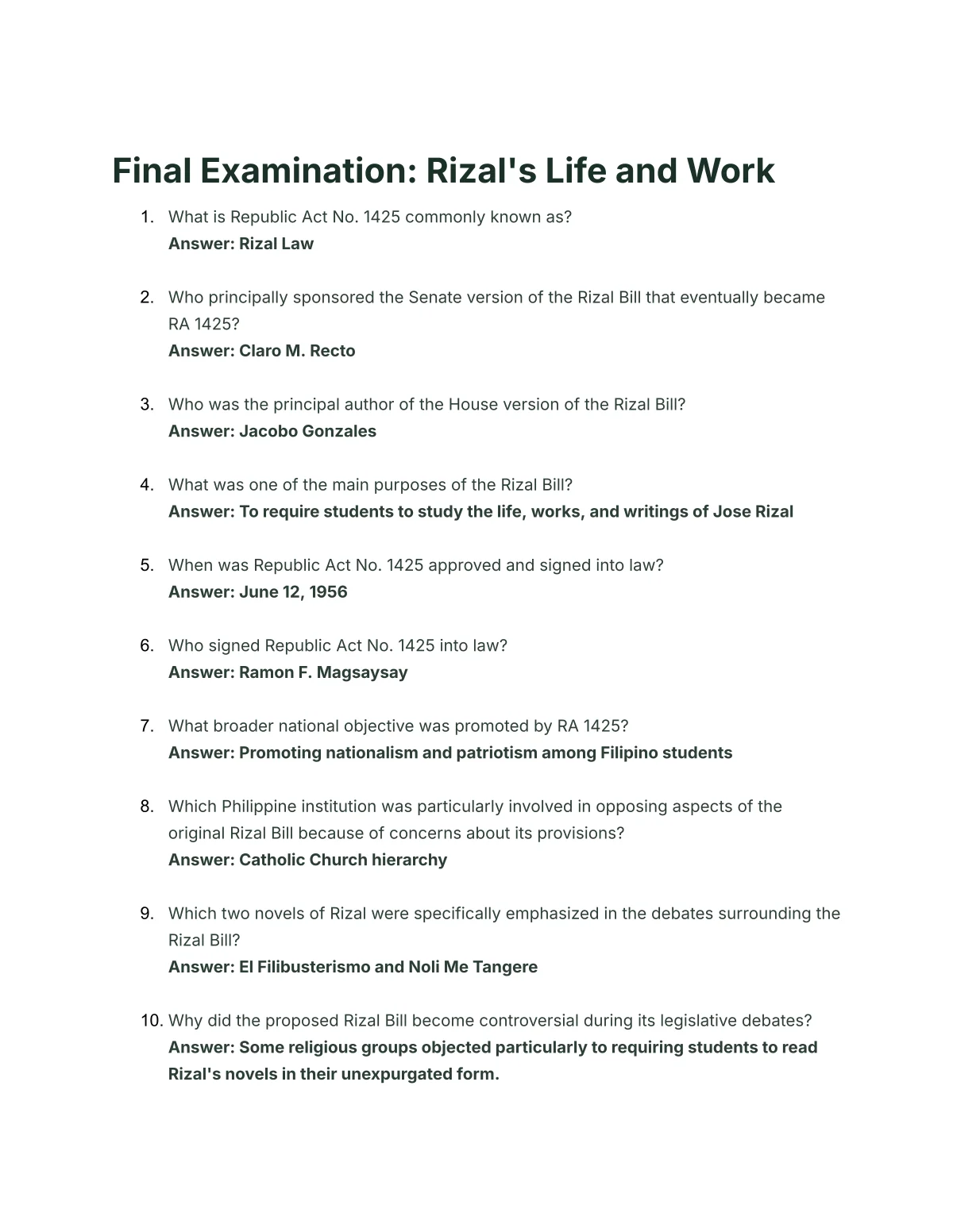
Final Examination: Rizal's Life and Work 1. What is Republic Act No. 1425 commonly known as? Answer: Rizal Law 2. Who principally sponsored the Senate version of the Rizal Bill that eventually became RA 1425? Answer: Claro M. Recto 3. Who was the principal author of the House version of the Rizal Bill? Answer: Jacobo Gonzales 4. What was one of the main purposes of the Rizal Bill? Answer: To require students to study the life, works, and writings of Jose Rizal 5. When was Republic Act No. 1425 approved and signed into law? Answer: June 12, 1956 6. Who signed Republic Act No. 1425 into law? Answer: Ramon F. Magsaysay 7. What broader national objective was promoted by RA 1425? Answer: Promoting nationalism and patriotism among Filipino students 8. Which Philippine institution was particularly involved in opposing aspects of the original Rizal Bill because of concerns about its provisions? Answer: Catholic Church hierarchy 9. Which two novels of Rizal were specifically emphasized in the debates surrounding the Rizal Bill? Answer: El Filibusterismo and Noli Me Tangere 10. Why did the proposed Rizal Bill become controversial during its legislative debates? Answer: Some religious groups objected particularly to requiring students to read Rizal's novels in their unexpurgated form.
11. When was José Rizal born? Answer: June 19, 1861 12. What was Rizalʼs full name? Answer: José Protacio Rizal Mercado y Alonso Realonda 13. What important influence did Rizalʼs mother, Teodora Alonso, have on his early development? Answer: She encouraged his early education, reading, and appreciation of literature. 14. What was Rizalʼs position among his siblings? Answer: Seventh child 15. What was one of Rizalʼs earliest childhood talents? Answer: Painting and drawing 16. What characteristic best describes Rizalʼs childhood learning environment? Answer: He was exposed early to education, reading, religion, arts, and intellectual development. 17. Which Patron Saint did Dona Teodora attributed her and Rizalʼs safe delivery? Answer: Our Lady of Peace and Good Voyage 18. Where did Rizal receive his early formal education in Biñan? Answer: School of Justiniano Aquino Cruz 19. Who was the last tutor of Rizal in Spanish and Latin? Answer: Maetro Leon Monroy 20. What caused Rizal's first sorrow? Answer: When his sister Concha died. 21. In what year did José Rizal enter Ateneo Municipal de Manila? Answer: 1872 22. What degree did Rizal initially pursue at Ateneo Municipal?
Answer: Bachelor of Arts 23. What was Rizalʼs religious affiliation when he entered Ateneo? Answer: Catholic 24. What system of education was used at Ateneo that divided students into two groups competing for academic honors? Answer: Roman Empire System 25. What academic distinction did Rizal receive at Ateneo? Answer: He graduated with the highest honors. 26. What literary talent did Rizal develop significantly during his Ateneo years? Answer: Poetry and writing 27. Which famous poem did Rizal write during his student years that expressed his love for his country? Answer: A La Juventud Filipina 28. After Ateneo, where did Rizal enroll for higher education in Manila? Answer: University of Santo Tomas 29. Why did Rizal later shift to the study of medicine at UST? Answer: He wanted to help treat his mother's worsening eyesight. 30. What medical field did Rizal eventually specialize in? Answer: Ophthalmology 31. What difficulty did Rizal experience during his studies at UST? Answer: He experienced discrimination and dissatisfaction with the educational system. 32. What accomplishment best demonstrates the importance of Rizalʼs higher education? Answer: It prepared him intellectually and professionally and contributed to his development as a writer, scholar, and physician. 33. Who advised Rizal to take Medicine in UST?
Answer: Pablo Ramon 34. What was Rizalʼs first favorite novel? Answer: Count of Monte Cristo 35. Who was Rizalʼs first love? Answer: Segunda Katigbak 36. Who accompanied José Rizal during an important part of his European journey in 1887? Answer: Maximo Viola 37. What was one major purpose of Rizalʼs travels in Europe? Answer: To pursue further studies and observe European society and institution 38. Which country became an important destination for Rizal during his European travels? Answer: Spain 39. What reform movement did Rizal support while in Spain? Answer: Propaganda Movement 40. Who was the German scholar and scientist whom Rizal met in Berlin and who became one of his important intellectual acquaintances? Answer: Ferdinand Blumentritt 41. Which European city did Rizal visit during his Grand Tour that was famous for its museums, art, and historical landmarks? Answer: Heidelberg 42. Which city was Rizalʼs major destination where he pursued studies in ophthalmology and completed important scholarly work? Answer: Berlin 43. Who was Ferdinand Blumentritt, whom Rizal met and later considered a close friend? Answer: German-Austrian scholar and educator interested in the Philippines 44. Which was considered as one of the best cities in Germany visited by Dr. Rizal and Dr. Viola?
Answer: Dresden 45. When did Rizal and Viola parted ways after their grand travel to Europe? Answer: June 23, 1887 46. According to Rizal, who is Pilosopong Tasyo in real life? Answer: Paciano 47. How did Noli Me Tangere ended? Answer: Ibarraʼs plans collapse; several character suffers and died. 48. Where was Noli Me Tangere published? Answer: Berlin, Germany 49. Who is the principal protagonist of Noli Me Tangere? Answer: Crisostomo Ibarra 50. What major social problem does Noli Me Tangere expose? Answer: Colonial oppression and abuse of power 51. What was Rizal's primary purpose in writing Noli Me Tangere? Answer: To expose the abuses and injustices experienced by Filipinos under colonial rule 52. Who is Elias, one of the important characters in the novel? Answer: A boatman who becomes an ally of Ibarra 53. Who financially assisted Rizal in the publication of Noli Me Tangere? Answer: Maximo Viola 54. In what year was Noli Me Tangere published? Answer: 1887 55. How much did Rizal paid for the first 2,000 copies of Noli? Answer: 300 56. Which political novel of Rizal contain bitterness, hatred, pain, violence and sorrow? Answer: El Filibusterismo
57. When did the first copies of El Filibusterismo came off the press? Answer: September 18, 1891 58. Who was known as the "Savior of El Filibusterismo?" Answer: Valentin Ventura 59. How many chapter did El Fili had? Answer: 38 60. What was the English translation of El Filibusterismo? Answer: The Subversive 61. Who helped Rizal build up a wide clientele in Hongkong as a physician? Answer: Lorenzo P. Marquez 62. What did Rizal do to discourage the young folks of Calamba from cockfights and gambling? Answer: He opened a gymnasium 63. Which poem was written and dedicated by Rizal to the industrious folks of Lipa? Answer: Hymn to Labor 64. Who invited Rizal to come to Malacanan because somebody told him that Noli Me Tangere contained subversive ideas? Answer: Gov.General Emilio Terrero 65. Who was assigned as Spanish personal bodyguard of Rizal? Answer: Jose Taviel de Andrade 66. When was José Rizal exiled to Dapitan? Answer: July 17, 1892 67. How long did Rizal stay in exiled in Dapitan? Answer: About four years 68. Which of the following was one of Rizalʼs contributions to the community of Dapitan? Answer: He established a water system and improved community facilities.
69. What happened to Rizal when he was traveling to serve as a physician in Cuba? Answer: He was arrested and eventually returned to Manila. 70. When was José Rizal executed? Answer: December 30, 1896