1
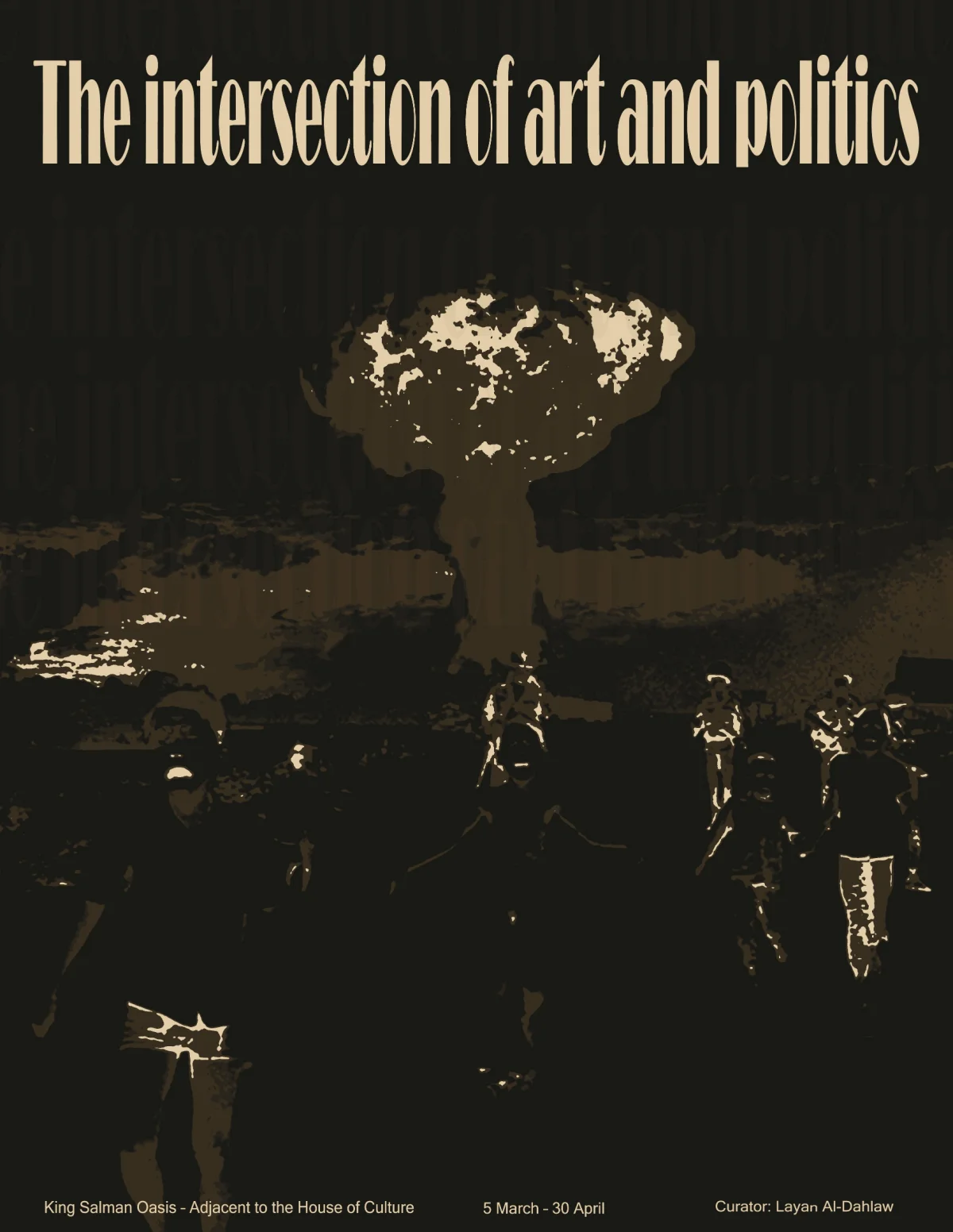
The intersection of art and politicsThe intersection of art and politics The exhibition focuses on the intricate relationship between art and politics, and on how an artwork can become a space for dialogue,resistance, and reflection. It aims to highlight the role of art in revealing truths and deconstructing political discourse, while raising questions about power, war, justice, and freedom. Through a diverse collection of artworks, the exhibition seeks to stimulate the viewer to consider how political images and meanings are constructed around them, and to rediscover art as an active force in shaping collective consciousness. 2
The Curator Layan is a curator whose work explores the relationship between art and politics, creating critical visual spaces that reframe contemporary social and human issues. She believes that art has the ability to deconstruct dominant narratives, reveal layers of power, identity, and freedom, and open conversations that engage the viewer’s consciousness. As the curator of this exhibition, Layan leads the development of its visual narrative and the organization of its artworks within a context that raises questions about justice, resistance,and the political dimensions of the image. She also presents a single artwork in the exhibition, reflecting her personal engagement with its themes. 3
Artists Albert Lynch Diego Rivera Pablo Picasso Francisco Goya Suleiman Mansour Frida Kahlo Layan Al-Dahlawi Igor Morski Banksy Nick Ut 4
5
Exhibition Sections Art and Memory: How art bears witness to war and destruction, transforming trauma into a collective visual memory while reflecting on its emotional and psychological impact on individuals. Identity and Resistance: Exploring the artist’s connection to their land, roots, and cul- ture as a symbolic act of resistance. Image and Propaganda: Examining the role of media and art in shaping public opinion and constructing “truth.” 6
7
Portrait of Joan of Arc (1903) By: Albert Lynch Oil on canvas, approx. 60 × 80 cm (24 × 32 in) This oil portrait depicts Joan of Arc (French: Jeanne d’Arc), known as the Maid of Orléans. Born to a peasant family in northeastern France in 1412, she died on May 30, 1431. Joan of Arc is regarded as a French national heroine and a saint of the Roman Catholic Church. She claimed to be guided by divine inspiration and led the French army to several significant victories during the Hundred Years’ War, paving the way for the corona- tion of Charles VII as King of France. She was later captured and handed over to the English in exchange for money, tried for heresy and insubordination, and exe- cuted by burning at the age of 19. The extent of Joan of Arc’s actual military leadership remains a subject of his- torical debate. Some traditional historians argue that she primarily served as a standard-bearer who boosted the army’s morale, relying on her court testimony in which she stated that she preferred carrying the banner to wielding a sword. However, other historians—particularly women historians—affirm that the military leaders respected her as a skilled strategist and tactician. She led the army to a series of remarkable victories that changed the course of the war. In either case, historians agree that the army achieved significant success during her brief in- volvement. In the painting, Joan appears at the center, holding a banner in her left hand and supporting her sword before her with her right hand. Behind her are white lilies, and in the background stands the Notre-Dame Cathedral in France. 8
9
Abstract Painting By: Igor Morski Abstract / Graphic Work The giant hands symbolize the controlling forces—political, media, or econom- ic—that direct individuals as if they were puppets bound by invisible strings. The small soldiers represent groups being pushed toward violence unconsciously, turning humans into tools in the hands of a higher authority. The work offers a profound critique of the manufacturing of wars and public opinion, showing how symbols and power are used to shape collective behavior without meaningful re- sistance. The scene, which appears realistic, transforms into a metaphor for the loss of free will. 10
11
The Flower Carrier, 1935 By: Diego Rivera Oil and tempera on Masonite, 121.9 × 121.3 cm The painting can be read as a visual statement against the social inequality re- sulting from the post-colonial era in Mexico, where the working class suffered marginalization despite being central to agricultural production. Rivera places the human body in confrontation with the oppressive economic system, trans- forming the simple scene into a metaphor for Mexican identity itself—burdened by history yet still carrying the seeds of beauty and resistance. 12
13
Guernica, 1937 — Pablo Picasso Oil on canvas, 349.3 × 776.6 cm The painting Guernica by Pablo Picasso measures 349.3 × 776.6 cm. 14
15
Guernica, 1937 By: Pablo Picasso Oil on canvas, 349.3 × 776.6 cm Picasso’s Guernica was inspired by the bombing of the Basque town of Guernica, carried out by German and Italian aircraft supporting the Spanish Nationalist forc- es on April 26, 1937, as an act of terror during the Spanish Civil War. The painting depicts the tragedy of war and the suffering it causes to individuals. Guernica has become a historic landmark and a permanent reminder of the horrors of war, as well as an anti-war symbol and an embodiment of peace. 16
17
18
19
Anime Film: Barefoot Gen — Hiroshima English title: Barefoot Gen Release year: 1983 Director: Masaki Mori Based on: Manga by Keiji Nakazawa Story: The film is set in 1945 in Hiroshima, Japan, and follows a lively boy named Gen who lives with his parents and siblings in extreme poverty. Despite the daily hard- ships caused by the war, his family tries to stay together. Their lives are turned upside down when the atomic bomb is dropped on the city. After the explosion, houses are destroyed, many people perish, and Gen loses his father and siblings. However, Gen and his mother survive miraculously, and he continues to face the aftermath of the catastrophe with a strong will to live. Theme and Message: The film serves as a powerful anti-war statement, highlighting the destructive force of nuclear weapons. It also reflects human resilience in the face of tragedy, portraying the suffering of civilians—especially children—from the devastation, radiation, and long-lasting effects of atomic bombs. 20
21
The Third of May 1808, 1814 — Francisco Goya Oil on canvas, approx. 2.5 × 4.5 m Full title: The Third of May 1808 or Executions on the Hill of Prince Pío. Painted by Francisco Goya in 1814 to commemorate the Spanish resistance against Napoleon’s army during the Peninsular War in 1808. 22
23
The Third of May 1808, 1814 By: Francisco Goya Oil on canvas, approx. 250 × 450 cm What began as an alliance between Spain and France soon turned into an occu- pation. On May 2, 1808, the people of Madrid rose in rebellion against the French forces, and by May 3, the retaliation was brutal. The French troops arrested hun- dreds of Spanish civilians and executed them in mass shootings. Goya, who lived through these events, painted this scene years later—not as a commission, but as a deeply personal and political statement. 24
25
Camel of Hardships (Jamal Al-Mahamel), 1973 By: Suleiman Mansour Oil on canvas, approx. 90 × 100 cm The artwork “Camel of Hardships,” also known as Jamal Al-Mahamel, depicts an elderly Palestinian man in traditional attire, standing in an open, vast space while carrying the city of Jerusalem on his back. The image symbolizes Palestine and the Palestinian struggle. Today, more than ever, Palestinians feel the heaviness of this burden—a dual sense of loneliness and abandonment in an endless sea of cruelty and indiffer- ence. The silence they encounter is deafening, yet they continue to carry their cause with resilience and dignity, just as they have for the past century. 26
Portrait of a Woman (2017)— Suleiman Mansour Mud and acrylic on wood, approx. 60 × 50 cm each 27
Portrait of a Man (2019) — Suleiman Mansour Mud and acrylic on wood, approx. 60 × 50 cm each 28
29
Portrait of a Man (2019) & Portrait of a Woman (2017) By: Suleiman Mansour Mud and acrylic on wood, approx. 60 × 50 cm each These works reflect the artistic shift that emerged during the First Intifada (1987– 1993), when Palestinians boycotted Israeli products as an act of resistance. Artists participated in this movement by abandoning Israeli-made art supplies. Mansour, along with Vera Tamari, Nabil Anani, and Tayseer Barakat, formed a col- lective known as “New Vision.” Turning to their immediate environment, they began using materials such as wood, leather, mud, henna, and natural pigments. This experiment not only deep- ened the connection between art and land but also played a key role in shaping a new visual language in Palestinian art. It bridged the earlier post-Nakba artistic identity with the emerging contemporary practices of younger Palestinian artists. 30
31
Mother Nursing Her Child, 1976 By: Suleiman Mansour Oil on canvas, approx. 70 × 50 cm This painting highlights the profound strength and tenderness embodied by Pal- estinian mothers. On Arab Mother’s Day, it becomes especially meaningful to re- flect on the harsh realities endured by mothers in Palestine—particularly in Gaza— where ongoing genocide and devastation continue to tear families apart. These steadfast women face the destruction of their homes, the injury or killing of their children, and the constant violation of their basic rights under occupa- tion. Despite unimaginable circumstances, they persist with courage, striving to create safety and stability for their families amid relentless bombardment and siege. Countless Palestinian mothers carry a grief that words cannot contain. Their fac- es bear the marks of unbearable loss as they search through rubble and lifeless bodies for their loved ones. To the mothers who lost their children, and to the children who lost their mothers to the unyielding brutality of occupation—no lan- guage can truly console such depth of sorrow. On this day dedicated to honoring mothers, we offer our deepest condolences and unwavering solidarity. Your pain is unfathomable, and your resilience stands as a testament to an unbreakable spirit. May you find strength in the memories you hold, and may the world stand with you in demanding justice and accountabil- ity for the lives taken unjustly. You are not alone in your grief, and your courage continues to inspire the fight for a future where no mother or child must endure such heartbreak again. 32
33
Self-Portrait on the Borderline Between Mexico and the United States, 1932 By: Frida Kahlo Oil on tin, 31.8 × 21.9 cm This painting depicts Frida Kahlo standing between two contrasting worlds: the industrialized United States and the traditional, Indigenous-rooted Mexico. The work serves as a visual commentary on the cultural and economic disparities between the neighboring nations, reflecting Kahlo’s conflicted feelings toward American culture and her deep connection to Mexican heritage. Through symbolic contrasts machines, smokestacks, and industrial power on one side, and earth, roots, and ancient motifs on the other Kahlo frames identity as a force grounded in ancestry and cultural memory. The painting asserts the strength of roots and tradition in the face of American modernity, presenting heri- tage not as something nostalgic, but as a source of resilience and self-definition. 34
35
My Dress Hangs There, 1933 By: Frida Kahlo Oil on tin, approx. 32 × 24 cm This painting is a direct statement of Kahlo’s attachment to Mexican society. Her dresses appear to walk alone in the United States, while her body, mind, soul, and heart remain firmly rooted in her homeland. Through this imagery, Kahlo empha- sizes the tension between physical absence and emotional presence, reflecting her profound connection to her cultural roots and the land of Mexico. 36
37
Marxism Will Give Health to the Sick, 1954 By: Frida Kahlo Oil on tin, approx. 31 × 23 cm In this work, Kahlo’s use of images and traditional Mexican folklore is not merely a celebration of cultural heritage, but a political statement against colonialism and Western cultural domination. By incorporating traditional Mexican symbols, she positions herself as a defender of identity and a critic of Western imperial- ism, embodying Mexican culture and, more specifically, the culture of Indigenous peoples. 38
39
Kufiya 2025 By: Layan Al-Dahlawi Digital work, A3 (29.7 × 42 cm) This digital artwork captures a moment from the First Palestinian Intifada, when the kufiya transformed from a head covering into an alternative flag and a symbol of resistance. The painting depicts three men standing calmly, wearing the kufiya on their shoulders. They carry no weapons—only books and cigarettes—creating a scene that pulses with the tension between steadfastness and resistance. In a time when words were acts of resistance, the kufiya a banner, and standing firm a message, this work embodies the power of symbolic resilience. 40
41
42
43
Mexican Muralism: Public Art Beyond Borders The history and art of Mexican Muralism as a public art movement. The international reach and influence of Mexican public art, showing how murals transcended Mexico’s borders to inspire the world. The cultural and political significance of public art in conveying social messages and national identity. 44
45
Abstract Painting By: Igor Morski Abstract / Graphic Work Approx. Igor Morski’s series “Media Manipulation and Mind Control” explores the relation- ship between human consciousness and the mechanisms of media deception. A man’s head is opened like an exposed space, symbolizing the fragility of percep- tion, while a giant eye represents surveillance, censorship, and the manufactured image used to create a false awareness. The small figure pushing the eye into the head points to the source that crafts the media message—forcing it into the viewer’s mind until it becomes the sole source of “truth.” The work raises crucial questions about an individual’s capacity to discern truth amid a flood of manipulated images, and it blurs the line between persuasion and deceit, consciousness and unconsciousness, in an era dominated by visual power. 46
47
Abstract Painting By: Igor Morski Abstract / Graphic Work Approx. This piece explores how human consciousness is shaped by unseen external forc- es. The messages we receive from media, society, and authority since childhood continue to guide our actions without our awareness. The work raises the ques- tion: Who holds the strings of our consciousness? Who directs our voices? 48
49
Igor Morski: Abstract Painting Abstract / Graphic Work 50
51
Abstract Painting By: Igor Morski Abstract / Graphic Work Approx. The work focuses on the power of the image in shaping truth. What we see is not reality itself, but the version chosen by the lens. The piece asks: Do we see the world as it truly is, or as it is presented to us? 52
53
Flower Thrower (2005) By: Banksy Spray paint on wall, approx. 200 × 200 cm This is Banksy’s most popular and iconic mural in Palestine. The image depicts a man equipped with traditional riot gear, his masked face partly obscured by a hat. The man’s hand is positioned as if ready to throw a grenade, but instead he holds a colorful bouquet of flowers symbolizing peace, poised to be hurled. 54
55
Girl Frisking Soldier (2007) By: Banksy Spray paint on wall, approx. 180 × 200 cm This mural depicts a small girl frisking a soldier, reversing the usual roles in occu- pied areas where the Israeli army searches civilians. The image serves as a pow- erful symbol of the loss of innocence among Palestinian children, highlighting the impact of occupation on everyday life. 56
57
The Terror of War (“Napalm Girl”), 1972 By: Nick Ut Black-and-white photoprint, approx. 30 × 40 cm 58
59
The Terror of War (“Napalm Girl”), 1972 By: Nick Ut Black-and-white photoprint, approx. 30 × 40 cm This iconic photograph, taken on June 8, 1972, by American photographer Nick Ut, shows a Vietnamese girl named Kim Phuc screaming and running after her village in Trang Bang was attacked with napalm bombs. The image became one of the most famous photographs of the 20th century, symbolizing the suffering of civil- ians during war and profoundly impacting public perception of violence and con- flict. More than 50 years later, Kim Phuc continues to advocate for peace, and this pho- tograph remains a poignant reminder of the human cost of war and the resilience of those affected. It stands as a historical testament to civilian suffering and a call for global awareness and empathy. 60
61
Media, Cinema, and the Politics of Fame: The Case of Pablo Escobar Pablo Escobar’s life exemplifies the intersection of politics, violence, and media representation. As the leader of the Medellín cartel, his actions triggered wide- spread violence in Colombia, including assassinations, bombings, and public terror, affecting politics and society. The U.S. government became involved due to the massive cocaine trade, supporting Colombian authorities in efforts to capture him. His story highlights how the struggle for power and control over territory and resources can escalate into quasi-warfare, affecting both local and international politics. Cinema and television, however, have shaped Escobar’s image in a way that often glosses over the brutality of his crimes. Series and films portray him as a charis- matic and cunning figure, sometimes elevating him to a “larger-than-life” status. This reflects the power of storytelling in transforming violent criminals into fig- ures of fascination, influencing public perception and collective memory. In the context of this exhibition, this case demonstrates how media and visual culture—through both art and cinema—can manipulate narratives of power, war, and morality. Clips from Pablo Escobar series can illustrate how entertainment and image-making amplify fame, even for figures responsible for immense human suffering. 62
63
64
65
Catalogue compiled by: Layan Al-Dahlawi _445005870 66
Supporters