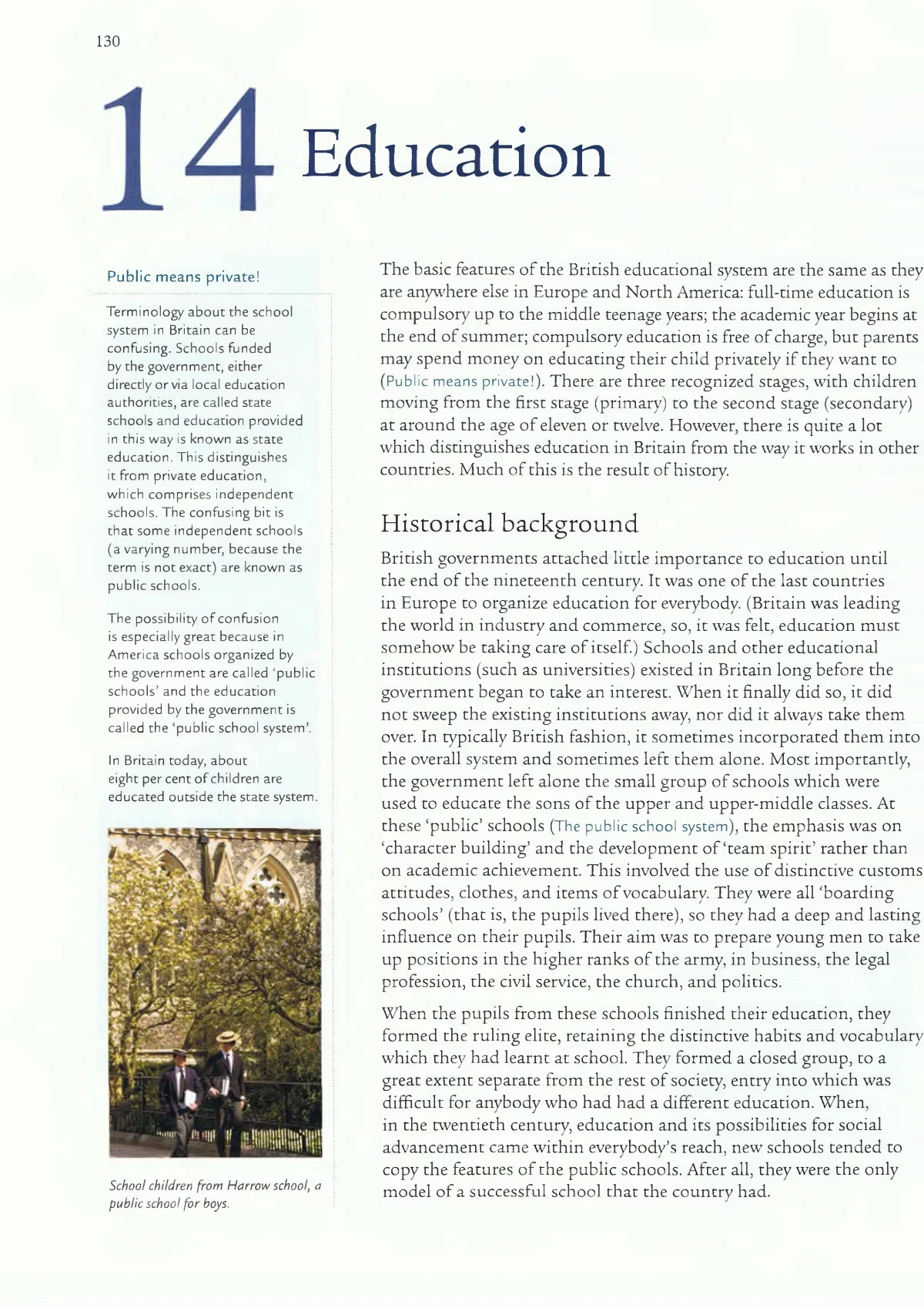
130 Education Public means private! Term inology about the school system in Britain can be confusing. Schools funded by the government, either directly or via local education authorities, are called state schools and education provided in this w ay is known as state education. T h is distinguishes it from private education, which com prises independent schools. The confusing bit is th at some independent schools (a varying number, because the term is not exact) are known as public schools. Th e possibility o f confusion is especially great because in A m erica schools organized by the government are called 'public schoo ls’ and the education provided by the government is called the ‘ public school system ’. In Britain today, about eight per cent o f children are educated outside the state system. School children from Harrow school, a public school for boys. The basic features o f the British educational system are the same as they are anywhere else in Europe and North America: full-time education is compulsory up to the middle teenage years; the academic year begins at the end o f summer; compulsory education is free o f charge, but parents may spend money on educating their child privately if they want to (P u b lic m e a n s p r iv a t e !). There are three recognized stages, with children moving from the first stage (primary) to the second stage (secondary) at around the age o f eleven or twelve. However, there is quite a lot which distinguishes education in Britain from the way it works in other countries. Much o f this is the result o f history. Historical background British governments attached little importance to education until the end o f the nineteenth century. It was one o f the last countries in Europe to organize education for everybody. (Britain was leading the world in industry and commerce, so, it was felt, education must somehow be taking care o f itself.) Schools and other educational institutions (such as universities) existed in Britain long before the government began to take an interest. When it finally did so, it did not sweep the existing institutions away, nor did it always take them over. In typically British fashion, it sometimes incorporated them into the overall system and sometimes left them alone. M ost importantly, the government left alone the small group o f schools which were used to educate the sons o f the upper and upper-middle classes. At these ‘public5 schools (The p u b lic sch o o l s y s te m ), the emphasis was on ‘character building5and the development o f ‘team spirit5rather than on academic achievement. This involved the use o f distinctive customs attitudes, clothes, and items o f vocabulary. They were all ‘boarding schools5 (that is, the pupils lived there), so they had a deep and lasting influence on their pupils. Their aim was to prepare young men to take up positions in the higher ranks o f the army, in business, the legal profession, the civil service, the church, and politics. When the pupils from these schools finished their education, they formed the ruling elite, retaining the distinctive habits and vocabulary which they had learnt at school. They formed a closed group, to a great extent separate from the rest o f society, entry into which was difficult for anybody who had had a different education. When, in the twentieth century, education and its possibilities for social advancement came within everybody's reach, new schools tended to copy the features o f the public schools. After all, they were the only model o f a successful school that the country had.
M ODERN TIMES: THE EDUCATION DEBATES 131 M odern rimes: the education debates Before the election which brought the Labour party to power in 1997, its leader, Tony Blair, declared that his three main priorities were ‘Education, education, education’. This emphasis testified to a general feeling in Britain that there was something very wrong with its system o f education. It was not a new feeling. Perhaps because o f its rather slow start, the British have long felt a little inadequate about their public educational provision. Education is the area o f public life about which British people and governments feel the most uncertain. No other area has been subject to so many changes in the last quarter o f a century. Debates about education in Britain centre around three matters. One o f these is quality. For decades, there has been a widespread feeling that British schoolchildren do not get taught properly and do not learn enough, and that they are less literate and less numerate than their European counterparts. Whether or not this is or was ever true is a matter o f opinion. But these days it is common for employers and universities to complain that their new recruits do not have the necessary basic knowledge or skills (The three Rs) and there is much talk about ‘grade inflation’ with respect to exam results (i.e. the standard o f a top ‘A’ grade is lower than it used to be). Moreover, there is no doubt that Britain suffers from a chronic shortage o f teachers (H e lp fro m a b r o a d ). Although many young people embark on teacher-training courses, only about half o f them remain in the profession for longer than three years, so that schools often have an unsettled atmosphere due to rapid turnover o f staff and class sizes are large. (In 2003, British primary schools had more children per teacher than any country in Europe except Turkey.) Why is it so hard for British schools to recruit, and keep, teachers? One reason is probably the tradition o f English anti-intellectualism (see chapter 5), which means both that it is often difficult to persuade pupils, especially boys, to be interested in learning (Going b a c k to Poland) and Help from abroad W h a t do you do if you’re the head o f a large school in Britain? Supervise the teaching? Organize the curriculum ? Make sure that good order is preserved in the school? W ell, yes, th at’s w h a t you do some o f the tim e. But these days you also spend a lot o f your time flying around the world desperately trying to find teachers to come and teach in your school. Such is the shortage o f teachers in Britain th at thousands o f foreign teachers are recruited every year. T h e teachers they get are often appalled at the behaviour o f pupils in British schools and they find it very hard, but they d o n ’t mind too much because it’s only tem porary and it’s good experience. In any case, they are made to feel special - the education authorities that employ them are so grateful they lay on special receptions for them and arrange fo r visa requirements to be relaxed. Som etim es, this practice creates bad feeling between the government o f Britain and these other countries, who accuse the British o f exporting their education crisis. The public school system H istorically, stereotypical public schools: • are fo r boys only, from the age o f 13 onw ards, m ost o f whom attended a private ‘ prep’ (prep arato ry) school beforehand • take fee-paying pupils (and some scholarship pupils w ho have won a place in a com petitive entrance exam and whose parents do not pay) • are boarding schools (the boys live there during term-tim e) • are divided into ‘houses’, each ‘ house’ being managed by a ‘ housem aster’ • make some o f the senior boys ‘ prefects’, which means that they have authority over the other boys and have their own servants (called ‘fags’), who are appointed from amongst the youngest boys • place great emphasis on team sports • enforce their rules with the use o f physical punishment • are not at all luxurious or comfortable However, this trad itio n al image no longer fits the facts. These days, there is not a single public school in the coun try in w hich all o f the above features apply, and some o f them do not app ly anywhere. There have been a fa irly large num ber o f g irls’ public schools fo r the last hundred years, and by now m ost public schools are mixed sex. M any schools ad m it day pupils as well as boarders, and some are day schools only; prefects no longer have so much power o r have been abolished; fagging has disappeared and so has physical punishm ent; there is less em phasis on team sp o rt and more on academ ic achievem ent; life fo r the pupils is more physically com fortable than it used to be. Am ong the m ost fam ous public schools are Eton, H arrow , Rugby, and W inchester.
1 3 2 EDUCATION Th e three Rs Basic literacy and numeracy is inform ally known in Britain as ‘the three Rs’. These are Reading, w Riting, and aRithmetic. T h e po litician s’ children The issue o f equal opportunity is often highlighted when the British media report a story about where a prominent government politician is sending his or her children to school. If, as is frequently the case, these children are found to be attending independent schools, there are loud cries o f derision and protest. Interestingly, though, the protests rarely focus on the question o f inequality. Indeed, they are usually careful to insist th a tX has the right to send his or her children wherever he or she likes. Instead, they focus on the quality issue and the case is held up as evidence that the government has no faith in its own education system. also that teachers in Britain have, in comparison with other European countries, rather low status. Unfortunately, this status can sometimes become even worse precisely because o f the general perception o f poor educational standards. People want someone to blame for this, so they blame the teachers. This means teachers have to spend a lot o f time being inspected and filling in forms to prove they are doing a proper jc making the job seem even less attractive. The government in this centu has tried to alleviate the situation by advertising campaigns and other initiatives (such as national awards for excellence in teaching, known ai the teaching ‘Oscars’). The other response o f British governments to the perceived deficiencies in quality o f education has been to revise (sometimes, it seems, alm ost constantly) the national curriculum. This is the body c documents which specifies what children in state schools are suppose to learn at each stage in their school careers. But the interesting thing about education debates in Britain is that they are not only or even mainly about quality. Another aspect that is the subject o f constant worry is social justice. Perhaps because o f the elitist history o f schooling in Britain and its social effects (see previous section), or perhaps just because o f the importance they attacl to fairness, the British are forever worrying about equal opportunitie: in education. British governments and educational institutions are obsessed with the knowledge that the majority o f children who do well in education are from middle-class, comparatively wealthy background It was for this reason that during the 1970s, most areas o f the countr scrapped the system in which children were separated at the age o f 11 into those who went either to a grammar school, where they were taug] academic subjects to prepare them for university, the professions or managerial jobs, or to a secondary modern school, where the lessons hi a more practical and technical bias. It was noticed that the children wh G oing back to Poland When Aleksander Kucharski arrived in Britain fro m Poland, he expected he would get a first-class education. He was accepted a t a state school with one o f the best academic records in the country. B ut after two years he is so disillusioned he has gone home to his old school, saying his British classmates were interested only in shopping and partying. ‘The boys were childish/ said 16-year-old Aleksander, cthey didn't read papers and weren't interested in anything. A nd the girls only talked about shopping and what they were going to do on Friday night.' In Poland\ y o u have to know the names o f all countries, even the rivers. B ut in England hardly anyone could place Poland or Kenya on the map. The teachers didn't test knowledge, only effort.' Aleksander said that before he left Poland he was an average student. Tn Poland, I only ever got average marks in Maths, y e t in the UK teachers said I was a genius. A fter a year, I was top o f the class in everything, and that includes English.’ A spokesman fo r the St Thomas More High School in Newcastle said: ‘We are disappointed that this pupil has decided to move away. Only two weeks ago the school was recognized by Ofsted1 as outstanding.' Here is a newspaper article from 2007 which fuels British people’s w orries that educational standards in the country are poor. It was headlined ‘A sad lesson’. 1 T h is is the name o f the government organization w hich inspects schools in Britain . Source: The Daily Mall 26 October 200>
M ODERN TIMES: THE EDUCATION DEBATES 133 went to grammar schools were almost all from middle-class families; those who went to secondary moderns tended to be seen as ‘failures’, so the system seemed to reinforce class distinctions. Instead, from this time, most eleven-year-olds have all gone on to the same local school. These schools are known as comprehensive schools. However, the fact remains that most o f the teenagers who get the best exam results, and who therefore progress to university, are those from relatively advantaged backgrounds and vice versa. In recent decades, a university education has become much more important than it used to be. At the same time, the gap between high earners and low earners has become wider than it used to be (see chapter 15). For both these reasons, equality o f educational opportunity is more important than it used to be. Various schemes are being tried to correct this imbalance. M ost notably, universities are now encouraged to accept students with relatively poor exam results if they come from a disadvantaged background). In some poorer areas, children are even offered, with government approval, cash incentives to pass their exams. However, it is almost impossible to provide real equality. Inevitably, the children o f parents who care about education the most, especially if they have money, tend to get what they want for them. In some cases, this means moving house to make sure they can get their child into a school which gets good exam results (since children m ust attend a school in the local area). In other cases, if they feel that pupils from good schools are being discriminated against, it even means making sure your child gets into a school with bad exam results - and then hiring private tuition for them! The only way in which such inequalities could be significantly reduced would be to ban all independent education and introduce lotteries for allocating places in secondary schools. In fact, this second possibility has already been tried (in modified form) in some areas. However, such measures conflict with another principle which is highly valued in Britain, and is the third subject around which there is debate. This is freedom o f choice. It is this principle, plus a belief that it would improve the quality o f education in schools generally that has led to the publication o f ‘league tables’ o f school exam results. This has had the unfortunate effect o f making it clear to ambitious parents which are the more desirable schools. (To some extent it has even led to the unofficial re-establishment o f the two-tier system which was abandoned in the 1970s. Comprehensive schools are supposed to be all equal, but some are better than others.) But the belief in freedom o f choice involves much more than which school a child goes to. It also implies a limit to what central government can impose generally. The British dislike o f uniformity is one reason why Britain’s schools got a national curriculum so much later than other European countries. It was not until the end o f the nineteenth century that it was fully operative. And since then, complaints that it was too rigid and dictatorial have resulted in modifications which have reduced the number o f its compulsory elements (Languages anyone?). S c h o o l u n ifo rm s Ever since schools made their appearance in Britain, it has been custom ary for pupils to wear school uniforms. When few children went to any kind o f school, uniforms were a sign o f status. It proclaimed the child’s attendance and it showed that the parents could afford to buy it. When schooling became universal, most schools took this lead and insisted on their pupils wearing uniform. It was a mark o f aspiration. During the sixties and seventies, more and more schools abandoned uniforms; they were regarded as a burden on the parents' finances and it was believed that they stifled creativity and individualism. For the last 20 years, however, the pendulum has been swinging the other way. These days, the vast m ajority o f parents are in favour o f uniforms. Ironically, this is for the same reason that made them w an t to get rid o f them previously - money. These days, buying a uniform is likely to be less expensive than buying their children the fashionable clothes which they otherwise demand. There is still a large minority o f schools in Britain which do not prescribe a uniform. But they often come under pressure from government advisers, who believe uniforms are symbols o f belonging and lead to an improvement in academic performance.
1 3 4 EDUCATION Languages anyone? For years now, ed ucatio n alists, econom ists and official reports have been bem oaning the poor state o f language-learning in British schools and the low level o f foreign language ab ility in general am ong the British population. The British w orkforce, say these people, is in danger o f being left behind in an increasingly internationalized jo b -m arket. And yet, when the national curriculum w as slim m ed down in the early years o f this century, ‘ modern foreign languages’ w as one o f the subjects th at w as left out. English children are the only pupils in Europe w ho are allowed to drop foreign languages com pletely from th eir studies afte r the age o f 14. Fewer than ten per cent learn a foreign language beyond the age o f 1 6. Rather than trying to educate the m any in foreign languages, the present policy is to train a very sm all section o f the population as language specialists. In W ales, the situation is different. The provision for a ‘foreign language’ is the same as in England but all pupils study both English and Welsh until the age o f 16. Sum m erhill and discipline Moreover, it should be noted that the national curriculum has never specified exactly what m ust be taught on a day-to-day basis or prescribed particular teaching materials. A school can work towards the objectives o f the national curriculum in any way it likes. Nor does central government dictate the exact hours o f the school day or the exact dates o f holidays. It does not manage a school’s finances either - it just decides how much money to give it. It does not set or supervise the marking o f the exams which older teenagers do (see ‘public exams’ below). In general, as many details as possible are left u to the individual institution or the Local Education Authority (LEA - a branch o f local government). (This was true even o f the decision to scrap the pre-1970s system mentioned above. Indeed, a very few areas still have grammar schools.) One o f the reasons for this ‘grass-roots’ pattern is that the system has been influenced by the public-school tradition that a school is its own community. Most schools develop, to some degree at least, a sense o f distinctiveness. Many, for example, have their own uniforms for pupils. Many have associations o f former pupils, especially those outside the state system. It is considered desirable (even necessary) for every school to have its own school hall, big enough to accommodate every pupil, for daily assemblies and other occasional ceremonies. Universities, although partly financed by the government, have even more autonomy. Style Traditionally, education in Britain gave learning for its own sake, rather than for any particular practical purpose, a comparatively high value. In comparison with m ost other countries, a relatively high proportion o f the emphasis was on the quality o f person that education produced (as opposed to the quality o f abilities that it produced). Concerns about the practical utility o f education have resulted in the virtual disappearance o f this attitude in the last 50 years. However, some significant reflexes remain. For example, much There may be another reason w hy it is so hard to find people to teach in B rita in ’s schools. It is a com m on belief th at the pupils are very badly behaved. Again, this is a m atter o f personal opinion. But the experience o f the fam ous independent school Summ erhil is perhaps indicative. W hen it w as founded in 1923 by the educationalist, A . S. Neill, his vision w as fo r a school where children could learn th at adults were not people to be frightened of, where they policed themselves and where they learnt because they wanted to, not because they were forced to. Neill once fam ously said he would rather turn a child into a happy street- sweeper than a successful but miserable professional. Accordingly, the tradition at Summerhill is that the children themselves set and police the rules and lessons are not compulsory. In the school’s heyday in the sixties, it w as an icon o f the hippy movement, with stories o f pupils reciting Shakespeare to cows and going communal nude bathing. H ow times change! T h is noble idea o f a libertarian education was all very well when the pupils had already learnt at least the concepts o f rules and discipline from their parents and o f co-operation from their brothers and sisters. But now children tend to come from much sm aller fam ilies, so th at these concepts are less necessary. The present head o f Sum m erhill, who is N eill’s daughter and in theory ju s t as comm itted to his ideals, says th at they now get children com ing along who are so selfish, so badly behaved, such (in her own w ords) ‘spoilt brats’, that they have to be taught th at living in a com m unity means you canno t always do exactly w ha t you w ant. Ironically, therefore, Sum m erhill has found itself in the position o f cham pioning a sense o f discipline and orde
SCHOOL LIFE 135 o f the public debate about educational policy still focuses on how schools can help their charges become good members o f society. The national curriculum includes provision for the teaching o f ‘citizenship5 and o f various other personal matters such as ‘sex and relationships education’. It also prescribes ‘physical education’. Indeed, British schools and universities have tended to give a high priority to sport. The idea is that it helps to develop the ‘complete’ person. The notion o f the school as a ‘community’ can strengthen this emphasis. Sporting success enhances the reputation o f an institution. Until the last quarter o f the twentieth century, certain sports at some universities (especially Oxford and Cambridge) and medical schools were played to an international standard and people with poor academic records were sometimes accepted as students because o f their sporting prowess (although, unlike in the USA, this practice was always unofficial). Another reflex is that the approach to study tends to give priority to developing understanding and sophistication o f approach over the accumulation o f factual knowledge. This is why British young people do not appear to have to work so hard as their fellows in other European countries. Primary schoolchildren do not normally have formal homework to do and university students have fewer hours o f programmed attendance than students in mainland Europe do, although on the other hand, they receive greater personal guidance with their work. School life Britain has been comparatively slow to organize nursery (i.e. pre-primary) education. But at the time o f writing all children are guaranteed a free, part-time early education place (up to 12.5 hours per week) for up to two years before reaching compulsory school age, which is the age o f 5, and the government has plans for all primary schools to be open from 8 a.m. till 6 p.m., throughout the year, even for children as young as two months. (The idea is not to keep them in the classroom all this time. Rather, it is that schools become the hub o f local communities, offering not only conventional education but also breakfast provision, childminding facilities, activity clubs and even health services for parents.) Even at present, the total number o f hours in a year which children spend at school is longer than in other European countries. It is not that the typical school day is especially long. It starts around 9 a.m. and finishes between 3 p.m. and 4 p.m., or a bit later for older children. It includes a lunch break which usually lasts about an hour and a quarter, where nearly half o f all children have lunch provided by the school. (Parents pay for this, except for those who are rated poor enough for it to be free. Other children either go home for lunch or bring sandwiches.) On the other hand, it is a full five-day week (there is no half day) and holiday periods are short (The school year). Learning for its own sake One effect o f the traditional British emphasis on academic learning as opposed to practical training can be seen in the way that people gain qualifications for certain professions. In many cases, this has not traditionally been done within universities, instead, people go to specialized institutions which are separate from any university. You can study architecture at university, but m ost architects have learnt their profession at a separate School o f Architecture; you can study law at university but this alone does not qualify you to be a lawyer (see chapter 1 1 ); you cannot get a teacher’s qualification by doing an ordinary university course - most teachers get theirs at a teacher training college. Until recently, schools were not usually involved in helping people to get qualifications for skilled manual jobs such as bricklaying or carpentry o r machine-operating.
1 3 6 EDUCATION The trouble with the internet In the 1980s, universities and post-16 education generally started moving aw ay from tim ed, sit-down exams as a method o f assessment and started aw arding some o f the total m ark for take-home assignments. It w as thought th at deciding 100% o f a m ark by sit-down exam put unnecessary stress on m any students and unfairly disadvantaged those who were less com fortable w orking under such conditions. Moreover, take- home pieces o f w ork could be longer and therefore potentially more sophisticated. By the start o f this century, in alm ost all subjects, a large proportion o f the m ark - and sometimes 100% o f it - for a particu lar qualification w as awarded for take-home w ork. But the trend is now back tow ards old-fashioned exams. Th e problem is th at today’s students have an opportunity for cheating unavailable to their predecessors - the internet, m aking it easy for them to dow nload relevant writing and pretend it is their own. In response, educational institutions now require assignm ents to be submitted electronically, so that any plagiarism can be detected. But the problem goes further than th at. In the years around the turn o f the century, thousands o f on line ‘essay com panies’ sprung up. They are not illegal. They say they sim ply provide inform ation to clients in the requested form but th at w hat the client does with this inform ation is not their business. But o f course w h a t the client does is present this w o rk as their own. T h is ‘inform ation’ is not available on the web; it is sent to clients in email attachm ents and so cannot easily be detected. In 20 0 6 , it was reported that the largest o f these com panies had supplied 15,000 people with bespoke essays in the previous three years and th at the annual turnover o f this new ‘service ind ustry’ w as about £200 m illion. Almost all schools are either primary or secondary only, the latter bei generally larger. Methods o f teaching vary, but there is most common a balance between formal lessons with the teacher at the front o f the classroom, and activities in which children work in small groups rour a table with the teacher supervising. In primary schools, the children are mostly taught by a class teacher who teaches all subjects, often wit the help o f a teaching assistant. At the ages o f seven and eleven, childr have to take national tests in English, mathematics and science. In secondary education, pupils get different teachers for different subject and regular homework. The older children get, the more likely they are to be separated into groups according to their perceived abilities, sometimes for particular subjects only, sometimes across all subjects. But some schools do not practice such ‘streaming’ and instead teach all subjects to ‘mixed abili classes. The rights and wrongs o f this practice is one o f the matters about which there has been heated debate for several decades, as it relates to the social-justice and quality issues. Public exams At the end o f their compulsory schooling, schoolchildren take exams. Although some o f these involve knowledge and skills specified by the national curriculum, they are in principle separate from the school syste They are organized neither by schools nor by the government. That is why they are called ‘public’. (There is no unified school-leaving exam or a school-leaving certificate.) There is nothing to stop a 65 year-old doing a few o f them for fun. In practice, o f course, the vast majority o f people wl do these exams are school pupils, but formally it is individual people wh enter for these exams, not pupils in a particular year o f school. The exams are set and marked by largely independent examining boards. There are several o f these. Each board publishes its own separate syllabus for each different subject (H istory? But which history?). Some boards offer a vast range o f subjects. Everywhere except Scotlanc The school year Schools usually divide their year into three ‘terms’, starting at the beginning o f September. In addition, schools have a ‘half-term’ (half-term holiday) lasting a few days o r a week in the middle o f each term.
EDUCATION BEYOND SIXTEEN 1 3 7 (which has its own single board), each school or LEA decides which board’s exams its pupils take. Some schools even enter their pupils for the exams o f one board in some subjects and another board in other subjects. In practice, nearly all pupils do exams in English language, maths and a science subject. Many take exams in several additional subjects, sometimes as many as seven more. The assessment o f each examinee’s performance in each subject is usually a combination o f coursework assignments and formal, sit-down exams. Coursework has formed a large component o f the total mark in many subjects in the last two decades. But the present trend is towards a return to more conventional exams (The trouble with the internet). Education beyond sixteen At the age o f 16, people are free to leave school if they want to. With Britain’s modern enthusiasm for continuing education, far fewer 16-year-olds go straight out and look for a job than did previously. About a third o f them still take this option, but even they take part in training schemes which involve on-the-job training, sometimes combined with part-time college courses. The rest remain in full-time education. About half o f them leave their school, either because it does not have a sixth form (The sixth form) or because it does not teach the desired subjects, and go to a sixth-form college, or College o f Further Education. An increasing number do vocational training courses for particular jobs and careers. Recent governments have been keen to increase the availability o f this type o f course and its prestige (which used to be comparatively low). In the era o f lifelong learning’ even older adults participate in such courses. At the time o f writing, the proportion o f adults over 25 in some kind o f education or training is higher than the European average (exceeded only by the Nordic countries). For those who stay in education and study conventional academic subjects, there is more specialization than there is in m ost other countries. Typically, a pupil spends a whole two years studying just three or four subjects, usually related ones, in preparation for taking A-level exams, though this is something else which might change in the near future (A c a d e m ic e xa m s a n d q u a lific a tio n s ). The independence o f Britain’s educational institutions is most noticeable in universities. They make their own choices o f who to accept for their courses. There is no right o f entry to university for anybody. Universities normally select students on the basis o f A-level results and a few conduct interviews. Students with better exam grades are more likely to be accepted. But in principle there is nothing to stop a university accepting a student who has no A-levels at all and conversely, a student with top grades in several A-levels is not guaranteed a place. The availability o f higher education increased greatly in the last second half o f the twentieth century (The growth of higher education), but finding a university place is still not easy. The numbers who can be accepted on each course are limited. H istory? But which history? The exam boards in Britain are not quite as independent as they used to be. There is now a Q ualifications and Curriculum Authority (Q C A ) w hich oversees them. It was due to pressure from the Q C A that the examining boards changed their A-level history syllabuses in 2008. It w as decided that these syllabuses needed a larger British component. This w as an interesting development. In the early twentieth century, most history in British schools consisted o f learning, in minute detail, about the glories o f the British empire. Then, in the second h alf o fth e century, a reaction set in, and by the end o f the century, Britain was more or less ignored. Instead, the focus w as on twentieth century dictatorships such as those o f H itler and Stalin. In one A-leve! syllabus, it was even possible for students to spend 80% o f their time on German history in the first h a lf o f the twentieth century. The feeling was that the reaction had gone too far. And there was another reason for this renewed British emphasis. The reality o f multicultural Britain means that a very large num ber o f children cannot rely on learning from their parents about the culture and history o fth e country in which they were born and are being brought up. It is widely felt that, in order to foster a sense o f Britishness, they need to be taught it in school. A t the same time, historians and educators have warned against a return to the bad old days o f empire glorification.
1 3 8 EDUCATION Th e sixth form The word ‘fo rm ’ w as the usual word to describe a class o f pupils in public schools. It w as taken over by some state schools, although many state schools sim ply used the word ‘class’. Since the introduction o f the national curriculum and the stream lining o f different kinds o f educational provision, it has become com m on to refer sim ply to ‘years’. However, ‘fo rm ’ has been universally retained in the phrase ‘sixth fo rm ’, w hich refers to those pupils w ho are studying beyond the age o f sixteen. U C A S If you w ant to study full time for a first degree at a British university, you do not apply directly to the university. Instead, you apply through the University Central Adm issions Service (U C A S ). UCAS does not make any decisions about your application. It ju st acts as a messenger between you and the universities. Th e Open U niversity T h is is one developm ent in education in w hich B ritain can claim to have led the w o rld . It w as started in 19 69. It allows people w ho do not have the o p p o rtu n ity to be students in the norm al w ay by attending a university to study fo r a degree through (w h a t has now become known as) distance education. W hen it sta rte d , its courses were taught through television, radio and specially w ritten coursebooks. These days, o f course, it uses the internet instead. Students w ork with tu to rs, to w hom they send their w ritten w o rk and w ith w hom they then discuss it. In the sum m er, they have to attend sh o rt residential courses o f abo u t a week. Because o f this limitation, students at university get a relatively high degree o f personal supervision. As a result, the vast majority o f university students complete their studies - and in a very short time too. In England, Wales, and Northern Ireland, only modern languages and certain vocational studies take more than three years. (In Scotland, four years is the norm for most subjects.) Indeed, it is only in exceptional circumstances that students are allowed to ‘retake5 years repeatedly. Traditionally, another reason for the low drop-out rate is that students typically live ‘on campus’, (or, in Oxford and Cambridge ‘in college’) or in rooms nearby, and are thus surrounded by a university atmosphere. However, the expansion o f higher education during the 1990s caused this characteristic, and other traditional features, to become far less typical. Until this expansion, ‘full time’ really meant full time. Many students got jobs in the holidays, but were forbidden to take any kind o f employment during term-time. But that was in the days when Academ ic exams and q ualifications G C S E General Certificate o f Secondary Education. T h e exams taken by most 15 to 16 year olds in England, W ales, and N orthern Ireland. M arks are given for each subject separately. The syllabuses and methods o f examination o f the various examining boards differ. However, there is a uniform system o f m arks, all being graded from A to G. Grades A , B, and C are regarded as ‘good’ grades. S C E Scottish Certificate o f Education. The Scottish equivalent o f G C S E. These exams are set by the Scottish Exam inations Board. Grades are awarded in num bers, 1 being the best. A Levels Advanced Levels. Higher- level academ ic exams set by the same examining boards th at set G C S E exams. They are taken mostly by people around the age o f 18 who wish to go on to higher education. A t present, they are split into A1 s and A2s. An A1 is w orth h alf an A2 (the full A-Level) and can stand as a qualification by itself. There is a certain am ount o f dissatisfaction with the A-level system. Many head teachers are now seriously thinking o f throwing it out and adopting a foreign model - specifically the baccalaureate. In fact, there are already dozens o f schools in Britain which prepare their students for the International Baccalaureate. Many people are now calling for a ‘British Bacc’. SC E ‘Advanced Highers’ The Scottish equivalent o f A-levels. Degree A qualification from a university. (O th er qualifications obtained after secondary education are usually called ‘certificate’ o r ‘diplom a’.) Bachelor’s Degree The general name for a first degree, m ost com m only a BA (B ach elo r o f A rts) o r BSc (B ach elo r o f Science). Students studying fo r a first degree are called undergraduates. When they have been awarded a degree, they are known as graduates. M ost people get honours degrees, awarded in different classes. These are: Class I (known as ‘a first’); Class II.I ( ‘a 2.1 ’ o r ‘an upper second’); Class II.II ( ‘a 2 .2 ’ or ‘a lower second’); Class III ( ‘a th ird ’) A student who is below one o f these gets a pass degree (i.e . not an honours degree). M a ste r’s Degree The general name for a second (postgraduate) degree, most com m only M A o r M Sc. A t Scottish universities, however, these titles are used for first degrees. D o ctorate The highest academ ic qu alification. T
EDUCATION BEYOND SIXTEEN 139 T y p e s o f u n iv e r s it y There are no im p o rta n t official or legal distinctio n s between the various universities in the country. But it is possible to discern a few broad categories. Oxbridge Th is name denotes the universities o f Oxford and Cam bridge, both founded in the medieval period. They are federations o f semi-independent colleges, each college having its own staff, known as ‘fellow s’. M ost colleges have their own dining hall, library, and chapel and contain enough accom m odation fo r at least h a lf o f their students. The fellow s teach the college students, either one-to-one or in very small groups (know n as ‘tu to ria ls’ in Oxford and ‘supervisions’ in Cam bridge). Oxbridge has the lowest stu dent/staff ratio in Britain. Lectures and laboratory w ork are organized at university level. As well as the college libraries, there are the two university libraries, both o fw h ich are legally entitled to a free copy o f every book published in Britain . Before 1970, all Oxbridge colleges were single-sex (m ostly for m en). Nearly all now adm it both sexes. The old Scottish universities By 1 600, Scotland boasted four universities. Th e y were Glasgow, Edinburgh, Aberdeen, and St. Andrews. The last o f these resembles Oxbridge in many w ays, w hile the other three are more like civic universities (see following colum n) in th at m ost o f the students live at home or find their own rooms in tow n. A t all o f them , the pattern o f study is closer to the Continental tradition than to the English one - there is less specialization than at Oxbridge. The early nineteenth-century English universities Durham University w as founded in 1832. Its collegiate living arrangem ents are sim ilar to O xbridge, but academ ic m atters are organized a t university level. Th e University o f London started in 1 836 w ith ju s t two colleges. M any more have jo ined since, scattered w idely around the city, so th at each college (m o st being non-residential) is alm ost a separate university. The central organization is responsible fo r little more than exam s and the aw arding o f degrees. The older civic (‘redbrick’) universities During the nineteenth century, various institutes o f higher education, usually with a technical bias, sprang up in the new industrial towns and cities such as Birm ingham , M anchester, and Leeds. T h e ir buildings were o f local m aterial, often brick, in contrast to the stone o f older universities (hence the name, ‘ redbrick’ ). They catered only for local people. A t first, they prepared students fo r London University degrees, but later they were given the right to award their own degrees, and so became universities themselves. In the mid twentieth century, they started to accept students from all over the country. The campus universities These are purpose-built institutions located in the countryside outside a nearby town. Examples are East Anglia, Lancaster, Sussex, and W arw ick. They have accommodation for most o f their students on site and from their beginning, mostly in the early 1960s, attracted students from all over the country. (M any were known as centres o f student protest in the late 1 960s and early 1970s.) They tend to place emphasis on relatively ‘new’ academic disciplines such as social sciences and to make greater use than other universities o f teaching in small groups, often known as ‘seminars’. The newer civic universities These were originally technical colleges set up by local authorities in the first sixty years o f this century. T h e ir upgrading to university status took place in two waves. The first wave occurred in the mid 1 960s, when ten o fth em (e.g. Aston in Birm ingham , Salford near M anchester, and Strathclyde in Glasgow) were promoted in this way. T h e n , in the early 1970s, another thirty became ‘polytechnics’, w hich m eant th a t, as well as continuing with their form er courses, they were allowed to teach degree courses (the degrees being awarded by a national body). In the early 1 990s m ost o f these (and also some other colleges) became universities. T h e ir m ost notable feature is flexibility with regard to studying arrangements, including ‘sandwich’ courses (i.e. studies interrupted by periods o f time outside education). They are now all financed by central government.
1 4 0 EDUCATION The growth o f higher education In 1960, there were fewer than 25 universities in the whole o f B ritain . By 19 80, there were more than 4 0 , and by now there are well over 100 institutions w hich have university status. % o f population enrolled in higher education courses 1970 4.2% 2005 N um ber enrolled in higher education courses (figures in millions) students got a grant to cover their term-time expenses. Because o f the expansion, the grant has long since disappeared for all but the poorest. And on top o f that there are now (unlike before) tuition feei to pay. Despite the existence o f a student loan scheme, the result is that universities can no longer insist their students don't take term- time jobs and about half o f the country’s students do so. Indeed, so important is the income from these jobs that their availability in the area is an important consideration for many prospective students in choosing a university. There is evidence that students' studies are suffering as a result o f th imperative to earn money. There is an irony here. The main thrust o f government policy is to open up higher education to the poorer classes. But it is, o f course, the students from poorer backgrounds w suffer the most in this way. It is for the same reason - money - that c increasing number o f students now live at home. QUESTIONS 1 Are the main topics o f debate around education in Britain the sar as they are in your country? If not, how are they different? 2 Is school uniform more or less common in Britain than it is in your country? 3 What would you say are the successes and failures o f the British educational system? What things, if any, does it appear to do well and what areas does it seem to neglect or do badly in? 4 From what you have read about British schools, would you like to (have) go(ne) to school in Britain? SUGGESTIONS To help you get the flavour o f British universities, find a few prospectuses (you can find them on the internet or at a British Council library) and look through them. Remember, though, that tl function as advertisements! Numerous British authors have used university or college settings fc their social comedies. Examples (in rough chronological order) are Evelyn Waugh (especially Brideshead Revisited), Kinsgley Amis (Lucky J David Lodge, Tom Sharpe, Malcolm Bradbury and Howard Jacobsoi Educating Rita (originally a play by Willy Russell) is a film about a working-class woman from Liverpool whose life is transformed by studying with the Open University.