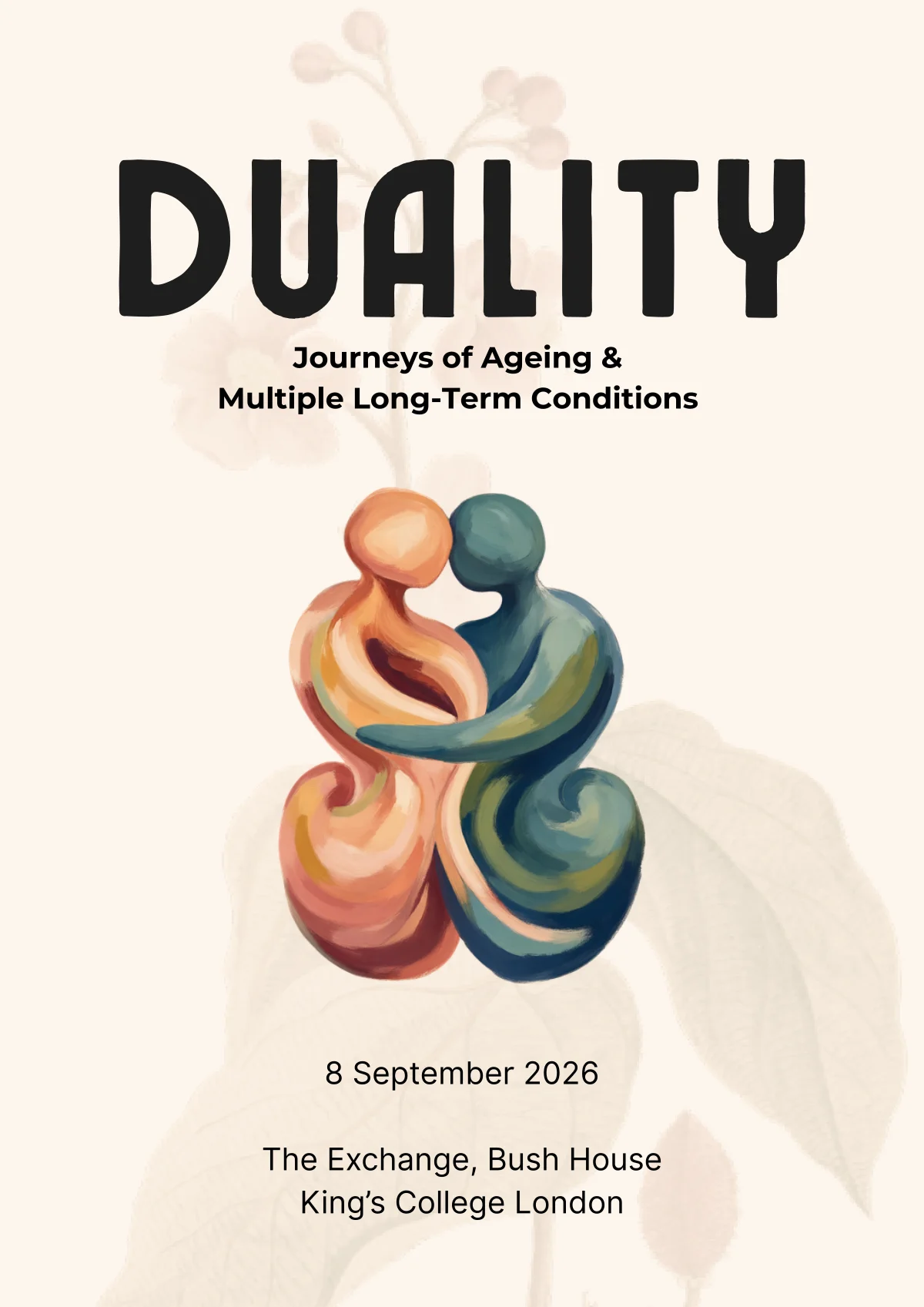
DUALITYJourneys of Ageing & Multiple Long-Term Conditions 8 September 2026 The Exchange, Bush House King’s College London
Table of Contents Welcome Programme outline Human library Photography exhibition Community booths Acknowledgements 2 3 4-10 11-63 64 651 Appendices (research information) 68-70
Welcome We're delighted to welcome you to Bush House at King's College London for DUALITY! DUALITY represents a unique opportunity to engage with some of the latest community- focused research while celebrating the strength and resilience of our communities. This guide provides a summary of what to expect, helping you make the most of your time with us as we explore research, reflection, storytelling and creative flair at the intersection of ageing, ethnicity, and multiple long-term conditions. This programme has been co-produced with the INTERCEPTION Study Advisory Group and our Patient and Public Involvement and Engagement (PPIE) Group, ensuring that lived experience and community lie at the heart of the event. We know that minoritised ethnic communities shoulder a greater burden of multiple long-term health conditions, and their experiences have not often been centered in health research, other than from a deficit perspective. Recognising this, we collectively wanted to focus on the creativity and strengths of our minoritised ethnic communities. We are also thankful for support from the INKLUDE to THRIVE programme, the Health Inequalities, Ageing and Life Course research group, the Department of Global Health & Social Medicine, Diversity Resource International, the Race Equality Foundation, and the Wellcome Trust. Throughout the evening, you'll have the opportunity to connect with a range of people who are passionate about improving health outcomes and addressing health inequalities. We invite you to explore our photo exhibition, take part in the Human Library, visit community information booths, and listen to a conversation about exercise and wellbeing. Whether you're a researcher, healthcare professional, community member or simply someone interested in learning more, there's something for everyone. Enjoy the event, the people and the food. We hope you find the evening informative, engaging, and inspiring. And if you’re lucky, you might even win a prize (although we’d argue the real prize comes in connecting with community)! Thank you for being here; we appreciate you. Best wishes, Dr Brenda Hayanga, Ph.D. Research Fellow Dr Sujith Kumar Prankumar, Ph.D. Postdoctoral Research Associate Department of Global Health & Social Medicine King’s College London2
04:00 PM - 04:30 PM Registration and light refreshments Grab your drink and a snack, and take an early look at the photo exhibition. 04:30 PM - 04:35 PM Welcome The Interception study team looks forward to welcoming you for an evening of learning and community. 04:35 PM - 05:05 PM Research Panel in Ethnicity, Ageing and Health Reflect on some recent and ongoing research at the intersection of health, ethnicity and ageing. 05:10 PM - 05:20 PM Energiser session (seated stretches) Energise your body with a guided seated stretch session led by a King's Sport and Wellness Coach. 05:20 PM - 05:30 PM Tea and bathroom break 05:30 PM - 06:15 PM Human Library (and Photo Exhibition + Community Information Booths) In this unique Human Library experience, people become “living books” who share their personal stories, experiences and perspectives. You will have the opportunity to challenge assumptions, build understanding, and connect with individuals living with multiple long-term health conditions, as well as those who care for them. Come with curiosity, ask questions, and discover the power of dialogue in breaking down stereotypes and fostering empathy. (The Human Library is limited to 36 readers per session, with Session 1 running from 5:30-5:50pm, and Session 2 running from 5:55-6.15pm. All other attendees are welcome to explore the community booths and photo exhibition). 06:20 PM - 06:30 PM Prizes, tokens of appreciation, and photo-taking with winners Join us in celebrating the people and stories behind the DUALITY photography competition. 06:30 PM - 06:35 PM Creative performance/presentation 06:35 PM - 07:00 PM Conversation: Keeping fit with multiple long-term health conditions Get inspired by a conversation between a physiotherapist, a researcher, and a person living with multiple long-term health conditions as they discuss ageing, exercising and wellbeing. 07:00 PM - 07:45 PM Hot dinner + networking Enjoy a hot buffet dinner as the event concludes. Programme outline3
The Human Library is a unique movement and conversation format that originated in Denmark in 2000. It is designed to foster empathy, challenge prejudices, and allow individuals to ask questions in a safe space to people who might not usually meet. Like a regular library, visitors can browse the catalogue for the available titles, choose the books they want to “read”, and borrow them for a short period. The difference is that in a Human Library, the books are real people, and the reading consists of listening to the books’ stories and having live conversations. DUALITY's Human Library is curated in partnership with the INTERCEPTION study's Study Advisory Group and Patient and Public Involvement and Engagement Group, and collaborator Diversity Resource International. To support the living books, a structured preparation process included three progressive online sessions: an individual screening conversation introducing the concept and assessing suitability; a group briefing where shortlisted books connected with one another and explored the event’s mechanics; and a practice session where they rehearsed their stories, refined their narratives together, and developed strategies for responding to readers' questions and managing unexpected emotions. Between sessions, living books received scaffolded take-home tasks designed to help them identify their objectives, reflect on their stories, and clarify boundaries. Human Library Session 1: Individual conversation + eligibility assessment Session 2: Group briefing + event run-through Session 3: Group practice + peer feedback4
I’m still me I hid my cancer to protect others, until I learned that vulnerability is strength. I'm a 54-year-old Black woman living with cancer, asthma, and COPD. I'm sharing my story because it may help someone navigating the same challenges. Treatment was gruelling: three years of cycles every six months that left me unable to manage everyday tasks. The length of the journey weighed heavily on my mental health. Initially, I hid my diagnosis from family and friends as I didn’t want them to feel sorry for me or see me any differently. When I finally found the courage to tell my family, they were very supportive. Face-to-face counselling was invaluable as it gave me space to process my feelings without burdening loved ones. Cancer hasn't defined me. I've continued living, travelling, and doing things I might never have attempted otherwise. My message is simple: illness may change your life, but it doesn't have to stop it. You are never alone. There is always someone ready to listen, help, and stand beside you. Ann-Marie5
My immigration journey (ignorance) Immigrants are people too, with their own unique stories; one act of kindness can transform everything. I am Christiana Beniamo. I am a Teaching Assistant, mum of three beautiful girls, and immigrant. Diagnosed with type 2 diabetes over a decade ago and recently with hyperthyroidism, I navigate health challenges while building my career and family. Immigration stories are often reduced to visa categories and legal outcomes. But behind those labels are individual lives, relationships, hopes, mistakes, sacrifices, and years of uncertainty. Two people can immigrate through the same pathway and have vastly different experiences. I learned that survival depends on connection. A pro bono lawyer, loyal friends, and most importantly, my daughters gave me hope when the system felt overwhelming. My message is to speak up, listen without judgment, and be there for others. Christiana6
A bald woman At twelve, I lost my hair to illness; what I found instead was strength, and a life far richer than I imagined. My name is Liane James, daughter of Windrush immigrants. At twelve, in Jamaica, my hair fell out, which was a devastating blow that brought bullying and pain. But books became my refuge, and I excelled academically, gaining protective friends. When I returned to England in 1985, I built a career in housing, managing large property portfolios across London. As a single mother with no financial support from my children's father, I worked multiple jobs, building resilience and gaining wisdom I later shared with others. Today, I manage alopecia areata, Sjogren’s Syndrome, lichen planus, hypothyroidism, prediabetes and high blood pressure through a combination of medication and rigorous self-care. With strict diet and exercise, I have stabilised my blood pressure, and improved my overall health dramatically. My hair may not grow back, but I have many wigs and can look good with or without them. I am retired, I have lovely children and my health & fitness is better than others my age. I am happy and thankful for my life. Liane7
The carer they didn’t see I was a carer nobody counted, until grief became words, and words became my way to say: we’re here, and we matter. I am an unpaid carer advocate, author and community campaigner from South London. My journey began supporting my mother through mental and physical health needs, and continues with other family members. For years, I was invisible: a son providing essential care yet largely unseen by the services meant to support us both. After my mother died, writing became my lifeline. Poetry helped me process grief and recognise that my lived experience had value. Through connecting with other carers, I discovered that isolation wasn't personal but systemic. Caring profoundly affects one’s identity, relationships, and wellbeing. Race, culture, and inequality compound this invisibility. Today, I use my voice to help others find theirs. My hope is that unpaid carers are recognised as people with knowledge, needs and voices that matter. Matthew8
Inherited Wounds I was born into colonialism and conflict, and fought for my nation's freedom. Now I ask: what does healing look like when the world ignores your wound? I was born into a legacy of colonialism and conflict. Eritrea was an Italian colony until 1941, and when fascism fell in the Second World War, British and American decisions ultimately led to Eritrea’s federation with Ethiopia, followed by a thirty-year war for independence. I was a member of the Eritrean People’s Liberation Front (EPLF) from 1978-1994. As a young female independence fighter, I was a barefoot doctor and then a Morse code radio operator until Eritrea gained its independence in 1991. My book explores how colonial decisions create conflict, and how war continues to shape the physical and mental health of individuals and nations long after the guns fall silent. Mebrak9
My art, my passion When art becomes your religion, even discarded materials can teach you how to live. I am Yusuf Seidu Okus, a Nigerian-born multidisciplinary experimental visual artist exploring migration, mental health, environmental sustainability, and resilience through reclaimed materials like plastic and aluminium foil. For nearly two decades, I worked in a psychiatric hospital in Benin City, using expressive art to help people heal. Now, in the UK, I continue this calling through exhibitions, workshops, and demonstrations. Art is my religion. Creating and connecting with people through visual work gives me purpose and deep fulfilment. My hope is that my story encourages you to reflect on your own experiences and recognise the things that give you strength and hope. Even during difficult periods, our passions and creativity can transform struggle into possibility and give our lives new meaning. Yusuf10
Photography Exhibition The DUALITY photography exhibition and competition invited submissions from participants worldwide on two interconnected themes: "Support" and "Inner and Outer Worlds." These themes reflected the event's focus on health, wellbeing, and human connection across diverse experiences. Submissions were assessed and shortlisted by artist and educator Eva Jonas, and fashion designer and photographer Elizabeth Hwu. The competition provided an accessible platform for photographers of all levels to share their perspectives and contribute to a collective and creative conversation about support, resilience, community and identity. To support community members in developing their ideas and skills, “Photography Fundamentals for Health & Wellbeing: A Three-Week Workshop Series” was offered in the lead up to the exhibition. Led by Eva Jonas and supported by Billy Nunn (King’s College London), the series was a supportive space to explore storytelling through phone photography over three consecutive Saturdays: Workshop 1 (18 July) covered photography fundamentals and composition; Workshop 2 (25 July) focused on discovering and developing the stories behind images; and Workshop 3 (1 August) explored titles and captions Each week, participants received constructive feedback on their photographs, which they could apply to reshooting and refining their work. Workshop 1: Photography Fundamentals Workshop 2: Discovering Your Story Workshop 3: Sharing Your Story11
Consultants The DUALITY photography exhibition and competition is facilitated and supported by a specialist team of artists, educators and communicators. Eva Louisa Jonas is a London-based virtual artist and educator, originally from Cornwall. Her work explores how our bodies shape the way we experience, move through, and connect with different landscapes. She works by collecting, adapting, and creating objects, often using sculpture alongside materials such as instruction manuals and guides for creative or outdoor activities. She also leads workshops where people explore places together through making, conversation, and simple creative activities. She is particularly interested in uncovering everyday knowledge and encouraging people to imagine new ways of understanding the places they live in and visit. Follow her work at www.evalouisajonas.com. Elizabeth Hwu is a London-based fashion designer and photographer specialising in editorial and portrait work. Since relocating from Australia, she has established a design practice dedicated to building sustainable fashion brands, while her photography has celebrated the richness of London’s diverse communities. Follow her work at www.lizhwu.com and on Instagram: @lizhwu. Bully Nunn is a Communications Assistant for the School of Global Affairs alongside his undergraduate studies at King’s College London. He is also a Social Media Officer for the UK Polar Network and the Media Representative for the Royal Geographical Society (RGS) Climate Change Research Group. The team would also like to acknowledge Tristan Poyser and Dr. Rowan Lear for their early guidance in developing the workshop series. Eva Louisa Jonas Elizabeth Hwu Billy Nunn12
2 wheels 6 legs 2 hands 1 world Aaron Mulusa It was just as i was going outside to shoot with my friend. I had not planned for this i just saw the moment before i could take my camera.In principle, I believe i just seized the moment. Kenya.13
Asili Elephant Ade Johnson Devotion, a story of conservation. The elephant walks, the river flows, the birds dance across the sky each playing its part in a story far greater than itself. This is what conservation looks like: life existing together, beautifully and freely. I wanted to capture the beautiful relationship between the elephant, the river, the birds and the wider landscape. I was particularly drawn to the way the scene came together naturally, with the sky stretching into the distance and the sunlight shining almost directly above the elephant. Technically, I wanted the elephant to remain the main focal point while still giving enough space to capture the river, birds and distant sky. The sunlight created a beautiful sense of majesty, highlighting the elephant’s flapping ears and tusks, giving the image a feeling of movement and life. I also paid attention to the positioning of the birds, which added another layer of interaction within the frame. For me, the photograph captures a moment of coexistence: the elephant, birds, water, land and sky all sharing the same space. Kenya.14
Coventry: city of peace and reconciliation Ade Johnson Beneath the night sky, the three spires and the ruins of the Cathedral stand alongside the city’s new and rising buildings , a powerful reminder of a city that chose not to remain in the ruins of its past, but to rise like a phoenix. Coventry’s skyline tells a story of resilience, hope and determination, where history and renewal meet. I was standing on the balcony of a student accommodation when I noticed this beautiful view of Coventry and the striking contrast between its historic landmarks and the modern city surrounding them. I wanted to capture the skyline as I saw it in that moment a city illuminated at night, full of life and movement, while still carrying the visible reminders of its past. From a technical perspective, I used the elevated viewpoint from the balcony to capture a wider perspective of the city. I focused on composition, bringing the three spires, the Cathedral and the newer buildings into the frame, while allowing the night sky and city lights to create depth and atmosphere. What drew me most to the image was the contrast between the old and the new. The Cathedral, which bears the scars of war, stands alongside a growing and vibrant city. For me, this reflects Coventry’s story of resilience, reconciliation and hope — a city that chose not to remain defined by the ruins of its past, but to rebuild and look towards the future. England.15
No place like home Ade Johnson No place like home — home is where we belong. I was standing in the lower seats of the Coventry Building Society Arena when I noticed the powerful moment unfolding in front of me. I took the photograph from a lower angle, looking upwards towards the stadium canopy, which helped create a sense of scale and excitement. From a technical perspective, my main focus was composition. I wanted to make sure the full “No Place Like Home” message on the screen was visible while keeping the man positioned centrally within the frame. This allowed the words and his expression to work together and tell the story. I also wanted to capture the emotion of the moment the excitement, pride and sense of belonging that came with Coventry’s promotion. Rather than simply photographing the stadium or the celebration, I tried to capture a person’s emotional connection to the occasion. The low viewpoint, central positioning and inclusion of the stadium canopy helped convey the atmosphere and significance of the moment. England.16
Different levels of support Angela Jeffery This photo shows 3 different size chairs showing the different levels of support needed at different times in our lives. I tried to use the rule of thirds in each photo. I came across these seats on a walk in a beautiful area in mid Wales. I made them into a Triptych to represent the different levels of support needed at different times in a persons life. I also made the photos different sizes so it is obvious that the furniture are different sizes. I also find being outside in the wild good for mental health and find that is another form of support. Wales.17
My safe spaces Angela Jeffery A reflection of my inner world, the lights in my kitchen and my outer world of my garden taken at night through the window. I used the rule of thirds for taking the photo. I also wanted to show some reflection and represent both worlds in one photo. England.18
Outer calm Angela Jeffery This photograph shows the beach at Llannon with stones, wood and the sea, but still creating a feeling of calm. I tried to get the branch to frame the picture and converted it to black and white so it was more dramatic. I tried to use the rule of thirds to have different parts to the photograph. I felt this photo demonstrated that the outer world can have a lot going on in it, but still be calm if you take time to sit and process it. Wales.19
Duty calls (1) Becky Hart In the time between arrival and obligation, there is a quiet moment that belongs to us alone. Our thoughts remain entirely our own. As a regular commuter, I observe people cramming in quiet moments and hobbies in the shortest of windows, as if they’re on borrowed time. Silently, trains transform into libraries, craft tables, cinemas and everyone respects that precious moment of just ‘being’ before duty calls. I took this in portrait mode, turned it to black and white, enhanced the clarity of the subject’s earring and finally used the Snapseed double exposure tool to depict the train approaching. England.20
Duty calls (2) Becky Hart For a brief moment, the journey belongs to us. Soon the working day will claim it back. This is the second and final photo in the duty calls series. Following Eva’s advice in the workshop, I wanted to capture another commuter in a similar style. While the subject is likely on their morning commute to work, I like the subtle power in the subject’s the gym-wear & the low plait, it shows they’re reclaiming their own time and peace before work to exercise, be healthy and prioritise wellbeing. Then I added the Battersea Power Station by using the Snapseed double exposure tool, as a subtle nod to that personal power. England.21
Respite Becky Hart Where the horizon asks nothing of us, just to pause long enough to notice and be present. I purchased second-hand binoculars and had some fun at low-tide on Eastbourne Beach capturing locals enjoying the low tide & rockpools. While experimenting, I twisted the binocular settings for different focus and zoom ratios - this photo required some adjustment and editing using iPhone settings to enhance the clarity of the couple. I was really impressed with how well the contrast of the draught cliffs against the green algae came out! I wanted a completely contrasting photo to the busy city and tiring commute, so wanted to capture a moment that physically narrows the world, shuts out distractions and shows people connecting in nature and the local landscape. England.22
Still standing Besim Gerguri Made from weathered, mismatched pieces of wood, the figure appears fragile yet remains upright. It reflects ageing, resilience and the forms of support that keep us standing. I framed the figure vertically and centrally, using the surrounding trees to create a natural frame and emphasise its humanlike form. Inspired by the workshops, I focused on noticing an unusual subject in an everyday environment and explored the themes of support, ageing and resilience. I then used the Colour Pop setting in Google Photos, allowing the remaining warmth to draw attention to the figure while the black and white surroundings emphasise texture, age and fragility. England.23
Between two worlds Besim Gerguri An old number plate from Prishtina, the capital of Kosovo, dating from socialist Yugoslavia, a country that no longer exists, hangs beside a portrait of my son and a punching bag. Together, they connect the world I left behind with the family and life I built in England, and the resilience that links them. Following feedback from the workshop, I simplified and rearranged the scene so that the three meaningful objects became the focus. I used the diagonal line of the punching bag to create movement and visual tension, balancing it with the number plate and portrait on the left. I retained the strong colours because they help separate the objects and reinforce the contrast between past and present. The workshop encouraged me to look more closely at everyday surroundings and use ordinary objects as visual metaphors. Here, the Prishtina plate represents the world I left behind, the unfinished portrait of my son, who is now a teenager, represents the life and family I built in England, and the punching bag suggests resilience. England.24
A place to rest Besim Gerguri A grasshopper rests on my sleeve after travelling with me from the allotment. This unexpected encounter became a small moment of trust and support between the human and natural worlds. I moved in close and focused on the grasshopper while trying not to disturb it. The dark fabric of my sleeve created a simple background, helping its shape and fine details stand out, while the softer background kept attention on the subject. I then used the Vivid preset in Google Photos to strengthen the warmth, contrast and texture. The workshops encouraged me to notice unexpected moments in everyday life and to consider how a simple image could express a wider theme. The grasshopper resting on me became a small example of support and a meeting between the human and natural worlds. England.25
Visiting a museum with my auntie Chris Pavlakis We are not alone in this world; different worlds are present at the same time. Walking through remnants of Antiquities is a reminder and perhaps a healer of our scars, a booster to our wellbeing. Greece.26
Moonlight as rest Cynthia Dawes My photograph of the full moon is a tribute to my late mother’s life in Nigeria. As a single parent, her days were filled with constant work and responsibility, leaving little space for rest or joy. Yet on nights when the full moon appeared, something in her softened. She would spread a big mat outside, call me and my siblings to join her, and rest under the moonlight as if she had become a child again. Those moments were her rare pauses, a place where support, togetherness, and an inner world of peace briefly opened. The moon became her escape, her joy, and our shared memory. She passed away five years ago, but the full moon still feels like her presence, shining in the quiet spaces she never had enough of. England.27
Full moon Cynthia Dawes This photograph of the full moon is informed by memories of my late mother and her experience as a single parent in Nigeria. Her daily life was defined by constant work, early mornings, and the ongoing pressure of providing for her children. Opportunities for rest or personal time were extremely limited. Full‑moon nights, however, offered a brief interruption to this routine. On these evenings, she would place a mat outside and lie under the open sky, often inviting me and my siblings to join her. These moments created a rare space for calm, connection, and reflection. They represented the few times she could step outside the demands of daily life and experience a sense of ease. My mother passed away five years ago, and the full moon has become a symbol of those nights when she allowed herself to pause and be present with us. The photograph reflects themes of support, inner and outer worlds, and the contrast between daily struggle and fleeting moments of peace. England.28
At home Devy Garna The flowers and houseplants create a quiet, intimate world indoors, while beyond the window the trees, houses and sunlight reveal the movement of life outside. The photograph captures the window as a boundary — and a connection — between two everyday worlds. I approached this photograph by using the window as a natural frame to explore the relationship between the inside and outside world. The flowers and houseplants create a calm and personal foreground, while the window opens onto a brighter outdoor environment. I deliberately included the window frame and curtains because they emphasise the physical boundary between these two spaces. From a technical perspective, I considered composition and layering, creating foreground, middle ground and background to give the image depth. I also used the natural daylight coming through the window and positioned the flowers as the main focal point. From the photography workshop, I applied ideas about framing, the rule of thirds, balance and observing how light can direct the viewer's attention. England.29
Alright, Bab Devy Garna Taken while walking to the train station after a networking meeting, this scene reminded me that support can appear in unexpected places — in a conversation, a shared space, or even a simple “Alright Bab” that makes a city feel a little more welcoming. For this image, I wanted to explore support through the relationship between people and the urban environment. The phrase gives the photograph a welcoming and friendly character, while the person resting at the edge of the garden suggests the importance of public spaces as places where people can pause and feel part of their surroundings. Technically, I photographed from a low viewpoint and used the buildings on both sides to frame the central sign. The open blue sky provides negative space and draws attention towards the words, while the garden creates a softer contrast with the architecture. I also considered perspective, leading lines and balance, skills discussed during the workshops, to guide the viewer from the foreground towards the centre of the image. England.30
Together we can Edwina Dogbey Just like in sports, teams go farther if they work together, so it is true when managing our health. We all need support at one point or another. England.31
Beyond the reeds Edwina Dogbey The reeds in this photo represent daily challenges that we may face. If we choose to focus on the reeds, we miss the beauty of everything else around us. I took this photo on my daily walking route. I was trying to work with the rule of thirds. I had submitted a similar shot and converted it to black and white using Snapseed. I took advice from Eva during the workshop and re-shot it from a different angle. The sunlight filtered through the clouds differently and did not have the same effect as in the initial shot. I chose to enhance the colours to showcase the beauty of all the elements. England.32
Go on... take a seat... Edwina Dogbey This photo represents the journey of life (the pathway). We must always look for moments of rest and accept support (the bench) along this pathway. I took this photo on my daily walk. I initially took the shot in portrait but then changed it to landscape after advice from Eva during the workshops. I changed it to black and white to focus on the textures of the road and bench which I find beautiful and it also represents the complexities and imperfections of life. England.33
At the Scottish Government building John Cassidy Ministers from the Scottish Government met people with a disability at the Scottish Parliament. I was with People First (Scotland) and Glasgow Disability Alliance at the Disability Cabinet Takeover. Scotland.34
Disability Cabinet Takeover with Scottish Government John Cassidy Ministers from the Scottish Government met people with a disability at the Scottish Parliament. I was with People First (Scotland) and Glasgow Disability Alliance at the Disability Cabinet Takeover. Scotland.35
Rainbow A406 John Mpaso A brilliant double rainbow arcs over a damp Coventry road, creating a moment of wonder amidst the everyday urban commute. I framed this shot at street level to connect the dramatic sky with the mundane reality of the road. Capturing both the arc and the moving cars required a quick, steady hand and a balanced exposure to avoid blowing out the bright colors against the overcast grey sky. The red route lines and wet asphalt provide leading lines to anchor the frame. I applied workshop skills by consciously considering the "Inner and Outer Worlds" theme, using the physical canopy of the rainbow to encapsulate the human activity below, while the natural phenomenon reflects the viewer's inner sense of awe and renewal. I also deliberately waited for the white car to enter the foreground to add a sense of motion and balance, ensuring the foreground wasn't too static. England.36
Symmetry in the square John Mpaso The sweeping metallic arcs of a public sculpture reach toward each other against a clear blue sky, framing the quiet bustle of an urban plaza below. I approached this shot by prioritising symmetry and negative space. I positioned myself in the center of the plaza and used a wide-angle perspective to capture the full spread of the sculpture, letting its heavy metallic form contrast against the delicate contrails and open blue sky above. I applied skills from the workshops by considering how the "Inner and Outer Worlds" theme interacts with the frame—the wide, expansive sky represents the limitless outer world, while the converging pillars draw the eye inward toward the human-scale activity. I also carefully balanced the exposure to keep the cloud textures visible while retaining the rich warmth of the sunlight hitting the building facades, ensuring the leading lines of the metal arcs anchored the composition. England.37
Pond serenity John Mpaso A striking white swan leads a flock of geese across a sunlit urban pond, creating a peaceful sanctuary against a backdrop of city buildings. I took this from a slightly elevated, standing vantage point to lower the horizon line and maximize the reflection and depth of the water. This allowed me to capture the sheer number of birds without losing the context of the surrounding park. I applied workshop concepts by consciously framing the scene to reflect the "Inner and Outer Worlds" theme—using the lush green trees and water to create a natural border that physically separates the quiet "inner" world of the pond from the architectural "outer" world in the background. I also timed the shot to catch the fountain in the distance and the swan confidently navigating the foreground, using the rippling water to add texture and a sense of calm movement. England.38
Joy Linda Reid The joy felt from the support of being with family and friends whilst enjoying jazz with Tomorrow's Warriors (a jazz music education and talent development organisation). I learned about placement of the subject(s) in the grid lines, so I took the photo from different positions and later cropped it. I learned about experimenting with colour and black and white. I discovered that I loved the black and white version which seemed to fit with the jazz music and dancing. I thought about different types of support. Dancers supporting each other's weight, a father holding up his child, the emotional support from a gentle touch on the shoulder and the support from interacting with others in the 'outer world'. I was moved by the emotional and physical support and by the visible joy in the faces, captured in this moment. England.39
Dignity Linda Reid A mature gentleman walking down the line at the end of the steel pan performance. He is carrying his folded support during the show. During the sessions, I learned the importance of thinking about what you want the photo to say. I aimed to catch a sense of the man's dignity and of movement. I wanted to emphasise his walking by taking the photo with him in the bottom left of the picture. I thought about the support of his now folded seat and the steel pan supports. I placed the group in the bottom half of the grid and tall buildings in the upper half of the grid when taking the photo. I loved the dignified way the man is walking. I thought about aging with dignity and the emotional and physical benefits or support we gain from intergenerational socialising. England.40
A quiet strength Linda Reid The strength of the tree trunk supporting the branches, providing shelter and welcoming us to take the path. In the sessions I learned to try taking photos from different heights. I found that by getting lower down it gave the photo a more welcoming feel, as if enticing a walker to walk along the path. I wanted to focus on the arch of the branches and a sense of them reaching out to the water. The photo makes me think about the acquired inner strength and wisdom that can come with age. Also, our willingness to provide support to others and the need to nourish ourselves. England.41
The carer they didn’t see Matthew McKenzie My mother's coat and shawl rest on the chair at the centre, while my own chair sits partly outside the frame. It represents the unpaid carer: always present and supporting, but not always seen. I wanted the photograph to tell the story rather than just relying on words. I deliberately placed my mother's chair in the centre of the image, with her coat and shawl providing a personal connection to my own lived experience of caring. My chair was positioned slightly at the edge and partly outside the frame to represent how unpaid carers can be present throughout someone's care while remaining less visible. From the photography workshops, I thought more carefully about framing, positioning and what should be included or excluded from the image. Rather than centring both chairs, I jut used the edge of the frame. I also wanted to keep the ordinary home environment visible because much unpaid caring happens quietly in people's homes? England.42
Shadow cascade I liked the harmony between the leaves and their shadows, reflecting the way that our inner and outer worlds can take a similar shape but manifest differently. Sometimes the outer world has more colour than the inner, and vice versa. I thought about using the rule of thirds which was discussed during the workshop. I thought about lighting: when projected onto the fence, I noticed how the shadows looked like additional branches to the tree rather than just shadows, and they had a nice contrast with the light colour of the fence. I thought about whether portrait or landscape would be best and settled on portrait as it drew attention to the shadow rather than the sky. England. Matthew Smith43
On the surface Matthew Smith The algae which blankets this lake is sufficiently dense to support a covering of leaves and even plastic waste. It makes me reflect on the support that nature provides us even when exploited by human wastefulness. I thought about the rule of thirds discussed during the workshop. I also thought about the colour palette, noticing that this environment is almost entirely two shades of green. I wondered about about how to draw the eye towards a small focal point, the plastic bottle in the lower left corner. While so much algae can be a sign of a poor environment, here the bright green has a kind of intense beauty. England.44
Shared ascent Nadia Koch My photo is a symmetrical image captured from behind women walking up a hill. The horizon is flat and the sky is clear blue. I wanted the photo to portray the supportive nature the Walking Roots Women's Walks event has. In terms of composition, I positioned myself directly behind the walkers to create a symmetrical frame, using the flat horizon and open blue sky to emphasise simplicity, balance and calm. I waited for the right moment when the walkers were naturally aligned and evenly spaced. Also, the upward slope suggests shared progress and resilience. England.45
Shared paths Nadia Koch Frame-within-a-frame framed by trees. I am following from far back on the path, 3 women from international backgrounds. There is a lake on the left. This photograph was taken from a distance to place the walkers within their surrounding. I used the trees on one side of the path as a natural frame, drawing the viewer's eye towards the three women while creating depth within the composition. The lake to the left balances the image and introduces a sense of openness and calm, contrasting with the enclosed woodland path. The closeness of the women portray them as companions sharing a journey. England.46
My mom is a champion Ozge Ali This photograph was taken during a Champions 4 Change Boxercise session in Thamesmead. These weekly sessions provide a crèche service, allowing mothers with young children to participate in physical activity. When childcare is not available, attendance often drops because many parents either have no alternative childcare arrangements or must bring their children along. I take around 50 photographs each week for my work but this particular image stands out to me. It reflects how important physical activity is not only for our physical health but also for our mental wellbeing. It also highlights one of the barriers many parents face in accessing exercise and wellbeing activities when childcare support is unavailable. Beyond this, the image captures something I had not expected. The young child in the photograph, JJ, is completely focused on his mother, watching her closely and copying her movements. In that moment, the photograph became a reminder that children learn from what they see. As parents, we are role models, and our actions can have a profound influence on our children's development. To me, this image tells a story of health, resilience, support, and inspiration. It shows not only a mother taking part in an activity that benefits her wellbeing, but also a child learning, encouraging, and being inspired by her example. It is one of those rare photographs that genuinely touched my heart. England.47
Before the world ended The eclipse approaches over the rooftops of Valencia, turning an ordinary afternoon into something strange and unfamiliar. It looked like the beginning of the end; strangely, it felt more like the end of a beginning. I took this photograph from where I was staying in Valencia, watching the light and atmosphere change as the eclipse approached. Rather than trying to eliminate the obstruction in front of me, I deliberately used it as part of the composition. The dark curved foreground, the silhouetted rooftops and the small, partially obscured sun created a sense of looking out from one world into another. I was less interested in producing a technically perfect image of the eclipse than in capturing how peculiar the moment felt. The restricted view and imperfect framing became part of that: an extraordinary event glimpsed through the very ordinary surroundings of where I happened to be. The theme Inner and Outer Worlds resonated with me because the photograph captures a contrast I remember very clearly. Outside, the light was disappearing and the scene felt almost apocalyptic. Internally, however, I felt an unexpected sense of possibility and renewal. What appeared to be an ending in the sky somehow felt like a beginning to me. Spain. Patrick Nyikavaranda48
The end of the world For a few extraordinary moments, the familiar sun almost disappeared, leaving only darkness edged by light. It looked like the end of the world, yet standing beneath it I felt an unexpected sense of possibility rather than fear. This was the moment I had been waiting for, but when it arrived I was struck less by the technical challenge of photographing it than by how extraordinary it felt to witness. I wanted the eclipse to stand almost alone in the frame, surrounded by darkness, rather than include other visual distractions.I used the large area of negative space deliberately. The small amount of visible light around the edge became much more powerful against the blackness, particularly the intense red and white light breaking through on one side. Timing mattered because the appearance of the eclipse was changing constantly, so I took several photographs rather than assuming I could capture the moment once. For me, this is the centre of the three photographs and of the Inner and Outer Worlds theme. The outer image suggests disappearance, darkness and perhaps even catastrophe. My internal experience was surprisingly different. I remember looking at something that resembled an ending while feeling strangely hopeful about beginnings. The photograph captures that contradiction better than I could have planned it. Spain. Patrick Nyikavaranda49
And the world continued The light returned over the rooftops of Valencia and the familiar world slowly reappeared. Everything did not feel quite the same. For the final photograph, I deliberately pulled my attention away from the eclipse itself and back towards the city around me. I wanted the photograph to contain both the extraordinary event in the sky and the very ordinary world beneath it: rooftops, chimneys, aerials and the edge of the building from which I was watching. I used the architecture as a natural frame and allowed the buildings to remain largely in silhouette. Rather than trying to correct the intense orange light, I wanted to retain the atmosphere as I experienced it. The contrast between the glowing sky and the dark, familiar structures below became the photograph. Spain. Patrick Nyikavaranda50
Misunderstood Mislabelled Mistaken Penelope Smith Quietly offering more than you have noticed. The Australian Ibis is important company for me while I live on this land. Isolated and alone, they greet me as I leave my home each day. They visit me when I move across the country, changing my isolation and aloneness. Because of this, my relationship with this bird has changed from taking on the nationwide view that it is a nuisance. I desired to feature this bird in my submission because it represents for me part of how I feel living here. Rejected, ignored, excluded, but still here, still working hard, still quietly contributing. Being introduced to the Snapseed app in the workshop, particularly the double exposure feature, enabled me to use the street art surrounded by a photo of the ibis. Mirroring the self to the self. Challenging the request to commit no nuisance. Australia.51
Together Penelope Smith I beat the drum so you know you are not alone. The complexity of the macro, meso and micro is dizzying at present. I wanted to represent this difficult painful reality but also the hope of human connection right now. For this is my lived experience. The photo of Kim Churchill's drum kit sent me searching for a photo within what I had to layer to represent this so I could layer using double exposure. I struggled to turn my vision into reality. I took both photos before learning about the grid. I know that with the grid that I could have layered in a more balanced way and I wasn't sure how to resolve this. Australia.52
Veilleur de pierre Raissa Aifa Un phare tient seul face au ciel, silencieux mais indéfectible — la promesse qu'on ne guide jamais dans l'obscurité sans y être resté soi-même debout. J'ai photographié ce phare à la fin de la journée, quand la lumière rasante venait frapper la façade blanche tout en laissant le ciel se charger de nuages dramatiques. J'ai choisi un cadre bas, presque en contreplongée, pour accentuer la verticalité et la solidité du bâtiment car sur son rocher — une façon de traduire visuellement l'idée de "supporter" comme une force stable plutôt qu'un geste ponctuel. "J'ai appliqué les principes vus en atelier sur la règle des tiers et la gestion des hautes lumières pour éviter de brûler le ciel". Algérie. A lighthouse stands alone in front of the sky, silent but unwavering — the promise that you never guide yourself in the dark without standing there yourself. I photographed this lighthouse at the end of the day, when the grazing light hit the white façade while letting the sky become full of dramatic clouds. I chose a low frame, almost from a low angle, to accentuate the verticality and solidity of the building because it is on its rock — a way of visually translating the idea of "supporting" as a stable force rather than a one-off gesture. I applied the principles seen in the workshop on the rule of thirds and the management of highlights to avoid burning the sky. Algeria.53
Le seuil Raissa Aifa Entre le mur carrelé qui nous abrite et la mer qui s'étend à l'infini, il n'y a qu'un pas — celui qui sépare, chaque jour, notre monde intérieur du monde extérieur. J'ai utilisé le cadre architectural de la terrasse comme une fenêtre naturelle pour créer une transition visuelle entre l'espace clos et l'horizon ouvert. La photo a été prise au coucher du soleil, qui donne une lumière douce et des couleurs pastel qui adoucissent le contraste entre les deux "mondes". "J'ai appliqué les notions de premier plan/arrière-plan pour renforcer la profondeur de la scène”. Algérie. Between the tiled wall that shelters us and the sea that stretches to infinity, there is only one step — the one that separates, every day, our inner world from the outside world. I used the architectural setting of the terrace as a natural window to create a visual transition between the enclosed space and the open horizon. The photo was taken at sunset, which gives a soft light and pastel colours that soften the contrast between the two "worlds". I applied the notions of foreground/background to reinforce the depth of the scene. Algeria.54
Le passage Raissa Aifa Une arche de pierre relie la falaise à la mer, portant en elle deux idées à la fois : ce qui nous soutient, et ce qui nous fait passer d'un monde à l'autre. J'ai placé mon smartphone au ras du soleil pour donner de la texture et de la profondeur au premier plan rocheux, qui attire l'oeil vers l'arche et le ciel rosé en arrière-plan. Ce choix de perspective basse renforce l'impression que la pierre "porte" littéralement le regard vers l'horizon. J'ai appliqué les conseils sur le premier plan flou pour créer de la profondeur. Algérie. A stone arch connects the cliff to the sea, carrying within it two ideas at once: what sustains us, and what makes us pass from one world to another. I placed my smartphone flush with the sun to give texture and depth to the rocky foreground, which draws the eye to the arch and the pinkish sky in the background. This choice of low perspective reinforces the impression that the stone literally "carries" the gaze towards the horizon. I applied the hints on the blurred foreground to create depth. Algeria.55
New life Seidu Okus Yusuf Life is transitional, the expiration of one life is the beginning of another. The theme around health and life, and the various effects and forms, presents a beautiful composition to capture. The process of decay, in itself, can herald an entirely new experience, a beginning of a new life evolving. I was inspired by the various tactile effects created through the interplay of different materials, as well as the rustic nature of what would eventually emerge as another masterpiece for my creative engagements. To me, this work speaks of transformation and renewal. What appears to be an ending can become the beginning of something new and beautiful. Yes! One life stops, and another springs forth. Nigeria.56
Against all odds Seidu Okus Yusuf This photo provides an experience of a fatherly bond and assurance. Understanding the theme of “support”, I wanted to capture a moment to treasure with my son by composing a joyful scene, enhanced here by strategic lighting. Experiencing the flakes of snow for the very first time was a beautiful and unforgettable moment. It became a lasting memory for my son and me that beautiful morning as we made our way to school. Everything seemed magical—the falling snow, the unfamiliar cold, and the joy of experiencing something so new together. We felt the coldness of the ice, yet found warmth in our embrace. Against all odds, some of life’s most beautiful moments are found in the simplest experiences—moments that become treasured memories for a lifetime. England.57
Where support meets journey Where rest meets crossing. I approached this photograph by first creating a still-life arrangement that felt grounded and personal, the boots, walking stick, and chair forming a small triangle of support and rest. After capturing that scene with careful attention to texture and shadow, I introduced a second image: the suspension bridge. Using double exposure techniques, I blended the two photographs so the bridge’s structure became an echo of the objects in the foreground. I applied workshop skills on composition, exposure control, and visual storytelling to ensure the two layers complemented rather than competed with each other. The sepia tone was added to unify the textures and create a sense of memory and journey. The theme behind the image is support both personal and structural. The boots and stick represent the intimate, everyday supports that carry us, while the bridge symbolises the larger frameworks that hold us up without us noticing. My aim was to create a photograph where these two worlds blend into a single narrative about movement, rest, and the unseen structures that guide us. England. Si Henwood58
A word from mama Seidu Okus Yusuf Words of our Elders, are Words of wisdom. Keying to the theme on “ageing”, representing abundance of wisdom, the two-figure composition and the interplay of lighting effects on the images against the surrounding offers a good composition and inspiration for me. The words of our elders are words of wisdom. The wise listen and obey, and in doing so, become wiser. “My son, these are my words of advice to you for an upright and purposeful lifestyle: Do not lose focus in life, and above all, pray regularly.” These words from Mama remain etched in my heart. Her wisdom continue to guide me, reminding me to stay focused, live purposefully, and never lose sight of the power of prayer. England.59
Triple vision Stephen Watson Stained glass at Église de la Sainte-Trinité, Paris, as seen through a double exposure. One of my long-term health conditions is diplopia (double vision). At a church in Paris last year— fittingly known as La Trinité—I was trying to admire the stained glass windows which lined the church in perfect pairs. To me, however, the windows came apart in a blurry mess. I took a photograph to better see what the windows actually looked like. From one part of the church, however, I noticed something unexpected: instead of two windows, I could see three. My brain fused the right-hand window seen by my left eye with the left-hand window seen by my right eye, creating a new “third” window between the outer two. That middle window was simultaneously blurrier, brighter, bolder, and more three-dimensional than the others, drawing me into the image. Rather than feeling frustrated by the limitations of my vision, I was struck by the beauty of something almost no one else could see. (This mirrors the vision therapy exercise "See Three Coins"). Inspired by the workshops, I used a mirrored double exposure of the original image to capture this experience and explore the relationship between my inner and outer worlds. The photograph was taken inside a church, looking towards the light. That, too, feels significant. La Trinité was the church of the great French organist and composer Olivier Messiaen—the reason for my visit. Looking at this photograph, I still feel the organ keys beneath my fingers and hear the sound of the organ filling the church. France.60
Drums and the sea Vandana Kakar A restless rhythm within, meeting the calm beyond. The drums symbolising music and noise appeared to be in direct contrast to the calm sea view. The room appeared dark again in contrast to the brightness outside. This is much like how we feel. Our hearts dancing to a quick paced beat while what we yearn for is peace, quiet and calm. This picture therefore felt apt for the inner and outer world theme. Technically, I used tips shared in the class like editing, use of filters, grid and an interesting caption. India.61
Barbed wire and the sea Vandana Kakar A thorny inner world longing to merge with the calm of peaceful waters. I often feel that there is a contrast in the edgy and thorny world we live in and what we actually crave. The sight of the barbed wire by the sea appeared to be symbol of that. From a technical point of view, I tried to focus on framing this piece, and giving focus to the barbed wire and keeping it in the foreground. I also changed the filter which gave it a different look and removed items which took away from the focus of the picture. India.62
The anchor and the light house Vandana Kakar I may appear strong and anchored, but I still need Your light and direction to be centred My Lord! I feel that people who appear to be very strong on the outside are the ones who are actually lonely and desperately seek advice and guidance, but are too proud to ask and find it difficult to share their problems and seek help. I also feel that having a mentor or belief in God provides direction and shows the way even to the most successful people. The anchor and the lighthouse captured this well. From a technical point of view, I tried to capture the light house through the anchor and keep it in the centre. That’s why the caption has the word “centred”. I used tools like editing, removing extra items that were placed behind the anchor. Changing the filter added more depth to the picture, I felt. And framing, also the use of an interesting caption. India.63
Community Booths Diversity Resource International Matthew McKenzie Elizabeth Hwu Champions 4 Change Wellbeing CIC King's Sport & Wellness Unique Lifestyle Art Limited64
Acknowledgments DUALITY is a collaborative project made possible by a community passionate about health, wellbeing and justice, including (but not limited to) the following groups and individuals: INTERCEPTION Patient and Public Involvement and Engagement (PPIE) Group members: Arshi, Betty, Douglas, John, Juline, Mark, Omolade, Sara, Sulumenty INTERCEPTION Advisory Board members: Dr. Deborah Ikhile, Dr. Mavin Kashyap, Dr. Mehrunisha Suleiman, Dr. Patrick Nyikavaranda, Tafadzwa Marapara King’s College London: Aniqah Kazi, Billy Nunn, Chloe Morgan, Dr. Colette Ridehalgh, Isobel Body, Laura Edwards, Dr. Mikal Woldu, Dr. Ragy Tadrous, Rosie Cammack, Victoria Ogunseitan, Dr. Wei Yang, Department of Global Health and Social Medicine, INKLUDE to THRIVE, King’s Venues Photography, performance and art: Elizabeth Hwu, Eva Louisa Jonas, Dr. Michelle Harewood, Dr. Rowan Lear, Dr. Tobias Yu-Kiener, Tristan Poyser Community booths: Champions 4 Change (Douglas Cosbert); Diversity Resource International (Aabha, Mebrak, Mudasir and Nadia); Elizabeth Hwu; King’s Sport and Wellness; Matthew McKenzie; Unique Lifestyle Art Limited (Seidu Okus Yusuf) Funding: Wellcome Trust; Health Inequalities, Ageing and Life Course Research Group (Department of Global Health and Social Medicine, King’s College London)Dr. Michelle HarewoodBush House, King’s College London65Dr. Mikal Woldu
Appendix 1: INTERCEPTION Study Outline (2025-2027) Racially and ethnically minoritised people are among those most likely to experience multiple long- term conditions (MLTCs), yet they are also among the least likely to receive high-quality care and adequate support to manage their health. Recent research has identified substantial ethnic inequalities in both the prevalence and impact of MLTCs, as well as in the quality of care received. Analyses of primary care experiences further show that people from minoritised ethnic groups are more likely than their white counterparts to report poorer care quality, lower satisfaction with primary care services, and insufficient support to manage their long-term conditions. Despite these disparities, little is known about the specific needs, preferences, and support priorities of racially and ethnically minoritised people living with MLTCs, or what would help them manage their conditions more effectively. The aim of this study is to advance understanding and transform how health providers, community organisations and policy makers construct, respond to, and support racially/ethnic minoritised people with MLTCs in local and national contexts. The study will: 1. explore how people from racial/ethnic minoritised groups with MLTCs and their carers understand and conceptualise MLTCs. 2. identify the range of needs, views and circumstances that influence management of their MLTCs. 3. identify how they want to be supported by healthcare providers to manage MLTCs. 4. examine the processes preventing/enabling healthcare professionals to adequately support racially/ethnic minoritised people with MLTCs. This study uses storytelling and creative methods co-produced by researchers and people living with multiple long-term conditions. The research is informed by an intersectionality framework, which recognises that individuals hold multiple social identities that intersect in complex ways to shape their experiences, opportunities, and outcomes. We seek to produce an in-depth understanding of the experiences and challenges of managing MLTCs from the perspective of minoritised ethnic people with MLTCs, carers, community leaders, healthcare professionals and policymakers in London, Coventry and Manchester. Our findings will help inform efforts to develop more inclusive, responsive and equitable healthcare services for minoritised ethnic people living with MLTCs. To learn more about the study and get involved, scan the QR code below, or visit: https://www.ethnicinequitiesinmltcs.co.uk/getinvolved66
Appendix 2: Key findings from the “Ethnic inequalities in heathcare and care quality among people with multiple conditionsˮ project (2020-2023) Brenda Hayanga , Mai Stafford , Laia Bécares1 2 3 What we know about ethnic inequalities among people with multiple long-term conditions (MLTCs) People with MLTCs tend to have poorer quality of life and a higher risk of early death compared to people with fewer conditions. Some studies suggest that people from minoritised ethnic groups have a much higher risk of developing MLTCs and do so at an earlier age than white people. There are also studies that have found ethnic differences in how much a patient uses health services and the quality of care they receive, however, the evidence is unclear. What we set out to explore The aim of this project is to investigate whether there are ethnic inequalities in healthcare use and care quality among people with MLTCs and how these inequalities can be addressed. The project seeks to produce evidence that can be used to improve care for people with MLTCs from minoritised ethnic groups. What we have done We have systematically reviewed and summarized the existing evidence from studies reporting on ethnic inequalities in: How common MLTCs are How much healthcare is used and the quality of that care for people with MLTCs We have also used data from surveys and from patients in General Practice and hospitals to address the following questions: Are there ethnic inequalities in MLTCs? Is the impact of MLTCs the same across ethnic groups? Is the care for MLTCs the same across ethnic groups? Is experience of primary care the same across ethnic groups? What we have found Evidence from existing literature: Existing UK studies suggest there are ethnic inequalities in how common MLTCs are, and in the quality of care they receive. For example, compared to white people, Black African, Black Caribbean, Black other and Mixed ethnicity people are more likely to report more LTCs. Also, Blacks and South Asians are more likely to have poor disease management and increased hospital admissions [1,2]. The number of LTCs is not the same across ethnic groups, and there are differences across age groups:. Older Pakistani, Indian, Black Caribbean and other ethnic people are more likely to have MLTCs compared to older white British people. Gypsy and Irish Travellers have higher levels of MLTCs at all ages. Chinese people have lower levels compared to white British people [3]. The impact of multiple conditions is not the same across ethnic groups: Thereʼs a higher risk of early death for people with MLTCs. This link between early death and MLTCs is stronger in minoritised ethnic groups compared with white people. In particular, Pakistani, Black African, Black Caribbean, and people from other Black ethnic groups have a higher mortality rate associated with MLTCs compared to white British people [4].67
Care quality for people with MLTCs is not the same across ethnic groups: (i) Some people with MLTCs need more appointments with their GP. Seeing the same GP each time (i.e., continuity of care) can help build trust and understanding between the patient and GP. Continuity was lower for people living in more deprived areas and for people with a Bangladeshi, Pakistani, Black African, Black Caribbean, and other Black background. Continuity of care was higher for Indian and Chinese ethnic groups [5]. These patterns were similar for those with MLTCs. (ii) GPs in England voluntarily take part in the Quality and Outcomes Framework – a program to resource and reward good practice. Some patients are not included in the statistics for this program because they are considered ‘unsuitableʼ (for example because they have complex care needs that require a different approach to treatment) or because they opt not to have the treatment or intervention offered. ‘Patient unsuitabilityʼ was higher among people of Black Caribbean, Black other, Pakistani ethnicity. These differences were accounted for by the number of long-term conditions and the socioeconomic deprivation of patients in these groups. People of Bangladeshi, Black African, Black Caribbean, Indian, other Asian and other ethnicity were less likely to be excluded from the program for informed dissent [6] Patient experience in primary care is not the same across ethnic groups. Compared to white British people, people of Arab, Bangladeshi, Chinese, Indian, Pakistani, other Asian, mixed white and Asian, other white and other ethnicity with MLTCs are less satisfied with appointment times, types and booking experience and have less confidence and trust in healthcare professionals and the extent to which they feel healthcare professionals listen to them, give them enough time, treat them with care and concern, involve them in healthcare decisions, and meet their needs [7]. What do our findings mean? A sizeable number of people from ethnic minority backgrounds live with MLTCs Our research shows that continuity of care is less available to some ethnic minority groups Exclusion from the Quality and Outcomes Framework program means that we are less able to have high quality intelligence that leads to improved health care, resulting in the maintenance of exacerbation of health inequalities. Poor patient experience may exacerbate the inequalities that we have uncovered. Within the health care setting, there may be opportunities to target clinical and self-management support for minoritised ethnic people with MLTCs Further research is required to ascertain the role that structural processes play, (including racism & discrimination) in the development and exacerbation of ethnic inequalities in MLTCs City, University of London, Brent Council, Kingʼs College London1 2 3 (This project was funded by the Health Foundation). References [1] Hayanga, B., M. Stafford, and L. Bécares (2023) Ethnic inequalities in multiple long-term health conditions in the United Kingdom: a systematic review and narrative synthesis. BMC Public Health, 23(178) [2] Hayanga, B., M. Stafford, and L. Bécares (2021) Ethnic Inequalities in Healthcare Use and Care Quality among People with Multiple Long-Term Health Conditions Living in the United Kingdom: A Systematic Review and Narrative Synthesis. International Journal of Environmental Research and Public Health, 18(23): p. 12599. [3] Hayanga, B., Stafford, M., Saunders, C. L., & Bécares, L. (2023). Ethnic inequalities in age-related patterns of multiple long- term conditions in England: Analysis of primary care and nationally representative survey data. Sociology of Health & Illness, 1– 26. https://doi.org/10.1111/1467-9566.13724. [4] Stafford, M., Knight, H., Hughes, J., Alarilla, A., Mondor, L., Pefoyo Kone, A., Wodchis, W. P., and Deeny, S. R. (2022) Associations between multiple long-term conditions and mortality in diverse ethnic groups. PLoS ONE, 17(4): p. e0266418 [5] Stafford, M., Bécares, L., Hayanga, B., Ashworth, M. and Fisher, R., (2022) Continuity of care in diverse ethnic groups; a general practice record study in England. British Journal of General Practice, 2022.027 [6] Hayanga, B., Stafford, M., Ashworth, M., Hughes, J., & Bécares, L. (2023). Ethnic inequities in the patterns of personalized care adjustments for 'informed dissent' and 'patient unsuitable': a retrospective study using Clinical Practice Research Datalink. Journal of public health (Oxford, England), 45(4), e692–e701. https://doi.org/10.1093/pubmed/fdad104 [7] Hayanga, B., M. Stafford, and L. Bécares (forthcoming) Ethnic inequalities in primary care for people with multiple long-term conditions: evidence from the General Practice Patient Survey.68