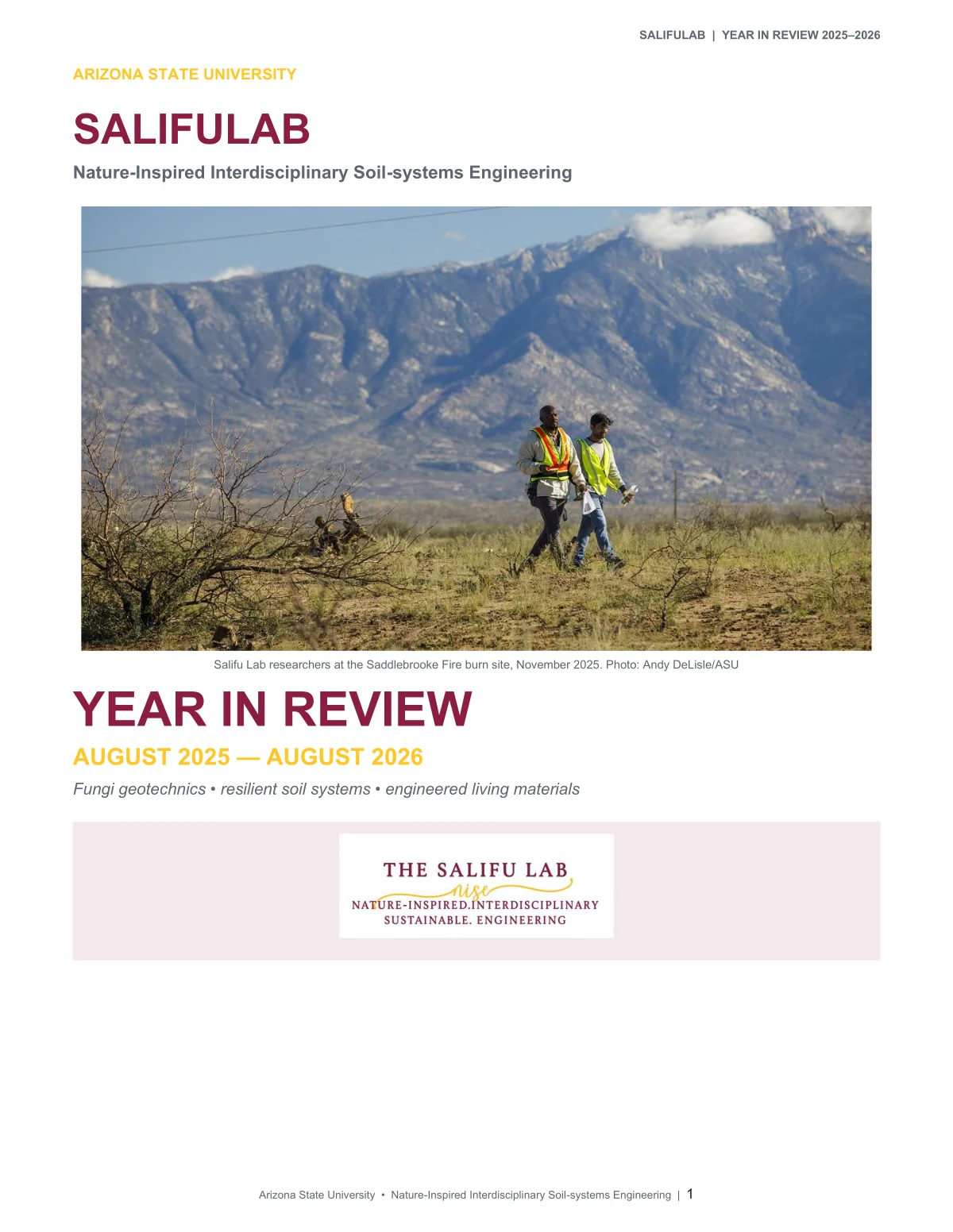
SALIFULAB | YEAR IN REVIEW 2025–2026 Arizona State University • Nature-Inspired Interdisciplinary Soil-systems Engineering | 1 ARIZONA STATE UNIVERSITY SALIFULAB Nature-Inspired Interdisciplinary Soil-systems Engineering Salifu Lab researchers at the Saddlebrooke Fire burn site, November 2025. Photo: Andy DeLisle/ASU YEAR IN REVIEW AUGUST 2025 — AUGUST 2026 Fungi geotechnics • resilient soil systems • engineered living materials
SALIFULAB | YEAR IN REVIEW 2025–2026 Arizona State University • Nature-Inspired Interdisciplinary Soil-systems Engineering | 2 FIRST EDITION Inside this review A public-facing record of research, people, teaching and impact across the academic year. 04 The year at a glance 06 Research in focus 11 People and student success 15 Publications and professional leadership 18 Media, outreach and global engagement 20 2024–2025 retrospective 21 Next year and release checklist REPORTING CONVENTION The principal reporting window is August 2025 through August 2026. Calendar-year records are included only when they fall within, or materially explain, that window. A short retrospective captures August 2024 through August 2025. EDITORIAL NOTE This inaugural review is intentionally selective. It highlights work that best represents the lab’s trajectory and the contributions of students and collaborators. It is not a replacement for the full curriculum vitae or an exhaustive proposal ledger. Funding status and publication status are reported as of August 8, 2026 unless otherwise noted.
SALIFULAB | YEAR IN REVIEW 2025–2026 Arizona State University • Nature-Inspired Interdisciplinary Soil-systems Engineering | 3 FROM THE DIRECTOR Engineering soils as living, adaptive systems The 2025–2026 academic year marked a shift from establishing the Salifu Lab to demonstrating what its research identity can contribute: fungi-based approaches for post-fire soil recovery, engineered living materials for geotechnical applications, coupled soil-system science, and field-oriented biogeotechnologies for dust and mine-waste challenges. Our progress was carried by students. Undergraduate researchers worked alongside graduate/doctoral researchers in the laboratory and at Arizona burn sites. Their work generated journal articles, conference papers, awards and public engagement. Visiting researchers extended the lab’s international reach, while new doctoral and master’s projects broadened our work into mycochar, fungi–metal-organic framework composites and critical-mineral recovery. This first annual review records that work and sets a baseline for future years. It also reflects our central commitment: to understand soil as a coupled bio-geo-hydro-thermo-chemo- mechanical system and to translate that understanding into reliable, low-carbon technologies for infrastructure and environmental resilience. Emmanuel Salifu, PhD Assistant Professor and Principal Investigator LAB MISSION Integrate geotechnical, agricultural, biological and environmental engineering with biotechnology to uncover system-level processes in soils and develop bio-mediated and bio-inspired technologies for resilient infrastructure and landscapes.
SALIFULAB | YEAR IN REVIEW 2025–2026 Arizona State University • Nature-Inspired Interdisciplinary Soil-systems Engineering | 4 2025–2026 The year at a glance 5 JOURNAL ARTICLES PUBLISHED OR IN PRESS 1 BOOK CHAPTER 3 DOCTORAL RESEARCHERS ACTIVE BY AUG. 2026 2 GRADUATE COURSES TAUGHT 4.91/5 CEE 598 EVALUATION 5.00/5 CEE 557 EVALUATION $809K NEW DOD ESTCP COLLABORATIVE AWARD 5 MAJOR PUBLIC MEDIA FEATURES Research output Five journal articles published or in press during the reporting period, including work on wildfire-impacted soils, fungal growth assessment with large language models, mycelium- based leather-like materials, coupled thermo-hydraulic soil behavior and field-scale mine-waste stabilization. Team development Abidemi Ajayi joined as a doctoral researcher; Lillian Moffatt began MS work; Jamie Magezi and Maxwell Zhao expanded undergraduate research; Manoj Kumar joined through Monash University’s Global Mobility Program. Ryan Cotter Willis joins August 2026 as doctoral researcher Public engagement The lab’s post-fire fungi research was featured by ASU News, AZFamily TV, KJZZ Radio and other media outlets. Dr. Salifu also contributed expert commentary on Arizona soil, erosion and geohazard issues. Translation A new DoD ESTCP project began on integrating enzyme- induced carbonate precipitation with engineered biocrust restoration for erosion-prone arid lands.
SALIFULAB | YEAR IN REVIEW 2025–2026 Arizona State University • Nature-Inspired Interdisciplinary Soil-systems Engineering | 5 RESEARCH PORTFOLIO One soil-systems vision, four connected fronts 01 FUNGI GEOTECHNICS Engineer fungal growth and fungal–soil interactions to alter erosion resistance, hydraulics, strength, thermal response and recovery after disturbance. 02 ADAPTIVE COUPLED SOIL SYSTEMS Study thermo-hydro-bio-chemo-mechanical responses under environmental loading, with sensing, modeling and AI-supported interpretation. 03 ENGINEERED LIVING MATERIALS Develop mycelium-based biogeotextiles, leather-like materials, fungi–MOF composites, mycochar sorbents and related functional materials. 04 FIELD TRANSLATION Advance enzyme-induced carbonate precipitation, engineered biocrust restoration, dust suppression, mine-waste stabilization and post-fire recovery at realistic scales. Salifu Lab research group, 2025. Photo: ASU/Salifu Lab website
SALIFULAB | YEAR IN REVIEW 2025–2026 Arizona State University • Nature-Inspired Interdisciplinary Soil-systems Engineering | 6 RESEARCH IN FOCUS Fighting fire damage with fungus From controlled growth studies to field-informed post-fire soil recovery. Adesola Adegoke and visiting researcher Manoj Kumar at the Saddlebrooke Fire burn site, November 2025. Photo: Andy DeLisle/ASU Following the March 2025 Saddlebrooke Fire, Salifu Lab researchers visited the burn scar in November 2025 to observe erosion, document soil recovery and collect field samples. The work connects fundamental studies of fungal growth in soil with a practical question: can engineered mycelium rapidly bind vulnerable particles, reduce erosion and support recovery before vegetation returns? PUBLISHED EVIDENCE A 2025 Biogeotechnics article led by undergraduate Henry Nakaana reported substantial erosion- resistance gains in wildfire-impacted soil treated through engineered fungal-mycelium growth under the study conditions. PUBLIC SIGNIFICANCE Arizona Department of Forestry and Fire Management advisor Russell Benford described the work as having potential for immediate and significant impact on post-fire risk mitigation. The research was featured by ASU News in May 2026 and AZFamily in June 2026.
SALIFULAB | YEAR IN REVIEW 2025–2026 Arizona State University • Nature-Inspired Interdisciplinary Soil-systems Engineering | 7 FIELD-TO-LAB PATHWAY Post-fire soil as a coupled recovery system Field observation Burn scars lose vegetation cover and soil structure. Rain and wind mobilize soil, deepen gullies and increase risks to landscapes, infrastructure and downstream communities. Field observations help define realistic materials, stresses and treatment constraints. Engineered response The lab grows filamentous fungal networks through affected soil. Hyphae physically entangle particles while fungal products contribute aggregation. The goal is a treatment that can be applied quickly and then coexist with ecological recovery. Conventional erosion-control barriers illustrate the need for scalable, lower-maintenance post-fire options. Photo: Andy DeLisle/ASU Research direction in the coming year • Quantify erosion thresholds and durability under rainfall and wind loading. • Evaluate treatment performance across soil textures, burn severity and environmental conditions. • Link hydraulic and mechanical change to fungal biomass, network architecture and soil recovery indicators. • Develop practical delivery pathways for surface biocovers and field deployment.
SALIFULAB | YEAR IN REVIEW 2025–2026 Arizona State University • Nature-Inspired Interdisciplinary Soil-systems Engineering | 8 FUNDAMENTAL SCIENCE Coupled thermo-hydraulic behavior in fungal-treated soil NEW 2026 PUBLICATION Anna D. Kwablah, Emmanuel Salifu and Aritra Banerjee reported fungal-network effects on coupled thermo-hydraulic soil behavior under controlled surface heating in Geosciences. The study advances a central Salifu Lab idea: fungal growth should not be treated as a single additive or isolated reinforcement. It changes pore structure, wetting behavior, water transport and thermal response together. Understanding those couplings is essential before living soil technologies can be designed for wildfire recovery, arid infrastructure or extreme-temperature conditions. What is measured Temperature evolution, moisture redistribution, hydraulic response, fungal growth state and material condition under controlled boundary conditions. Why it matters Performance in the field depends on interacting environmental drivers. A coupled framework provides the basis for predictive design, sensing and adaptive management. AI-supported interpretation The lab also published a cross-disciplinary evaluation of large language models and human expertise for fungal-mycelium growth assessment in biogeotechnics. The work provides an evidence base for responsible AI-supported image interpretation while retaining expert judgment and experimental validation.
SALIFULAB | YEAR IN REVIEW 2025–2026 Arizona State University • Nature-Inspired Interdisciplinary Soil-systems Engineering | 9 ENGINEERED MATERIALS From fungal networks to functional biohybrids Mycelium-based biogeomaterials A 2026 Biogeotechnics article led by Adesola Adegoke characterized mycelium-based leather-like materials for sustainable geotechnical applications. The broader program includes biogeotextiles for erosion control, separation and filtration. Fungi–MOF composites Taylor Fisher and Anna Liddle and collaborators/ contributors including Lillian Moffatt, developed fungal-mycelium–metal- organic-framework biohybrids for nutrient-controlled release and soil remediation; a manuscript is under revision in JECE since July 2026. Mycochar sorbents Doctoral researcher Abidemi Ajayi began work on mycochar- based sorbents for metal recovery, connecting fungal processing, waste-derived carbon and environmental remediation. MycoMed exploration Undergraduate Maxwell Zhao explored mycelium-derived scaffolds at the intersection of biological materials and biomedical engineering. This is an exploratory project rather than a core geotechnical claim. DESIGN PRINCIPLE The lab’s materials work follows a common logic: grow structure biologically, control function through processing or hybridization, then test performance against a specific engineering requirement.
SALIFULAB | YEAR IN REVIEW 2025–2026 Arizona State University • Nature-Inspired Interdisciplinary Soil-systems Engineering | 10 FIELD TRANSLATION Dust, mine waste and erosion-prone arid lands FUNDED PROJECT, 2025–2028 DoD ESTCP awarded $809,356 for “Synergistic Integration of Enzyme-Induced Calcium Carbonate Precipitation and Engineered Biocrust Restoration for Stabilizing Erosion-Prone Arid Lands.” Emmanuel Salifu serves as co-PI with Edward Kavazanjian (PI), Nariman Mahabadi and Ferran Garcia-Pichel other Co-PIs. This work builds on the team’s earlier acre-scale dust-suppression research in fallow agricultural soils and seeks compatibility between a rapid mineral-cementation treatment and longer-term engineered biocrust restoration. Mine-waste stabilization A field deployment study of enzyme-induced carbonate precipitation for mine-waste stabilization was accepted in Biogeotechnics. Related ASU collaborations examine stabilization, contaminant reduction and critical-mineral recovery. Acre-scale dust work The 2022–2025 ABOR/TRIF project evaluated bio-mediated and bio-inspired treatments for fugitive dust suppression and soil fertility in fallow fields; a 2026 technical report consolidated field findings. Proposal and concept development The lab also developed proposals and collaborative concepts in wildfire resilience, food production, autonomous experimentation and space-resource systems. These activities are reported as portfolio development, not as research awards; and proposal- specific budgets and pending/unsuccessful outcomes remain in internal records.
SALIFULAB | YEAR IN REVIEW 2025–2026 Arizona State University • Nature-Inspired Interdisciplinary Soil-systems Engineering | 11 PEOPLE A growing interdisciplinary research group 2025 group portrait. Left to right: Habeeb, Henry, Emmanuel, Anna Liddle, Anna Kwablah, Abidemi, Lune, Jamie and Maxwell. Photo: ASU/Salifu Lab website 3 DOCTORAL RESEARCHERS ACTIVE BY AUG. 2026 2 MS RESEARCHERS/ADVISING ROLES 6+ ACTIVE UNDERGRADUATE PROJECTS 2 INTERNATIONAL VISITORS/FELLOWS New and continuing graduate researchers Adesola Adegoke: mycelium-based biogeomaterials. Anna Anna Kwablah: adaptable coupled THBCM soil systems. Abidemi Ajayi: mycochar sorbents for metal recovery. Lillian Moffatt: fungi–MOF materials. Visiting researchers Manoj Kumar, Monash University Malaysia, joined from October 2025 to January 2026 through the PhD Global Mobility Program. Precious Chisala, Copperbelt University, joined in spring 2026 through the SLB Faculty for the Future program.
SALIFULAB | YEAR IN REVIEW 2025–2026 Arizona State University • Nature-Inspired Interdisciplinary Soil-systems Engineering | 12 STUDENT & TRAINEE PROFILES Graduate researchers A consistent annual record of each researcher’s role, work and progression. Replace each gray tile with an approved portrait. ADD PHOTO Adesola Habeeb Adegoke PHD RESEARCHER Mycelium-based biogeomaterials. Published studies on sustainable mycelium materials and AI-assisted fungal-growth assessment; earned ASCE and Digital Green Talent recognition. Passed his PhD prospectus on August 26, 2026; remaining milestones are dissertation completion and final defense. ADD PHOTO Anna Dornukie Kwablah PHD RESEARCHER Adaptable coupled THBCM soil systems. Published 2026 work on fungal-network effects on coupled thermo-hydraulic soil behavior; second-place poster, Geo-Arizona 2025. ADD PHOTO Abidemi Ajayi PHD RESEARCHER Joined in fall 2025. Developing mycochar sorbents for metal recovery at the intersection of fungal processing, waste- derived carbon and environmental remediation. ADD PHOTO Ryan Cotter Willis INCOMING PHD RESEARCHER Transitioning from earlier undergraduate/REU work on heavy-metal mycoremediation to doctoral research on the ESTCP project & mycelium for mine- waste remediation, starting fall 2026. ADD PHOTO Lillian Moffatt MS RESEARCHER • CO-ADVISED Interested in fungal-mycelium–MOF biohybrid composites for nutrient- controlled release and soil remediation. ADD PHOTO Ahmad Hayat MS APPLIED PROJECT • GRADUATED MAY 2026 Completed the MS applied-project advising pathway during the reporting year. .
SALIFULAB | YEAR IN REVIEW 2025–2026 Arizona State University • Nature-Inspired Interdisciplinary Soil-systems Engineering | 13 STUDENT & TRAINEE PROFILES Undergraduate research Students contributed as authors, field researchers, laboratory investigators and emerging independent scholars. ADD PHOTO Henry Nakaana FURI SCHOLAR Led the published study on fungal treatment of wildfire-impacted soils; participated in Saddlebrooke Fire fieldwork and received a 2025 Society of Fire Protection Engineers student research award. ADD PHOTO Lune Martin BARRETT HONORS COLLEGE • FURI SCHOLAR Co-authored an ASABE paper on nutrient dynamics in fire-affected soils and contributed to field sampling, biodegradation research and public-facing wildfire coverage. ADD PHOTO Anna Liddle UNDERGRADUATE RESEARCHER Contributed to fungi–metal-organic- framework composites for nutrient- controlled release and soil remediation and to the manuscript prepared for JECE. ADD PHOTO Jamie Magezi FURI SCHOLAR Studies fungal modification of sulfate- affected soils, with an interest in translating biogeotechnical findings to infrastructure challenges in Uganda. ADD PHOTO Maxwell Zhao UNDERGRADUATE RESEARCHER Explored mycelium-derived scaffolds for wound healing through the exploratory MycoMed project at the interface of biological materials and engineering. ADD PHOTO Lohgaganeshaa Saravanan UNDERGRADUATE RESEARCHER Interested in mycelium growth and crust formation in lunar-regolith analog as an early-stage FURI concept connecting living materials and off-Earth soils.
SALIFULAB | YEAR IN REVIEW 2025–2026 Arizona State University • Nature-Inspired Interdisciplinary Soil-systems Engineering | 14 SCHOLARLY OUTPUT Selected publications during the reporting year PUBLICATION Scott et al. Compatibility of EICP and engineered biocrust restoration. Ecological Engineering 232, 108104. Aryal et al. Mine Waste Stabilization via EICP: Field Deployment Study. Biogeotechnics, accepted/in press. Kwablah, Salifu & Banerjee. Fungal Network Effects on Coupled Thermo-Hydraulic Behavior of Soil. Geosciences 16(6), 210. Adegoke et al. Comparing Large Language Models and Human Expertise for Fungal Mycelium Growth Assessment. JRMGE. Adegoke et al. Mycelium-Based Leather-Like Materials for Sustainable Geotechnical Applications. Biogeotechnics 100234. Nakaana, Adegoke & Salifu. Engineered Fungi-Mycelium Growth for Recovery and Erosion Resistance of Wildfire-Impacted Soils. Biogeotechnics 100224. Salifu et al. Influence of Environmental Conditions on Pleurotus ostreatus Growth in Sand. Biogeotechnics 100137. Cristelo, Salifu & Banerjee. Bio- and waste-based solutions as the next generation of soil stabilisation techniques. CRC Press book chapter.
SALIFULAB | YEAR IN REVIEW 2025–2026 Arizona State University • Nature-Inspired Interdisciplinary Soil-systems Engineering | 15 PROFESSIONAL LEADERSHIP Conferences, editorial service and disciplinary community Editorial and review service Editorial board member, Scientific Reports and PLOS ONE (from 2025). Theme Editor for the ICBBG 2025 Fungi in Geotechnics collection. Reviewer for journals, conferences, USDOT and other technical bodies. Conference leadership Committee member for ICBBG 2025; co-chair of the Fungi in Geotechnics symposium; co-organizer of the Exploring Biogeotechnics workshop at Durham; advisory committee member for the 2026 sustainability and geotechnics conference in Lisbon. PROFESSIONAL COMMITTEES Chair, ASABE NRES-223 Technical Subcommittee on Erosion Control, 2025. Corresponding member, ISSMGE TC-223 on Biogeotechnical Engineering, 2026. Selected 2025 conference contributions • ICBBG 2025 papers on desiccation cracking, post-fire soils, EICP dust mitigation and fungi–biopolymer soil systems. • EUNSAT+BGE 2025 papers on hydromechanical response and fungal/biopolymer modification of sandy soil. • ASABE AIM 2025 paper on nutrient dynamics and retention in fire-affected soils treated with engineered fungal mycelia.
SALIFULAB | YEAR IN REVIEW 2025–2026 Arizona State University • Nature-Inspired Interdisciplinary Soil-systems Engineering | 16 TEACHING Research-informed courses with strong student response 4.91/5 CEE 598 BIOGEOTECHNICAL ENGINEERING 5.00/5 CEE 557 GEOENVIRONMENTAL ENGINEERING 15 STUDENTS ACROSS THE TWO GRADUATE OFFERINGS 6 HANDS-ON LAB MODULES IN CEE 598 CEE 598: Biogeotechnical Engineering Taught in fall 2025 with nine students, the course connects soil mechanics, environmental biotechnology and bio-mediated design through lectures, literature, laboratory work and modeling. Topics include fungi, enzymes, biomineralization, biopolymers and plant–soil systems. The recorded evaluation was 4.91/5. CEE 557/598: Geoenvironmental Engineering Taught in spring 2026 with six students and a 5.00/5 evaluation. The course addresses contaminant transport, waste containment, remediation and the geotechnical–environmental decisions that shape sustainable infrastructure. FACULTY DEVELOPMENT Dr. Salifu participated in the ASCE Excellence in Civil Engineering Education workshop and the USUCGER geotechnical faculty workshop in 2025, and a civil underground “Teach the Professor” program in 2026. Fall 2026 note CEE/CNE 351 Geotechnical Engineering begins at the close of this report’s window with more than 100 students. It will be reported fully in the 2026–2027 edition.
SALIFULAB | YEAR IN REVIEW 2025–2026 Arizona State University • Nature-Inspired Interdisciplinary Soil-systems Engineering | 17 PUBLIC ENGAGEMENT Research made visible beyond the laboratory The Saddlebrooke Fire field visit became the visual anchor for a major ASU News feature. Photo: Andy DeLisle/ASU ASU NEWS • MAY 14, 2026 “Fighting fire damage with fungus” profiled the lab’s post-fire work and featured Adesola Adegoke, Manoj Kumar, Henry Nakaana and Lune Martin alongside collaborators and Arizona land-management perspectives. AZFAMILY • JUNE 23, 2026 A television and web story showed laboratory samples and explained how fungal mycelium may bind burned soil, limit erosion and contribute to future post-fire treatment strategies. Expert commentary Dr. Salifu also contributed media commentary on Arizona soil instability, erosion, rockfall, flash flooding and environmental stressors. These appearances support the lab’s broader goal of making geotechnical and soil-systems science useful to the public.
SALIFULAB | YEAR IN REVIEW 2025–2026 Arizona State University • Nature-Inspired Interdisciplinary Soil-systems Engineering | 18 GLOBAL ENGAGEMENT A research network spanning disciplines and regions Durham University, United Kingdom Visiting researcher appointment in June 2025 and co- organization of the Exploring Biogeotechnics workshop. Continuing collaborations examine fungal–biopolymer systems, erosion and slope processes. Monash University Malaysia Manoj Kumar joined Salifu Lab from October 2025 to January 2026 through the PhD Global Mobility Program, contributing to wildfire-related field and laboratory work. Canada and South Africa Collaborations include fungal-induced carbonate precipitation, waste-derived materials and graduate research networks extending through UBC and South African partners. Arizona and U.S. partners Work connects ASU units with the Department of Defense, Arizona agencies, field managers, professional societies and university collaborators in biogeotechnics, wildfire and mine- waste research. LEADERSHIP TRAJECTORY The lab is building a distinctive international profile around fungi geotechnics and coupled adaptive soil-systems science, while strengthening Arizona-facing work on wildfire, dust, arid lands and infrastructure resilience.
SALIFULAB | YEAR IN REVIEW 2025–2026 Arizona State University • Nature-Inspired Interdisciplinary Soil-systems Engineering | 19 RESEARCH SUPPORT Funded work and proposal development $1.89M ACTIVE/PAST AWARDS $421K SALIFU RECOGNITION SHARE $809K NEW DOD ESTCP COLLABORATIVE AWARD 4 PROPOSAL THEME AREAS ADVANCED INTERPRETATION Award figures are not annual expenditures. They combine projects spanning multiple years. Pending and unsuccessful submissions are intentionally excluded from the public headline metrics. A deliberate portfolio Proposal activity extended the lab’s foundational work into wildfire resilience, coupled soil systems, autonomous experimentation, fungi–biochar soil amendments, food production and off-Earth resource concepts. The public record emphasizes the scientific directions and partnerships developed; the complete submission and outcome ledger is retained for internal planning and institutional review. PUBLIC REPORTING CONVENTION Only executed awards are described as funding. Pending proposals are identified only when public disclosure is useful and permitted; unsuccessful submissions are treated as part of iterative program development rather than displayed as a dollar-value performance metric.
SALIFULAB | YEAR IN REVIEW 2025–2026 Arizona State University • Nature-Inspired Interdisciplinary Soil-systems Engineering | 20 PREVIOUS YEAR August 2024 — August 2025 retrospective The year that established the platform for 2025–2026 growth. RESEARCH FOUNDATION Published foundational work on fungal growth in sand, abiotic crust formation for dust suppression and composite biomediated engineering approaches; advanced post-fire and biogeotextile research toward publication. STUDENT MOMENTUM Anna Kwablah joined the doctoral program; Adesola Adegoke and Taylor Tuckett earned poster, scholarship and pitch recognition; Henry Nakaana continued FURI-supported post-fire research; two MS students completed degrees by May 2025. PROFESSIONAL VISIBILITY Delivered an invited NJIT seminar on fungi geotechnics, co-organized the Durham workshop, served on ICBBG 2025 committees and co-chaired the Fungi in Geotechnics symposium. FIELD AND TRANSLATIONAL WORK Continued acre-scale EICP and dust-suppression work as co-investigator under the ABOR-TRIF funds, and advanced field-oriented mine-waste stabilization and erosion-control studies as co-PI under the ADEQ funded project. TEACHING AND LAB BUILDING Built on the first offering of CEE 351 and continued development of a research-connected biogeotechnical engineering curriculum and laboratory infrastructure.
SALIFULAB | YEAR IN REVIEW 2025–2026 Arizona State University • Nature-Inspired Interdisciplinary Soil-systems Engineering | 21 LOOKING AHEAD From proof of concept to validated, adaptive soil systems 2026–2027 priorities Field validation of post-fire fungal treatments; mechanistic and durability studies for living soil systems; integrated EICP– biocrust work; new biomaterials and remediation pathways; stronger sensing, modeling and AI-supported experimentation. Ongoing reporting practice Maintain routine updates on lab website (once internal maintenance is completed), and public facing engagements on LinkedIn and professional platforms. Complete before public release • Replace every gray student-photo tile with an approved portrait and add any missing current role or milestone. • Confirm the final reporting cutoff date and all publication statuses/DOIs. • Confirm the exact title of Henry Nakaana’s SFPE award. • Add any omitted 2025–2026 student awards, graduations, invited talks, service or media appearances. • Replace or supplement website photographs with original high-resolution files where available. • Confirm photo reuse permissions and retain photographer credits. • Run a final name, title, affiliation and accessibility review. labs.engineering.asu.edu/salifulab Emmanuel Salifu, PhD | Arizona State University ASU News feature • Salifu Lab website