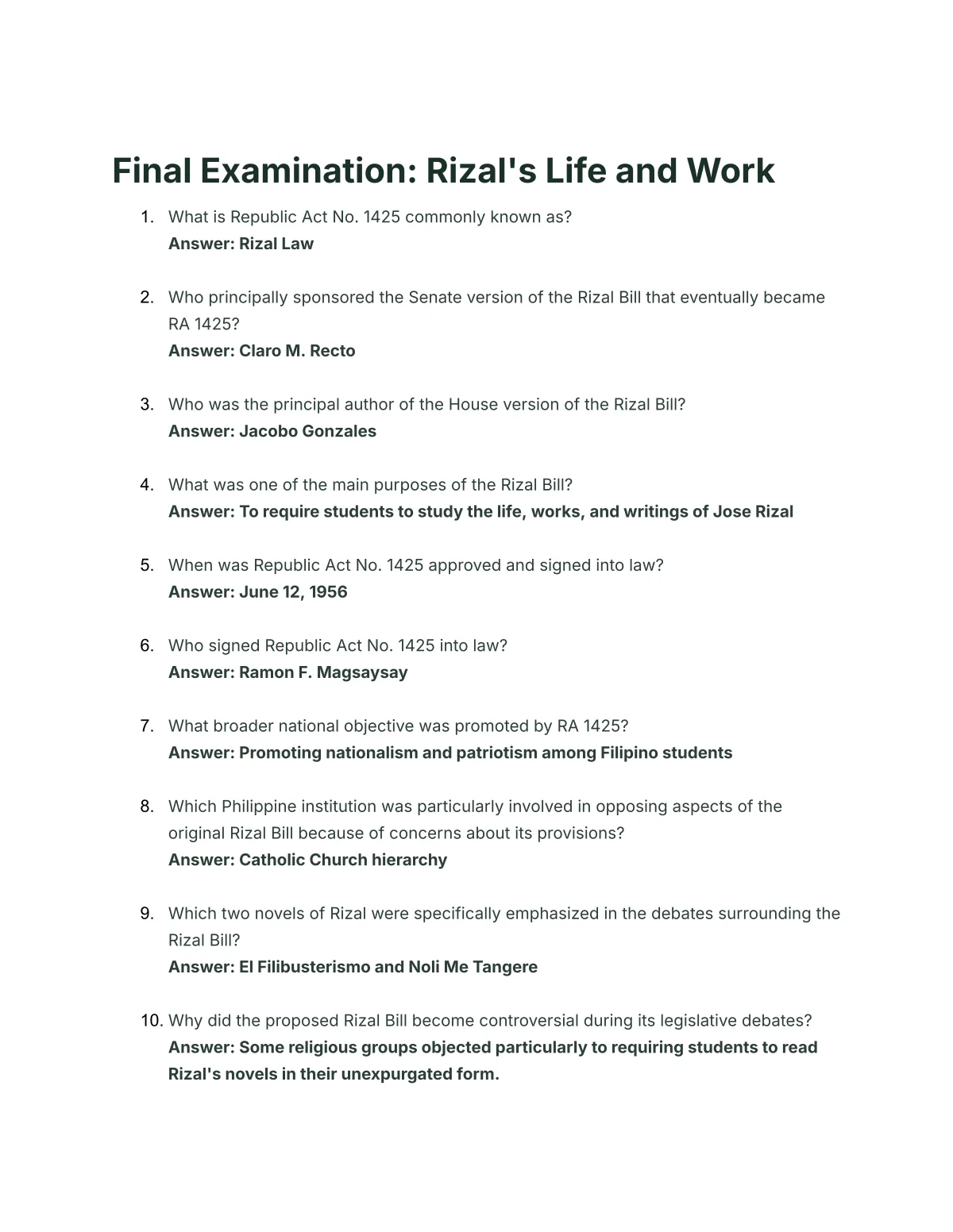
This document is a final examination answer key for a course on José Rizal's life and work. It is intended for instructors or students reviewing the material. The first section covers the Rizal Law (Republic Act No. 1425), including its sponsors, purpose, and the controversy surrounding it. The next section addresses Rizal's early life, family, education at Ateneo Municipal and University of…
This document is a final examination answer key for a course on José Rizal's life and work. It is intended for instructors or students reviewing the material covered in the course.
The first section covers the Rizal Law (Republic Act No. 1425), including its sponsors Claro M. Recto and Jacobo Gonzales, its purpose to require study of Rizal's life and works, and the controversy involving the Catholic Church hierarchy over reading Rizal's novels in unexpurgated form.
The next section addresses Rizal's early life, including his birth on June 19, 1861, his full name, his mother Teodora Alonso's influence, his education at the School of Justiniano Aquino Cruz in Biñan and at Ateneo Municipal de Manila, and his shift to medicine at University of Santo Tomas to treat his mother's eyesight.
The document then covers Rizal's European travels, his studies in ophthalmology in Berlin, his meeting with Ferdinand Blumentritt, and his support for the Propaganda Movement. It also details the publication of Noli Me Tangere in Berlin in 1887 with financial help from Maximo Viola, and the publication of El Filibusterismo in 1891 with help from Valentin Ventura.
The final sections cover Rizal's exile in Dapitan from July 17, 1892, where he established a water system and improved community facilities, his arrest while traveling to Cuba, and his execution on December 30, 1896.