View 66Zn FUSEV flipbook.
Probing the Interplay Between Superdeformation and Triaxiality in 66Zn AGATA + EUCLIDES + NEDA G. Benzoni1, P. E. Garrett2, A. Goasduff3, B. Greaves3, K. Hady´nska-Kl¸ek4, T. La Marca5,6, N. Marchini6, A. Nannini6, M. Polettini7, M. Rocchini6, F. Simioni8,9, C. E. Svensson2, K. Wrzosek-Lipska4, M. Zieli`nska10 1 INFN Milano, Italy. 2 University of Guelph, Canada. 3 INFN Laboratori Nazionali di Legnaro, Italy. 4 HIL, University of Warsaw, Poland. 5 Universit`a di Firenze, Italy. 6 INFN Firenze, Italy. 7 GSI, Germany. 8 Universit`a di Padova, Italy. 9 INFN Padova, Italy. 10 IRFU, CEA, Universit´e Paris-Saclay, France. Abstract We propose to characterize the superdeformed (SD) band recently identified in the stable, N ≈ Z nucleus 66Zn, populated via the 40Ca(30Si, 4p)66Zn fusion-evaporation reaction at 135 MeV. The AGATA tracking array, coupled to the EUCLIDES charged-particle detector and the NEDA neutron detector, will provide the channel selectivity needed to (i) search for the weak, high-energy E2 transitions linking the SD band to the normal-deformed yrast line, fixing for the first time its spin, parity, and excitation energy, and (ii) measure the lifetimes of the in-band states through the Doppler-Shift-Attenuation Method, mapping the transitional quadrupole moment Qt as a function of spin to test the suggested triaxial character of the band. I. SCIENTIFIC MOTIVATION The collective properties of nuclei near the Z = 28 shell closure are currently the focus of in- tensive nuclear structure investigations. Shape coexistence and triaxial deformation at low spin have been identified in Ni, Zn, and Ge isotopes (see, e.g., Refs. [1–5]), while superdeformation manifests at higher spin (see, e.g., Refs. [6–8]). The stability of highly collective states at high spin (β2 ≈ 0.4–0.5) in nuclei nearby Z = 28 originates from the occupation of the intruder 1g9/2 orbitals by both protons and neutrons, which drives the nucleus from its collective but weakly-deformed ground-state configuration, toward a strongly elongated minimum [9]. Experi- mentally, the region was probed starting with the discovery of an unlinked superdeformed (SD) band in 62Zn [17], and firmly established two years later with the identification of the doubly magic SD band in the N = Z nucleus 60Zn [7]. In 60Zn, several high-energy, non-statistical stretched-E2 transitions (ranging from 3.1 to 5.8 MeV, with B(E2) values up to 0.8 W.u.) were observed to directly link the SD states to the normal-deformed (ND) yrast line, providing the first unambiguous spin, parity, and excitation-energy determination for an SD band in this mass region and demonstrating that its decay-out proceeds through pairing-induced mixing with the underlying ND configurations at low spin [7]. Theoretical projected-shell-model calculations, however, predicted that this clean decay-out pattern would not generalize to every isotope of the chain: depending on the systematics of shell filling along the even-even Zn isotopes, the observation of a regular, well-linked SD sequence was expected to become increasingly unlikely for nuclei further from 60Zn [11]. However, the same calculations predicts a SD band in 66Zn, stabilized because of the shift in neutron Fermi level. On the contrary, calculations performed within the deformed Relativistic Mean-Field (RMF) theory predict difficult for 66Zn to stabilize SD states with the equilibrium between the rotational energy and the pairing interaction [12]. A rotational cascade of stretched E2 transitions compatible with a superdeformed configura- tion was recently observed in 66Zn using the 26Mg(48Ca, α4nγ)66Zn reaction at 275, 290, 320 MeV with Gammasphere and the Fragment Mass Analyzer (FMA) [13]. While this measurement con- firmed the existence of the band up to high spin, the authors didn’t manage to identify discrete 1
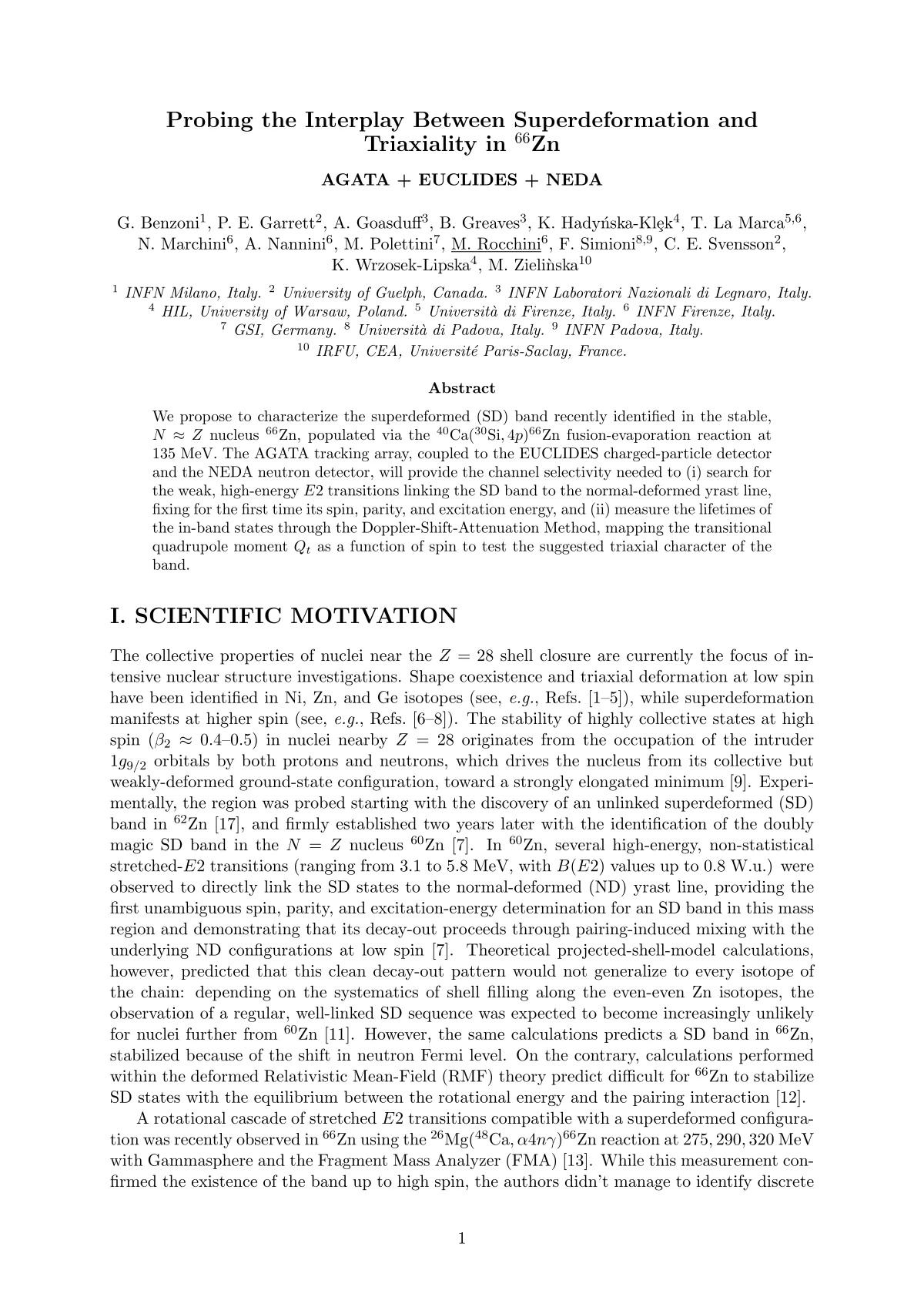
0 10 20 30 40 50 60 γ β 0 0.2 0.4 0.6 0.8 0 0.2 0.4 0.6 0.8 0 10 20 30 40 50 60 γ β 0 0.2 0.4 0.6 0.8 0 0.2 0.4 0.6 0.8 0 10 20 30 40 50 60 γ β 0 0.2 0.4 0.6 0.8 0 0.2 0.4 0.6 0.8 0 10 20 30 40 50 60 γ β 0 0.2 0.4 0.6 0.8 0 0.2 0.4 0.6 0.8 0 10 20 30 40 50 60 γ β 0 0.2 0.4 0.6 0.8 0 0.2 0.4 0.6 0.8 0 10 20 30 40 50 60 γ β 0 0.2 0.4 0.6 0.8 0 0.2 0.4 0.6 0.8 0 10 20 30 40 50 60 γ β 0 0.2 0.4 0.6 0.8 0 0.2 0.4 0.6 0.8 0 10 20 30 40 50 60 γ β 0 0.2 0.4 0.6 0.8 0 0.2 0.4 0.6 0.8 0 10 20 30 40 50 60 γ β 0 0.2 0.4 0.6 0.8 0 0.2 0.4 0.6 0.8 0 10 20 30 40 50 60 γ β 0 0.2 0.4 0.6 0.8 0 0.2 0.4 0.6 0.8 0 10 20 30 40 50 60 γ β 0 0.2 0.4 0.6 0.80 0.2 0.4 0.6 0.8 0 10 20 30 40 50 60 γ β 0 0.2 0.4 0.6 0.8 0 0.2 0.4 0.6 0.8 0 10 20 30 40 50 60 γ β 0 0.2 0.4 0.6 0.8 0 0.2 0.4 0.6 0.8 0 10 20 30 40 50 60 γ β 0 0.2 0.4 0.6 0.8 0 0.2 0.4 0.6 0.8 0 10 20 30 40 50 60 γ β 0 0.2 0.4 0.6 0.8 0 0.2 0.4 0.6 0.8 0 10 20 30 40 50 60 γ β 0 0.2 0.4 0.6 0.8 0 0.2 0.4 0.6 0.8 0 10 20 30 40 50 60 γ β 0 0.2 0.4 0.6 0.8 0 0.2 0.4 0.6 0.8 0 10 20 30 40 50 60 γ β 0 0.2 0.4 0.6 0.8 0 0.2 0.4 0.6 0.8 0 10 20 30 40 50 60 γ β 0 0.2 0.4 0.6 0.8 0 0.2 0.4 0.6 0.8 0 10 20 30 40 50 60 γ β 0 0.2 0.4 0.6 0.8 0 0.2 0.4 0.6 0.8 𝛾 (deg) β2 𝛾 (deg) β2 𝛾 (deg) β2 𝛾 (deg) β2 𝛾 (deg) β2 𝛾 (deg) β2 𝛾 (deg) β2 𝛾 (deg) β2 𝛾 (deg) β2 𝛾 (deg) β2 𝛾 (deg) β2 𝛾 (deg) β2 𝛾 (deg) β2 𝛾 (deg) β2 𝛾 (deg) β2 𝛾 (deg) β2 𝛾 (deg) β2 𝛾 (deg) β2 𝛾 (deg) β2 𝛾 (deg) β2 0+ 1 2+ 1 4+ 1 6+ 2 8+ 2 2+ 2 3+ 1 4+ 2 5+ 1 6+ 4 0+ 2 2+ 4 4+ 4 6+ 3 8+ 4 0+ 3 2+ 3 4+ 3 6+ 1 8+ 1 Collective wave functions. Bands66Zn 0 1163 2730 4904 2173 3590 3421 4713 2181 3441 4336 5729 2989 3112 3903 4673Figure 1: Collective wave functions for selected states in 66Zn obtained within the SCCM frame- work, showing the localized, deformed 0+ 3 configuration [15]. linking transitions to the low-spin yrast states, leaving the absolute excitation energy, spin, and parity of the SD configuration undetermined [13]. An earlier, lower-statistics in-beam study of 66Zn using the 52Cr(18O, 2p2n)66Zn reaction at 72.5 MeV with the Indian National Gamma Array (INGA) did not reveal the SD band at all [14], a result perhaps due to the low angular momentum populated in the reaction (closer to the Coulomb barrier) and to the more limited efficiency and channel selectivity of the array, operated without charged-particle or neutron tagging. Beyond-mean-field calculations within the symmetry-conserving configuration-mixing (SCCM) framework, used to investigate the low-spin structure of 66Zn in Ref. [15], indicate a well-localized, strongly deformed 0+ 3 configuration, but place it at an excitation energy of only ∼ 3 MeV (see Fig. 1). Systematics disagree with such a low value: if the SD bandhead would be located at such low energy, the band would already be yrast by spin 6ℏ, in contradiction with the available experimental data. A bandhead energy of 7 − 8 MeV, placing the SD states well above the ND yrast line, would be more plausible, and would explain the difficulties in ob- serving experimentally the decay-out pattern, analogous to the situation that, prior to Ref. [7], prevented the characterization of the 60Zn band. The newly identified SD band in 66Zn [13] is discussed by the authors concerning the role of triaxiality. Low-energy Coulomb-excitation of 66Zn at LNL with GALILEO and SPIDER has already shown that the triaxial degree of freedom has a measurable impact on the electromag- netic properties of this nucleus, even among its lowest-lying 0+ and 2+ states, and that 66Zn cannot be described by simple collective models [15]. This connect to the lightest known case of triaxial superdeformation, established in 42Ca through a complete set of E2 matrix elements measured with AGATA, where state-by-state electromagnetic data revealed a highly deformed, triaxial sideband coexisting with the near-spherical ground state [16]. In a triaxial rotor, the transitional quadrupole moment Qt is expected to vary with spin, reflecting the underlying structural evolution of the band. While a conventional thin-target Doppler-broadening mea- surement averaged over the full cascade would wash out any such variation, a state-by-state lifetime determination would allow to probe triaxiality in the SD band of 66Zn. 2
Table 1 summarizes the current experimental and theoretical status of the SD and highly deformed (HD) bands in the Zn isotopes. While 60Zn represents the only case in which the band is firmly linked to the low-spin level scheme [7], the 62Zn band remains unlinked [17]. In 64Zn, a deformed band has been identified with smooth termination, discussed also in terms of triaxiality [18], while both HD and SD structures have been observed in 65Zn [19]. Furthermore, 68Zn occupies a highly prominent role as the heaviest Zn isotope in which an SD band has been experimentally confirmed [20], establishing a new island of superdeformation at high spin. In this context, 66Zn occupies a unique position, positioned between the lighter highly deformed Zn isotopes near the N = Z line (60,62Zn) and the heavier, neutron-rich superdeformed 68Zn, and with both experimental indications of triaxiality at low spin and beyond-mean-field predictions of a well-developed SD minimum [13, 15]. Table 1: SD and HD structures in the Zn isotopes. Isotope Reaction Spin range (ℏ) β2 deformation Ref. 60Zn 40Ca(24Mg,α) 10–20 ≈ 0.45 [7] 62Zn 40Ca(28Si,α2p) 16–30 ≈ 0.43 [17] 64Zn 40Ca(28Si,4p) 11–26 ≈ 0.35 [18] 65Zn 40Ca(29Si,4p) 17/2–37/2 ≈ 0.40 [19] 66Zn 40Ca(30Si,4p) ≥ 8 (expected) ≈ 0.40 (triaxial?) [13, 15] 68Zn 12C(62Ni,α2n) 15–24 ≈ 0.40 [20] II. PROPOSED EXPERIMENT The proposed measurement will provide sufficient statistics to: • Search for discrete, high-energy (3−6 MeV) linking transitions from the SD band identified in Ref. [13] to the low-spin states, fixing for the first time its absolute excitation energy, spin, and parity, following the methodology successfully applied to the doubly magic SD band in 60Zn [7]. • Determine the spins of the populated SD states through Directional Correlation of Oriented (DCO) states extracted with AGATA. • Measure the lifetimes of the in-band states using the Doppler-Shift-Attenuation Method (DSAM), mapping the transitional quadrupole moment Qt as a function of spin. • Establish whether the triaxial character already identified at low spin in 66Zn [15] persists in the SD band, in analogy with the triaxial superdeformation found in 42Ca [16]. We propose to populate 66Zn via the 40Ca(30Si, 4p)66Zn fusion-evaporation reaction at a laboratory beam energy of 135 MeV and an intensity of 5 pnA, delivered by the Tandem- ALPI accelerator complex at LNL. Two 40Ca targets will be employed: a thin 0.5 mg/cm2 self-supporting target as in Ref. [7], and one of the same thickness but with a thick 10 mg/cm2 Au backing to apply the DSAM technique by fully stopping the recoiling 66Zn nuclei. The γ rays depopulating the excited states of 66Zn will be detected by 10 triple clusters of the AGATA tracking array [22], in coincidence with the EUCLIDES 4π silicon-ball array [23] for charged-particle identification and the NEDA liquid-scintillator array [24] for neutron tagging and vetoing. At Elab = 135 MeV, the cross section calculated with the HIVAP code [25] of the 4p channel leading to 66Zn is 35 mb, while the competing 4pn (65Zn) and α2p (64Zn) channels amount to 80 mb and 115 mb, respectively. The selection of the channel of interest will be obtained using EUCLIDES and NEDA: 3
• An EUCLIDES ≥ 3p gate (efficiency ≈ 47%) will be used to search for linking-transition in the self-supporting target measurement, maximizing the available statistics while com- pletely suppressing the dominant, low proton-multiplicity α2p (64Zn) channel. • A strict EUCLIDES 4p gate (efficiency ≈ 13%) will be applied to obtain background- free spectra for the DSAM analysis with the target with backing. • A NEDA neutron veto, applied in anti-coincidence, will further suppress the 4pn (65Zn) contamination by ≈ 35%. III. RATE ESTIMATES AND BEAM TIME REQUEST Considering the 40Ca(30Si, 4p)66Zn cross section of 35 mb, the 40Ca thickness of 0.5 mg/cm2, and a beam intensity of 5 pnA, the production rate of 66Zn is ≈ 3 × 10⁷ nuclei per hour. For the DSAM measurement using the target with backing, the number of measured in-band γ-rays is calculated assuming a 0.1% population for the SD band, as typically observed in nearby nuclei, and a large branching ratio (80%) for the in-band transitions. The number of emitted in-band γ-rays is ≈ 2.4 × 10⁵ per hour. Taking into account the efficiency of the EUCLIDES 4p gate and the efficiency of AGATA for both the transition of interest and the gate, and assuming that the NEDA veto will have a negligible impact on the selection of the channel of interest, the expected rate is ≈ 210 γ-rays per hour. Dividing these statistics into the 8 angular ranges defined by AGATA results in ≈ 25 γ-rays per hour per angular range. In order to achieve at least 3000 γ-rays for each range, which is necessary to properly reconstruct the lineshape with the DSAM technique, 5 days of measurement with the backed target are required. For the thin-target measurement, the number of γ-rays decaying out of the SD band is cal- culated assuming a small branching ratio of 0.15%. Considering the efficiency of the EUCLIDES ≥ 3p gate and the efficiency of AGATA for the high-energy transition of interest, and assuming that the NEDA veto will have a negligible impact on the selection of the channel of interest, the expected rate is ≈ 10 γ-rays per hour. In order to achieve at least 1000 γ-rays for the decay-out transitions, which is necessary for their clear identification and to set a gate on them to observe the in-band transitions of the SD band, 4 days of measurement with the thin target are required. During the thin-target measurement, the target may deteriorate due to irradiation. Conse- quently, an additional shift is taken into account to allow for multiple possible target changes. To summarize, we request 10 days of beam time under the following conditions: • Beam – 30Si (Tandem only) with intensity 5 pnA and energy 135 MeV, continuous; • Target – 1) 40Ca, with thickness 0.5 mg/cm2 and a Au backing of 10 mg/cm2; 2) 40Ca, with thickness 0.5 mg/cm2, self-supporting; • Experimental setup: AGATA + EUCLIDES (≥ 3p and strict 4p gating) + NEDA (active neutron veto). As a final remark, the proposed reaction will also allow for the study of superdeformation in 64Zn via the α2p channel, selecting α and 2p in EUCLIDES, and 65Zn via 4pn channel, with the same selection that will be used in 66Zn with the additional 1n gate in NEDA. References [1] A. D. Ayangeakaa et al., Phys. Rev. Lett. 110, 102501 (2013). [2] A. D. Ayangeakaa et al., Phys. Lett. B 754, 254 (2016). 4
[3] S. Leoni et al., Phys. Rev. Lett. 118, 162502 (2017). [4] N. M˘arginean et al., Phys. Rev. Lett. 125, 102502 (2020). [5] M. Rocchini et al., Phys. Rev. Lett. 130, 122502 (2023). [6] D. Rudolph et al., Phys. Rev. Lett. 82, 3763 (1999). [7] C. E. Svensson et al., Phys. Rev. Lett. 82, 3400 (1999). [8] H. Amro et al., Phys. Lett. B 506, 39 (2001). [9] A. V. Afanasjev, I. Ragnarsson, and P. Ring, Phys. Rev. C 59, 3166 (1999). [10] C. E. Svensson et al., Phys. Rev. Lett. 79, 1233 (1997). [11] Y. Sun, J.-Y. Zhang, M. Guidry, and C.-L. Wu, Phys. Rev. Lett. 83, 686 (1999). [12] W. Z. Jiang, Z. Z. Ren, T. T. Wang, Y. L. Zhao, Z.Y. Zhu, Eur. Phys. J. A 25, 29 (2005). [13] A. D. Ayangeakaa et al., Phys. Rev. C 105, 054315 (2022). [14] S. Rai et al., Phys. Rev. C 102, 064313 (2020). [15] M. Rocchini et al., Phys. Rev. C 103, 014311 (2021). [16] K. Hady´nska-Kl¸ek et al., Phys. Rev. Lett. 117, 062501 (2016). [17] C. E. Svensson et al., Phys. Rev. Lett. 79, 1233 (1997). [18] A. Galindo-Uribarri et al., Phys. Lett. B 422, 45 (1998). [19] C.-H. Yu et al., Phys. Rev. C 62, 041301(R) (2000). [20] M. Devlin et al., Phys. Rev. Lett. 82, 5217 (1999). [21] D. Ward et al., Phys. Rev. C 63, 014301 (2001). [22] S. Akkoyun et al., Nucl. Instrum. Methods A 668, 26 (2012). [23] D. Testov et al., Eur. Phys. J. A 55, 47 (2019). [24] J. J. Valiente-Dob´on et al., Nucl. Instrum. Methods A 927, 81 (2019). [25] W. Reisdorf, Z. Phys. A - Atoms and Nuclei 300, 227 (1981). 5