View Down Memory Lane Booklet flipbook.
DOWN MEMORY LANE DOWN MEMORY LANE T.S. GOPAL
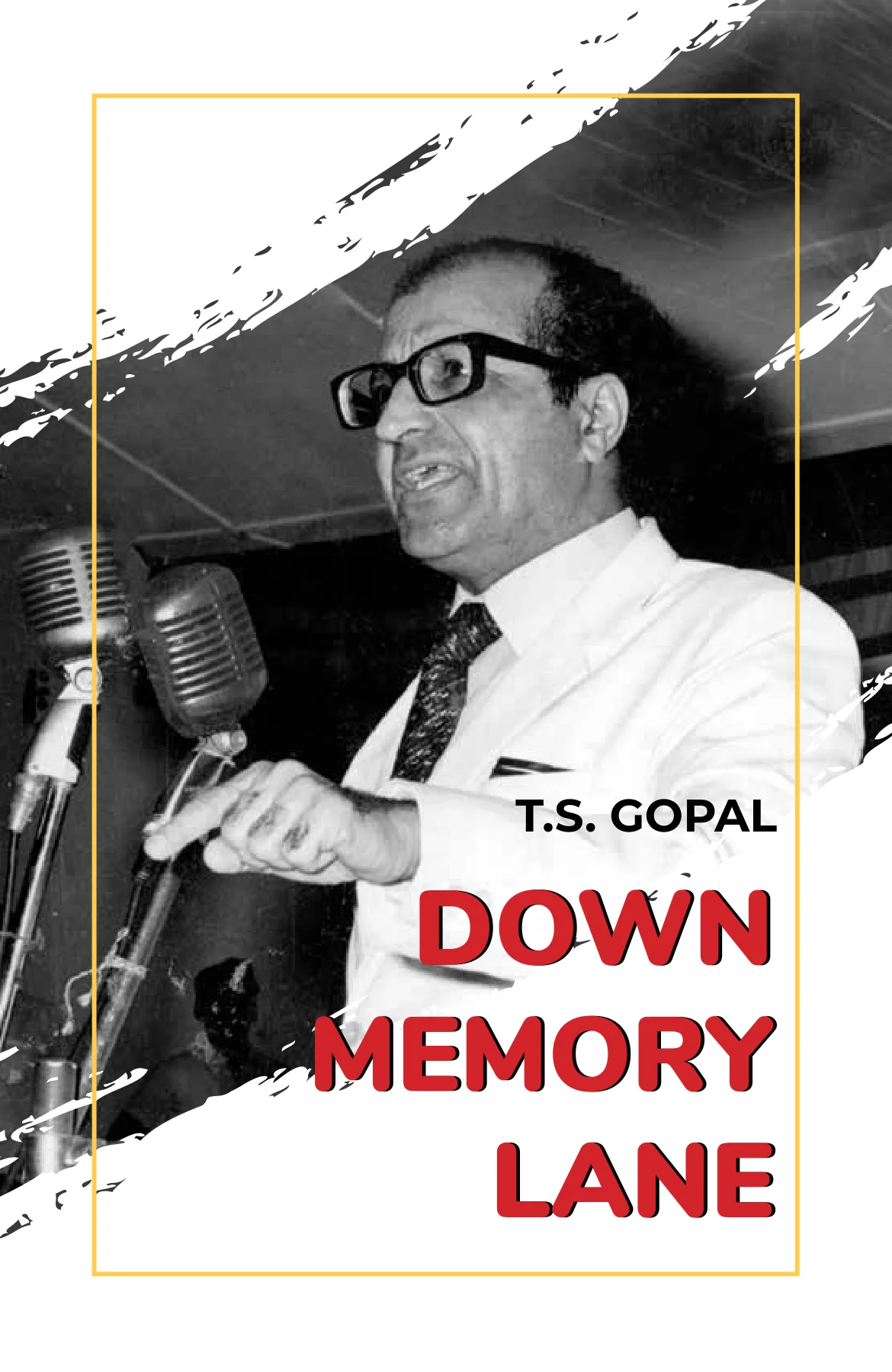
Mr. Cho Ramaswamy speaks at Abbotsbury, on 4th February, 1973.
DOWN MEMORY LANE A N D A N O T H E R E S S A Y T. S. GOPAL A NANI PALKHIVALA BIRTH CENTENARY YEAR RELEASE (2019-20)
NANI A. PALKHIVALA A Profile Born in 1920 in Bombay to a middle class Parsi parents, Nanabhoy Ardeshir Palkhivala (1920 – 2002) graduated from St. Xavier College obtaining a Masters Degree in English Literature. When denied the post of a lecturer in Bombay University, he enrolled at the Government Law College, Bombay. Having obtained his law degree, he enrolled as an Advocate in 1944 and joined the chambers of Jamshetji B. Kanga, together with whom he authored a celebrated treatise on The Law and Practice of Income Tax. Having overcome a stammer that afflicted him in his younger days, he rose to become one of the most persuasive and eloquent advocates in India. His profound respect for the Constitution found powerful expression in many of the landmark Constitutional cases he fought before the Supreme Court, including the Kesavananda Bharati case (1973) in which the Apex Court ring-fenced the “basic structure” of the Constitution. His annual budget speeches under the auspices of the Forum of Free Enterprises for a couple of decades from a humble beginning in 1958 to attracting crowds filling up a cricket stadium were legendary. Reeling off facts and figures without notes and enlivening his speeches with literary quotations, he deplored year after year the stifling economic policy and crushing taxation regime in India until the economic environment was liberalized. He was India’s Ambassador to the United States from 1977 to 1979. He was conferred honorary doctorates by many Universities including the Princeton University and Lawrence University. Described by Rajaji as ‘God’s Gift to India’, he had a deep concern for the well-being of his country, to which his writings collected in two best-selling books, We, The People, and We, The Nation, bear ample testimony, and profound respect for India’s spiritual heritage.
DOWN MEMORY LANE M Y R E M I N I S C E N C E S O F N A N I P A L K H I V A L A I N C H E N N A I * moved from Bombay to Madras, as those cities were then called, in 1967 as Assistant Secretary of the Forum of Free Enterprise’s Madras centre. I have fond recollections of making arrangements for Nani Palkhivala’s budget speeches for many years in Madras. Madras was close to his heart. If Bombay was the commercial capital, he maintained that Madras was the intellectual capital of India. Many interesting memories of Palkhivala and the Madras of those days crowd my mind as I look back across a few decades. In the nineteen seventies, Madras had a number of shaded avenues and street houses; apartments were mostly unknown. Residents of the city had more time at their disposal. The city reverberated with public speeches of eminent personalities addressing cerebrally alert audiences. I have always maintained that when it came to a perspicacious crowd for a cricket match or a speech by Palkhivala, Madras was unsurpassed. I have pleasant recollections of seeing people walking on far less crowded streets, after attending a music concert or a stage drama or a speech by Palkhivala. These memories also bring back images of people who were so moved by his speech that while walking back from the venue to their respective places they would fervently discuss the many points he had raised that evening. Such conversations sowed many seeds of friendship, * This essay first appeared as a special chapter in Nani Palkhivala: A Miscellany by Suresh Balakrishnan. In this booklet, I have added a couple of paragraphs to the essay. I
2 DOWN MEMORY LANE which grew stronger and withstood the test of time among those who were total strangers until then. I also recall my volunteers at the Forum of Free Enterprise – volunteers who helped me out in arranging Palkhivala’s speeches in Madras – forming teams for different events and becoming great friends and who kept in touch with each other for many, many years. They were young collegians and students of the Chartered Accountancy course who never failed to respond enthusiastically whenever I asked them to assist me in making arrangements for a speech by Palkhivala and at the venue during the event. I consider it a privilege to have been part of an energetic group of public spirited men devoted to causes in the interest of the common man, including Veeraraghavan of Mylapore Academy and the Parthasarathy-Narasimhan duo, who even now are quite active, of the Triplicane Cultural Academy. A Speech in 1966 As far as my recollection goes, the first time Palkhivala spoke under the Forum’s auspices in Madras was in January 1966, a year before I moved to the city; I was on a visit to Madras when I attended this speech. The event took place at the famous Gokhale Hall and it attracted an audience of four hundred. The next time he gave a speech in Madras was in 1969, under the auspices of the Sir C. P. Ramaswami Aiyar Foundation, at the Grove in Teynampet. That event attracted a crowd of about seven hundred. A Budget Speech in 1970 Realising that those venues were inadequate to accommodate the vast crowds, I chose the famous R. R. Sabha Hall in Mylapore as the venue for his budget speech in 1970. That was the first time when I was associated with arranging his speech in Madras.
DOWN MEMORY LANE 3 The R. R. Sabha Hall had a capacity of about a thousand. If the earlier venues were too small, my boss at the Forum of Free Enterprise wondered if this venue might be too big and if all the seats would get filled. But I believed that ample publicity coupled with Palkhivala’s popularity would ensure that the hall will be filled to capacity. That was also the first time when we had posters printed for a non-political meeting. Apart from the name of the venue, date and time, they simply read ‘Palkhivala Speaks on the Budget’. We had them pasted at a few prominent places in Madras such as Mylapore, Kilpauk and Sowcarpet. A few were pasted en route from the airport so that Palkhivala could see them while travelling by car. I invited Cho Ramaswami, the late founder-editor of Thuglak (a Tamil magazine on Indian politics), to attend this speech and he quietly slipped in and sat in a chair at a corner of the stage. Of Cho’s association with Palkhivala, I have many memories to share and will relate them in a later portion of these reminiscences. Dr. P. S. Lokanathan, the eminent economist, presided. The stature and popularity of the speaker was such that even this venue proved inadequate. The crowd overflowed the hall and filled the corridors and passages! Popularity in Madras By the mid-seventies, Palkhivala’s popularity had grown by leaps and bounds, owing mainly to his relentless championing of the common man’s cause and the landmark constitutional cases he had fought, the most popular of which was the Fundamental Rights Case. This meant that larger venues had to be found for his speeches as years rolled on. For many years those events were held in Abbotsbury (where there is now a hotel and a mall) in Teynampet, and the crowds that gathered there invariably numbered between three and five thousands! When even Abbotsbury proved small, they were held in Congress Grounds in Teynampet. On one occasion the crowd numbered about eight
4 DOWN MEMORY LANE thousand! As his popularity grew, I felt that from R. R. Sabha, it was but a natural progression to Abbotsbury and Congress grounds. Making arrangements for his speeches was always a great experience and I learnt much from every occasion. I ceased to be the Assistant Secretary and formerly associated with the Forum in 1977. In later times, Palkhivala’s speeches were held in the Ramakrishna School grounds in T. Nagar and in the Centenary auditorium of the Madras University. Although I was not formally associated with arranging his speeches in the nineteen eighties, I was still actively involved in the planning and making the necessary arrangements. Among the many memories I have of Palkhivala in Madras, I recall a speech by him held at Rajeswari Kalyana Mandapam in Mylapore sometime in the nineteen seventies. It was held under the auspices of an NGO called ‘Roof for the Roofless’, and I distinctly remember that the dais was placed at such an angle that no pillar obstructed the view of the speaker from anywhere in the hall or from the open space outside. A Speech at Bertram Hall in 1971 Another event that stands out in my memory was the speech† he gave on the 24th and 25th amendments of the Constitution at Bertram Hall, Loyola College, in 1971. Presided by Rajaji (C. Rajagopalachari), that speech was held under the auspices of The Servants of India Society. To me, the occasion was a dream that came true. After the speech under the auspices of the Sir C. P. Ramaswami Aiyar Foundation in 1969, I told Palkhivala that he deserved a larger audience and some day his speech must † As part of Palkhivala’s birth centenary celebrations, the full audio of this speech has been uploaded on YouTube. It can be accessed by the search words ‘Palkhivala and Rajaji’. thousand! As his popularity grew, I felt th was but a natural progression to Abb grounds. Making arrangements for his great experience and I learnt much from e I ceased to be the Assistant Secretary a with the Forum in 1977. In later times were held in the Ramakrishna School gr in the Centenary auditorium of the Madr I was not formally associated with arran nineteen eighties, I was still actively invol making the necessary arrangements. Among the many memories I have of I recall a speech by him held at Rajeswari Mylapore sometime in the nineteen seven the auspices of an NGO called ‘Roof I distinctly remember that the dais was p that no pillar obstructed the view of the in the hall or from the open space outside A Speech at Bertram Hall in 1971 Another event that stands out in my mem gave on the 24th and 25th amendments Bertram Hall, Loyola College, in 197 (C. Rajagopalachari), that speech was hel The Servants of India Society. To me, the that came true. After the speech under C. P. Ramaswami Aiyar Foundation in that he deserved a larger audience and so † As part of Palkhivala’s birth centenary ce of this speech has been uploaded on YouTu the search words ‘Palkhivala and Rajaji’.
DOWN MEMORY LANE 5 be presided by Rajaji. He was exhilarated by the thought and wondered if it might happen. It happened two years later! In 1971, the news of Rajaji presiding over his speech attracted a huge number of people, including party workers, from near and afar. Thousands thronged the venue and the surging audience spilled out to the lawns. Even so distinguished an attendee as Raja Sir Muthiah Chettiar could not enter the hall but he was happy to hear the speech sitting near a pillar outside. The turnout was so large that day that after the event a great number of people wanting to return to their respective places formed a long queue at the nearby Nungambakkam railway station. To various destinations until the Fort and Beach stations at one end and Tambaram station at another, there was a great demand for tickets. I had jocularly warned the station master about this; it was hardly surprising that the railway station ran out of ticket cards that day! After that event, M. S. Subbulakshmi, the famous singer and in later years Bharat Ratna, and Sadasivam, her husband, hosted a dinner to Palkhivala and other distinguished personalities at their house. Rajaji had left after the speech and did not attend the dinner. At the dinner gathering, I related to Palkhivala and M. R. Pai that the railway station was all of a sudden mobbed by a huge crowd, which brought a broad smile to their faces. A photograph of Palkhivala, Pai and me was taken on that occasion. The audio recording of Palkhivala’s speech at Bertram Hall in 1971 is now popularly known. G. Narasimhan of The Hindu asked me if the speaker would object if he recorded the speech. I sought Palkhivala’s permission and informed Narasimhan that he had no objection but I insisted that the Forum be given a copy. Narasimhan gladly did so and the copy given to the Forum, I have carefully preserved over the decades. In more recent years, N. Murali, Narasimhan’s son, kindly permitted us
6 DOWN MEMORY LANE to make and distribute copies of that recording, which enabled us to disseminate the audio of that speech through CDs. Palkhivala and Cho Ramaswami No account of my reminiscences of Palkhivala in Madras will be complete without mentioning the mutual respect and admiration that Cho Ramaswami and he had for each other. I have the fond recollection and pride of bringing them together on a public platform for the first time. Their appearance in the same event used to attract enormous crowds. Whenever Palkhivala shared the platform with Cho, one could see that he was visibly infected by Cho’s humour. Once he invited Cho to preside over his meeting in Matunga, Bombay, and for breakfast at his home which faced the Oval maidan. In the story of Palkhivala’s association with Madras, I regard the coming together of Cho and him as a landmark event. Palkhivala, who was well-known among the intellectual class and the upper echelons, became enormously popular among the middle class and the younger generation in Madras after Cho’s association with him, especially after a speech at Abbotsbury in which Cho presided. Of that speech, I have vivid recollections, which I will share later. Cho – I am sure everyone knows – was not only a journalist but also a film actor and a playwright. Through his Thuglak writings, he was immensely popular with the middle class, of which Madras has always had a considerable number. The first time I got Cho to meet Palkhivala was later in the evening after the budget speech at R. R. Sabha in 1970. While making arrangements for this speech, I was exploring ways of getting the youth and the common man in Madras to attend Palkhivala’s speeches. Since Palkhivala and Cho belonged to the same profession – Cho was then the legal advisor to the TTK Group – and were deeply concerned about the welfare of the
DOWN MEMORY LANE 7 common man, I wanted them to meet and possibly come together on public platforms. Cho was at his satiric best and I believed that his immense popularity with the middle class would help attract them to Palkhivala’s speeches. A week before the speech at R. R. Sabha, on a late evening, I went to Cho’s office. It was then located in the Ananda Vikatan (a popular Tamil magazine) offices near Indian Overseas Bank’s Head Office on Mount Road. Mahendran, who later became a famous film director, was then an assistant editor of Thuglak and he was sitting at the front office. Rather than customarily sending in my visiting card, I gave the invitation for the budget speech, asking Mahendran to inform Cho that we wanted him to attend it. Mahendran went in and after giving him the invite, came out and told me that Cho wanted to meet me. I went in and met him. He had not yet lost the hair on his body. He had also not yet adopted the familiar green attire, which became a habit in more recent times. His response impressed me, “Mr. Gopal, thank you for inviting me. Palkhivala is a great man, an icon for all of us. But my presence would only be a distraction. People should come to listen to him, not gaze at me.” But I was insistent. I assured him that I will wait for his arrival, take him to the stage and seat him away from public gaze. He attended the speech at R. R. Sabha and as quietly as he slipped in, he left after the event. Later that evening, at a dinner hosted by A. Sivasailam, the famous industrialist, I told Palkhivala about Cho’s inconspicuous visit. He immediately became curious to meet him. I then rang up Cho, and Palkhivala spoke to him on the phone and expressed a desire to meet him. It was then 9.30 p.m. Cho arrived at Sivasailam’s house by 9.45 p.m. Palkhivala and he held a conversation for a little more than half an hour. In the following issue of Thuglak, Cho carried synopses of Palkhivala's speech at R. R. Sabha and their
8 DOWN MEMORY LANE conversation. From that time onwards, Palkhivala became more popular among the middle class in Madras. A Speech at Abbotsbury in 1973 In 1973, I arranged Palkhivala’s speech, presided by Cho, at Abbotsbury. In the Thuglak issue immediately preceding this event, Cho had published a small note signed by him, in which he invited the readers to attend it, not because he was presiding but to hear the man who was championing the common man’s cause! I believe that if I was invariably successful in arranging Palkhivala’s budget speeches in Madras, it was due to a divine intervention on many occasions, including the one at Abbotsbury in 1973. Palkhivala only found time to give that speech on 4 February 1973, a Sunday. But Abbotsbury was booked for a wedding on that particular Sunday. Since Cho was presiding, we could not find any other auditorium large enough for the expected crowd. I spent sleepless nights trying to work other options. A solution presented itself when my mother looked up the almanac and said that that Sunday morning was not suitable for any auspicious function and the marriage party might only arrive between 2 p.m. and 4.30 p.m. I wasted no time in seeking the person who had booked the hall for his daughter’s wedding. Fortuitously, he was the Branch Manager of ACC and Palkhivala was the Chairman of ACC! Overwhelmed, the gentleman readily consented to let us use the hall in the morning. I assured him that the pandhakal (an auspicious pole forming part of the wedding ritual) will be protected by our volunteers and I would be happy to provide seats for him and the groom’s family at the event. It had thus happened that we not only got the venue but also got it free of cost! The Sunday arrived and the audience overflowed the hall. Many stood outside the hall, under the scorching sun to hear Cho and Palkhivala. Cho’s
DOWN MEMORY LANE 9 introductory remarks were so witty that Palkhivala said, “Rarely have I seen the Chairman‡ outshine the speaker in advance.” This was also the occasion when Palkhivala said with a broad smile as to why he thought the organisers had invited Cho to preside, using the anecdote of a waitress in a U.S. railway restaurant, who served the customer two eggs, “in case one turned out bad.” Among the numerous people who attended the event, there were distinguished personalities such as A. Sivasailam and D. C. Kothari, well-known industrialists, J. H. Tarapore, the famous architect, Justice Narayanaswamy Mudaliar, K. S. Venkataraman I.C.S. (Retd.), M. S. Subbulakshmi and T. Sadasivam. Making arrangements for this speech, successfully despite the initial hurdle, gave me immense satisfaction as this event brought Palkhivala in close contact with the youth of Madras. He always loved and had great hopes for the younger generation of the country. As I recall those events, more memories of the 1973 Abbotsbury speech come back. An interesting incident concerns the late J. Jayalalitha, former Chief Minister of Tamilnadu. She was then a busy film star. It is well-known that she wanted to become a lawyer but circumstances led her into the film industry. She held Palkhivala in high esteem and wanted to attend the speech at Abbotsbury. Sometime before the event, she called up Cho, who was her good friend, and asked him if a seat could be reserved for her at the venue because she might arrive late. Cho asked me on her behalf but I firmly declined the request. Normally seats were not reserved for anybody and I was not willing to make an exception for Jayalalitha. But I must add that we used to have volunteers sitting in rows other than the first row, and they would give up their seats for VIPs if needed. ‡ Although the ‘Chairman’ was S. Narayanaswamy, who spoke briefly at the beginning, those were the exact words.
10 DOWN MEMORY LANE I also felt that a popular film actress arriving late would be an unwelcome distraction at the venue. When Cho conveyed my decision to her, she was understandably upset and did not attend the speech. This coincided with the time when she was writing some of her reminiscences as a series in Thuglak. After that unhappy incident, the series came to an abrupt end. As if he held me to blame for it, Cho said in a lighter vein, “Gopal, because of you she stopped writing her reminiscences!” Another interesting memory relating to the speech at Abbotsbury is that Palkhivala came to Madras by a Tata owned private aircraft – it was ‘Cessna’ if my recollection is correct – because his busy schedule prevented him from catching a commercial airline flight from Bombay in good time. The plane landed in Madras two hours before the event and flew back without any passenger, while Palkhivala, who later visited the Aurobindo Ashram at Pondicherry, went to Delhi by flight. His arrival at Madras by a private aircraft caused an interesting titbit to appear in Ananda Vikatan. Bala, who was on the editorial staff of the magazine, was a close friend of Cho. I used to chat with him while waiting to meet Cho at the Ananda Vikatan office. At Abbotsbury, while we were chatting before the speech, I said to him that Palkhivala had to arrive by a private plane. Impressed by the public adulation that he witnessed at the event, he caused a box item to appear inAnanda Vikatan that read ‘Palkhivala came by a private Tata plane especially for this speech’. The same piece also carried a facsimile of the initials ‘NAP’ written by Palkhivala with the caption, ‘This is how he signs’. Appearing in Ananda Vikatan, which has always been quite popular among Tamil readers, this was unexpected publicity for us. I sent the clippings to Palkhivala. He was pleased to see them and felt flattered like a child. Cho’s presiding over the speech at Abbotsbury and that piece in Ananda Vikatan made him a household name in Madras.
DOWN MEMORY LANE 11 In more recent years, at a book release function in which L. K. Advani was the chief guest, Cho called out ‘Hello Forum Gopal’ when he saw me. I was elated that he recognised me after so many years. That book release event happened a few decades after my Forum days when I was known to many people as ‘Forum Gopal’. The occasion brought back pleasant memories from the seventies, especially the speech at Abbotsbury. Tamil Version of ‘Constitution and the Common Man’ The Palkhivala-Rajaji speeches at Bertram Hall and the Cho- Palkhivala event at Abbotsbury had generated considerable interest among local politicians from the ruling party in the State. The name ‘Cho’ always made them nervous. Palkhivala, arguing in the Supreme Court in the marathon Kesavananda Bharati case to safeguard our Fundamental Rights, was also very much in the news. The media was covering the case on a day to day basis. I thought, “Why not have the article in English by Palkhivala called ‘Constitution and the Common Man’ translated in Tamil and have it distributed among MLAs and others to create an awareness about the Constitution in peril?’. I suggested about this to M. R. Pai, Secretary of the Forum of Free Enterprise and my boss in Bombay. He agreed to my suggestion. I then got in touch with T. V. Balasubramaniam, a close friend and who was earlier commissioned by Forum to translate some English articles on economic issues for the Tamil press. He was an excellent translator. Considering the passion of local politicians for their language and alliterations, I suggested to him that the title in Tamil should be alliterative and catchy. Before I could wink, he came out with the title “Arasiyal Sasanamum Appavi Kudimaganum” (Tamil for the English title ‘Constitution and the Common Man’). The booklets were printed and distributed among members of the Tamilnadu Legislative Assembly and a few others. Then I felt that it should reach people beyond Madras.
12 DOWN MEMORY LANE A. G. Venkatachari of Dinamani, a Tamil daily, with whom I used to travel every day by bus from Mylapore to Mount Road (Arts College) suggested that we put a news item in Dinamani about the booklet announcing that it would be sent free of cost to those who respond with a post card mentioning their addresses. This, he said, would take Palkhivala’s voice across the State. Discerning readers from all over the State responded, asking for copies. G. K. Sundaram, eminent Industrialist in Coimbatore, asked for some copies. We had printed 500 copies and distributed them all. I have another interesting memory concerning this booklet. We had received a request for 50 copies from a town called Sethiathope claiming that it was for distribution among members of some ‘Youth Group’. I sent the copies gladly. When a request came again from the same town but from a different address, I found the handwriting on the card to be identical to the first letter! In the next few days two more identical requests came from the same town for multiple copies! I did not respond, suspecting that this could be a ruse to get the booklets free of cost and sell it as waste paper, which would perhaps be used by some peanut vendor to wrap and sell his roasted product! Forum’s Chennai Centre during the Emergency When Palkhivala returned Indira Gandhi’s brief and withdrew from appearing for her, some organisations he was associated with came under Government scrutiny. The Chennai centre of the Forum of Free Enterprise was one of them. We got a letter from the Government stating that the Forum office should maintain an ‘Employees Attendance Register’ and that it should be kept ready for scrutiny whenever required. In the Chennai centre, I was the only or ‘all-in-one’ employee! I showed the letter to our Chairman ‘Chitra’ S. Narayanaswamy and told him that I will keep a register in his office and will come in and sign
DOWN MEMORY LANE 13 every day and he can initial the same once a week. He merely chuckled and said nothing in reply. We got another Circular stating certain ‘dos and don’ts’ while arranging lectures/speeches, which included the conditions that we should not criticize the Emergency, the President, P.M., Governor, etc. I was rather perturbed by the ‘etc.’, and told our Chairman that anything from a loud laughter to a sneeze or a cough or an applause at the wrong place during a lecture or speech could be construed as criticism and we might get into trouble under the ‘etc.’ clause! After communicating with the Bombay office, we decided to not arrange public events but occasional classes on Economic Theory for student members of the Forum at Srinivasa Sastri hall, Mylapore, addressed by my economics mentor Prof. S. Radhakrishnan. Thanks to the Government of Tamilnadu’s stand on Emergency we were able to have some semblance of activity. We were also able to get some underground material on what was going on in the Supreme Court where Palkhivala was passionately arguing for our rights during those black days. We also had that material circulated among like-minded people, including Cho. Other Speeches While Palkhivala’s budget speeches and lectures on topics falling broadly under the head of economics were held under the auspices of the Forum of Free Enterprise, speeches under other topics were usually held under the auspices of other well-known organisations such as, for example, The Servants of India Society which arranged the Bertram Hall speech in 1971. As I had arranged his speeches under the Forum’s auspices on many occasions, the other institutions and associations would usually seek my assistance, especially to communicate with him, while making arrangements for their events.
14 DOWN MEMORY LANE A Speech on the Supersession of Judges in 1973 In 1973, Palkhivala gave a speech in Madras on ‘Supreme Court and Judicial Independence’ at the Congress grounds in Teynampet under the auspices of the Triplicane Cultural Academy. The subject-matter of the speech was the supersession of three senior Supreme Court judges. He was deeply concerned about the supersession of Judges and the book ‘A Judiciary Made to Measure’ he had edited was already making waves. M. R. Pai called me from Bombay and asked if the Triplicane Cultural Academy would hold the event in Madras. I communicated their assent to him. Just as a speech by Palkhivala invariably exceeded the expectation of the audience, the strength of the audience invariably exceeded the expectation of the organisers. The Academy was faced with the question of selecting a suitable venue for this event because, by this time in the seventies, a speech by Palkhivala was what a film star- studded event is today for the masses! On the day of the speech, thousands of chairs were placed in Congress grounds but they proved inadequate to accommodate the vast crowd that actually assembled. More number of Palkhivala’s fans than expected had gathered at the venue and a good number of them spilled out to the open grounds beyond the chairs. K. Subba Rao, former Chief Justice of India, presided. Eminent legal minds, including Gopalaswami Aiyangar, were present. Narayanaswamy Mudaliar, State Minister for Law, who sat in the front row, was pleased that he had arrived quite early because he escaped the ordeal of wading his way through the crowd that gathered later. So large was the assembled crowd that, before Palkhivala’s arrival, clouds of dust rose from the ground due to the rushing of thousands of pairs of feet. I wished and hoped that he did not wear the immaculate white attire characteristic of him because I was certain that it would get quite dirty before he ascended the stage. But he did not depart from his usual habit and arrived at the venue in spotless
DOWN MEMORY LANE 15 white. Nonetheless, to my relief, I noticed that the dust had settled down by then. He paddled his way to the stage through the swarming sea of eager faces. Attired in the white that had fortunately escaped the dust, he held the audience spellbound by a speech filled with trenchant observations on the topic. On this occasion the humour and wittiness that were usually present in his speeches were absent because the topic was a grave one. An exceptional moment when he infused his observations with appropriate witticism was when he said that if the Government succeeded with its Machiavellian idea then there would be more “looking forward” judges than “forward looking” judges. Every member of the audience heard the speech in rapt attention. The reports of that speech in The Hindu and The Mail (now defunct but for several decades since the British times one of the leading dailies in Madras) carefully preserved by the Triplicane Cultural Academy enable me to share some more details. It was a 90 minutes speech on 12th May 1973. Palkhivala said that a committed judiciary is a contradiction in terms and added, “It is like a boiling ice cream. Either he is committed or he is a judge in the true sense of the term. He cannot be both.”1 He replied point by point to the arguments raised by H. R. Gokhale, Union Law Minister, and Mohan Kumaramangalam, Union Steel Minister, in support of the Government’s decision to appoint A. N. Ray as Chief Justice of India superseding three senior judges. He said he could not imagine a greater damage done to the cause of freedom than by the promulgation of what he described as the “Kumaramangalam doctrine” that the executive was entitled to have judges of its choice, whose qualification would consist in the fact that they were committed to the philosophy of the ruling party.2 He said that the Government’s action was a “severe blow and lasting damage to the democratic character of our Constitution much more than complete and total deletion of the whole chapter on fundamental rights enshrined in it.”3 Later, he warned, “If judges began to uphold
16 DOWN MEMORY LANE the philosophy of the ruling party India would cease to remain as one nation. They would then only witness disintegration of the country.”4 Subba Rao, who presided, said that they were witnessing a conflict between democratic forces and totalitarian forces.5 When Palkhivala was Annoyed with Me My recollections of Palkhivala in Madras also include the memory of an exceptional occasion when he was annoyed with me. At the first Rajaji Memorial Lecture he delivered under the auspices of the Mylapore Academy, his bio-data was read out while he was introduced as the speaker. It disclosed biographical information relating to his early life which, out of modesty, he preferred not to publicise. Under the impression that I had shared all that information with the Academy, he was furious with me. Only when the organisers told him that they got it from some other source did his annoyance with me abate. The first G. L. Mehta Memorial Lecture (1975) The Institute for Financial Management and Research invited him to deliver the first G. L. Mehta§ Memorial Lecture** in Madras on 4th January 1975. They wanted to hold the event at the Taj hotel and asked me to assist them in making the necessary arrangements. I enquired if the public were free to attend and advised them that if it were otherwise then the Taj might not be the appropriate venue. They replied that attendance was to be by invitation only and they did not expect to see a large crowd. I conveyed this matter to Palkhivala. He then asked § Journalist, economist, administrator and diplomat ** Collected in We, The People, under the title ‘The Tragedy of Waste’
DOWN MEMORY LANE 17 his P.A. to tell the organisers that he did not wish to give the lecture at the Taj because he wanted it to be a public speech. He preferred to address the common citizens of Madras and not just a few elite invitees. He suggested Abbotsbury as the preferred venue; he had grown fond of it lately. The Institute then decided to hold the event at Abbotsbury but they doubted if the hall would get filled. The evening of the event arrived, and the crowd overflowed the hall! Busy Practitioner My recollections of Palkhivala also include memories of his clients trying to meet him for professional advice or assistance when he visited Madras for giving speeches. He was so busy that he would hardly find time to meet them. He would also leave immediately for the airport after the speech to catch the return flight to Bombay. On one occasion a client was insistent because of the urgency in the matter and his local advocate sought my help. I informed Palkhivala of the matter and he agreed to meet the client at the airport for a few minutes if the flight was delayed. Fortunately for the client, the flight got delayed that day! On another occasion, Palkhivala appeared before a Tribunal in Madras and, after giving a speech at a venue, left for the airport. One of the members of the Tribunal, who was a personal friend of mine, told me, “You may inform Mr. Palkhivala informally that he has won the case and wait for the formal communication tomorrow.” I gave Palkhivala the good news at the airport. In a child-like manner he was surprised and happy to hear it. A piece of information that made rounds in those days was that Air India – Palkhivala was its legal advisor – ensured that the seat next to him in a flight in which he was travelling was left vacant so that he could grab some sleep, because usually he would be pestered by the passenger sitting next to him. Whether
18 DOWN MEMORY LANE this was a fact or merely a rumour I do not know, but I wonder if it would be an exaggeration to liken his popularity to that of a movie star! A Fond Personal Recollection A fond personal recollection comes from 1998, when he acceded to my request and gifted me the precious eleven volume set of Will and Ariel Durant’s celebrated work, The Story of Civilization, from his collection. During our phone conversation, he apologized with characteristic humility that he was unable to write and sign on each volume. He dictated and signed below the following words in the first volume called The Oriental Heritage: For, Mr. T. S. Gopal, In appreciation of your services to the Forum of Free Enterprise, and to public causes. He also arranged to have the set packed in a box at his office in Mumbai and, having paid for the parcel charges himself, directed his P.A. to check with me if I had received it! His Last Visit to Chennai The last time I saw him was during his last visit to Chennai. That was on 4th February 2000 when he came to Chennai to receive the honorary doctorate conferred by the Manipal Academy of Higher Education (MAHE). On that memorable occasion, MAHE honoured Palkhivala, C. Subramaniam and A. P. J. Abdul Kalam with doctorates for noteworthy contributions in their respective fields.
DOWN MEMORY LANE 19 Earlier that day, Palkhivala, who was suffering from persistent ill-health, felt unsure if he would be able to travel from Mumbai to accept the honour. At 2 p.m., I got a call from Mumbai that he wanted to be present at the event and he would be accompanied by a nurse. I was asked to look after his needs at the venue. He arrived at the venue ahead of the scheduled time for the start of the event. His physical condition was in such a poor state that he could barely talk or walk. I took him to the wash room. After he had freshened up, he was put up for a while in a small room in the same premises as the auditorium in Bharatiya Vidya Bhavan’s Chennai centre, which was the venue. The nurse who had accompanied him made a failed attempt in the last minute to make him wear a tie. We then wheel-chaired him into the auditorium and helped him climb the stage. I met Suresh Balakrishnan†† for the first time in that event and he too was of great help in assisting Palkhivala. While encomiums were paid that evening, Palkhivala’s ill- health prevented him from properly comprehending them or responding. It was sad to see that the man who used to move thousands with his speeches had to struggle to move his limbs and utter the words that did not come out coherently. This tinged the occasion that was otherwise a happy one with melancholy. Many had assembled in that hall with the fond hope of hearing him but that was not to be. When the function ended, I helped him get into the car. The car drove away and I saw him no more. A couple of years later the sad news of his passing came. Today, in Chennai, the Nani Palkhivala Foundation and the Nani Palkhivala Arbitration Centre in Mylapore, and the buildings in the Sankara Nethralaya campus on College Road, named after him and his wife, perpetuate his memory. †† Lawyer and author of Nani Palkhivala: A Miscellany
20 DOWN MEMORY LANE Conclusion The fragrance of the many memories lingers in my mind. It was a pleasure and an honour to have known him. Although I am reminded of Will Durant’s words, “with as much modesty as my inherent immodesty would permit”, I will not dissemble the pride of having been associated, though in my own little way, with Palkhivala for many years. The pleasant exercise of sharing these recollections had transported me in my mind across a few past decades to hear his speeches laced with mordant wit and sprinkled with apt quotations and the tumults of applause that greeted him whenever he spoke in Madras. Many times when I felt reminiscent, I have heard the audio recording of the 1971 speech at Bertram Hall. I cannot help feeling nostalgic whenever I hear the sound of his voice and Rajaji’s. It is a heart-warming feeling that many people in Chennai associate me with Palkhivala in their memory. Money cannot buy but only passion for a cause can bestow so great an honour. ______ * ______ NOTES 1 ‘Palkhivala Ridicules Idea of Having Committed Judiciary’, The Mail, 13 May 1973 2 Ibid. 3 ‘Supersession of Judges: Palkhivala Attacks Govt. Action’, The Hindu, 13 May 1973 4 Ibid. 5 Ibid.
NANI ARDESHIR PALKHIVALA D E F E N D E R O F T H E R I G H T S O F T H E P E O P L E A N D C R I T I C O F T H E W R O N G S O F T H E R U L E R S * r. N.A. Palkhivala (Nani to many of his friends) who passed away on December 11, 2002, was a legend in his lifetime. Millions across the country and the world are well aware of his prowess as a defender of the people whenever the Constitution that guaranteed the people their rights was under threat from the people in power. To Palkhivala the Constitution was the ultimate protector of the people in a nation where emotions swayed the electorates than reason. Constitution was a sword fashioned by many wise men to strike down attacks on democracy. The government had tried, during the dark days of Emergency in 1975 and before, to convert the instrument as a stick to beat the people with. Due to the curb on press freedom at that time, not many were aware that even during the Emergency, he argued in the Supreme Court to defeat the efforts of the Government to alter the basic structure of the Constitution to suit their needs. The most telling point of his argument was that what guarantee a truncated Constitution can give to the people on their rights, when at that very moment when he was arguing in the highest Court of the nation, not a word will reach the people due to curbs on * This article I had planned for his birthday due in January 2003. But He willed otherwise. All I did was to change, for factual and chronological accuracy, the tenses overnight from present to the past. But Palkhivala will always be present in the hearts of people who believe in rights of the people for which he fought all the time. Some of the contents in this article are based on the book ‘The Legend of Nani Palhivala’ by M.R. Pai. M
22 NANI ARDESHIR PALKHIVALA freedom of expression, the most fundamental right of rights in a democracy. Critics have faulted him for championing the cause of the wealthy and the influential. But they miss the point. His clients cited in the Court papers were there only to fulfill the needs of the Court procedures and those affected individually. The real beneficiaries were the people of this nation. Every case and cause he argued for, in the final analysis, was related to the people. When he argued for the Princes for their Privy Purses, it was not the purse that mattered but the integrity of the Government that made promises not to be kept and could later affect the people too. The Privy Purse was guaranteed and charged to the Consolidated Fund of the President of India and the provident fund of the people was also charged to the same fund. Any Government with brute majority and brutal mind can take over the provident fund claiming it was 'for public good'. The Bank Nationalization Case again was to protect the fundamental right to do business with adequate regulatory measures to monitor the functioning. In future the Government could take over any business in public interest and pay 'an amount'. A term as vague as promises made by the politicians. His arguments in the 'Archaka Case' was not to defend a particular tribe. It was to ensure that the men who help people reach for God's blessings need to have the core competency and sanctity born of genetic integrity and acquired knowledge as per rules laid by tradition and Agama Sastras, that will instill and sustain faith in God among the devotees. One cannot just graduate from a college to the Temple just on acquired knowledge alone. Palkhivala successfully argued before the Supreme Court the case which affirmed the Fundamental Rights of the minorities to establish and administer educational and religious institutions of their choice and to choose the language in which education should be imparted.
NANI ARDESHIR PALKHIVALA 23 Barring some exceptions, the above cases were all fought without charging any fees and as a matter of service to the nation. In the Bank Nationalisation Case not a single affected bank or its Directors were willing to lend their names as petitioners and Palkhivala incurred the expenses himself. Fourteen banks got additional compensation to the tune of Rupees Forty Eight Crores because of his efforts. Except two, none of the banks had the courtesy to record their appreciation. Palkhivala was one who never publicized his help to the poor and needy. When his servants retired he continued to send the same salary and perquisites to them as if they were in service. Out of inborn modesty and humility he was averse to his past struggles and achievements being mentioned in public. This writer recalls how upset he was when one organizer in Chennai got hold of the information about his past and the president of the meeting mentioned this in the meeting. He had to be convinced that I was not the source for this information. I have had the good fortune, as Hon. Secretary of the Forum of Free Enterprise’s Chennai centre, of organizing many of his public lectures in Chennai in the nineteen seventies. I would get unnecessarily nervous about seeing the vacant seats even as I waited for the crowd thirty minutes before the event, when some elderly early birds would trickle in. About twenty minutes before start of the meeting the rush would start with people scurrying across the roads, overtaking the crowding, honking cars to the exasperation of the traffic constable posted at the meeting venue. In next to no time, every available nook and corner of the hall would have been taken up. Such were the crowds that the policemen on duty often wondered how could a non-political personality draw such a large number of people! Palkhivala was a child at heart. Accustomed to the standardised 'five star' comforts of Hotels where he hardly had time to stay and relax, on one occasion he was thrilled to stay at the Chettinad Palace in Chennai, as the guest of Rajah Sir
24 NANI ARDESHIR PALKHIVALA Muthiah Chettiar who was well known for his out of the world hospitality. He loved staying in the Palace with open lawns, on the edge of the Adyar estuary and the Theosophical Society and the sea at the other end. The tall beaming Rajah Sir Muthiah Chettiar hovering around like a genie playing host to perfection! He even arranged for a warm light dinner sent in a car to await Palkhivala at the airport when he rushed out from the meeting hall to catch the late night flight to Bombay and the waiting clients. It was the same host, the Rajah who patiently heard the voices of Rajaji and Palkhivala from the lawns outside when Bertram Hall was filled and overflowing. When I tried to get him inside, I remember him telling me it was a pleasure to stand and listen to such great men and asked me, ‘Do we not stand and worship in temples and still never complain?’ I replied it was his age more than his stature that compelled me to find a seat for him. The respect and admiration Palkhivala had for M. S. Subbulakshmi was well known. The feeling of admiration was mutual, both being the best in their own spheres. With words he evoked in people the strength to resist curbs on freedom and she with melody and prayer brought peace to the people's hearts. MS used to listen to his speeches in rapt attention and what she could not comprehend in the words, she felt in the intensity of his voice and body language. On his bequeathing a major portion of his wealth to Sankara Nethralaya, I wrote to him asking for the Eleven Volume ‘Story of Civilisation’ by Will and Ariel Durant. Having read a few volumes in the USIS library every evening in the 1970s it was a dream to acquire the set from U.S. because of the prohibitive cost one could ill afford at that time. But when affordability came the set was out of print. It remained an unfulfilled dream until Palkhivala, responding promptly to my request, sent the entire set with his autographed message on the first volume to me insisting he would pay for transportation too.
NANI ARDESHIR PALKHIVALA 25 Palkhivala, cutting across the genetic beliefs had great faith in Destiny that was proved right in his own life in many instances. Like the illness contrary to the normal progression, saved his life than threaten his life when he canceled an appointment in Delhi and lived long because of that. His was a searching soul for truth and enlightenment and his respect for the seers well known. The Sage of Kanchi, Ramakrishna Paramahamsa, Vivekananda, Aurobindo, and Sathya Sai Baba of Puttaparthi influenced him among others. He had the humility to learn from these men yet wise enough to listen to the One within him for guidance. Palkhivala's progress in life as student, lawyer and defender of people's rights should be the bench mark for any one who wants to be a near-perfect man from heart upwards. Born in 1920 took his M.A. Degree with Honours in English from the Bombay University. As is to be expected, his academic career was a brilliant one. It is said that one answer paper he wrote was so good, the examiner returned it with a noting in the paper that the student knew more about the subject than he did. He stood First Class First in the first LL.B (1943), as well as in the second LL.B. (1944), and again First in the Advocate (Original Side) Examination of the Bombay High Court in 1946. As a lawyer he was meticulous in preparing the brief and always added value to it with his flair for language. He had a prodigious memory and his talks always shone with gems of quotations drawn from eminent men and scriptures of many religions. It is no exaggeration that many of his own words were worthy of being quoted. The Annual General Meetings proceedings of ACC of which he was the Chairman for many years, were read by many more for his language than the concrete facts and figures of the company! In the World Court where written arguments were prepared in advance, Palkhivala trusted his memory and spoke extempore and won cases for India. Possibly the only one to do so. Such was his confidence born of conviction. The readers of the
26 NANI ARDESHIR PALKHIVALA 'Hindu', in the seventies, will recall the front page daily coverage of the proceedings of the marathon Fundamental Rights Case that went on for five months. It was a brilliant display of endurance and histrionics that drew the admiration of his opponents too. The impact made by Palkhivala on the common man as well is reflected in the following letter written to Palkhivala by a peon in the Supreme Court who must have heard many legal luminaries: 'Respectful Salutations to Shri Palkhivala saheb You are truly a great man. By the special grace of God, He has given you enormous wisdom. You are the true friend if the common people and the poor of the country. By exerting yourself very much for the last few months, you are trying to get justice for the common people. You will definitely succeed in your efforts. Whatever new laws are made by our Government or plans are started, they have proved all useless. The common people are loaded with new and new taxes. But still the rulers do not understand the difficulties of the common people. I seek your pardon for writing this letter. I pray on behalf of the public of this country and myself to God that you win in your efforts. Otherwise, people of this country will have to face very great difficulties. I pray to God to grant you great wisdom and continue to seek justice for the people." Justice H.R. Khanna of the Supreme Court of India, in a meeting, commented on Palkhvala's legal acumen as follows: If a count were to be made of the ten top most lawyers of the world, I have no doubt that Mr. Palkhivala's name would find a prominent mention therein. There have been occasions ly a great man. By the special grace of God, He u enormous wisdom. You are the true friend if people and the poor of the country. By exerting y much for the last few months, you are trying to for the common people. You will definitely our efforts. Whatever new laws are made by our t or plans are started, they have proved all common people are loaded with new and new ill the rulers do not understand the difficulties of n people. I seek your pardon for writing this y on behalf of the public of this country and od that you win in your efforts. Otherwise, is country will have to face very great difficulties. od to grant you great wisdom and continue to for the people." Khanna of the Supreme Court of India, in a nted on Palkhvala's legal acumen as follows: ere to be made of the ten top most lawyers of the ve no doubt that Mr. Palkhivala's name would inent mention therein. There have been occasions 26 'Hindu', in the seve of the proceedings that went on for endurance and his opponents too. The man as well is r Palkhivala by a p heard many legal lu 'Respectful S You are truly a has given you e the common pe yourself very m get justice for succeed in your Government o useless. The co taxes. But still t the common p letter. I pray o myself to God people of this c I pray to God seek justice for Justice H.R. Kh meeting, commente If a count were world, I have find a prominen
NANI ARDESHIR PALKHIVALA 27 when his advocacy has reached great heights, and long after we had heard him we find his words echoing in our memory and leaving a trail of pleasant remembrance. One such occasion was when a bench of thirteen judges was convened to consider the correctness of majority view expressed in Kesvanand Bharati's case that parliament as a result of the amendment of the Constitution cannot change its basic structure. The height which Mr. Palkhivala touched that day in his address has in my opinion been rarely reached, and I am glad to say that my opinion in this respect was shared by number of my colleagues. After hearing Mr. Palkhivala the attempt to have the majority view reconsidered was given up and the bench was dissolved. As Ambassador to the United States Palkhivala took the opportunity to visit most of the Universities there and also many States and spoke to the students and scholars on Indian Heritage, Constitution and economy and made India proud. His speeches needless to say were appreciated for their scholastic contents, wit and command over the English language reminiscent of the writings of the American Scholar-Historian Will Durant whom Palkhivala greatly admired. Many of his thoughts by ways of writings and speeches in U.S.A., India and elsewhere were reproduced in his bestseller books 'We, The People' and 'We, The Nation'. He was a man not for the masses but one immensely popular among the student community. Where ever he went his face lit up on seeing young faces in the audience. In Chennai, known for the old age traditions and values still cherished, he was slightly embarrassed when young aspiring Chartered Accountants fell at his feet for blessings. He would tirelessly sign autographs holding the pen in a peculiar grip (due to genetic fault) after the lectures. He gladdened many elders in the crowd by recalling their names and enquiring about others mutually known to them.
28 NANI ARDESHIR PALKHIVALA These are times when a few Gandhis by name have eroded the memory and values of the Mahatma and it took Attenborough beyond our shores, to bring him back to the people's mind thorugh a movie. But Palkhivala is one who will be remembered as long as we have the Fundamental Rights with us and the Constitution untarnished and dismembered. As long as we have a Government that may fail economically but not become morally corrupt and to quote his own words, “arrogate to itself the powers as the official liquidator of the Constitution”. If that happens it is not worth remembering Palkhivala because to him the Constitution was the ultimate protector of people as recent judgments of the Supreme Court have proved. When the Lord said 'Sambhavami Yuge Yuge' one tended to think of a human form, not an institution that made India proud. That is how God works. If the corrupt could not usurp and cling to Chairs of Power at any cost hoodwinking the masses, it is because the Constitution and Supreme Court were there to protect the gullible people, as elections were won on emotional than economic and ethical issues. Today the Supreme Court is the Court of Last Resort for the people, whatever be the issue be it safeguarding the rights or the lungs of the people as the recent verdict on smoking in public places has revealed. We have seen many politicians walking around the Raj Ghat once or twice a year or once in five years or less, and then go on with the business of eulogizing the seven sins that the Mahatma abhorred. The lamp lit there lives on fuel but the spirit is dead. But as long as the Constitution and its basic structure remain untouched, the spirit of the nation will remain alive. For this, one has to remember Palkhivala's contribution. It may seem strange to compare the Mahatma and Palkhivala. When the freedom for the people that the Mahatma fought and got was in peril, it was men like Palkhivala who fought for the people that they may not lose it again this time not to an alien but to one 15 that the dust had the stage through the white that had nce spellbound by the topic. On this usually present in was a grave one. observations with if the Government ere would be more ing” judges. Every pt attention. nd The Mail (now h times one of the by the Triplicane ore details. It was hivala said that a s and added, “It is ed or he is a judge both.”1 He replied R. Gokhale, Union lam, Union Steel ecision to appoint eding three senior er damage done to ation of what he that the executive hose qualification committed to the the Government’s to the democratic han complete and undamental rights s began to uphold
NANI ARDESHIR PALKHIVALA 29 of their own. As Palkhivala who once wrote eloquently of his countrymen: “Who gave unto themselves the Constitution but not the ability to keep it, Who inherited a resplendent heritage but not the wisdom to cherish it, Who suffer and endure in patience without perception of their potential…” have hardly learnt to fight injustice or assert their rights. (this last line is this author’s own) ______ * ______ INSPIRING WILL OF NANI A. PALKHIVALA When I die ... Give my sight to the man who has never seen a sunrise. Give my heart to one who has known the agony of the heart. Give my blood to a youth pulled from the wreckage of a car so that he might live to see his grandchildren play. Let my kidneys drain the poison from another's body. Let my bones be used to make a crippled child walk Burn what is left of me and scatter the ashes to the wind to let the flowers grow. If you must bury something, let it be my faults and my prejudices against my fellowmen. Give my sins to the Devil. Give my soul to the God. If you wish to remember me, do it with a kind deed or word to someone who needs you. If you do all I've asked, I'll live forever. - Nani A. Palkhivala NANI ARDESHIR PALKHIVALA 29 of their own. As Palkhivala who once wrote eloquently of his countrymen: “Who gave unto themselves the Constitution but not the ability to keep it, Who inherited a resplendent heritage but not the wisdom to cherish it, Who suffer and endure in patience without perception of their potential…” have hardly learnt to fight injustice or assert their rights. (this last line is this author’s own) ______ * ______ INSPIRING WILL OF NANI A. PALKHIVALA When I die ... Give my sight to the man who has never seen a sunrise. Give my heart to one who has known the agony of the heart. Give my blood to a youth pulled from the wreckage of a car so that he might live to see his grandchildren play. Let my kidneys drain the poison from another's body. Let my bones be used to make a crippled child walk Burn what is left of me and scatter the ashes to the wind to let the flowers grow. If you must bury something, let it be my faults and my prejudices against my fellowmen. Give my sins to the Devil. Give my soul to the God. If you wish to remember me, do it with a kind deed or word to someone who needs you. If you do all I've asked, I'll live forever. - Nani A. Palkhivala
Published in 2019, this special hardbound edition of Nani Palkhivala: A Miscellany is released in commemoration of Nani Palkhivala’s Birth Centenary Year (2019-20). It contains many uncollected writings of Palkhivala and other essays. It also contains many rare photographs. Publisher: OLD MADRAS PRESS, Chennai www.oldmadraspress.com ISBN: 978-81-937335-3-0 Price: Rs. 480/- Buy Online on Amazon! Copies are also available at C. Sitaraman & Co. 73/37, Royapettah High Road, Chennai – 600 014 Ph: 044 – 2811 1516 / 7069
AbOuT The AuThOr T.S. Gopal. Secretary, Palkhivala Foundation, Chennai and Social Activist. Formerly as Assistant Secretary, Forum of Free Enterprise (Madras Centre) he had arranged lectures by Mr. N.A. Palkhivala (who was also President of the Forum) under the auspices of Forum in Chennai. He lives in Chennai. Mr Gopal can be contacted at: teessgpal@hotmail.com The Author, Mr. N.A. Palkhivala and Mr. M.R. Pai Published by T.S. Gopal Printed by CompuprinT no.9, ariSTo Flat C, 2nd Street, Gopalapuram, Chennai 600 086. phone : 044 - 2811 1224 / 6768 | E-mail : compuprint@gmail.com Website : www.compuprint.in