View Finesse flipbook.
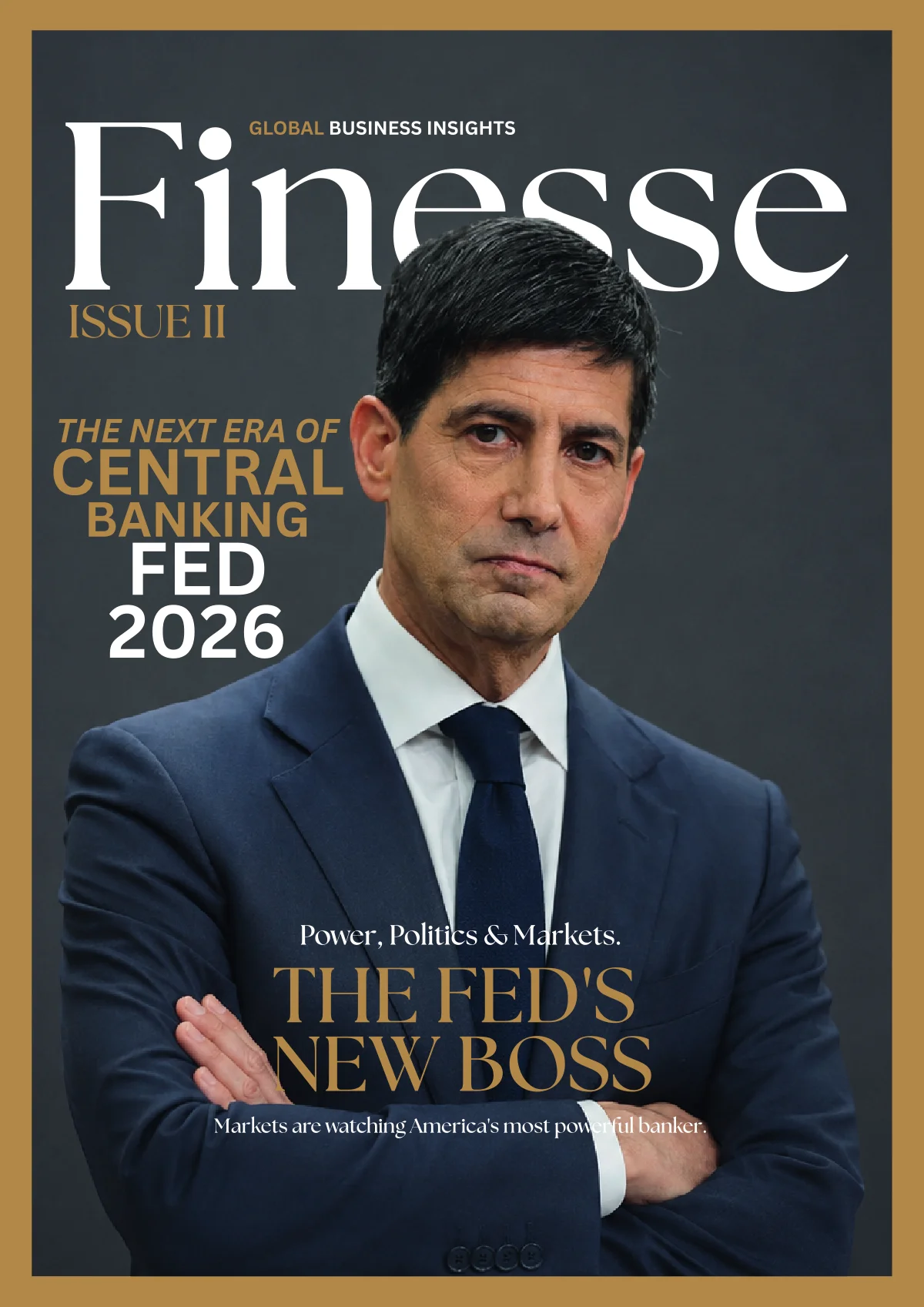
1 GLOBAL BUSINESS INSIGHTS ISSUE II Finesse THE NEXT ERA OF CENTRAL BANKING FED 2026 Markets are watching America's most powerful banker. Power, Politics & Markets. THE FED'S NEW BOSS
3 “Let Finesse continue to serve as a mirror of your insights, and a platform for fresh and fearless ideas.” FROM DEAN’S DESK Dr. Puneet Pasricha Associate Dean- Student Affairs, IIT RoparIt gives me immense pleasure to share my thoughts with you through the pages of FinCom, a magazine that continues to bring young minds closer to the ever-evolving worlds of finance, economics, technology, and business. We are living in a time when the boundaries between finance, technology, and geopolitics are becoming increasingly blurred. From the remarkable rise in gold prices and the growing importance of quantitative analysis to the emergence of blockchain, AI, and quantum computing, the financial world is undergoing a transformation that demands both curiosity and adaptability. Global conflicts and shifting geopolitical alliances have further highlighted how closely economies are interconnected. Wars continue to influence energy prices, inflation, trade, and supply chains, while the expansion of BRICS and the growing discussion around dollar dominance point towards a gradually evolving global financial order. At the same time, India's efforts to attract foreign investment, strengthen the rupee, and emerge as a global financial hub reflect the country's growing role in this changing landscape. Technology is another major force shaping India's economic future. The India Semiconductor Mission represents an important step towards building domestic technological capabilities and creating resilient global supply chains. Similarly, the increasing use of AI in investment decisions and quantitative finance presents enormous opportunities, but also raises important questions about trust, risk, and responsible innovation. Our understanding of finance is also shaped by the lessons of the past. The Lehman Brothers collapse remains a powerful reminder of the consequences of excessive leverage, interconnected financial systems, and inadequate risk management. As financial markets become increasingly complex - with instruments such as derivatives operating on a massive global scale - the importance of financial awareness and responsible decision-making cannot be overstated. Dear friends, I encourage you to look beyond textbooks and numbers and understand the larger forces that shape the financial world. Question assumptions, analyse critically, embrace technology responsibly, and most importantly, remain curious. The future of finance will be shaped by those who can bring together knowledge of economics, technology, mathematics, and human behaviour. Let FinCom continue to be a platform for fresh perspectives, meaningful discussions, and fearless ideas. May the insights shared through this magazine inspire you to understand the world better and contribute towards building a more innovative, resilient, inclusive, and prosperous India.
0401 0302 Fincom Spotlight Meet the team behind the magazine and discover the vision, initiatives, and milestones rhat shaped this year’s edition TABLE OF Global Economy Explore the major economic trends, geopolitical shifts, and global developments influencing markets, trade, and growth worldwide. Rupee Economy Understand India's economic pulse through key policy decisions, fiscal trends, inflation, and the evolving role of the rupee. Tech in Finance Discover how AI, fintech, blockchain, and digital innovation are transforming financial services and reshaping the future of money. 05 Market Prospects Explore market trends, forecasts, and expert insights. Stay informed on equity, commodities, and global financial movements.
08 090706 Campus to Career & Beyond Practical guidance to bridge college and corporate life. Career tips, internships, skills, and success stories to inspire your journey. Case Study - McKinsey and BCG Expansion Breaking down real-world business and financial events. Learn key lessons through in-depth analysis of major cases. FinTimes Quick updates on the latest business and financial news. Stay ahead with bite-sized insights that matter and impact the world. Mind & Media Curated books, podcasts, videos, and brain teasers. Expand your financial knowledge beyond the classroom. 10 CONTENTS Achievem ent Celebrating Fincom's milestones and member accomplishm ents. Recognizing excellence, impact, and memorable moments together.
Abhishek AggarwalSecretaryCharvi GargRepresentativeMeetOurTeamArmaanMentorSakshamMentorSiddharthMentorNimeshMentorAkshat KulkarniCoordinatorHardik SharmaCoordinatorMeenal JainCoordinatorOmCoordinatorVaibhav JainCoordinatorVedansh JoshiCoordinatorShivam GuptaCoordinatorVikas BhatiaCoordinatorPratibhaCoordinatorUttkarsh GoyalCoordinatorA team of passionate creatives bringing bold ideas to life and delivering limitless possibilities for every project.
who’sthal person?K evin Warsh,a former Federal Reserve Governor (2006–2011) and longtime advocate of central bank independence, assumed office as the Chairman of the U.S. Federal Reserve in May 2026 after being nominated by President Donald Trump and confirmed by the U.S. Senate. His early tenure has been characterized by a commitment to restoring the Fed's focus on price stability, re-evaluating its monetary policy framework, and reducing reliance on forward guidance. Warsh has signaled an intention to modernize the Federal Reserve's approach while reinforcing its credibility in an increasingly uncertain global economic environment. Warsh first gained international recognition during the 2008 Global Financial Crisis, when he served as one of the youngest Governors in the history of the Federal Reserve. At a time when global financial markets were on the brink of collapse, Warsh emerged as a key architect of the Federal Reserve's crisis response, helping restore confidence in the U.S.
ISM 2.0 INDIA'S Semiconductor Mission All the tech we use everyday has one thing in common: semiconductor chips. These little parts are often called the “brains” of electronics, and they power the digital world we live in. Today, they’re at the core of some of the biggest technological shifts with AI, machine learning, IoT, 5G, self- driving cars, robotics, and quantum computing all depending on ever more sophisticated chips. The COVID-19 pandemic has shown how fragile the global supply chain is. With chip production slowing whole industries, automotive and consumer electronics in particular, came to a halt. For India, it was a wake-up call, revealing the risks of dependence on imported technology to such an extent and serving to reinforce the case for developing domestic capability. The mission succeeded in attracting significant investments in the value chain including raw fabrication, memory packaging and testing infrastructure with powerful financial incentives. That’s a good first step, but true tech leadership requires more than assembly lines, it requires owning the research, design and intellectual property behind the chips themselves. ISM wasn't about building a chip factory here and a chip factory there. It was about building a whole ecosystem from scratch, including: DESIGN. MANUFACTURE. INNOVATE INDIA Rs 76,000+ CRORE Outlay under India Semiconductor Mission Manufacturing facilities for silicon chips Units for testing and packaging Compound semicondu ctors production Advanced chip design centers $1 TRILLION+ global semiconductor market by 2030 $100+ BILLION India’s chip demand by 2030 MILLIONS Jobs. Innovation Infinite possibilities
FROM SILICON TO SOVEREIGNTY Why ISM2.0 matters? LAUNCH OF ISM 2.0 True tech leadership requires more than assembly lines, it requires owning the research, design and intellectual property behind the chips themselves. India wants to be a real creator of chip technology, not just a consumer of it from elsewhere. The mission is not just about making chips but driving long-term sustainable growth in the sector. Since the semiconductor industry demands highly specialised expertise, the government is investing in research centers, training programs, and innovation hubs to build a workforce ready for this challenge. The development of its own capabilities would allow India to cut down on its dependencies, build economic resilience and reinforce its position in the global tech markets. ISM 2.0's importance extends far beyond manufacturing. This has an impact on investment flows, research output, workforce development and innovation - all the factors that determine whether a country can establish itself as a genuine technology leader. The mission is geared towards fostering a domestic semiconductor ecosystem, lessening tech dependence, attracting global investment, generating skilled jobs, and backing homegrown research and IP development. Reliable chip supplies are critical for sectors such as AI, IoT, electric vehicles, robotics, telecom, and quantum computing, so a strong domestic semiconductor base could create ripple effects across the broader economy. It is also expected to give a boost to India’s startup ecosystem with semiconductor infrastructure growing, as do opportunities for deep-tech startups, chip design firms and research-focused companies. It could unleash a wave of innovation, create high-skilled jobs and attract investment from across the world. ISM 2.0 is more than just hardware. At its core, it’s a strategic wager on India’s future importance in global tech and geopolitics. Those countries that hold the keys to chip manufacturing will chart the course of the digital age, and with ISM 2.0, India is positioning itself to be one of them. Fueling the next wave of India’s economic transformation
The QUANTUM THREAT HOW TOMORROW’S COMPUTER COULD BREAK TODAY’S BLOCKCHAINSA blockchain is a decentralized digital ledger that records transactions securely across a distributed network of computers. Cryptocurrencies like Bitcoin and Ethereum rely on blockchain technology and advanced cryptography to ensure secure ownership and transfer of digital assets. For years, blockchain security has depended on the assumption that current computers cannot break modern cryptographic systems. However, the rapid progress of quantum computing may challenge this assumption. Unlike classical computers that use bits (0 or 1), quantum computers use qubits, which can exist in multiple states simultaneously. Combined with quantum phenomena such as entanglement, this allows them to solve certain problems far more efficiently than traditional computers. WHY QUANTUM COMPUTING MATTERS The biggest threat comes from Shor's Algorithm, which can solve the mathematical problems underlying today's public-key cryptography. Most major blockchains, including Bitcoin and Ethereum, rely on Elliptic Curve Cryptography (ECC) for digital signatures. A sufficiently powerful quantum computer could potentially derive private keys from public keys, allowing unauthorized access to digital assets. Another quantum algorithm, Grover's Algorithm, weakens hashing and symmetric encryption by reducing their effective security. While it does not completely break them, it would require stronger cryptographic standards to maintain security. As a result, the greatest quantum risk to blockchain technology lies in its digital signature infrastructure.THE QUANTUM RISK
to Cryptocurrency SYSTEMIC RISK BEYOND CRYPTO The implications extend beyond cryptocurrencies. Financial institutions, governments, and critical infrastructure systems all depend on cryptographic security. A major concern is "Harvest Now, Decrypt Later." Attackers can collect encrypted data today and store it until powerful quantum computers become available, potentially exposing sensitive information years in the future. This risk has accelerated global efforts to develop quantum-safe communication systems and security standards.It’s not a matter of if quantum computers will break crypto, but when - and are we ready?“ THE PATH FORWARD India is actively preparing for the quantum era through the National Quantum Mission (NQM), backed by an investment of ₹6003 crore to advance quantum computing, communication, sensing, and security technologies. At the same time, blockchain adoption is expanding through national initiatives, creating opportunities for quantum-safe digital infrastructure. While the quantum threat is not immediate, it is no longer purely theoretical, and transitioning to quantum-resistant systems will require years of research, testing, and implementation. Organizations and governments that begin preparing today will be better positioned to protect digital assets, secure critical systems, and maintain public trust in the future, making the race against quantum computing ultimately a race to prepare before the breakthrough arrives.
12INTRODUCTION After Russia's 2022 invasion of Ukraine, Western nations imposed strict sanctions to weaken its economy and limit access to global finance. Instead of complete isolation, Russia and other sanctioned countries, including Iran and Venezuela, developed alternative trade routes, payment systems, and shipping networks. This emerging Shadow Fleet Economy allows them to bypass restrictions and continue international trade. What began as a temporary response has evolved into a resilient parallel financial system, reshaping global trade and commerce, reducing dependence on Western-controlled institutions, and challenging the long- standing dominance of the traditional global financial order. THE SHADOW FLEET ECONOMY How Sanctions Created a Parallel Global Financial System THE SHADOW FLEET ECONOMY
13 Understanding Shadow Fleet A shadow fleet consists of ships operating out- side standard internatio- nal regulations to bypass sanctions. Since 2022, Russia has significantly expanded its fleet by acquiring older tankers through offshore companies, Shadow fleet vessels mimic Iranian and Venezuelan networks by changing registrations, hiding ownership, disabling tracking, transferring cargo, and bypassing Western insurers. Parallel Financial System Sanctioned countries increasingly bypass the US dollar and SWIFT by using China's CIPS, local currencies, offshore networks, front companies, cryptocurrencies, and stablecoins, creating an alternative financial system that enables cross-border trade while reducing exposure to Western sanctions.De-Dollarization The shadow fleet economy accelerates de-dollariz- ation as countries increa- singly trade in yuan and local currencies, diversify reserves, and adoptalterna- tive payment systems, redu- cing reliance on the US dollar while gradually shaping the global financial order.The Enforcement Challenge Despite expanding sanctions, shadow networks rapidly adapt by changing shipping flags, trade routes, and financial intermediaries, creating an enforcement paradox where restrictions disrupt operations but rarely stop sanctioned trade and financial flows completely.Impact on Global MarketsThe Future of the Shadow Fleet Economy \The shadow fleet economy has become a durable parallel system, where sanctions foster alternative trade and financial networks, accelerating global fragmentation and potentially reshaping international commerce, finance, and geopolitical influence.FINESE | FinCOM
THE $800 TRILLION PARADOXUNDERSTANDING THE WORLD’S MOST MISUNDERSTOOD MARKETDERIVATIVES TRANSFER RISK, NOT ASSETS THREE NUMBER EVERYONE CONFUSES NOTIONAL AMOUNT Reference value underlying deivatives contracts. GROSS MARKET VALUE The cost of replacing all contracts at current market prices. NET EXPOSURE The actual amount at risk after offsetting positions. $800T + GLOBAL OTC DERIVATIVES $115T + WORLD GDP counter derivatives market stands at over $800 trillion. In comparison the World's GDP is approximately $115 trillion. How can a market that is times bigger than the entire global economy exist? t first sight, the figures appear to be mind-boggling. The global over theA FUEL PRICE RISK Airlines reduces fuel cost uncertainty through fuel hedging CURRENCY RISK Exporters reduce it through currency hedging, using forward contracts . INTREST RATE RISK Pension funds uses swaps to manage intrest rate movements The answer lies in understanding what derivatives actually do. They are not side bets on economic acitivity instead they are mechanism for transferring risk. A derivative is a financial contract whose value derives from another variable which can be interest rates, foreign exchange, equities, commodities, credit risk, inflation risk, weather risk, or other types of risk. . Instead of trading assets, derivatives trade the risks associated with those assets Derivatives have decoupled the concept of asset ownership from risk ownership. A company can own an asset without bearing all its risks. An investor can bear a risk without owning the underlying asset. $800 trillion is simply the nominal amount upon which the contracts are based for calculating payments between the counter- parties involved in each individual contract A typical case would be the interest rate swap where the nominal amount is $100 million. No money changes hands, except interest payments calculated upon that nominal amount by the parties who make an agreement regarding the payment of interest.
Intrest Rate Derivatives 75-80% Foreign Exchange 15% Credit Derivatives 3-4% Equity Derivatives 2-3% Commodity Derivatives 1-2% WHAT’S INSIDE THE DERIVATIVES MARKET? EXCHANGE TRADED OTC (OVER-THE- COUNTER) Standardised Customised Transparent Flexible Hiighly Liquid Bilateral Derivatives do not eliminate risks. They determine who ultimately bears it. Excessive leverage Complex interconnections Concentrated exposures Model risk Liquidity shocks RISKS THE DOUBLE - EDGED SWORD More efficient risk transfer Lower financing costs Better price discovery Greater market liquidity Improved capital allocation BENEFITS THE NEXT FRONTIER The nature of derivatives evolves along with the development of economies. Climate derivatives allow institutions to hedge weather related uncertainty. Volatility derivatives facilitate investor speculation on anticipated levels of volatility. Artificial intelligence is revolutionizing pricing and portfolio management of derivatives positions. . The future of finance will likely involve trading increasingly abstract forms of risk.However the underlying principle remains unchanged. As long as uncertainty exists, markets will seek ways to price and transfer it. Interest rate derivatives dominate because they manage borrowing costs across a $300+ trillion global debt market. FX derivatives rank second, allowing international businesses and investors to eliminate volatile exchange rate risks during cross-border trade. WHY OTC MAKETS STILL MATTERS There is a significant volume of trading taking place outside exchanges. Like a multinational companies may need particular tenures when trading currencies. Pension funds may need specific arrangements when dealing with interest rate risk management. Not all derivatives can fit within standardized arrangements. DERIVATIES AND MONETARY POLICY Derivatives allow financial markets to price the future path of interest rates, making market expectations as crucial as actual policy. Consequently, central banks now influence global bond, FX, and derivatives markets ahead of time, driving immediate shifts through their policy statements and communication alone. 15
THE CRISISCRISIS On September 15, 2008, employees streamed out of Lehman Brothers' 32-story Midtown tower carrying cardboard boxes — desk plants, family photos, a spare charger. Photographers lined the sidewalk, capturing faces that hadn't yet found the right expression for what was happening. The boxes weren't the crisis. They were its receipt. What had actually failed was ten years in the making: a collision of easy money, reckless leverage, and one rule finance forgot — if you sell the risk, someone still has to own it. A Retrospective LookA Retrospective Look THE EUPHORIA Every bubble needs fuel. This one got it from Washington. After the 2001 dot-com crash, the Fed slashed rates from 6.5% to 1.0%, fearing deflation. Cheap money did what it always does — Americans borrowed, and they built. Wall Street saw a bigger opportunity: turn the mortgage itself into a tradable product. Banks bought home loans, bundled them into Mortgage-Backed Securities, and sold slices worldwide. Rating agencies stamped the bundles “AAA” — on one fatal assumption: home prices don't fall everywhere at once.
Safer now - until the next bubble proves it wrong Safer now - until the next bubble proves it wrong THE RECKONING Fed Chairman Ben Bernanke reached for an unprecedented tool: Quantitative Easing, conjuring trillions to buy long-term bonds and mortgage securities, forcing liquidity into a frozen system. It stabilised Wall Street but couldn't undo the damage on Main Street, where the Great Recession erased 8.7 million jobs — and with them, a decade of middle- class security. What's left is a paradox finance hasn't resolved. Dodd-Frank and Basel III forced stress tests and thicker capital cushions — the core is sturdier now. But the risk migrated: shadow banking and derivatives are larger today, outside the post-2008 rules. SO, WHAT HAPPENED? In 2004, the Fed raised rates, doubling teaser-rate mortgage payments. However, the crisis’s true engine was an unregulated parallel banking system hiding risky mortgages in shell entities, leaving Lehman Brothers heavily leveraged by 2007. When falling home prices dried up funding markets, Treasury Secretary Paulson gave Wall Street CEOs 48 hours to save Lehman. No rescue came; on September 15, Lehman filed the largest bankruptcy in US history. The shockwave hit Wall Street and Main Street alike. AIG buckled under Credit Default Swaps, forcing an $85 billion Fed rescue. Meanwhile, the Reserve Primary Fund "broke the buck," triggering a nationwide money fund run. Credit froze and bank lending rates spiked. When Congress initially rejected the $700 billion TARP bill on September 29, the Dow plummeted 778 points. Lawmakers quickly reversed course to prop up Citigroup and Bank of America, but it was too late for Washington Mutual, which became the largest bank failure in U.S. history.
South Korea is emerging as one of the biggest economic winners from the global race for artificial intelligence, advanced manufacturing and defence readiness. Its key industries are semiconductors, shipbuilding and weapons production.These industries are benefiting from strong demand across the world. This has helped the economy grow by 3.6 per cent in the first quarter compared with the same period last year, far higher than the 1.6 per cent growth recorded in the previous quarter. Exports also jumped 38 per cent to a record $220bn. Analysts say several Korean industries are currently in a strong position, even though the country still faces problems such as expensive living costs, youth unemployment and dependence on imported energy. The biggest driver of growth has been artificial intelligence. Memory chip exports alone contributed $31.9bn to April’s total exports of $85.89bn. Samsung Electronics and SK Hynix have become trillion-dollar companies and are now among the world’s largest firms. South Korea’s AI-Powered Boom South Korea's 2026 Economic Boom: The Impact of Semiconductors, Shipbuilding, and Weapons
The New Chaebol Renaissance The AI boom has also increased demand for data centres, creating huge orders for ultra-high-voltage transformers made by Hyosung Heavy Industries, HD Hyundai Electric and LS Electric. Together, these companies have an order backlog of Won32tn, while Hyosung Heavy’s share price has risen more than 50 times in five years. Bank of Korea governor Shin Hyun-song said semiconductor strength could add 0.7 percentage points to 2026 GDP growth, even after accounting for damage from the Iran war. Shipbuilding is another area where South Korea is gaining. The global market is now mainly dominated by China and Korea, pushing the US and its allies to rely more on Korean shipyards. Hyundai Heavy Industries has already received orders for 16 LNG carriers this year, compared with seven in all of 2025. Workers say shipyards are operating at nearly full capacity. Samsung Heavy Industries, Hanwha Ocean and Korea Shipbuilding & Offshore Engineering secured $19.1bn in contracts between January and mid-May, putting them on track to beat last year’s $36.3bn total.SHIPS, TRANSFORMERS, AND TANKS: The US is also looking to Korea and Japan for naval construction. In April, the Pentagon announced a $1.85bn feasibility study on outsourcing warship design and production, after concerns that the US shipbuilding industry had seriously weakened. Defence exports are also rising because of the Ukraine war and wider security tensions. Korean weapons are attractive because they are cheaper than many western systems and usually face fewer delivery delays or restrictions. Korea has signed deals with Peru, Norway, the UAE and Poland, including a $6.5bn Polish order for fighter jets, rockets and tanks. Its defence export backlog has grown 24 per cent to Won113.3tn. Korea’s chaebols, often criticized for spreading into too many sectors, are now proving useful because their scale supports complex industries. Cosmetics and tourism are also growing, helped by Korean pop culture. However, the boom is uneven. Steel, petrochemicals and smaller businesses are under pressure from China, energy prices and wage costs. Experts warn that China’s rise threatens Korean industries such as machinery, batteries, displays and cars. Still, many believe Korea’s constant fear of losing competitiveness keeps its companies moving forward.
The answer is unfolding inside an 886-acre patch of land in Gujarat. By legally designating the Gujarat International Finance Tec-City (GIFT City) as a "non- resident" entity, companies inside the zone can transact in foreign currencies, completely bypassing the frictions of the domestic rupee market. Armed with a unified regulator (the IFSCA) and aggressive tax holidays, the experiment is working. By early 2026, banking assets in the hub crossed $106 billion, and GIFT City broke into the top 50 of the Global Financial Centres Index.INSIDE THEINSIDE THESandbox For decades, the global financial map was anchored by a few indisputable heavyweights: New York, London, Singapore, and Hong Kong. But as global capital looks to diversify, a multi-trillion- dollar question has emerged: Can India transition from being just a consumer of global capital to a manager of it? How India is Rewriting the Rules of Global Finance"But who is actually making money in this new system? The reality is that the financial hub isn't just serving one master." From ultra-high-net-worth families to everyday retail investors and corporate aviation giants, here are three ways India’s financial sandbox is democratizing access and disrupting global capital flows.
For decades, Non-Resident Indians (NRIs) and global billionaires parked their wealth in Dubai, Singapore, or Switzerland. The domestic Indian tax code was simply too complex and punitive for efficient succession planning or global portfolio management. That changed with the introduction of the Foreign Family Investment Fund (FFIF) framework within GIFT City. By operating out of the IFSC, these funds enjoy a 10-year tax holiday and are treated as offshore entities. We are now witnessing a historic repatriation of offshore wealth structures back to Gujarat, allowing families to manage generational wealth transfers without paying the "toll" of the domestic tax system. THE GREAT WEALTHMigration BREAKING THE SPOTLIGHT: THE MIDDLE CLASSBorder Until recently, an Indian mutual fund investor looking to diversify into Apple, Tesla, or global bonds hit a massive regulatory wall: the RBI's $7 billion industry-wide cap on overseas investments. Once mutual funds hit that ceiling, the door to global diversification slammed shut. Enter the GIFT City bypass. As of 2026, resident Indians are utilizing platforms stationed inside GIFT City to legally sidestep domestic mutual fund caps. By routing capital through the $250,000 LRS quota directly into IFSC-based brokers, the middle class can buy US ETFs and global fixed-income products. Indian retirement portfolios are no longer strictly tethered to the domestic Nifty 50. WE CAN DO THELeaseIndia is the world’s fastest-growing aviation market, routinely placing record- breaking orders from Boeing and Airbus. Yet, airlines rarely buy planes outright— they lease them. Historically, almost all of that lease money instantly left the country, flowing to leasing behemoths in Ireland or China. By providing both tax efficiency and legal safety via the adoption of the Cape Town Convention, GIFT City successfully hosted over 35 aircraft lessors by early 2026. India is finally putting a stop to this massive capital flight, pulling gravity away from Dublin. The next five years will determine if this financial sandbox remains an offshore gateway, or if it truly pulls gravity away from established hubs to rewrite the global financial order. THE VERDICT
"The stock market is a device for transferring money from the impatient to the patient." -Warren Buffett Yet behind every trade, option contract, and billion-dollar hedge lies something unexpected: physics. The journey from observing tiny particles floating in water to pricing complex financial derivatives is one of the most fascinating examples of interdisciplinary innovation. What began as an attempt to understand nature eventually became the mathematical foundation of modern finance.
The path is random. The pattern is not“ ”A Curious Observation in a Glass of Water In 1827, Scottish botanist Robert Brown observed pollen grains suspended in water moving randomly in every direction. The motion seemed mysterious until Albert Einstein explained it in 1905, showing that countless collisions with water molecules caused the particles to jitter unpredictably. What appeared chaotic could, remarkably, be described using mathematics. This phenomenon became known as Brownian Motion. When Physics Met Finance Decades later, researchers noticed a striking similarity between particle motion and stock prices. Markets react to earnings, economic reports, geopolitical events, and investor sentiment, causing prices to move in seemingly random ways. Just as Brownian particles are constantly bombarded by molecules, stock prices are continuously influenced by new information. While individual movements are unpredictable, their overall behavior can be modeled statistically. This idea became one of the foundations of modern quantitative finance. Enter Black-Scholes In 1973, Fischer Black, Myron Scholes, and Robert Merton introduced a framework that transformed finance. Their goal was simple: determine the fair value of an option. Rather than predicting whether a stock would rise or fall, they modeled how uncertainty evolves over time. Using concepts inspired by Brownian Motion, they developed the famous Black-Scholes model, which became the foundation of modern derivatives pricing. When Nature Meets Markets The journey from pollen grains floating in water to trillion- dollar derivatives markets is one of the most fascinating examples of ideas crossing disciplines. A botanist studying plants, a physicist investigating molecules, and economists pricing options were all trying to understand the same thing: randomness. Today, the mathematics behind Brownian Motion continues to power modern finance, proving that even chaos can reveal patterns and those patterns can be priced.
THE RUPEE RESCUEIndia exempts foreign investors from tax on bonds to shore up rupee. In a bold move to attract global capital and strengthen the rupee, India has removed taxes on government bonds for foreign investors. The policy shift enhances returns, boosts bond demand, and signals India's intent to deepen its integration with global financial markets. RUPEE ECONOMY TAX ON FOREIGN BOND INTEREST20% 0%NEW RATE Before this decision, foreign investors had to pay a twenty Bpercent tax on the interest they earned from Indian government bonds. They also paid a tax on the profits they made when selling these bonds. By dropping these taxes to zero, India makes its bonds much more attractive. A foreign investor will now keep the full return on the investment, which makes Indian bonds highly competitive against similar options in other developing nations.
THE ECONOMIC BALANCE THE CHANGE IN TAX RULES India has removed taxes on returns earned by foreign investors from specified government bonds, making these investments significantly more attractive. By eliminating taxes on capital gains, the policy aims to improve post-tax returns and encourage greater participation from global institutional investors. SUPPORTING THE CURRENCY The primary objective of this policy is to strengthen the rupee by attracting stable foreign capital into India's bond market. Unlike stock market investments, which can fluctuate rapidly, government bonds are typically preferred by long-term investors such as pension funds, and sovereign wealth funds. A steady inflow of foreign investment increases demand for Indian bonds, brings additional foreign currency into the economy, and helps maintain stability in the exchange rate during periods of global financial uncertainty. Although the government forgoes some tax revenue in the short term, increased demand for government bonds can reduce borrowing costs. Lower interest rates on government debt translate into substantial savings on infrastructure and development spending. The benefits extend beyond public finances. Lower borrowing costs can also make credit more affordable for businesses, encourage private investment, and support long-term economic growth. Global institutions look for stable returns. India removes taxes on bond interests and profits. Higher post-tax returns attract greater demand. Capital flows in, strengthening forex services. Increased stability and confidence in the currency.
Markowitz turned investing into math: optimize portfolios by balancing returns against how assets move together (covariance). Calculus and statistics are the core of quant where the prices are modelled as some sort of differential equations - accounting for complex market dynamics as models become more sophisticated. Besides this, numerical methods become essential. Together, these mathematical tools have transformed finance into a discipline where complex decisions can be approached with greater precision, efficiency, and objectivity. TODAY FROM GUT FEELTO ALGORITHMSHow is Quantitative Analysis driving Modern Finance? A few decades ago, successful investing was often associated with experience, intuition, and market instincts. Today, billions of dollars are managed by algorithms that analyze vast amounts of data, execute trades in milliseconds, and optimize portfolios using advanced mathematics. This transformation has been driven by quantitative analysis, commonly known as "quant," which has reshaped modern finance from an intuition-driven practice into a data-driven science. 1952 1973 Black-Scholes-Merton solved option pricing via dynamic hedging, making derivatives replicable and launching modern trading.
1Statistical Arbitrage strategies look for persisting relationships between securtities. This statistical work involves cointegration testing (to confirm long run equibrium relationship based on mathematical models rather than considering it a coincidence), time-series models such as ARIMA -(Auto Regressive Integrated Moving Average)- for forecasting, and volatility models such as GARCH - Generalized Auto Regressive Conditional Heteroskedasticity, which capture the well-documented tendency of financial returns to exhibit "volatility clustering" — periods of calm followed by periods of turbulence.4 Portfolio Management3 Models can be trained on complex, linear and non linear relationships in the data and predict the future output that is based on optimization techniques. They have become dramatically useful in regulating modern financial markets and really transformed them from a play on market sentiments and 'guesswork' to something more reliable - mathematics. Neural networks, including recurrent and transformer architectures originally developed for language modeling, are increasingly applied to tasks such as parsing earnings call transcripts for sentiment, forecasting order flow, and even generating synthetic market data for training other models. Statistical Arbitration2 Portfolio construction is a constraint optimization problem – allocating funds in different assets or instruments in order to maximize the returns subject to constraints on factor exposures, sector concentration, turnover, transaction costs, and regulatory limits. High-frequency trading (HFT) firms take the idea of how orders get matched, how prices are actually formed, and how new information gets into prices in just milliseconds to extremity. They hold stocks for fractions of a second to earn money by providing liquidity, catching tiny price differences across exchanges, or reacting to order flow faster than anyone else. It needs serious computer science and proximity to servers right next to the exchange (co- location), thus fading the line between quant and system engineering. High-Frequency Trading Machine Learning Quant has changed how we manage and regulate markets. It has made them more scientific, data- driven, and statistical, which helps handle risks better. However, relying only on past data and calculations can still lead to losses — because it's the stock market. The future of quantitative finance is heading toward more use of alternative data, machine learning, and automation. We also need powerful predictive models that are clear, trustworthy, and acceptable to regulators, risk managers, and companies. THE JOURNEY AHEAD
GOLD & SILVER IN INDIAMaking Sense of the February 2026 Frenzy Anyone who follows the bullion market closely will tell you the same thing about February 2026 , It was unlike anything they had seen before. Gold did not just rise, it smashed through a level most people thought was decades away, and silver gave traders a heart attack with one of the sharpest crashes and recoveries in memory. Gold Crosses a Line Nobody Expected So Soon By the end of January, gold had already pushed past $5,000 an ounce globally, a number that would have sounded like science fiction even two years ago. In India, that meant 24 karat gold in Delhi was comfortably trading above the ₹16,000 per gram mark, a level jewellers and investors had been watching nervously for months. January 2026 (Low) Geopolitical Tension WHY GOLD ROSE Central Bank Buying Retail Investor Demand ₹15,332 per gram US Iran uncertainity has kept investors on edge, driving safe haven demand for gold. China's imports surged and PBoC continued building reserves. RBI too remain a steady buyer. Gold ETFs saw massive inflows as investors treat gold like a core asset class. Feburary 2026 (High) Global Gold (Futures) ETF Inflows (Globally) ₹16,204 per gram $5,252 per ounce $5Billion+
SILVER'SROLLERCOASTER MONTH Silver hit a record high, crashed hard, and bounced back sharply one of the most volatile months in recent history. If gold had a big month, silver had a wild one. The metal crossed $100 an ounce for the very first time in late January, something nobody trading silver had ever experienced. For a moment, the gold to silver ratio dropped below 50, a level last seen back in 2012, which basically means silver was outperforming gold by a huge margin. Then it all came apart. As prices spiked, the CME raised margin requirements sharply, pushing gold's from 6 to 8 percent and silver's from 11 all the way to 15 percent. That was enough to trigger a wave of forced selling among leveraged traders. In just three trading days, silver crashed about 41 percent, falling from its January high near $122 down to around $75 by February 6. What Should Indian Investors Take Away If you are holding gold or thinking about buying some, the big picture story still looks solid. Central banks keep buying, geopolitical risk is not going away anytime soon, and Indian demand for gold as an investment continues to grow. J.P. Morgan expects gold to average around $6,000 an ounce by late 2026, which would mean meaningfully higher prices in rupee terms too, assuming the currency does not move too much in the opposite direction. Silver is a different story, and February is the perfect example of why. The same metal that delivered massive gains in January gave a lot of that back within days. For anyone in India buying silver through ETFs or futures, this is a good reminder that position size matters a lot more in silver than people often realise. At the end of the day, gold and silver are not the slow moving, boring assets they used to be. They are moving like growth stocks now, with sharp swings in both directions. The investors who do well with them are the ones who think long term, size their bets sensibly, and do not panic every time the headline number jumps or drops.
BRICS We require a commitment from these Countries that they will neither create a new BRICS Currency, nor back any other Currency to replace the mighty U.S. Dollar or, they will face 100% Tariffs, and should expect to say goodbye to selling into the wonderful U.S. Economy. They can go find another "sucker!" There is no chance that the BRICS will replace the mighty U.S. Dollar in International Trade, and any Country that tries should wave goodbye to America.MONETARY SYSTEM Background Historically, the U.S. dollar has been the cornerstone of international trade, serving as the primary reserve currency for nations worldwide. Previous attempts by various countries to introduce alternatives have largely been unsuccessful due to limited acceptance and practicality.BRICS nations have long expressed a desire to reduce their dependency on the dollar. Economic sanctions and the need for a more equitable financial system have fueled this ambition. However, the lack of a viable and widely accepted alternative has been a significant hurdle until now. The New BRICS Currency initiative At the 16th BRICS Summit held in Kazan, a pivotal development unfolded. The bloc announced plans to expand its membership significantly, with over 20 countries expressing interest in joining. This expansion is crucial because a larger coalition increases the currency's usability and acceptance in international trade. Financial expert James Rickards highlighted that the success of the new currency hinges on a sufficient number of participants willing to adopt and transact using it. With potentially 15 to 20 or more member nations, the BRICS currency could facilitate transactions across multiple jurisdictions, enhancing its viability. The proposed currency, tentatively named "BRIC," is expected to be backed by a combination of gold and a basket of local currencies. Reports suggest a backing of 40% gold and 60% local currencies, including the Chinese yuan, Russian ruble, and Indian rupee. This structure aims to instill confidence and stability, making it an attractive alternative for international trade.The proposed BRICS currency represents a significant development with the potential to alter the dynamics of world trade fundamentally. By reducing dependence on the U.S. dollar, member nations seek greater financial autonomy and influence in the global economy.
Potential Impact on World Trade Reduction of Dollar Dominance The introduction of a BRICS currency could significantly reduce the global reliance on the U.S. dollar. Member countries would have the option to conduct trade using BRIC, thereby decreasing transaction costs associated with currency exchange and mitigating exposure to dollar-based economic policies and sanctions. Enhanced Trade Among Member Nations A shared currency can streamline trade processes among member countries. For instance, Russia could purchase aircraft from Brazil or semiconductors from Malaysia using BRIC, simplifying transactions and fostering stronger economic ties within the bloc. Attraction of Non-BRICS Countries Non-member nations may find value in adopting the BRICS currency for trade with member countries. The assurance of a widely accepted currency backed by gold and major emerging economies could make BRIC an appealing option for international transactions, further expanding its influence. Challenges and Considerations Liquidity and Acceptance: Achieving widespread acceptance will require building trust and ensuring liquidity in global markets. Regulatory Hurdles: Aligning the financial regulations of diverse member countries could pose significant challenges. Market Volatility: The currency's value could be susceptible to fluctuations in gold prices and the economic stability of member nations. Reactions from the United States and Other Countries The potential shift in the global financial balance has not gone unnoticed. In the United States, concerns about the dollar's waning dominance have surfaced. Political figures, including former President Donald Trump, have suggested imposing substantial tariffs on countries that abandon the dollar in international trade. Such reactions underscore the geopolitical implications of the BRICS currency initiative. The move could lead to increased economic tensions and prompt policy responses aimed at safeguarding national interests.
AI IN INVESTING The traditional strategies of portfolio management such as buy and hold strategy, diversification, asset allocation, Modern Portfolio Theory (MPT) and Mean Variance Optimization (MVO) failed because they relied on historical data for future predictions and could not adapt to a fast-moving economy and unpredictable economic turmoils. Due to these events, the outcomes of these strategies differed drastically from expectations, leaving portfolios exposed to declining industries, outdated allocations and disturbed stock-bond relations. When markets changed in seconds, these strategies took months to years to evolve. The uncertainty created by these shortcomings also influenced investor behaviour, leading to panic selling, herd investing behaviour, excessive risk-taking and frequent portfolio investments. The uncertainty created by these shortcomings also influenced investor behaviour, leading to panic selling, herd investing behaviour, excessive risk-taking and frequent portfolio investments.In search of more adaptive and data-driven solutions, investors began shifting towards computer-based investing. As we move towards the present decade from the 2000s, markets became increasingly difficult to analyse due to information overload, inflation shocks, rapid technological changes and geopolitical conflicts. Investors slowly started shifting towards computer-assisted analysis to process large amounts of data and perform complex calculations.
Today, however, AI can do much more than that. It can collect and analyse vast datasets, monitor markets in real time and detect potential risks and opportunities. This can create the illusion among novice investors that they can use AI to obtain a strategy that can somehow beat the market, a perception strengthened by the wide accessibility of low-cost and commission-free platforms. In addition, many platforms promote AI- powered recommendations, investment tips and automated portfolio tools which require very little financial knowledge from the user. However, they often disregard the fact that AI models rely heavily on their training data, model assumptions and the economic conditions under which they were trained. AI can surely give useful insights on predictable data-based events such as market trends, risk levels, seasonal demands, consumer spending behaviour and portfolio risks. Nevertheless, no technology can predict future market happenings, as AI models cannot work with situations they have not already seen. To understand how AI can be analysed in our favour while taking these limitations into account, let us understand how investment firms utilize these tools. These firms rarely use a single “super investor” to make all decisions. Instead, they use many specialized AI systems to assist different teams. Their goal is to make advisors faster, more informed and efficient. The same approach should guide individual investors, where AI is used as a decision- supporting tool. While AI can efficiently process news, financial reports and other forms of information, it is limited to analysing data that is explicitly available. Humans, on the other hand, can interpret subtle cues and underlying intentions, helping investors develop intuition and judgement that play a crucial role in the significance of events. An investment approach that combines AI’s analytical capabilities, human judgement, experience and personal finance goals can be considered the most effective and safe investment strategy.
0102GROWTHVSFISCAL DISCIPLINERUPEE ECONOMYTHE END OF STATE-LED HEAVY LIFTINGFor the past five years, the government has been the undisputed driver of the economy, aggressively pouring public money into roads, railroads, and ports while private companies held onto their cash. This budget changes course.While the ₹12.2 lakh crore allocation for infrastructure sounds massive, the pace of that spending has slowed considerably. An increase of just under 9% actually trails the expected nominal growth of the economy itself.The message to the corporate sector is direct: the state is throttling back toIdle, and private capital needs to take the lead. Instead of fully funding projects, New Delhi is pivoting to offering credit guarantees and pushing public-private partnerships to coax private money into action.Growth in allocation, below expected nominal GDP growthSHIFT IN STRATEGYFrom state-led spending to private capital-led growthBETTING ON CORPORATE CONVICTIONIf businesses decide to wait out the year, the broader economic momentum could stall.This budget isn’t about who spends more. It’s about who invests better.THE BIG TEST:Can private capital rise to the occasion and deliver the growth India aspires to?U N I O N B U D G E T 2 0 2 6Nirmala Stharaman's ninth Union Budget broke tradition by landing on a Sunday, but the stock market's reaction was decided ordinary: a light dip and a collective shrug. There were no surprise tax cuts for the salaries class or flashy announcements tailored for prime-time television. Yet, taking this lack of immediate drama as a sign of inaction misses the actual strategy at play. The Finance Ministry is executing a massive pivot regarding who pays for India's growth.BUDGET AT A GLANCE₹12.2LAKH CROREInfrastructure allocation< 9%This shift relies on a major assumption. Indian corporate balance sheets are flush with cash right now, yet boardrooms remain cautious, historically preferring to see concrete consumer demand before committing to expansion. The government is wagering that its previous infrastructure work is enough to finally trigger a private investment cycle that has been anticipated—but largely absent— for years.01 02
0405A QUIET ESCAPE FROM THE DEBT TRAPThat single line item eats up 40% of the government’s revenue.It dwarfs spending on defense, healthcare, or any single infrastructure initiative. By capping the fiscal deficit at 4.3%, the Finance Ministry is not just practicing standard austerity. It is formalizing a shift away from short-term deficit targets toward a longer-term goal of wrestating the total debt-to-GDP ratio down to around 50% by 2031. It is a necessary constraint, even if it limits their ability to spend freely.THE LIABILITIES PICTURETOTAL REVENUEInterest Payments on Existing BorrowingMore than Defense SpendingMore than Healthcare SpendingMore than any single Infrastructure InitiativeHOLDING STEADY ON INCOME TAXFor the average salaries taxpayer hoping for a break, the budget offered nothing new. This was a deliberate political choice. Last year’s budget effectively eliminated taxes on incomes up to ₹12.75 lakh, and the government is clearly choosing to let that substantial relief settle into the system rather than doubling down.The focus for households this year is strictly macroeconomic: controlling inflation and stabilizing logistics costs.THE FINAL WAGER40%NO CHANGE IN INCOME TAXNo new reliefs. No surprises.₹12.75 LAKSH TAX-FREE INCOMELast year’s relief continues. Letting it settle in.A DELIBERATE POLITICAL CHOICEStability over short- term populist gains.The reasoning behind this restrained spending becomes obvioues when looking at the government’s liabilities. Next year, interest payments on existing borrowing will consume roughly ₹14 lakh crore.The only targeted action was a hike in the securities transaction tax on futures and options, signaling a clear preference for long-term savers over short-term market speculators.Sitharaman has authored a document of compounding over catalysis.By easing the state out of the driver's seat, she is forcing the private sector's hand. The math only works if Indian businesses finally start risking their own capital rather than relying on the government's balance sheet.Ultimately, this budget is an offer. The response won't be measured by the immediate market reaction, but by the physical projects greenlit by corporate boards throughout the rest of the year.THE TAKEAWAY ¸LESS DRAMA. REAL DISCIPLINE. THE GROWTH STORY NOW RESTS IN INDIA INC.'S HANDS.THIS IS NOT A BUDGET OF INSTANT GRATIFICATION. IT IS A BUDGET OF SUSTAINED AMBITION.35030405
North America, Europe and later China. But as traditional markets mature and growth opportunities become increasingly limited, global consulting giants such as McKinsey & Company and Boston Consulting Group (BCG) are turning their attention to what many call the “last frontier” of economic growth, Africa and Southeast Asia. F The Last Frontier WHY MCKINSEY AND BCG ARE RACING INTO AFRICA AND SOUTHEAST ASIA Demographics is one of the biggest drivers of this change. Africa will be home to nearly a quarter of the world’s people by 2050 and will have a stunningly young workforce. Nigeria, Kenya and Ghana are among countries witnessing rapid urbanisation and a growing middle class. Similarly, Southeast Asian countries such as Indonesia, Vietnam and the Philippines have large populations with increasing incomes and purchasing power. While developed economies continue to grow at relatively low levels, many African and Southeast Asian countries are growing at rates that consistently exceed global averages. Vietnam has emerged as a manufacturing hub, Indonesia continues to attract foreign direct investment, and a number of African economies are emerging as players in renewable energy, fintech and telecommunications. or London, but from Lagos, Jakarta, Nairobi, and Ho Chi Minh City. Economic Growth Beyond Traditional Markets The Rise of Digital Transformation FINESSE or decades the world's top consulting firms have built their empires advising corporations and governments in- The Demographic Dividend These regions, formerly on the periphery of global business strategy, are quickly becoming hubs for investment, innovation and demographic growth. These demographic trends offer major opportunities for consulting firms. Rising populations drive the need for improved infrastructure, healthcare systems, financial services, education and digital technologies, all of which require strategic consulting. Multinational companies venturing into these markets require expert advice on market entry strategies, supply chain optimization, risk management and regulatory compliance. This naturally creates a booming market for consulting services. Both McKinsey and BCG realize that the future generation of leaders in international business might come not from New York- The digital transformation in mobile banking within African nations has led to a revolution within financial inclusion, making Kenya an international example due to the invention of M-Pesa. On the other hand, the surge in e- commerce activity within Southeast Asian nations can be attributed to internet proliferation and phone usage.
Conclusion There is heavy investment on behalf of governments and private businesses in digital technology, artificial intelligence, cloud computing, and data analysis. Consulting companies have experience in deploying such technology to help firms transform their operations to stay relevant and competitive.Many of the countries in both Africa and South-East Asia are working towards economic reforms to make their country attractive for foreign investors. There have been huge investments in transport, intelligent cities, and renewable energy projects by many nations. The implementation of such programs necessitates careful planning, feasibility analysis, policy suggestions, and assistance in their implementation. Consulting companies play the role of advisors to governments and businesses, guiding them through difficult tasks while maximizing economic benefits. The increasing involvement of international development institutions and sovereign wealth funds further expands opportunities for advisory services. It is not only about the present opportunity that exists; it is about positioning oneself for future leadership. Consultancies realize that forging alliances now with the government, start-ups, and conglomerates could give them a sustained competitive edge. The regional startups of today could turn into multinationals tomorrow. This way, firms such as McKinsey and BCG will be able to form long-term relationships with these organizations and do business with them for years to come. Moreover, local consulting ecosystems are becoming increasingly sophisticated. Global firms must expand aggressively to maintain relevance and compete with emerging regional players who possess deeper local knowledge.Africa and Southeast Asia represent the next chapter of global economic growth. Their expanding populations, rising consumer markets, accelerating digital adoption, and ambitious development agendas make them increasingly attractive destinations for investment and innovation. For McKinsey, BCG, and other consulting firms, the move into these regions is not simply an expansion strategyit is a strategic necessity, As the economic center of gravity gradually shifts toward emerging markets, those who establish a strong presence today will be best positioned to shape the businesses, industries, and economies of tomorrow. The consulting race has already begun, and the stakes could not be higher. As these economies continue to evolve, the firms that combine global expertise with deep local understanding will not only unlock new business opportunities but also play a defining role in shaping the next era of global economic development. Competition for Emerging Market Leadership FINESSE Government Reforms and Infrastructure Development Large-scale initiatives and value creation make the digital transformation initiatives of great appeal to consulting firms.While the prospects are immense, there are many factors that make these markets difficult for business operations. These include political instability, uncertain regulations, inadequate infrastructure, and differences in institutional development. Furthermore, the cultural diversity and uniqueness of the market require a different approach compared to other more developed markets. Success therefore depends on combining global expertise with strong local understanding. Consulting firms are increasingly hiring local talent and establishing regional offices to bridge this gap. Challenges Remain
ISRAEL’S INVOICE Page 5Israel has one of the most advanced economies in the Middle East. It also has a war bill it didn't budget for. The country's defense budget jumped from around $23 billion in 2022 to over $27 billion in 2024. This constitutes 5% of its GDP. To put that into perspective, the countries which are part of NATO ,are allowed to spend 2% of their GDP on military activities. These fractions might seem too low, but we must keep in mind that every currency spent on defence, is a currency NOT spent on healthcare,education,infrastructure or economic growth. And yet somehow Israel keeps fighting because it has America on speed dial. The US donates $3.8 billion in military aid every single year. Moreover ,after October 7 2023, the US approved an additional emergency aid package of $14.1 billion specifically for the war. This alliance that writes blank cheques to Israel gave a total of $130 billion just as "foreign aid" since its own independence .The war has also caused quite a domino effect on the Israeli economy. Firstly , it almost killed tourism which constitutes almost 3% of the country's GDP. This fraction might seem low but we must keep in mind that tourism is not an absolute sector.Simply put, if tourism deteriorates , it affects hotels,flights, taxis, airports,tour guides etc. And this hits a massive chunk of the GDP. Moreover, even the local life got disturbed, barbers have no customers , doctors have no patients , the streets in Tel Aviv which were once vibrantly alive have their shops closed due to security restrictions. This caused the GDP to crash from 6.5% in 2022 to nearly 0% in 2024.The economy contracted by about 20% in the first quarter of the war alone. Israel became a red flag for investors. They started to sell Israeli stock and assets, essentially flooding the market with shekels increasing supply while demand stayed low. Likewise, the shekel's value weakened against the dollar. To create a demand for shekel in the market , the Bank of Israel started to buy shekels using its dollar reserves , burning almost $30 billion.
THE EXPENSIVE SHIELDEven Israel's most prized possession,the Iron Dome,comes at a brutal cost. Each interceptor missile costs roughly $40,000-$50,000 to launch. The rockets it's shooting are built for as little as $500-$1,000. Israel is paying nearly 50 times more to stop a rocket than the enemy spent to fire it. During the April 2024 Iranian missile and drone attack alone, Israel and its allies burned through over $1 billion in a single night just on defense.. Add this to the military spending, the economic losses, the reconstruction near the Lebanon border, and the cost of paying 300,000 reservists to not do their actual jobs and the war's total bill climbs to an estimated $50-60 billion. That number might be abstract to put as such but that's nearly a third of Israel's entire annual government budget, spent fighting a war it didn't choose the price tag for. THE IRANIAN FRONTIERO n paper, Iran lost this war before it started. US aided Israel(yet again) way before war by withdrawing from . the 2018 Iran nuclear deal (JCPOA) ,unilaterally imposing all sanctions while Iran kept abiding by the treaty.This decelerated its growth and rial lost over 90% of its 2018 value by the start of war.Inflation was rather a by-product of this deterioration of currency. Since sanctions were heavily imposed which implied the blockade of oil export. This caused the internal circulation of currency,hence raising inflation of over 50 % annually. This worsens the situation for them as Iran's economy is mainly built on oil export. But all these hardships don't limit to economies ,they bleed into everyday life. Iran's oil industry is government owned, meaning oil revenue lands directly in state hands, bypassing the civilian economy entirely. The government funds its military and proxies abroad while the common man can't afford bread at home. Two completely different realities, one country. This was a huge blow for the Iranian economy as it meant no Iranian bank could send or receive international payment. Iran was financially invisible to the outside world.Cut off from global banking and unable to trade openly, Iran built a shadow economy to survive. Oil gets shipped to China and India through ghost tankers vessels that simply switch off their GPS mid ocean, disappearing from any radar. Payments happen in yuan, completely bypassing the dollar. No dollar, no American oversight. Iran essentially built a back door into the global economy that sanctions couldn't lock.
The Parallel Economy Looking at all the harrowing facts and situations about the Iranian economy, it might amaze you that Iran spends $1-2 billion every year on Hezbollah, Hamas, and the Houthis, their proxies. Their civilian economy is hemorrhaging but their proxy budget never got cut. Iran has a disreputable tendency to have a very strong preference for a proxy budget.When the government needed to cut costs, they cut subsidies for ordinary Iranians food, fuel, medicine.Iran's GDP crashed from $600 billion to $230 billion but its military never felt it. That's because Iran runs two separate economies inside one country. Sanctions can crush the civilian economy but the war economy, built on ghost tankers and hawala transfers, is completely out of reach.Nobody’s War, Everybody’s Problem Nobody’s War, ProblemEverybody’s Talking about the global aspect of War will eventually connect us to Red sea Crisis. The Red Sea proved to be a path for roughly 12-15% of all global trade.Saving so much time and money for export, it connects Asia and Middle East to Europe.But that’s just the pre-war case.After the scenario escalated ,the Houthis proxy began attacking commercial ships passing through the Red Sea. They thought they were just targeting ships linked just to Israel. They could not consider the economic aspect of making such an important path so dangerous to pass through. Major shipping companies like Maersk and MSC abandoned Red Sea routes entirely, rerouting around the Cape of Good Hope and adding 10-14 days to every journey. Freight rates on Asia-Europe routes jumped 100- 300%. War-risk insurance premiums for ships still willing to transit the Red Sea rose by over 1000%. The biggest casualty however was Egypt. Suez Canal traffic fell by 50% in 2024, slashing Egypt's canal revenue from $10.25 billion to roughly $4 billion — a $7 billion loss for a country that had nothing to do with the war. War on the trading floor The Iran-Israel conflict didn't stay contained to oil tankers and trade routes, it spooked Wall Street too. Nobody likes uncertainty, and traders got a heavy dose of it: chatter about the Strait of Hormuz getting choked off had everyone bracing for pricier oil and another inflation scare. Cash started fleeing into safe havens, and markets got twitchy. Shipping companies and anyone tied to global trade got stuck paying more for less certainty, while oil producers, ironically, made out pretty well as prices climbed. None of this stayed local either—gas got more expensive, shipping costs crept up, and a low hum of economic anxiety spread well past the Middle East.India quietly profited from both sides buying sanctioned Iranian oil at a steep discount while simultaneously increasing exports to Israel. In a war nobody wanted, India found an opening nobody expected.
BB IInvesting innvesting in LLuxuryuxury eyond Stocks:eyond Stocks: TIMEPIECESTIMEPIECES VINTAGE CARSVINTAGE CARS REAL ESTATEREAL ESTATE FINE WINEFINE WINE Rock a rare piece on your wrist to effortlessly outclock inflation and wear your wealth right on your sleeve. Buying a rare ride is the ultimate flex: you get to park your portfolio in the garage, watch it outpace inflation, and actually drive your dividends. Stack up blocks of brick and mortar to build a bulletproof empire that spits out rent checks while you sleep. Pop a bottle of liquid gold that gets richer while it ages, turning your cellar into a high-yield vault that tastes like absolute luxury.
2. Financial data powerhouse (9) 4. Tech-heavy US stock exchange (6) 5. A financial obligation (9) 8. Investment app popular among young Indians (5) 9. Protection against financial risk (5) 1. Benchmark index of BSE (6) 3. Ownership in a company (6) 6. Company's first public stock sale (3) 7. Another word for stock exchange (6) ACROSS DOWN CROSSWORD Scan the qr code to get the solutions
FinQuiz Groww Session Inauguration Quant Finance Workshup Core Team
Inter IIT Bronze medal achievement momentWinning pitch at Startup IdeathonFirst product intern at Revolut IndiaIsmp Sessions AY 2025-26TRADER’S ARENA 2026PM Handbook 2026FINESSE 2025CONSULTING CASEBOOK 2026MOST ACTIVE CLUB AY 2025-26Fincom Achievements WHAT LEGACY LOOKS LIKEMONTHY FINTIMES AY 2025-26
SPOTLIGHT
46 YOUTUBE Picks Institutional giants Aswath Damodaran (NYU Stern) Corporate Finance Institute (CFI) MIT OpenCourseWare Macroeconomics & Market Infrastructure The Plain Bagel Patrick Boyle on Finance Principles by Ray Dalio Quant Dev, Low-Latency & Systems Engineering Coding Jesus Dimitri Bianco / Fancy Quant RareLiquid Part Time Larry Pure Quant Theory Socratica Mathematical Monk QuantPy Quant Guild
Building the Arbitrage Mindset THE JP MORGAN LIST 1.How great Ideas Happen by George Newman 2.The Infinity Machine by Sebastian Mallaby 3.AI for Good by Josh Tyrangiel 4.America: The Imagination of a nation by Assouline and Joel Stein 5.Crisis engineering by Marina Nitze, Matthew weaver and Mikey Dickerson 6.The Coming Storm by Odd Westad 7.Mattering: The secret to a life of deep connection and purpose by Jennifer Wallace 8.Coachable: How the greatest Performers Reach their highest potential by Ric Bucher 9.The Stimulated Mind by Dr Tommy Wood 10. Light and thread by Han Kang THE TRADER READS 1.Option volatility and pricing by Sheldon Natenberg 2.Advances in financial machine learning by Marcos López de Prado 3. Inside the black box by Rishi K. Narang THE MODELLING GUIDE 1.Deep learning with python by François Chollet and Matthew Watson 2.Getting started with NLP by Ekaterina Kochmar 3.The hundred page Machine Learning book by Andriy Burkov
Inter IITTHE CONTINGENT DIARIESThe problem statement we were given was brutal,nothing about it could be solved with standard, textbook approaches, and that's exactly what made it so gripping. In the weeks leading up to our end-semester exams, our team practically lived in the CS lab, showing up most nights from 9 or 10 p.m. till 2 a.m. to test ideas, debug code, and argue over approaches; once exams ended, the lab became our full-time base for the rest of the day. We had two major checkpoints,the midterm, which we barely scraped through just two or three minutes before the deadline, and the final, which demanded far more from us. Conventional strategies kept failing in ways we didn't expect: a causality violation here, a calculation error there, a flawed backtesting engine somewhere else,so every moment we thought we'd cracked it, a new issue would surface. We kept refining the solution through these repeated setbacks until we finally had something we were confident enough to submit. Looking back, those months of late nights, failed attempts, and constant iteration taught us more about working as a team under real pressure than any single result could have. One of the most interesting parts of the presentation round was watching teams from other IITs perform, all judged anonymously by number rather than institute name. The results were surprising—IIT Bombay and Delhi were solid but more moderate than expected, while IIT Kharagpur stood out for its clarity, and IIT Indore and IIT Tirupati delivered results that exceeded most people's expectations, ours included. This taught me one of the most valuable lessons of the competition: prestige and reputation create expectations, but they don't determine outcomes. What truly matters is the quality of thinking, the dedication of the team, and the willingness to question assumptions and push through failure. Inter IIT reinforced the belief that it isn't an institute's name that wins competitions—it's the minds, teamwork, and perseverance of the people representing it. -Ashish Singh
The Adobe ContingentThe Adobe ContingentIf someone asked me to summarize my first Inter IIT Tech Meet experience in one sentence, it'd probably be: "Very little sleep, a lot of last-minute fixes, and somehow... we made it." Our team worked on the Adobe problem statement for Inter IIT Tech Meet 14, and before writing a single line of code, we spent time studying existing products, reading research papers, and exploring the latest work in the field to understand what was worth building. As the only second-year student on a team of experienced third- and fourth-years, I learned far more than I expected. I contributed to product research, feature ideation, UI design, and evaluating AI models before integration, while the team built features such as pose manipulation, spatial relighting, and our own LLM assistant, ObiWan. The days leading up to the submission were exactly what you'd expect from an Inter IIT project: long hours in the lab, endless debugging, and countless last- minute fixes. We finally uploaded our submission just two minutes before the deadline—a moment none of us will forget. With our presentation scheduled on Day 1, we were able to enjoy the rest of the event, meeting students from IITs across the country, exchanging ideas about AI, startups, and internships, and exploring the IIT Patna campus. Looking back, what stays with me isn't just the product we built, but the people I worked with, the lessons I learned, and the shared experience of building something meaningful under pressure -ARMAAN DUA.
Quantitative Finance & TradingFixed Income Division (Summer Internship)My journey into trading and quantitative finance began in my first year when I started exploring personal finance.PIYUSHAnalyst – Options TeamFutures First, GurugramEDUCATIONAnalyst – Options TeamDOMAINPPO – Options Team at Futures FirstPA GE02IInitially, I learned how stock markets work, how companies are listed, and how investing functions. I started learning through YouTube, Zerodha Varsity, and online blogs. Through FinCom, sessions and interactions with its alumni, I discovered the career opportunities available in quantitative trading on our campus. During my second year, I focused on data structures, algorithms, and competitive programming, as these skills are essential for both software engineering and quantitative roles. At the same time, I also focused on learning more about financial markets, training algorithms, and related concepts. By the beginning of my third year, I was certain that I wanted to build a career in trading and quantitative finance, so I targeted only firms hiring for such roles. This led to a summer internship at Futures First in the Fixed Income division, where I gained valuable exposure to fixed-income and financial markets while developing discipline and the ability to perform under pressure. The internship eventually resulted in a PPO, and I will be joining in the Options team at Futures First in Gurugram.IIT ROPARCOMPANYFutures FirstROLEINTERNSHIPACHIEVEMENT A J O U R N E Y O F L E A R N I N G & G R O W T H YEAR 1 YEAR 2 YEAR 3Explored personal finance and understood markets, investing, and career opportunities.Focused on DSA, CP and deepened knowledge of financial markets and targeted firms concepts.Decided to build a career in trading & quant finance and targeted firms hiring for such roles. SUMMER INTERNSHIPInterned at Futures First (Fixed Income), earned a PPO and will be joining the Options team.ALUMNI STORIESINTERNSHIP & PLACEMENT DIARIESINTERNSHIP & PLACEMENT DIARIES FINANCE MAGAZINE 2026 Build strong foundations, stay consistent, and be patient. The journey is challenging, but the learning growth, and rewards make it worthwhile.PROFILE SNAPSHOT
FINCOM - IITRPRFINANCE AND ECONOMICS CLUBWITH BY Finesse