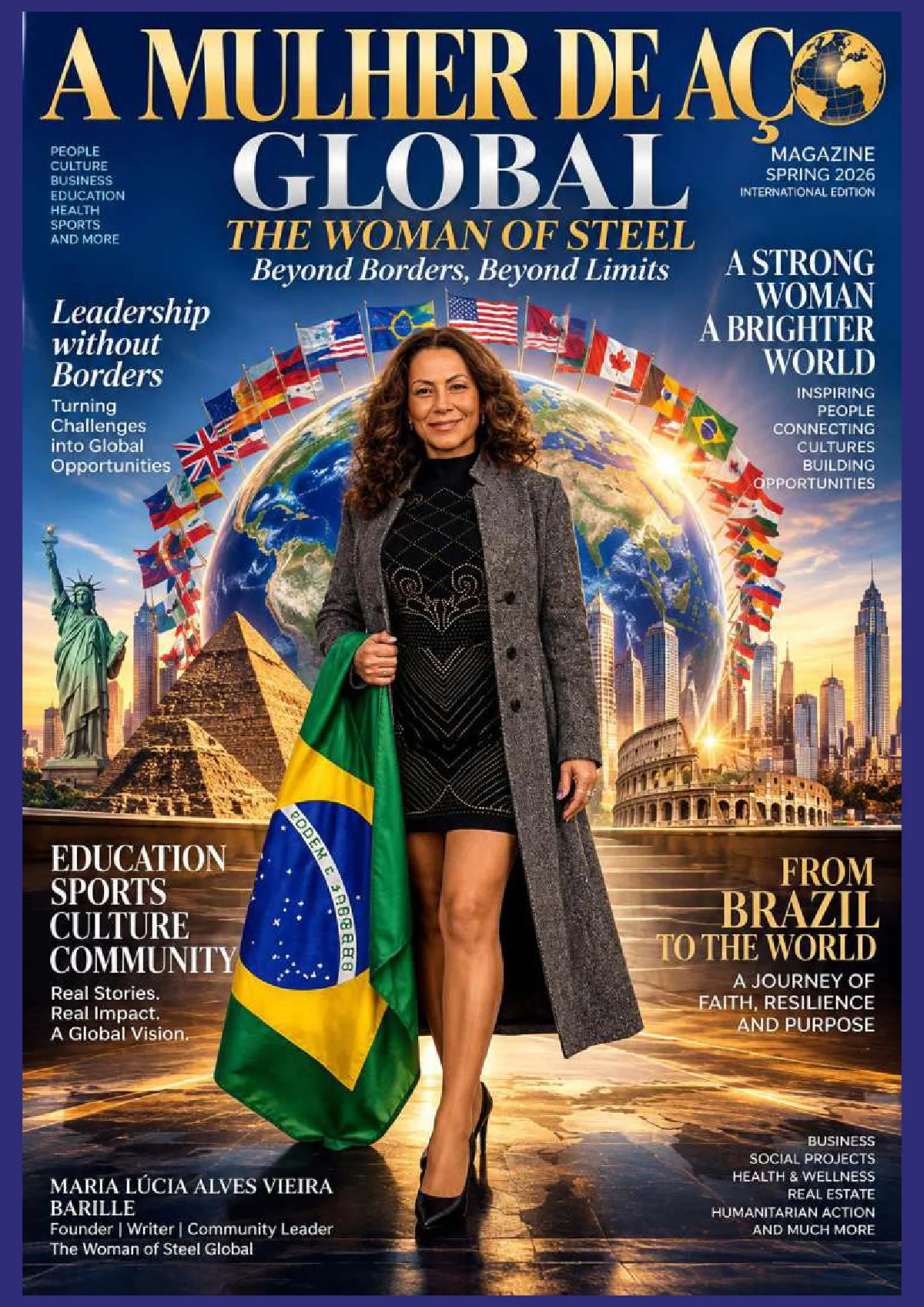
View MULHER DE AÇO GLOBAL pdf cru cru flipbook.
A MULHER DE AÇO | 1̃̂̂̃̂̃́̃̂ ̂̃́̃̃̃̃ ̂̂́̃̂́́ ̃̃ ̃̃́̃̂̂̃ ̂̃̃ ́̃̂ ̂́̃̃̂̃́̃ ̃ ́́
2 | NOVEMBRO 2026́̃̃̃
A MULHER DE AÇO | 3 CONTRA CAPA 1 # Expediente Diretora, redatora e gerente comercial: Maria Barille. © 2026 Maria Lúcia Alves Vieira. Todos os direitos reservados. Equipe Editorial:.... | Equipe produção: .... editorial@amulherdeaco.com. | www.amulherdeaco.com | Contatos: ??? Ano 0? - Edição 00? | novembro 2026̃ Meet Maria Barile Founder, President, and Editorial Director of A Mulher de Aço Magazine Maria Barile is a Brazilian author, entrepreneur, athletics coach, educator, and journalist whose work brings together sports, culture, and community leadership. She is the author of A Mulher de Aço, presented at the Rio de Janeiro International Book Fair in 2023, and has participated in literary and cultural events across the United States. Her journey includes recognition for international leadership, athletic achievements, and volunteer service to immigrant communities. As a supporter of the Artur Santiago Athletics School project in Africa, she believes in the power of education, sports, and solidarity to transform lives. Through A Mulher de Aço magazine, Maria seeks to inspire readers with stories of resilience, compassion, and positive change.
4 | NOVEMBRO 2026̂ ̂̃ THE WOMAN OF STEEL — WITHOUT BORDERS M for Maria. M for Mulher (Woman). M for Mãe (Mother). M for Muito Mais (So Much More). A story of struggle, achievement, and resilience. By Maria Barille | Editorial Director, Writer, and Editor A WOMAN WAS NOT BORN TO BE AN OBJECT. SHE WAS BORN TO MAKE HISTORY. 4
A MULHER DE AÇO | 5̂ ̂̃ THE IMPORTANCE OF WOMEN: A GLOBAL PERSPECTIVE To speak of the importance of women is to speak of the history of humanity itself. Behind the building of societies, the development of nations, cultural change, and many of humanity's greatest achieve- ments stand women whose intelligence, labor, cour- age, and determination helped shape the world. Yet those contributions have not always received the recognition they deserve. For centuries, in many parts of the world, women have lived under social systems that limited their rights, restricted their opportunities, and dictated how they should live, think, act, and even dream. Across cultures and historical periods, women have been treated as property or bargaining chips, as though their lives should be governed by men's deci- sions. Their intelligence was dismissed, their opin- ions went unheard, and their feelings were too often disregarded. But no woman has ever been merely what society permitted her to be. Behind an outward appearance of silence were dreams, knowledge, emotions, talents, and extraordinary strength—the kind of strength that endures across generations and helps change history. THE WOMAN AS A DECORATIVE VASE, A DRY LEAF IN THE WIND There was a time, in many societies, when a woman was treated like a decorative vase: an object to be admired, placed where others wanted her, moved at someone else's whim, and valued primarily for her appearance. But a woman is not a vase. She was not born to stand motionless while someone else decides where she belongs. She was not born to decorate another person's life at the expense of her own dreams. The restrictions imposed on women throughout history can also be compared to a dry leaf carried by the wind: a leaf that breaks away from a tree and drifts from place to place, unable to choose where it will land. Countless women were treated in much the same way. Others made decisions that determined the course of their lives. In many places, women could not choose whom to marry, did not have equal access to education or employment, and were excluded from political decision-making. Yet there is a fundamental difference between a dry leaf and a woman. The leaf is at the mercy of the wind; a woman, even in the midst of a storm, can find the strength to change the direction of her own story. That is exactly what millions of women have done. They resisted, questioned, learned, worked, and fought for change. Step by step, they began to trans- form institutions and attitudes that had seemed unchangeable for generations. CHALLENGES ACROSS GENERATIONS The history of women cannot be told through vic- tories alone. It must also acknowledge the injustices, losses, indignities, and obstacles that have marked their journeys. For much of history, in many societies, formal education was regarded as a privilege reserved for men. Women who wanted to study encountered resis- tance from their families, communities, and institu- tions. Many were educated almost exclusively to man- age a household, care for relatives, and fulfill domestic duties. How many aspiring women scientists were denied the opportunity to pursue their work because univer- sities would not admit them? How many women writ- ers were silenced? How many potential leaders were prevented from taking part in decisions affecting their communities? We cannot measure everything humanity lost when so many women were denied the chance to real- ize their potential. We can, however, recognize that inequality harmed more than women themselves. It deprived society of knowledge, discoveries, talent, and progress that might have benefited everyone. WOMEN CLAIM THEIR PLACE IN THE WORKFORCE Over time, women asserted their right to enter spaces from which they had long been excluded. Expanded access to education, movements for women's rights, and broader economic and social changes reshaped their participation in public life. Women entered universities, businesses, govern- ment institutions, international organizations, and professions traditionally dominated by men. They became physicians, engineers, scientists, attorneys, journalists, teachers, athletes, entrepreneurs, and political leaders. They also established themselves in construction, manufacturing, transportation, technology, and other industries where their abilities had once been ques- tioned simply because of their gender. These milestones represent far more than profes- sional advancement. They stand for independence, freedom of choice, and the right to help shape the economic and social future of nations. Still, gaining entry does not automatically bring equality. Some women continue to earn less than men
6 | NOVEMBRO 2026 in comparable circumstances, encounter barriers to leadership, or feel compelled to prove their compe- tence again and again to receive equal recognition. Others finish a full day of paid work only to return home to an unequal share of household and caregiving responsibilities. Opening doors is not enough. Women must be able to walk through them with dignity. THE WOMEN WHO BUILD OUR WORLD When we think of women who have changed his- tory, we often picture internationally celebrated fig- ures. But millions of women whose names may never appear in a history book have also helped build our world. They include agricultural workers who grow our food, health care professionals who care for the sick, and teachers who help children learn to read and write. They are women employed in cleaning, con- struction, retail, factories, and domestic work. They are mothers raising children under difficult circumstances, grandmothers helping support entire families, immigrant women leaving their homelands in search of safety and opportunity, and entrepre- neurs launching businesses with limited resources. The world must recognize that a woman's value does not depend on her social status, profession, appearance, or financial means. A woman who leads a major corporation deserves respect. So does the woman who cleans its floors. No honest occupation diminishes a person's dignity, and no position of power makes one person more worthy of human respect than another. M FOR MARIA. M FOR MULHER. M FOR MÃE. M FOR MUITO MAIS. A single letter can symbolize many dimensions of womanhood: M. A capital M. M for Maria. The name Maria appears across cul- tures, traditions, and generations. For millions of people, it also holds deep spiritual meaning. Here, Maria stands for women who face hardship without surrendering hope. M for Mulher—the Portuguese word for “woman.” A woman who thinks, feels, works, creates, builds, leads, and transforms. A woman who has the right to choose her own path. M for Mãe—the Portuguese word for “mother.” A mother who gives birth to a child or welcomes one into her life; who teaches, protects, and perseveres to create opportunities for her children. Yet motherhood is neither an obligation nor the only path to fulfill- ment. Every woman has inherent worth, dignity, and identity, whether or not she is a mother. M for Muito Mais—Portuguese for “so much more.” More than society tried to prescribe. More than prejudice allowed others to see. More than the limits imposed over generations. More than the hard- ships endured, tears shed in silence, dreams inter- rupted, and doors closed along the way. She can be a mother and an entrepreneur, an ath- lete and a writer, a teacher and a community leader. She can work in construction and lead a company. She can begin a career at twenty and discover a new calling at sixty. The M in Mulher is capitalized as a symbol of a dignity that must never be diminished. And one idea runs through this entire story: RESILIENCE AND OVERCOMING ADVERSITY. Overcoming barriers, prejudice, hardship, and injustice does not mean that every woman must be strong every moment of her life. It means that no woman should be denied the support, opportunities, or resources she needs to begin again. A WOMAN OF STEEL IS NOT A WOMAN WHO NEVER CRIES There is a persistent misconception that a strong woman must endure everything in silence—as though sadness were a weakness and asking for help were an admission of failure. But strength does not require anyone to conceal her emotions. A Woman of Steel can feel fear, disap- pointment, and pain. She, too, may need rest, protec- tion, compassion, and support. Steel is valued for its strength, yet it can also be shaped and transformed. In that sense, the Woman of Steel represents not only endurance but also the capacity to change and rebuild. She is the woman who finds a way forward after loss, rebuilds her life after a separation, seeks inde- pendence after years of financial dependence, returns to school, confronts illness, speaks out against injus- tice, or crosses borders in pursuit of a new beginning. A Woman of Steel need not be invincible. What she needs—and deserves—is the freedom to live in safety, with respect and dignity. A MESSAGE TO CITIZENS AND POLITICAL LEADERS To citizens, elected officials, government represen- tatives, public authorities, and leaders around the world: A nation's development cannot be measured by wealth, infrastructure, technological advances, or economic power alone. A society must also be judged by the way it treats women.
A MULHER DE AÇO | 7 What is economic growth worth if millions of women still face violence, discrimination, and limited opportunities? What does it mean to champion free- dom in public speeches while girls are denied an edu- cation? Respect for women must extend beyond Interna- tional Women's Day and election-season promises. It must be reflected in laws, classrooms, workplaces, hospitals, public institutions, and homes. Governments have a responsibility to advance policies that broaden access to education, address violence, strengthen social protections, and expand economic opportunities. Women living in poverty, older women, women with disabilities, immigrants, refugees, and women living in conflict zones must not be rendered invisible. Fundamental rights should never depend on nation- ality, income, or social position. This message also speaks to employers, educators, faith leaders, journalists, and families. Equality begins in everyday choices—in the way we raise chil- dren, treat one another, and value people's work. A society that fails to value women puts its own future at risk. EQUALITY IS NOT A BATTLE BETWEEN WOMEN AND MEN The pursuit of women's rights should not be framed as a contest over which gender is more valu- able. Women and men share equal human dignity. The goal is not to replace one form of domination with another. Real progress is possible when everyone can develop their abilities without unjust barriers. Men also have an important role in this transfor- mation: fathers who encourage their daughters to pursue education, husbands who respect their part- ners' independence, teachers who support girls' ambi- tions, and leaders who recognize women's contribu- tions. This is not about taking rights away from men. It is about ensuring that women are not denied theirs. Equality takes nothing away from human dignity; it creates opportunities for everyone. WOMEN TODAY AND THE GENER- ATIONS TO COME Every achievement by a woman can help clear a path for others. A girl who sees a woman succeeding in a profession once considered exclusively male may begin to imagine new possibilities for herself. A young woman who learns about pioneering women scientists may be inspired to study. A mother who returns to school can show her children that learning has no age limit. We must preserve women's stories: their experi- ences, struggles, and victories. Human history was not made only by kings, presidents, generals, and prominent male leaders. It was also shaped by women who worked, taught, defended rights, expanded knowledge, and transformed communities. Future generations deserve to know these stories. Without an understanding of the struggles that came before them, they may not fully appreciate the rights won through those efforts. F R O M A D R Y L E A F T O T H E A U T H O R O F H E R O W N S T O R Y Let us return to the image of the dry leaf blown by the wind. For generations, women were told that their destinies belonged in other people's hands. Others tried to decide how far women could go, which professions they could enter, which dreams they could pursue, and which choices they could make. They tried to reduce women's lives to some- thing decorative. But a woman was never simply a vase. Never merely a dry leaf. Never just a silent figure in history. Many barriers and injustices remain. Too many women still live without safety, freedom, or access to fundamental rights. That is why the work is far from finished. Recognition must not be reserved for a fortunate few while others remain overlooked. No woman should have to endure a lifetime of hardship simply to earn the right to be treated with respect. THE WOMAN OF STEEL — WITHOUT BORDERS: A VOICE FOR THE WORLD The mission of The Woman of Steel — Without Borders is to cross geographic and cultural bound- aries and recognize the importance of women in every part of the world. It is to honor their stories, bring their achieve- ments to light, confront the challenges they face, and defend human dignity. Brazilian, African, American, European, Asian, and Indigenous women. Women in great cities and rural communities. Women who cross oceans in search of opportunity, and women who stay where they are and work to transform their communities. Their obstacles are not identical, and their oppor- tunities are not equal. But every one of them deserves the right to live with dignity. CONCLUSION: THE CAPITAL M THE WORLD MUST RESPECT Woman. One word encompassing millions of sto- ries, dreams, challenges, and accomplishments. M for Maria. M for Mulher (Woman). M for Mãe
8 | NOVEMBRO 2026́̃ sumário 10 14 16 17 19 21 24 11
A MULHER DE AÇO | 9́̃
10 | NOVEMBRO 2026̃ Políca internacional
A MULHER DE AÇO | 11̃
12 | NOVEMBRO 2026̃ Políca internacional
A MULHER DE AÇO | 13̃ Economia Global
14 | NOVEMBRO 2026̃ ̂ Economia Global̂́
A MULHER DE AÇO | 15̃ ̂̂́ Ciência e tecnologia
16 | NOVEMBRO 2026̃ Ciência e tecnologiâ
A MULHER DE AÇO | 17̃̂ Mulheres que transformam
18 | NOVEMBRO 2026 EDUCAÇÃO
A MULHER DE AÇO | 19 Sport is far more than competition. It brings people together, strengthens communities, and creates opportunities for better physical, mental, and emotional health. When education, sports, and recreation are made accessible to everyone, they can enrich lives from early childhood through adolescence, adulthood, and old age. The goal is not simply to encourage exercise. It is to build a culture of participation—one in which every generation has the chance to learn, develop confidence, discover new interests, and experi- ence the joy of belonging. The foundation begins in childhood Schools have a unique opportunity to intro- duce children to the lifelong value of movement. Physical education can teach teamwork, persever- ance, respect, and self-confidence while helping young people develop healthy habits. Whether through swimming, soccer, volleyball, skate- boarding, athletics, or other activities, children should have the freedom to explore sports that match their interests and abilities. Families are equally important. A walk in the park, a weekend bicycle ride, or an afternoon spent playing together can turn recreation into a shared experience. When parents, teachers, and community organizations work together, physical activity becomes more than a school subject: it becomes part of everyday life. An active life has no age limit The benefits of participation do not end when childhood does. During adolescence and adult- Education, Sports, and Recreation: A Lifelong Path to Inclusion and Well-Being From the classroom to later life, opportunities to learn, move, and connect can help build healthier, more inclusive communities. By Maria Barile hood, sports and recreational activities can pro- vide opportunities to manage stress, maintain social connections, and support long-term health. Community races, group fitness classes, nature walks, mountain trail races, and supervised adventure activities such as rappelling can all offer a sense of purpose and accomplishment. There is no single way to be active. What mat- ters is offering safe, welcoming opportunities that reflect different levels of fitness, mobility, and experience. Inclusion means making room for the beginner as well as the experienced athlete. Growing older should not mean being left out Later life may bring physical changes, emo- tional challenges, and a greater risk of social isola- tion. Some older women struggle with loneliness, chronic pain, changes in self-image, or depres- sion. Some older men may be reluctant to seek psychological support. Unhealthy coping habits, including excessive drinking or smoking, can affect people of any gender. These challenges deserve compassion, access to care, and meaning- ful opportunities for connection—not stigma. Sports and recreation can be part of that sup- port. Walking groups, swimming, water aerobics, dance, adapted fitness programs, and age- appropriate team activities encourage movement while creating friendships. Even a game of chess in a public square can stimulate the mind and bring neighbors together. For those who enjoy more demanding pursuits, organized races, hik- ing, and other outdoor adventures may remain rewarding with appropriate preparation and guid-
20 | NOVEMBRO 2026 ance. People in their seventies, eighties, nineties, and beyond are demonstrating that later life can still be active, curious, and fulfilling. Regular physical activity is associated with important health benefits, including better mobility, improved well-being, and greater independence. It is not a cure for every illness, but it can be a valu- able part of healthy aging alongside appropriate medical and mental health care. Inclusion is a shared responsibility S c h o o l s , l o c a l g o v e r n m e n t s , s p o r t s organizations, healthcare professionals, and community leaders all have a role to play. Affordable programs, accessible public spaces, safe walking routes, trained instructors, and welcoming recreation centers can help remove barriers to participation. Programs should be designed not only for young athletes, but also for adults, older people, and individuals with disabilities. When communities invest in education, sports, and recreation, they invest in more than physical fitness. They create places where generations meet, where isolation gives way to companionship, and where people are reminded that they still have something to contribute. A simple invitation to begin A healthier, more inclusive society starts with opportunity. Invite a child to discover a sport. Encourage an adult to return to an activity they once loved. Welcome an older neighbor into a walking group or a game of chess. Small gestures can open the door to lasting change. The true value of sport is not measured only in medals, records, or victories. It is also m e a s u r e d i n c o n fi d e n c e r e g a i n e d , friendships formed, and lives enriched. At every age, everyone deserves the chance to take part.́ ̃
A MULHER DE AÇO | 21 Fazer um título com duas linhaś ̃ Health is the foundaon of a fulfilling life, and culvang well-being goes far beyond any single pracce. It requires a harmonious combinaon of physical acvity, balanced nutrion, quality sleep, and mental health care. Incorporang regular exercise into our daily rounes, even light physical acvity, strengthens the body, improves blood circulaon, and smulates the release of endorphins. A balanced diet provides the essenal nutrients our bodies need to funcon properly and maintain opmal health. Ensuring sufficient, restorave sleep is fundamental to physical recovery, emoonal stability, and overall well-being. Equally important is caring for our mental health. Pracces such as meditaon and therapy can help us navigate everyday challenges with greater resilience, emoonal balance, and peace of mind. Ulmately, embracing a holisc approach to health—one that nurtures the body, supports the mind, and encourages healthy daily habits—is the key to living a fuller, healthier, and happier life. Start today, one step at a me. SAÚDE E MEDICINA
22 | NOVEMBRO 2026̃ ̃̃ Esporte internacional
A MULHER DE AÇO | 23̃ ̃̃ Literatura mundial
24 | NOVEMBRO 2026́ Cultura e arte Culture is not confined to museums, libraries, or grand theaters. It lives in every neighborhood, village, city, and community. It is present in the food prepared for family gatherings, the songs remembered by grand- parents, the objects made by hand, and the stories passed from one generation to the next. To preserve culture is to recognize the dignity, imagination, and knowledge of the people who create it. Art, talent, and literature are inseparable parts of this living inheritance. One person shapes clay; another embroiders a tablecloth; someone else recounts a childhood memory or begins, late in life, to write the first letters of a name. Each expression is different, yet all carry the same extraordinary message: every human being has something to contribute to the world. The art of everyday life Traditional food is one of the most intimate forms of cultural memory. Recipes prepared with fish, cassava flour, and regional ingredients—including variations of pirão—can tell the story of families, landscapes, and Indigenous and other local influences. A dish is more than a meal when the knowledge behind it has been lovingly shared across generations. The same can be said of the homes people build. In various parts of the world, earth, clay, sand, and natural fibers have long been used to create practical dwellings, sometimes with other locally available binding materi- als. These structures reflect an understanding of the land and climate, as well as the ingenuity of their build- ers. They bring to mind the Brazilian rufous hornero, known as the joão-de-barro, whose carefully formed mud nest is itself a remarkable work of natural archi- tecture. What may appear simple from a distance often con- tains generations of experimentation, skill, and adap- Talent, Art, Culture, and Literature: The Stories Our Hands Keep Alive From golden-grass weaving and clay pottery to handmade lace and the first written letter of a name, cultural heritage is shaped by human creativity —and renewed through the power of learning. By Maria Barile tation. A hand-built home, a woven mat, or an embroi- dered cloth deserves to be seen not as a relic of poverty, but as an expression of knowledge, resourcefulness, and identity. Hands that weave a nation's memory In the Jalapão region of Tocantins, Brazil, the shim- mering stems of golden grass, known as capim- dourado, are harvested and woven into baskets, acces- sories, and decorative objects. The craft is especially associated with the Mumbuca community, where knowledge has been carried across generations. Every finished piece represents more than beauty: it reflects patience, cultural continuity, and the relationship between people and the land. In the Jequitinhonha Valley of Minas Gerais, arti- sans transform clay into pots, figurines, and sculptural expressions of daily life. In Espírito Santo, the cele- brated clay-pot makers of Goiabeiras preserve a dis- tinctive tradition of hand-shaped cookware. Elsewhere in Bahia and across Brazil, clay, stone, fiber, and wood become objects of everyday use and works of art, each rooted in its own regional history. In northeastern Brazil, lacemakers guide wooden bobbins across intricate patterns, creating delicate pieces that preserve techniques learned from earlier generations. Embroidered linens, grass mats, patch- work quilts, and cushion covers assembled from small fabric rosettes—the craft known as fuxico—show how imagination can give new life to ordinary materials. Maranhão, Ceará, Pernambuco, and many other places contribute their own colors, rhythms, and traditions to this vast artistic landscape. Beyond Brazil, textile and woodcraft traditions
A MULHER DE AÇO | 25́ flourish in communities across Latin America, Africa, and Asia. From the Andes to Angola, and from Para- guay to India and Vietnam, handmade objects offer different expressions of memory and belonging. These traditions should not be treated as interchangeable: each deserves to be understood in its own cultural con- text and valued for the people who keep it alive. When literature reaches the doorstep For generations, access to formal schooling and printed books has been unequal, particularly in iso- lated or underserved communities. In some house- holds, a Bible carried by a visiting priest or pastor may have been among the few books people encountered. Yet even where printed pages were scarce, stories sur- vived through speech, song, prayer, and shared experi- ence. Oral tradition is also a form of literature—a library carried in human memory. Television expanded horizons for many families; later, mobile phones and digital media opened new paths to information, reading, and connection. Tech- nology does not erase the barriers of poverty, limited connectivity, or interrupted education. But when it is accessible and accompanied by encouragement and teaching, it can help someone discover a story, hear a poem, follow a lesson, or take the first steps toward literacy. Imagine a woman who has spent decades making beautiful objects with her hands, yet was never given the opportunity to attend school. At sixty, seventy, or eighty, she begins to trace the first letter of her name. That small mark on a page can carry the weight of an entire lifetime: determination, hope, pride, and the joy of a door finally opening. Literacy belongs to no single age. The right to learn, like the capacity to create, lasts a lifetime. Preserving the past while opening the future Safeguarding cultural heritage means more than admiring the final product. It means supporting arti- sans fairly, respecting Indigenous and traditional knowledge, protecting the materials and places on which crafts depend, and making room for younger generations to learn. It also means ensuring that older adults and people who missed formal education can find welcoming opportunities to read and write. A community flourishes when its artists are visible, its traditions are respected, and its people can partici- pate in literature and learning. The fingers that shape a clay vessel, weave golden grass, sew a quilt, or turn the page of a first book are all part of the same human story. Talent gives shape to imagination. Art makes that imagination visible. Culture gives it roots. Literature gives it a voice. Together, they preserve who we are—and make room for who we may yet become.
26 | NOVEMBRO 2026 DIREITOS HUMANOS Women's voices, the freedom to choose, and the pursuit of a future free from violence. By Maria Barile Human Rights: Dignity Knows No Borders
A MULHER DE AÇO | 27 The right to live with dignity There is a right that does not always make a sound, yet deserves to be heard everywhere: the right to live with dignity. It belongs to the new- born girl, the woman shaping her own story, the mother protecting her children, the grand- mother preserving memories, the great- grandmother passing on wisdom, and every per- son seeking respect along life's journey. Human rights are not favors granted to the fortunate. They belong to us all. No one chooses where they are born, the cir- cumstances of their family, or the borders they may one day encounter. We enter the world through a woman's body, amid pain and hope, without asking to inherit inequality, prejudice, or violence. We are born with the right to life, lib- erty, security, and the chance to dream. When violence tries to silence a life Yet in too many homes, dignity remains under threat. Domestic violence can turn a place meant to offer shelter into a place of fear. Women and girls may see their freedom restricted, their words dismissed, and their plans cut short. Behind every story is a whole person: someone with a name, a family name, desires, talents, and a future worth protecting. We must never accept as normal a woman having to weigh every word to avoid an assault, a girl growing up believing she has no right to decide, or a mother remaining silent because she fears she will not be heard. Violence is not a tra- dition to preserve, nor a private matter to over- look. It is a violation of human dignity that calls for protection, support, justice, and prevention. In different parts of the world, some girls and women are still subjected to forced unions, mar- riage-related pressure, or practices that deny them free choice. No custom should be used to justify taking away someone's right to determine the course of their own life. The freedom to choose, the freedom to live A woman is no one's property. She has the right to study, to work, to express her ideas, to choose whom she shares her life with, and to shape her own future. She has the right to say “yes,” to say “no,” and, above all, to have both choices respected. Human rights also mean access to education, healthcare, clean water, protection, and mean- ingful opportunity. Dignity must reach those who live in great cities and those who draw a cup of water from a deep well; those who cross rivers and oceans and those who have never had the opportunity to leave their communities. Geo- graphic distance does not diminish the value of a human life. A voice that crosses borders For generations, voices were stifled behind closed doors. But no wall can erase the human need for freedom forever. There is a strength that endures, even when it seems reduced to dust: the strength of someone who rises to declare that they exist, that they feel, that they think, and that they deserve to be heard. A woman has a voice. She has a story, a title, a subtitle, a first name, and a family name. She is more than the pain she has endured or the silence imposed upon her. She is the author of dreams, a keeper of knowledge, and an essential part of building a more just society. The legacy we choose to leave May our daughters and sons inherit the free- dom to walk without humiliation, to learn with- out barriers, and to love without coercion. The peace we envision for tomorrow begins with the respect we extend to others today. Protecting human rights is the responsibility of families, communities, institutions, and gov- ernments. It begins when we listen to those who have been silenced, challenge discrimination, and turn respect into meaningful action. May no girl have her dreams bargained away. May no woman be condemned to silence or forced to choose between her freedom and her safety. May no human being have to plead for the right to live with respect and dignity. We were not born for violence, but for love. We were not born to bear the chains of fear, but to forge paths toward peace and hope. May we leave future generations a legacy of justice, equality, and freedom. Because human dignity knows no bor- ders. It does not distinguish between nationalities, skin colors, religions, or social backgrounds. It has a face, a story, a first name, a family name—and, above all, a voice. No voice should ever be silenced.
28 | NOVEMBRO 2026̃ MEIO AMBIENTE The Earth Is Crying Out Nature, Human Responsibility, and the Urgency of Sustainability From the wisdom of fallen leaves to the suffering caused by pollution, the planet reminds us that caring for the soil is inseparable from caring for humanity. By Maria Barile
A MULHER DE AÇO | 29̃ The breath of life Nature is the breath of life and the heartbeat of our shared home. The wind comes from every direction, moving through the trees, carrying the promise of renewal. It loosens the leaves whose season has ended and lays them gently upon the earth. What may appear to be the end of a cycle is, in fact, the beginning of another. Those fallen leaves have a purpose. As they decom- pose, they become part of the organic matter that sus- tains living soil. Nature wastes very little: it trans- forms, renews, and returns. In this quiet process lies a lesson that humanity can no longer afford to ignore. Sustainability does not begin with grand speeches. It begins with respect for the earth beneath our feet. When progress leaves people behind We live in an age of astonishing scientific and technological advances, yet too many communities still face polluted waterways, inadequate sanitation, and waste exposed to the open air. Children must sometimes cross contaminated streets and play in places where basic environmental protections are absent. This is not a tragedy confined to Africa, Brazil, Latin America, or Asia. It is a challenge that concerns the entire world. How can we celebrate progress while looking away from such suffering? Public authorities, businesses, and citizens all have responsibilities. Safe drinking water, effective sewage treatment, responsible waste collection, and the protection of vulnerable communi- ties are not luxuries. They are foundations of public health, human dignity, and a sustainable future. From dust, a reminder of our origins The biblical account of creation offers a powerful image of our connection to the earth. In Genesis, Adam is formed from the dust of the ground, and Eve enters the story through the creation of a companion from his side. The serpent and the forbidden fruit introduce questions of temptation, choice, and consequence. Beyond the different ways people interpret this account, the image of humanity emerging from the earth invites reflection: we are not separate from nature. The same soil that supports our footsteps helps pro- duce the food we eat, the fruit we sell, and the harvest we share. To damage it carelessly is to endanger something on which every generation depends. And if the earth could speak, perhaps its voice would be a cry for help. A wounded earth can sll be restored Soil can be exhausted by erosion, pollution, and agricultural practices that do not protect its long-term health. Pesticides can have legitimate uses in crop protection, but unsafe or excessive exposure to certain chemicals can damage ecosystems and threaten human health. Some exposures have been linked to serious illnesses, including particular cancers; the risks depend on the substance and the conditions of exposure. That is why science, monitoring, proper regulation, and safer farming practices matter. There is also wisdom in everyday actions. Dry leaves, fruit and vegetable scraps, and crushed egg- shells can be returned to the natural cycle through composting when handled properly. A well-managed compost pile turns suitable organic material into a soil amendment that helps improve soil structure, retain moisture, and support plant growth. Banana and orange peels need not be treated as worthless rubbish: with care, they can become part of this renewal. Composting alone cannot solve environmental degradation, just as one household cannot repair a polluted river. But small acts become powerful when supported by public policy, responsible agriculture, environmental education, and collective commitment. What we owe the generaons to come The earth does not belong only to those living today. It is also the inheritance of children who have not yet taken their first steps. We owe them rivers that are not open sewers, soil capable of sustaining food, and communities where the air, water, and land are protected rather than sacrificed. For some, the final passage of life is marked by burial; for others, by cremation. Both can call to mind the same ancient truth: our bodies are part of the natu- ral world, and one day we return to its elements. “From dust we came, from dust we are nourished, and to dust we shall return.” More than a reflection on our existence, these words call us to humility and respon- sibility toward the earth that sustains life. Let us heed that call while there is still time. Let us protect our forests and waterways, handle waste responsibly, safeguard the people most exposed to pollution, and restore the health of the soil. The earth feeds us, shelters us, and receives us at the end of our journey. Yet between life's first breath and the heart's final beat, we are entrusted with a mission: to protect the land that feeds us, the water that sustains us, and the natural world that embraces us. May future generations inherit not a wounded earth, but a planet where life continues to flourish. For caring for the Earth is more than an environ- me
30 | NOVEMBRO 2026 In Rio Grande do Norte, Brazil, several hidden gems evoke the natural beauty and tranquility of Ireland. Among them are Lagoa do Carcará, in Nísia Floresta, known for its calm waters and surrounding dunes; Parque das Dunas, in Natal, considered the second-largest urban park in Brazil; and Barra do Cunhaú, a charming fishing village where the river meets the sea, offering an ideal desnaon for water sports enthusiasts and nature lovers. Lagoa do Carcará – A Hidden Paradise in Nísia Floresta Located in the municipality of Nísia Floresta, Lagoa do Carcará is a peaceful retreat surrounded by picturesque dunes and calm, greenish waters. Its serene atmosphere makes it an ideal desnaon for travelers seeking relaxaon and a deeper connecon with nature. The surrounding landscape features small scenic viewpoints, nave vegetaon characterisc of the region, and the rusc charm of a nearly untouched village. This combinaon of natural beauty and tranquility makes Lagoa do Carcará a truly special desnaon. Visitors can enjoy a variety of outdoor acvies, including kayaking and stand-up paddleboarding, while taking in the lagoon's breathtaking scenery. Along the shoreline, charming small inns and local restaurants offer visitors an opportunity to experience authenc regional cuisine and warm Brazilian hospitality. Lagoa do Carcará also serves as an excellent starng point for exploring nearby beaches, which share the same peaceful atmosphere and remarkable natural beauty. How to Get to Lagoa do Carcará For travelers deparng from Currais Novos, the most common route is to head toward the municipality of Nísia Floresta, located approximately 40 kilometers (25 miles) from Natal, the capital of Rio Grande do Norte. From there, travelers can follow the BR-101 highway and then take either the RN-003 or RN-063 state highway, connecng to the unpaved road that leads to the lagoon. Visitors should exercise cauon, as road signage in the area can be limited, parcularly along the final stretch of the journey. For a more convenient and comfortable experience, many travelers choose guided tours, which provide local knowledge and assistance in navigang the route. With its peaceful waters, beauful dunes, authenc regional culture, and welcoming atmosphere, Lagoa do Carcará offers an unforgeable experience for anyone wishing to discover one of Rio Grande do Norte's hidden natural treasures. TURISMO INTERNACIONAL Lagoa
A MULHER DE AÇO | 31 In Rio Grande do Norte, Brazil, there are hidden gems that recall Ireland's natural beauty. Among them are Lagoa do Carcará, in Nísia Floresta, with its calm waters and dunes; Parque das Dunas, in Natal, the second-largest urban park in Brazil; and Barra do Cunhaú, a fishing village where the river meets the sea, ideal for water sports and nature lovers. Located in the municipality of Nísia Floresta, Lagoa do Carcará is a peaceful retreat surrounded by picturesque dunes and calm, greenish waters. It's the perfect spot for travelers seeking tranquility and a close connecon with nature. In addion to its serene waters, the lagoon is surrounded by small scenic viewpoints and nave vegetaon. The rusc charm of the nearly untouched village enhances the sense of escape, making it a truly special desnaon. Visitors can enjoy acvies such as kayaking and stand-up paddleboarding, all while taking in the breathtaking natural scenery. Along the shore, small inns and local restaurants serve regional cuisine, offering a taste of authenc local flavors. Lagoa do Carcará, is also an excellent starng point for exploring nearby beaches, which share the same peaceful atmosphere and striking natural beauty. For those traveling from Currais Novos, the most common route is to head toward Nísia Floresta, about 40 kilometers from Natal. From there, travelers can follow the BR-101 and then take the RN- 003 or RN-063 to the access road leading to the lagoon. Care is advised due to limited signage, and many visitors choose a guided tour for convenience and local insight. With its tranquil waters, stunning dunes, and warm, authenc atmosphere, Lagoa do Carcará promises an unforgeable experience for anyone looking to discover one of Rio Grande do Norte's hidden natural treasures. do Carcará
32 | NOVEMBRO 2026̂̂̃ ̂ Gastronomia mundial
A MULHER DE AÇO | 33̂̂̃ ̂
34 | NOVEMBRO 2026 Entrevista especial̃
A MULHER DE AÇO | 35̃
36 | NOVEMBRO 2026̃ ́̃̂ ̂
A MULHER DE AÇO | 37̃ ́̃̂ ̂ Conexão global
38 | NOVEMBRO 2026́
A MULHER DE AÇO | 39́
40 | NOVEMBRO 2026