Copy of KIAR MALAYSIA CASE
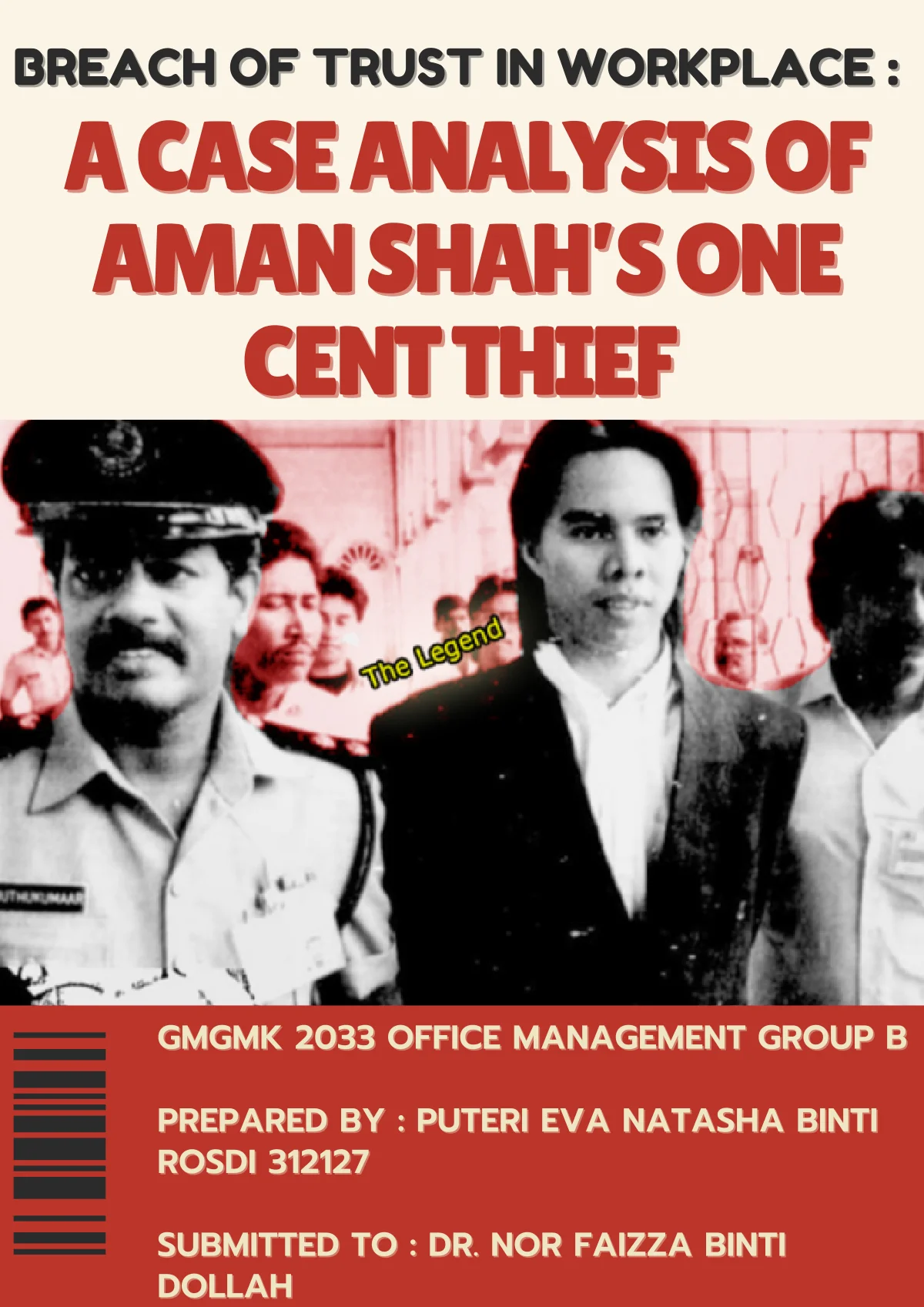
GMGMK 2033 OFFICE MANAGEMENT GROUP BGMGMK 2033 OFFICE MANAGEMENT GROUP B PREPARED BY : PUTERI EVA NATASHA BINTIPREPARED BY : PUTERI EVA NATASHA BINTI ROSDI 312127ROSDI 312127 SUBMITTED TO : DR. NOR FAIZZA BINTISUBMITTED TO : DR. NOR FAIZZA BINTI DOLLAHDOLLAH GMGMK 2033 OFFICE MANAGEMENT GROUP B PREPARED BY : PUTERI EVA NATASHA BINTI ROSDI 312127 SUBMITTED TO : DR. NOR FAIZZA BINTI DOLLAHA CASE ANALYSIS OFA CASE ANALYSIS OF AMAN SHAH’S ONEAMAN SHAH’S ONE CENT THIEFCENT THIEF A CASE ANALYSIS OF AMAN SHAH’S ONE CENT THIEF BREACH OF TRUST IN WORKPLACE :BREACH OF TRUST IN WORKPLACE :BREACH OF TRUST IN WORKPLACE :
INCIDENT OVERVIEW1 TABLE OFTABLE OF CONTENTSCONTENTS TABLE OF CONTENTS ETHICAL OR PROFESSIONAL ISSUES 2 CONTRIBUTING FACTORS3 AFFECTED STAKEHOLDERS AND CONSEQUENCES 4 RECOMMENDED SOLUTIONS5 REFERENCES 6 7 8 CASE CONCLUSION EMPLOYEES GUIDELINES FLOWCART
Between January and March 1990, Aman Shah was involved in unauthorised financial transactions involving approximately RM4.01 million. The Kuala Lumpur Sessions Court found him guilty of seven counts of criminal breach of trust under Section 408 of the Penal Code. Between January and March 1990, Aman Shah was involved in unauthorised financial transactions involving approximately RM4.01 million. The Kuala Lumpur Sessions Court found him guilty of seven counts of criminal breach of trust under Section 408 of the Penal Code.INCIDENT OVERVIEWINCIDENT OVERVIEWINCIDENT OVERVIEW Aman Shah Ahmad was a former bank employee at Hock Hua Bank in Malaysia. He became widely known after being involved in a major financial misconduct case in 1990. His case highlighted the risks of employees misusing their professional positions and access to banking systems. Aman Shah Ahmad was a former bank employee at Hock Hua Bank in Malaysia. He became widely known after being involved in a major financial misconduct case in 1990. His case highlighted the risks of employees misusing their professional positions and access to banking systems. His luxurious lifestyle attracted the attention of his former employer. Following suspicions, the bank conducted an internal audit and discovered suspicious financial transactions. A police report was subsequently lodged on 8 June 1990. His luxurious lifestyle attracted the attention of his former employer. Following suspicions, the bank conducted an internal audit and discovered suspicious financial transactions. A police report was subsequently lodged on 8 June 1990. Who was Aman Shah?What Happened ? How was it discovered?
Aman Shah violated integrity when he was involved in the unauthorised transfer of approximately RM4.01 million belonging to Hock Hua Bank. His actions contradicted the honesty expected of a banking employee. Aman Shah violated integrity when he was involved in the unauthorised transfer of approximately RM4.01 million belonging to Hock Hua Bank. His actions contradicted the honesty expected of a banking employee. As a banking employee, Aman Shah was responsible for handling financial transactions properly. His involvement in the criminal breach of trust case showed a failure to fulfil his professional responsibilities. As a banking employee, Aman Shah was responsible for handling financial transactions properly. His involvement in the criminal breach of trust case showed a failure to fulfil his professional responsibilities. Hock Hua Bank entrusted Aman Shah with access to its financial operations. However, the case demonstrated how his actions violated the trust placed in him by the organisation. Hock Hua Bank entrusted Aman Shah with access to its financial operations. However, the case demonstrated how his actions violated the trust placed in him by the organisation. His access to the bank’s financial system required responsible handling of financial information and resources. The case highlights the importance of preventing unauthorised use of banking access. His access to the bank’s financial system required responsible handling of financial information and resources. The case highlights the importance of preventing unauthorised use of banking access. ETHICAL ORETHICAL OR PROFESSIONAL ISSUESPROFESSIONAL ISSUES ETHICAL OR PROFESSIONAL ISSUES ABUSE OF TRUST ANDABUSE OF TRUST AND PROFESSIONAL RESPONSIBILITYPROFESSIONAL RESPONSIBILITY ABUSE OF TRUST AND PROFESSIONAL RESPONSIBILITYINTERGRITY ACOUNTABILITYCONFIDENTIALITYTRUSTWORTHIINESS
Aman Shah’s position provided access to banking transaction processes. Without proper restrictions and supervision, such access may create opportunities for employees to misuse their authority for personal benefit.WHAT CONTRIBUTED TO THE INCIDENT?WHAT CONTRIBUTED TO THE INCIDENT?WHAT CONTRIBUTED TO THE INCIDENT? CONTRIBUTINGCONTRIBUTING FACTORSFACTORS CONTRIBUTING FACTORS Financial transactions should involve different employees for processing and approval. The reported unauthorised transfers in this case highlight the importance of independent verification to prevent one employee from having excessive control. Regular internal audits are important to identify financial irregularities and weaknesses in organisational procedures. This case highlights the need for independent reviews to ensure that financial activities are properly monitored 1) PRIVILEGED SYSTEM ACCESS 2) INSUFFICIENT TRANSACTION MONITORING Banks must regularly monitor financial transactions to identify unusual activities. Effective monitoring could help detect suspicious transfers earlier and reduce the risk of further financial losses. 3) WEAK SEGREGATION OF DUTIES 4) WEAK INTERNAL AUDITING
BANK BUMIPUTRABANK BUMIPUTRA MALAYSIA BERHADMALAYSIA BERHAD BANK BUMIPUTRA MALAYSIA BERHAD HOCK HUAHOCK HUA BANK’SBANK’S MANAGEMENTMANAGEMENT HOCK HUA BANK’S MANAGEMENT The bank suffered a financial lossThe bank suffered a financial loss involving approximately RM4.01involving approximately RM4.01 million due to the criminal breach ofmillion due to the criminal breach of trust committed by Aman Shah. Thetrust committed by Aman Shah. The incident also affected its financialincident also affected its financial operations and organisationaloperations and organisational reputation.reputation. The bank suffered a financial loss involving approximately RM4.01 million due to the criminal breach of trust committed by Aman Shah. The incident also affected its financial operations and organisational reputation. Aman Shah faced legal consequences after being found guilty of seven criminal breach of trust offences under Section 408 of the Penal Code. He was sentenced to five years’ imprisonment in 1990.This bank was involved because the transferred funds were deposited into an account belonging to Bistro Advertising Agency held at the bank. Its account records formed part of the financial transaction trail. The bank’s management had toThe bank’s management had to investigate the missing funds,investigate the missing funds, conduct internal audits and reportconduct internal audits and report the incident to the police. The casethe incident to the police. The case also exposed the importance ofalso exposed the importance of reviewing the bank’s financialreviewing the bank’s financial transaction controls.transaction controls. The bank’s management had to investigate the missing funds, conduct internal audits and report the incident to the police. The case also exposed the importance of reviewing the bank’s financial transaction controls.AFFECTEDAFFECTED STAKEHOLDERSSTAKEHOLDERS AFFECTED STAKEHOLDERS HOCK HUAHOCK HUA BANKBANK HOCK HUA BANK AMAN SHAHAMAN SHAH AHMADAHMAD AMAN SHAH AHMAD The police became involved after aThe police became involved after a report was made concerning thereport was made concerning the missing funds. They were responsiblemissing funds. They were responsible for investigating the alleged financialfor investigating the alleged financial misconduct and gathering evidence formisconduct and gathering evidence for legal proceedingslegal proceedings The police became involved after a report was made concerning the missing funds. They were responsible for investigating the alleged financial misconduct and gathering evidence for legal proceedings POLICE / LAWPOLICE / LAW ENFORCEMENTENFORCEMENT POLICE / LAW ENFORCEMENT
RECOMMENDEDRECOMMENDED SOLUTIONSSOLUTIONS RECOMMENDED SOLUTIONS STRICT ACCESS CONTROLSTRICT ACCESS CONTROLSTRICT ACCESS CONTROLBanks should limit access to financial systems according to employees’ job responsibilities. Only authorised employees should be allowed to perform specific transactions, while sensitive functions should require additional approval. This can reduce the risk of employees misusing their positions or transferring funds without permission. Every high-value or unusual financial transaction should require approval from at least two authorised officers. One employee handles the transaction, while another independently verifies and approves it. This creates shared responsibility and prevents a single employee from having complete control over the movement of funds. Banks should conduct regular and independent internal audits to examine financial records, transaction histories and employees’ activities. Auditors must verify that every transaction is properly authorised and supported by valid documentation. Any irregularities should be reported immediately to management for investigation and corrective action. DUAL AUTHORISATION SYSTEMDUAL AUTHORISATION SYSTEMDUAL AUTHORISATION SYSTEM CONTINUOUS TRANSACTION MONITORINGCONTINUOUS TRANSACTION MONITORINGCONTINUOUS TRANSACTION MONITORING Banks should use automated monitoring systems to identify unusual transactions, repeated transfers and suspicious financial activities. Any transaction that exceeds a certain limit or shows unusual patterns should automatically be flagged for further investigation. Early detection can help prevent further unauthorised transfers and reduce financial losses. REGULAR INTERNAL AUDITINGREGULAR INTERNAL AUDITINGREGULAR INTERNAL AUDITING
CASE CONCLUSIONCASE CONCLUSIONCASE CONCLUSIONThe Aman Shah Ahmad case highlights the serious consequences of unethical behaviour and the misuse of authority in the workplace. His involvement in seven criminal breach of trust offences, involving approximately RM4.01 million belonging to Hock Hua Bank, demonstrated a failure to uphold integrity, accountability and professional responsibility. His conviction and five-year prison sentence also show that financial misconduct can lead to serious legal consequences and damage an organisation’s trust. In conclusion, this case emphasises the importance of strong internal controls, proper supervision, regular auditing and ethical conduct among employees. Every organisation must ensure that financial transactions are properly monitored and that employees understand their responsibilities. Most importantly, employees must use their authority honestly and professionally because trust is earned through integrity, but it can be destroyed by a single act of misconduct.
REFERENCES Radhakrishna, G., & Pointon, L. (2007, February). Fraud in internet banking: A Malaysian legal perspective. The IUP Journal of Bank Management. https://iupindia.in/207/IJBM_FraudinInternet_47.html Hassan, N. A. (2024, July 26). Insiden pegawai bank songlap duit pelanggan. Sinar Harian. https://www.sinarharian.com.my/article/676929/berita/ nasional/insiden-pegawai-bank-songlap-duit- pelanggan Muhamud, F. S., & Abu Bakar, N. A. (2024). Identity theft: Issues and challenges from Islamic finance perspective. Jurnal ‘Ulwan, 9(1), 42–53. https://ejournal.unimel.edu.my/index.php/JULWAN/articl e/download/1672/1331/2967 Media Mulia. (2021, January 3). Aman Shah dakwa dicari menteri, bank. Utusan Malaysia. https://www.utusan.com.my/nasional/2021/01/aman- shah-dakwa-dicari-menteri-bank/ Bank for International Settlements. (2024). The core principles and assessment criteria: Principle 26— Internal control and audit. https://www.bis.org/committees/bcbs/basel- framework/standard/bcp/40/inforce/2024-04- 25/published/2024-04-25
THAT’S ALL THANK YOU !!