SJNHS THEMEDALLION
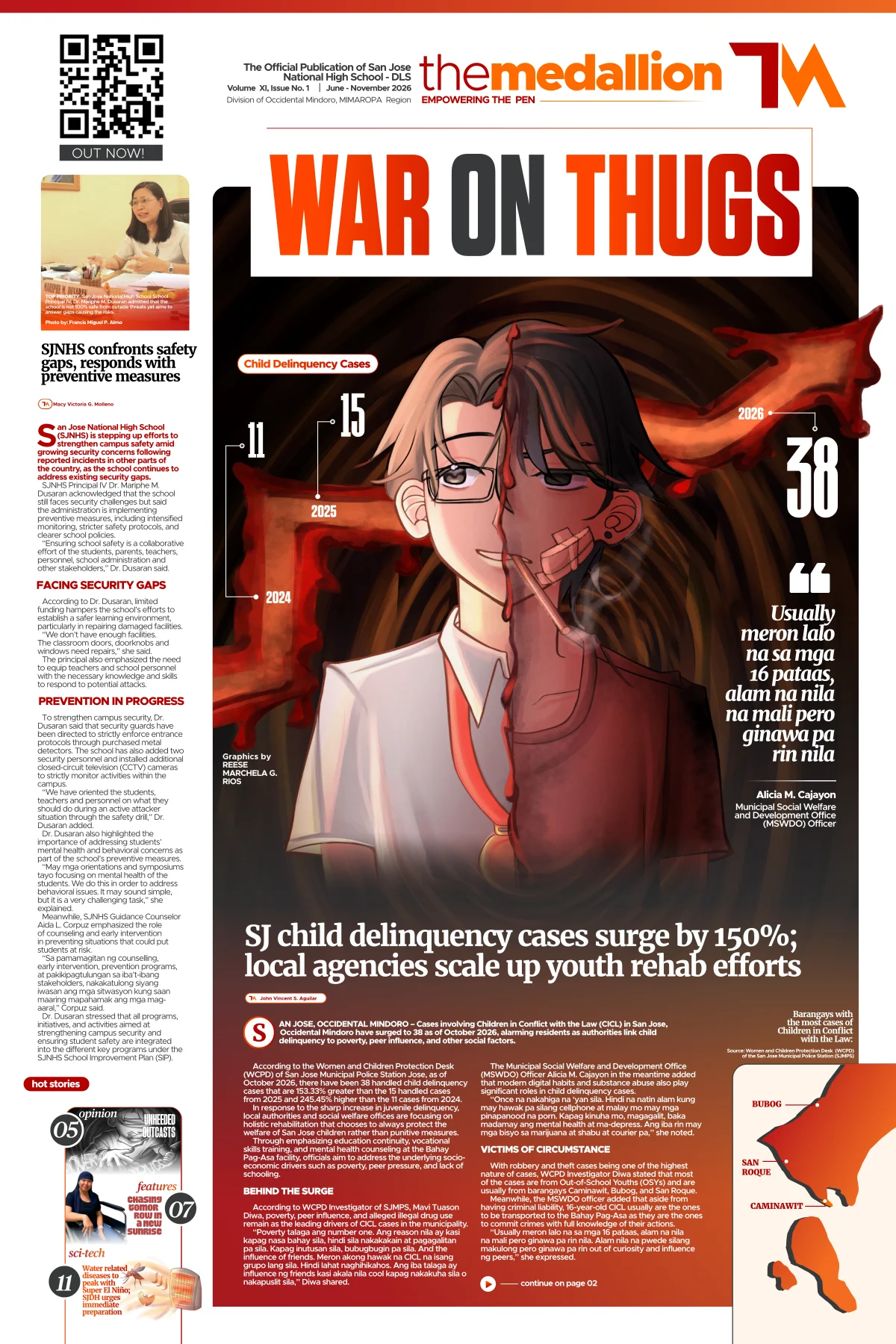
themedallionEMPOWERING THE PEN The Official Publication of San Jose National High School - DLS Division of Occidental Mindoro, MIMAROPA Region Volume XI, Issue No. 1 June - November 2026SJ child delinquency cases surge by 150%; local agencies scale up youth rehab efforts San Jose National High School (SJNHS) is stepping up efforts to strengthen campus safety amid growing security concerns following reported incidents in other parts of the country, as the school continues to address existing security gaps. SJNHS Principal IV Dr. Mariphe M. Dusaran acknowledged that the school still faces security challenges but said the administration is implementing preventive measures, including intensified monitoring, stricter safety protocols, and clearer school policies. “Ensuring school safety is a collaborative effort of the students, parents, teachers, personnel, school administration and other stakeholders,” Dr. Dusaran said. According to Dr. Dusaran, limited funding hampers the school’s efforts to establish a safer learning environment, particularly in repairing damaged facilities. “We don’t have enough facilities. The classroom doors, doorknobs and windows need repairs,” she said. The principal also emphasized the need to equip teachers and school personnel with the necessary knowledge and skills to respond to potential attacks. To strengthen campus security, Dr. Dusaran said that security guards have been directed to strictly enforce entrance protocols through purchased metal detectors. The school has also added two security personnel and installed additional closed-circuit television (CCTV) cameras to strictly monitor activities within the campus. “We have oriented the students, teachers and personnel on what they should do during an active attacker situation through the safety drill,” Dr. Dusaran added. Dr. Dusaran also highlighted the importance of addressing students’ mental health and behavioral concerns as part of the school’s preventive measures. “May mga orientations and symposiums tayo focusing on mental health of the students. We do this in order to address behavioral issues. It may sound simple, but it is a very challenging task,” she explained. Meanwhile, SJNHS Guidance Counselor Aida L. Corpuz emphasized the role of counseling and early intervention in preventing situations that could put students at risk. “Sa pamamagitan ng counselling, early intervention, prevention programs, at pakikipagtulungan sa iba’t-ibang stakeholders, nakakatulong siyang iwasan ang mga sitwasyon kung saan maaring mapahamak ang mga mag- aaral,” Corpuz said. Dr. Dusaran stressed that all programs, initiatives, and activities aimed at strengthening campus security and ensuring student safety are integrated into the different key programs under the SJNHS School Improvement Plan (SIP).John Vincent S. AguilarMacy Victoria G. Molleno “Usually meron lalo na sa mga 16 pataas, alam na nila na mali pero ginawa pa rin nila According to the Women and Children Protection Desk (WCPD) of San Jose Municipal Police Station Jose, as of October 2026, there have been 38 handled child delinquency cases that are 153.33% greater than the 15 handled cases from 2025 and 245.45% higher than the 11 cases from 2024. In response to the sharp increase in juvenile delinquency, local authorities and social welfare offices are focusing on holistic rehabilitation that chooses to always protect the welfare of San Jose children rather than punitive measures. Through emphasizing education continuity, vocational skills training, and mental health counseling at the Bahay Pag-Asa facility, officials aim to address the underlying socio- economic drivers such as poverty, peer pressure, and lack of schooling. According to WCPD Investigator of SJMPS, Mavi Tuason Diwa, poverty, peer influence, and alleged illegal drug use remain as the leading drivers of CICL cases in the municipality. “Poverty talaga ang number one. Ang reason nila ay kasi kapag nasa bahay sila, hindi sila nakakakain at pagagalitan pa sila. Kapag inutusan sila, bubugbugin pa sila. And the influence of friends. Meron akong hawak na CICL na isang grupo lang sila. Hindi lahat naghihikahos. Ang iba talaga ay influence ng friends kasi akala nila cool kapag nakakuha sila o nakapuslit sila,” Diwa shared. The Municipal Social Welfare and Development Office (MSWDO) Officer Alicia M. Cajayon in the meantime added that modern digital habits and substance abuse also play significant roles in child delinquency cases. “Once na nakahiga na ‘yan sila. Hindi na natin alam kung may hawak pa silang cellphone at malay mo may mga pinapanood na porn. Kapag kinuha mo, magagalit, baka madamay ang mental health at ma-depress. Ang iba rin may mga bisyo sa marijuana at shabu at courier pa,” she noted. With robbery and theft cases being one of the highest nature of cases, WCPD Investigator Diwa stated that most of the cases are from Out-of-School Youths (OSYs) and are usually from barangays Caminawit, Bubog, and San Roque. Meanwh
02 news themedallion EMPOWERING THE PEN The Official Publication of San Jose National High School - DLS Volume XI, Issue No. 1 June - November 2026 Division of Occidental Mindoro, MIMAROPA RegionBOUNTIFULBUFFERMacy Victoria G. MollenoNEWS BITS MAO advances seed distribution amid looming El Niño San Jose targets 60,000 eco-bricks for Aroma Beach boardwalk SJNHS stands out in NCIII; achieves perfect passing rate DALI opens three SJ branches, brings lower revenue to local businesses With the aim of addressing plastic waste and reduce the volume of garbage sent to landfills, the municipality of San Jose is targeting to produce 60,000 eco-bricks for a boardwalk project along Aroma Beach. Municipal Environment and Natural Resources Office (MENRO) Environmental Management Specialist Engineer Anna Marie R. Onilla stressed the need to change how residents dispose of their waste. “Hindi ideal na tapon lang tayo nang tapon ng basura. Kailangan matuto sila sa tamang pag-segregate,” Onilla said. She emphasized that proper waste segregation must begin in every household, stressing that even with more machines, waste management efforts would remain insufficient without discipline. “Kailangan nating i-work out ‘yung proper segregation per household. Kahit na gaano kadaming machines ang bilhin natin, hindi ‘yan sasapat kung talagang walang disiplina,” she said. San Jose National High School brings home pride as 27 out of 27 learners from the Accountancy, Business, and Management strand passed the National Certificate III Assessment for Bookkeeping of the Technical Education and Skills Development Authority (TESDA). Teacher-trainer and class adviser Herminigilda G. Cabado revealed that out of the three batches of examinees who took the exam on September and November, 2026, two examinees achieved a perfect score and one earning a rating of 99%. “I am so proud that they got a perfect score as most of the people who took the exam with them is much older than them, some are already working. Us staying at school until nighttime has been worth it because of it,” she shared. To prepare the next batches of examinees for their assessment has been the goal of the ABM adviser as she added that she aims to have majority of her students to be competent in bookkeeping. “Kahit na all of the takers na ay nakapasa, gusto ko sana lahat pa na magta-take ng accountancy o bookkeeping ay makapag-exam so that they are prepared for their future professions,” the adviser expressed. Before minors can be sent to rehabilitation facilities, Cajayon revealed social workers must legally establish whether the child acted with discernment or the capability to understand right from wrong and recognize the consequences of their actions. “Kung may filed case na, ide-determine kung may discernment. Trabaho ng social worker na alamin kung alam ba nila ang tama o mali, o kung alam nila ang consequences. May mga tools tulad ng Family Functioning Checklist, Child Functioning Checklist, at Morality Assessments,” the Social Worker explained. Once discernment is established, she said that the qualified children are sent to the Bahay Pag-Asa in Mangarin where they are met with a minimum six- month rehabilitation program filled with counseling sessions that aim to help them spiritually and mentally. “Dadalhin na sila sa Bahay Pag-Asa sa Mangarin na isang facility na doon naming sila nilalagay for a minimum of six months para ma-rehabilitate. Kung nag-aaral sila, itutuloy, ihahatid-sundo naming sila dahil isa ang education sa hindi dapat na ma-stop. Kung mag-stop, ipapagpatuloy dapat. Meron ding mga counseling sessions at spiritual sessions. Tapos may mga skills like paggawa ng mga fashion accessories, crafts, pastry making, gardening at iba pang activities,” the MSWDO Social Worker disclosed. While provincial guidelines mandate one Bahay Pag-Asa per province—with Occidental Mindoro’s housed primarily in Sablayan—Cajayon replied that Occidental Mindoro has a secondary child rehabilitation facility in Mangarin to accommodate local demands. “Actually, ang required lang dapat na Bahay Pag-Asa per province ay isa lang. Nasa Sablayan siya, pero nagpagawa ng isa pa sa Mangarin,” she revealed. She further emphasized that all preventive and rehabilitative actions that the MSWDO do are always anchored on the RA 9344 or the Juvenile Justice and Welfare Act and children’s best interest. “Ang main purpose pa rin namin is always ang best interest ng child which is ang welfare nila. Kasi biktima lang din sila. Biktima ng sirkumstansya,” Cajayon said. To counter the surge proactively, the San Jose Municipal Police Station (SJMPS) is shifting toward preventive delinquency interventions, recognizing that mitigating poverty, peer pressure, and substance exposure requires early intervention alongside necessary law enforcement. Partnering closely with the Barangay Council for the Protection of Children (BCPC), the police station plans to improve early identification of at-risk youths and en
03newsthemedallion EMPOWERING THE PEN The Official Publication of San Jose National High School - DLS Division of Occidental Mindoro, MIMAROPA Region Volume XI, Issue No. 1 June - November 2026Flights DG6339 and DG6340 of Cebu Pacific Air that transports tourists from the Clark International Airport (CRK) in Pampanga to San Jose Airport (SJI) and vice versa for 18 years have been discontinued by the carrier company due to few passengers being transported in the route and the worsening runway condition of the San Jose Airport. One year after SJI flights were transferred to the CRK from the Ninoy Aquino International Airport (NAIA) to ease runway congestion, Firefighter I Robert Paul Rios disclosed that aside from runway and passenger conditions, limiting turboprop planes from flying in the area. “Cebu Pacific Flights in San Jose were stopped because of low revenue sales as there were only a few people flying from Clark [Airport] to San Jose. Secondly, the runway conditions of the San Jose Airport are not safe anymore—so much that the NAIA airbuses cannot return safely. They also changed a policy that canceled turboprop planes to lessen flight congestion,” Rios shared. The Station Manager of Cebu Pacific Jan Paul Cruz also explained that the passengers were informed in advance that the flights were to be suspended on October 24, 2026. “We made sure to tell our passengers through their notifications in their apps and also through their emails,” Cruz discussed. According to Firefighter Rios, to repair the asphalt road and expansion of the San Jose Airport is one of the main priorities of the Civil Aviation Authority of the Philippines (CAAP). “It is already in the program of work of the CAAP to repair the asphalt overlay of the San Jose Airport and to expand it so that booking of the flights can return as well as the flights from NAIA,” he added. Forecasting a return within next year, Cruz expressed that the carrier has planned to accommodate bigger planes in the future and the return of routes to Manila’s NAIA.Allovedine C. OrtegaFollowing the Department of Education’s (DepEd) nationwide implementation of the Strengthened Senior High School Curriculum for Grade 11, students, teachers, and faculty members of San Jose National High School continue to face challenges in adjusting to the changes brought by the new curriculum. While the new system aims to provide a more flexible and integrated learning experience, its implementation continues to raise concerns regarding student choice, teacher specialization, learning resources, and scheduling. The new curriculum promised to lessen the distinction between the strands—however, based on the survey conducted by the Medallion, 76% of all Senior High School students in the campus reported that they still feel separated from the different clusters. “Ang kumuha ng STEM [Science, Technology, Engineering, and Mathematics], STEM pa rin. ‘Yung nag-BE [Business and Entrepreneurship], BE pa rin. It’s all just like the old curriculum,” Loren Impelido, a Grade 11 BE student shared. Teachers also get affected by the curriculum change as 49% of the students reported out the issue of mismatch between their specializations and the subject they teach. “Minsan nakikita ko ang teachers ko na naguguluhan sa mga tinuturo nila. Ang isang teacher namin, iba ang tinuturo last year. Kaya ngayon hindi siya sure kung ano ang isasama niya sa ituturo niya sa amin,” Cathlene Ruiz, a student added. Meanwhile, 68% of Grade 11 students reported that they are unable to study their subjects in advance because learning materials for the new curriculum are not readily available in the school library. “Need naming magtanong sa former Senior High students kung may notes sila. But because the curriculum changed, hindi nila alam ibibigay nila,” Vannesa Berame, a STEM 11 student disclosed. Bea Villajos, the school librarian, noted that the school is still waiting for additional materials from DepEd, leaving some teachers to shoulder the cost of acquiring books themselves. “Most ay nagse-search sa DepEd portal. Some do buy kasi wala talagang available pero iba ay nagcross-reference from SDOs [School Division Office], DepEd learning material, and textbooks here in the library,” she commented.With Occidental Mindoro being the top growing province economically through the tourism sector with the help of the San Jose Night Market, San Jose Municipal Mayor Atty. Rey C. Ladaga revealed that the municipality has paid off its debts from banks since March 2026. According to the Philippine Statistics Authority (PSA), Occidental Mindoro achieved the fastest rate of economic development in all of the Philippines at 11.2 percent—being the only one province out of 82 provinces and Highly Urbanized Cities (HUCs) to post a double-digit percentage. The municipal mayor further added that the Night Market and other tourist sites from San Jose have helped with the economic rise of the province. “Occidental Mindoro had the highest
UNHEEDED OUTCASTS As noted by the San Jose Women and Child Protection Desk (WCPD) of the San Jose Municipal Police Station, 38 cases of ‘Children in Conflict with the Law’ or CICL have been recorded as of October 2026. That is a 153.3% increase from the prior year. If 2024 is also taken into account, it is observable that the rates have more than tripled since. Apprehension is mistaken as the grand measure of successful monitoring. Way beyond that, though, the matter demands scrutiny upon the environment these young criminals grew up in. They grow up to become thieves. Poor robbers who know little of empathy. Robbery and theft are identified as the prevalent offenses, while poverty is pointed at as the culprit. Their raw conscience must have looked at stealing and thought it quite good as a response to unmet needs. Sure, poverty does not automatically equate to criminal behavior; it is the dire thirst and sheer deprivation that turn them susceptible to harmful choices. Commonly, we talk about the poor and call them “unfortunate”. Hence, society had mistaken that the impoverished just fell under unlucky circumstances rather than pinpointing the scarcity that calls for sustention. Hunger and harsh household treatment within homes are also underscored by local authorities as contributing factors. This tells us more that actions do not end by the handcuff. The municipality must examine if vulnerable families can access adequate social assistance, especially the developing children. In hindsight, the investigation took account of children whom are reportedly victims of physical punishment and detrimental scolding at home. Such dysfunction may root from broken families, practiced abuse, and neglect. The child cannot form a sound judgment if they are confined and isolated in an uncertain environment whereas that same judgment is formed. Home itself feels unsafe, and that is what rehabilitation should confront aside from the fearful law-breaker. WCPD also noted that groups are also involved in the execution of poor decisions. Not everyone knows how living is for the other, and misaligned dynamics generate friction and tension for the misunderstood. Peer pressure exposes how the desire for acceptance, excitement, or social status plays a part in altering a child’s brain chemistry. Barangays such as Caminawit, Bubog, and San Roque were named as the majority of case origins. Coincidentally, these areas are where big portions of the town’s ‘Out-of-School Youth’ reside. Their educational exclusion deems them unfamiliar to structured guidance and monitored interactions where stable support systems can be formed. Perhaps it must be looked into as to how the local government can help them get back to school. See, no police involved. Just a humble piece of financial assistance and considerate authority. It is quite impossible to rely on a one-size-fits-all solution in dealing with this matter. With local child protection units being able to pinpoint major hotspots of where the cases come from, they can then opt for targeted intervention and prevention. The concentration of cases reflects that a particular local circumstance looms around the area. Socioeconomic pressure and educational barriers, to name some. Though, we must not mistake this information as a means to label the children generally as potential offenders just because. It provides reference points for specific actions, not excuses to name the youth illogically. Illegal drug use and substance abuse, sadly, are also common among the recorded minors. Harsher environments and incomplete personal judgment elevate their vulnerability to being drawn to careless deeds by addiction. In worse cases, these juveniles might have been exploited or coerced by their persuasive peers who know no better. Establishing social welfare means to be concerned with the depth of circumstances. Excessive cellphone use, exposure to pornography, mental health, and substance abuse do not directly cause crimes but they shape the criminal mind. Modern digital habits are inevitable, but it is essential that it is still seen as a documented risk factor. Age-appropriate education, responsible guidance, and responsive mental health support can help in mitigating the abrupt rise in cases as well as influencing household security. Later teens know right or wrong. Their discernment cannot dismiss that their victims deserve justice. Some choices are still deliberate and demanding of municipal actions. Yet, poverty, family circumstances, insufficient education, and brute influences remain relevant. The balance of tending to the poor victim and the inner lives of the vulnerable offenders ensures that matters are managed just and fair, while keeping a keen eye on what could have led to such rigid decisions. In order to facilitate a six- month rehabilitation process, a reformation center also known as a Bahay Pag-asa stands in Brgy. Mangarin. Not limited to handcuffs and prison bars, it combines counselin
As students, we are constantly told that success is measured by the number of sleepless nights we endure and the ability to juggle everything at once. But at what cost? For many of us, the weight of this environment is heavy and overwhelming. When a pile of schoolwork and requirements stacks up, the weight of it all can lead straight to severe burnout. According to a student, “I get easily burned out, to the point that I become lazy over the work, but I cannot just sit there and wait for improvement. Even though I am tired and exhausted, I will still do it. Aside from that, there are times when I go to school with no sleep at all because of the piling schoolwork.” It reflects the daily battle of countless students faces along the way . We reach a point of mental and physical fatigue where our brains simply shut down, sometimes looking like laziness from the outside. Yet, even when we are exhausted, we still force ourselves to continue because there is always another deadline waiting. The fear of being left behind forces us to push forward, dragging our exhausted bodies to school on zero sleep just to meet the next deadline. Why has sleep deprivation become a badge of honor? Across campuses, students are proud about how late they stayed up finishing a project or reviewing for an exam. Meanwhile, those students who prioritize their health and try to get eight hours of sleep are often labeled as lazy or not hardworking enough. This toxic normalization of overworking teaches a lesson, that your worth as a student is directly tied to how much suffering you endure. When the focus shifts entirely from understanding the lesson to simply surviving the deadline, education loses its true meaning and significance. Admittedly, waiting to break away from this cycle can feel like waiting forever. Therefore, students are left caught in a difficult situation, too exhausted to keep running, yet too afraid to stop. To create genuine change, school environments must reevaluate what education really means. Learning should not require sacrificing our mental health, emotional stability, and physical well-being. Schools need to promote balance, reasonable workloads, prioritize mental health, and remind students that taking care of oneself is just as important as getting high grades and applause. Ultimately, we need to stop romanticizing burnout. A student who has slept for eight hours and approaches learning with a clear mind will always achieve more meaningful growth than one running on an empty stomach and sleepless nights. It is time to make our schools back into a safe place of genuine learning, where students are encouraged to thrive, not just survive. To learn and not just survivE NOAH: Afflicted by ineffective intervention NOAH may surely work but it must run under competent governance, complete infrastructure, and proportionate community preparedness. “ Through the years, San Joseños have witnessed the growth of commerce that has shaped the town into what it is today. Yet amid this progress stands a place that continues to serve its people—the San Jose Public Market. Every day, some head to it to earn a living, while countless residents rely on it for their everyday necessities. But as the municipality moves rapidly forward, the market seems to be trapped in the past, struggling to keep up with the economic growth surrounding it and potentially becoming a burden rather than a backbone to development. Long lives enjoy short-lived stability Unbacked spines collapse Porpis: Agovernment may save you again and again, but ask one more time: does it teach you how not to want more? When aid becomes its own unending cycle, the people forget that they have to actually escape the poor living they had before the helping. Officials, you are not here to survive with us; you ought to help your people get out of poverty, not take advantage of their unsolved hitches. In provinces like here in Occidental Mindoro, people are very much subjected to this loophole. To leave it behind is to leave the people in its stalls within its walls under the rubble. With numerous citizens depending on the market—whether as vendors or buyers—it brings both sides of the economy together. But with multiple issues appearing day by day, an institution carrying this much weight cannot be sustained by less than the bare minimum. Still, it appears that the ones tasked to maintain it only do so temporarily—a band-aid to a gunshot wound. But beyond the gates of the public market lies a bigger hurdle: keeping up with the rapid modernization. As San Jose’s business sector turns and grows into a San Jose that earns and glows, the expectations and standards of the consumers also change. Our vendors should be able to maintain and improve the quality and safety of their products through better facilities while competing with a modern marketplace. Yet when their livelihood is confined within a space failing to meet basic decency, the struggle for modernity never stops. San
Children used to be excited to go to school. Nothing motivates us better than our baon (allowance), right? Nowadays, we are forced to spend sparingly; like there is no more baon to come tomorrow, or next week. At school, canteen prices have risen alike to those of the food stalls outside. P30 to P40 for a burger that I would not even bother buying one. It is unfortunate that the compromise here is, sadly, to look for cheaper options or just endure the hunger. Of course, that is not the case for all. Those who are in families along the middle and higher classes can afford to not walk to school, have food in stock, and still have spare money by the end of the day. Though, inflation again, knows how to deal everybody damage. Prices of public transportation fares, grocery goods, and even school materials underwent notable changes. This causes a small shift in daily expenditure that can become stressful in the long run when the mismatch in local prices and family incomes grow even more disproportionate. Not limited to elementary and high school learners, even college students bear the same weight with more to account for. Diplomas are shrinking into promises of an uncertain future. The demands of higher education such as daily transportation, project materials, and printing clash fight for their spot in the very much limited allowances of students whom are also entitled to their basic needs like food, rent, and clothes. It is a sad contradiction that society expects to mobilize its children without making navigating end-to-end breathable. Even education itself, affected by rising prices, loses its role as an avenue for social progression with it threatening to exclude the people who need it most. To make living accessible, it should come from deep within how hard we work to make a living, not from the corners of our pockets that we cannot fill yet. As a student who experiences the revised guidelines firsthand, I can confirm that it does not only help establish new rules, but also provide protection amidst threatening circumstances. Given that nowadays, violence can occur at any minute, this is where newly intact guidelines can be beneficial by preventing unacceptable behaviors to extinguish, address potential risk before it even happens by providing heavy consequences as per the guidelines choose to follow. In that way, students can be more aware that their actions will equate to disciplinary actions, promoting accountability and self-awareness. Moreover, the revised guidelines can improve clarity what should be done and what should not, whether we like to deny it or not. Some students, especially those who are younger needs to be strictly monitored as they are more vulnerable. On top of that, students spend a significant part of the day inside the campus. With such, we deserve an environment where our well-being is taken seriously. Updated guidelines can help establish boundaries, identify unacceptable conduct, and remind everyone that keeping the school safe is not solely the responsibility of teachers and administrators, but a shared obligation among all learners. Discipline becomes difficult to establish when students are uncertain about what is expected of them. But with the aid of clear, concise, and updated guidelines, it addresses concerns such as bullying, inappropriate behavior, proper clothing, and personal grooming within the campus, because when policies specify what students should follow and explain the consequences of violations they might do, there is less room for confusion and inconsistent implementation. After all, we cannot expect a disciplined environment if the standards meant to maintain it are unclear. Nevertheless, these rules should not exist merely to restrict students; they should establish reasonable boundaries that promote respect and preserve an environment suitable for learning. However, implementing revised guidelines also requires fairness and consistency from both the students and school authorities. Rules may lose their effectiveness when they are selectively enforced, poorly explained to us, or used to punish without helping students understand their mistakes and the accountability it must pay. With that, learners must remain accountable for their actions, administrators, teachers, and the school body should also ensure that policies are reasonable, clearly communicated, and appropriate to the concerns they want to address. After all, a safe and disciplined school cannot be built through restrictions alone, it requires cooperation of both forces, profound, understanding, and the willingness of everyone to uphold the same standards the school must establish. Ultimately, revising school guidelines is not simply about adding more rules or tightening existing restrictions. It is about recognizing the changing needs of students and ensuring that campus policies remain relevant to the circumstances we face today. Buried beneath booming prices conomic regression had already been bi
As night falls over San Jose, Occidental Mindoro, the quiet streets come alive with the sound of sizzling grills, boiling pots, and smoky barbecue on hot coals. For locals, these street foods do more than quiet a hungry stomach, they bring comfort to the whole town, and a warm feeling that reminds everyone another good day has ended. Here are the comfort, and delicious around the corner staples that feed the hearts and appetites of San Jose. Around the Corner Staples in San JoseAround the Corner Staples in San Jose Comfort BitesComfort Bites on Every Corneron Every Corner Gathering around a shiny metal cart at every street has become a favorite habit for locals looking for a simple, tasty bite. Serving San Jose since 2022, this humble spot is best known for its crowd-pleasing favorites like golden fish balls, bright orange kwek- kwek, and more served on sticks, dipped in homemade sweet ‘’manong sauce’’. Walking down the street at the sunset, the smell of charcoal barbecue stand long before you see the glowing fire. It remains a timeless town’s favorite, best loved for its juicy pork and chicken sticks covered in a sweet garlic sauce and grilled right over hot coals, giving a classic, mouthwatering bite that feels like a warm welcome home. Lined up along the busy sidewalk, hot pares stands have been comforting San Jose locals since 2019. This hearty spot is famous for its soft, slow-cooked beef cooked in a sweet and salty sauce, served with garlic rice and a bowl of hot soup, offering a quick relief after a long day of hard work. Bringing big, bold flavors to the corner sidewalk, shawarma has quickly become a popular food stop across town. Freshly sliced off a spinning grill, soft pieces of spiced beef are wrapped in soft bread with crisp cucumber, fresh tomatoes, creamy garlic sauce, and melted cheese. Shawarma Beef Pares Grilled Barbeque Street Foods More than just quick food on the road, these street stalls show the true heart of San Jose: friendly, warm, and deeply comforting. Every corner gives people a chance to slow down, share a bite, and enjoy the simple tastes of the town. 07featuresthemedallion EMPOWERING THE PEN The Official Publication of San Jose National High School - DLS Division of Occidental Mindoro, MIMAROPA Region Volume XI, Issue No. 1 June - November 2026 In San Jose town Mall, a mall built for the sake of the entertainment of the townspeople, a place with colorful lights and all kinds of mixed sounds existed: the arcade. Its bright lights and catchy music created a joyous atmosphere, one that instantly put the people in a light and uplifted mood. The place where people have gathered to play games has become an area where all sorts of emotions mixed to occupy the space. Some enter with smiles that threaten to reach their eyes, only to leave with slumped shoulders and empty wallets. Some enter with gloomy auras, only to leave with satisfied grins and prizes clutched in their arms. There was an odd satisfaction that came with the rhythmic tapping of buttons and the notification that came with the act of winning a round or even a complete game. Watching the numbers on the screen rise became something that people looked forward to. What some people found childish was, for others, something that provided them with joy and entertainment. It was not only a mere way to de-stress, but an opportunity to have a simple moment to themselves. “Masaya siya. Malapit lang siya sa bahay ko, eh. Kapag walang magawa, pumupunta ako doon kasama mga kaibigan ko para maglaro,” Jarold Javier, an avid player of arcade games shared. He then added, “madalas, kapag napupuno ng gawain o ng iniisip, nagkakayayaan kami ng laro. Pero madalas, sa arcade lang din kami dumidiretso.” His eyes shone with mirth, recollecting the small moments he had shared with his friends within the arcade. Blessy Sophia Pagilagan, a person who enjoyed digital games, opted to go to the arcade due to its close resemblance with the games she liked to often play. “Naaalala ko pa unang punta ko roon kasama mga friends ko. It was a month after the arcade was built,” Blessy began to share. She continued, “ I usually go there to watch my friends play. But to be honest, I felt pressured since a lot of people watched me while I was playing. They were waiting for their own turns to play.” Blessy had laughed nervously then, but a small smile crept back onto her face. “Still, it was a fun experience. I felt relaxed while rotating the games in the arcade. I’d definitely go back again soon when I have the time,” she concluded. As you roam San Jose for the hundredth or thousandth time, you will slowly notice the everchanging structures found in the said town. What will not change, however, is the drive to search for something that may cure one’s boredom. And in San Jose where games have become something part of their routine, the arcade has proven to be a short break from the real world. Search the town of San Jose for spots, and you will find results for
And yet, when people mention it, they find their minds flashing to women with pleasing smiles, to the clothes draped over their bodies. As if on autopilot or abiding by an unwritten standard, beauty has become something tied to only the outward appearance of people. It had quickly become something akin to shallowness, too unbothered to swim in the depths of someone’s soul. However, not everyone has become accustomed to the same thought process. Contrary to what most people believe, beauty is something that stretches far beyond the surface. For the people of San Jose in the province of Occidental Mindoro, this was something they had learned to acknowledge. Each place has its own signature, something that makes people immediately think about them once it is mentioned. In San Jose, Occidental Mindoro—it is not the sizzling of food and its aroma. It is also not the beach that has become an infamous spot for not only locals, but tourists and visitors as well. Rather, it revolves around the bright lights that illuminate the stage, around the cheers and claps that shake the place when names are called. In San Jose where pageantry has become a source of pride and its foundation for its identity, the hearts of the people that reside within the said town have started to beat with the rhythm of its musical backtrack. In a town where beauty has found its own stage, eyes have become pinned to the center. Year after year, pageants became something that transcended gowns, crowns, and applause; they have grown in the hearts of the San Joseos and carved their markers in their minds. “San Jose, Occidental Mindoro is more than just my hometown—it is part of my identity and the foundation of who I am today,” Jonnabeth Velante, Mrs. Grand International 2026 opened. “I may represent the Philippines on a global stage, but a part of my heart will always belong to San Jose, Occidental Mindoro,” she continued. Others may view San Jose as just that: a town. However, for Velante, it went beyond what words could ever begin to express. It was the first witness to her story of achieving success, the place where her dreams first began to bloom. Velante stated, “I hope young women in San Jose will see that their dreams are valid, regardless of where they come from, what their circumstances are, or how many times they have faced challenges.” On the same interview, she follows with a message, “to every young woman in San Jose, I want you to know that you are capable of becoming more than what others expect of you. Your hometown does not limit your dreams—it can be the very foundation that makes you strong enough to achieve them.” Within the borders of San Jose, beauty could not be so easily defined. Instead, it was felt. Beyond the cheers. Beyond the pictures posted on billboards and social media. Rather, it was nestled in the hearts of every resident, the quiet pride that came with knowing that San Jose was a place not merely a town celebrated for its achievements and titles gained, but cherished for the people who gave it beauty. B eauty, by definition, is a quality or collection of traits found in a person, place, or thing that appeals to others’ minds. It is something that pertains to something that could be found in anything. The sparkle of gold, the glimmer of the water that reflects the sky in the sea. A town crowned in beautyA town crowned in beauty As an Indigenous Buhid student from Panaytayan, Oriental Mindoro, now studying at San Jose National High School in Grade 11-Courage, Eshin’s life is a testament to quiet resilience. October marks Buwan ng Katutubo, a time dedicated to celebrating indigenous heritage, traditions, and roots. Yet for Eshin, this month is more than a cultural celebration; it is a living reminder of a hard-fought battle to simply breathe, learn, and dream. Walking through unfamiliar faces and hallways while carrying the roots of an indigenous community often comes with invisible barriers and social biases. Reflecting on these daily struggles, Eshin shares with profound sadness, “Nakakaranas ako ng paghusga at hindi pantay na pagtingin o pagtrato dahil sa pinagmulan ko as katutubo.” This reality exposes the constant biases katutubo youth endure when stepping into new academic spaces, turning what should be a peaceful learning environment into a test of emotional endurance and self-worth. Earning an education becomes even harder with financial struggles and living far from home. Reflecting about the sacrifice of leaving family behind, Eshin shares, “Dahil sa hirap ng buhay, kinailangan namin mawalay sa mga magulang namin para lang makapag- aral dahil hindi kaya ng mga magulang namin ang gastusin sa school.” For indigenous youth from remote communities, getting an education requires stepping far away from home at a young age, turning school from a simple daily routine into a profound act of personal sacrifice. When heavy household burdens forced a temporary pause from school in 2022, returning to education requir
Hues of memories in timeless kakanin traditions What started as a viral trend scrolling across TikTok videos has blossomed into a physical trend that the whole town has welcomed with open arms. In a world where daily lives and pictures usually stay hidden inside the screens of our phones, people in San Jose are falling in love all over again with the simple magic of holding a real, printed photo strip in their hands. Behind this joyful local boom are creative dreamers who saw a chance to bring something special to the community. Janrey Soriano of Kiku Photo Studio originally planned to open a standard photo studio. However, after watching pop-up booths take over feeds online, he and his team decided to take a leap of faith. “Our original plan was to build our own photography studio, but we saw that photobooths were becoming trendy in other places through social media, particularly on TikTok.” Janrey Soriano of Kiku Photo Studio enunciated. When they launched their booth in December 2025, the love from the town was instant. People embraced it not just as a quick activity, but as a meaningful way to keep memories of their weekend bond alive. Similarly, Hanz Avrick Sarmiento of XZY Photo Booth noticed a deep craving of San Jose for fresh, interactive fun. He realized that while locals love celebrating milestones together, choices for a unique photo experience were hard to find. “Customers are also becoming more willing to try different setups, designs, and photo experiences,” Hanz Avrick Sarmiento, XZY Photo Booth uttered. Sarmiento shares that the secret to the boom goes way beyond just clicking a camera shutter. “They give people a fun experience that they can enjoy with their friends, family, or partners, while also giving them something physical to keep as a memory.” Of course, every great trend invites challenges. As more booths began to pop up across San Jose, the competition grew fierce. For a time, it felt scary. Soriano honestly admitted how hard it was when other competitors entered the scene. “It really became challenging when competitors started appearing, but we took it as motivation to improve our business model.” Mr. Soriano said with so much proudness etched on his face. Instead of giving up, that pressure pushed them to upgrade their setups and care even deeper for the people walking through their doors. Over time, complete strangers turned into warm, familiar faces who came back week after week, becoming true “suki” who kept the business alive with their steady support. Sarmiento faced that same test of challenges with open arms. To stay special in a busy market, he chose to focus on the heart of the service rather than just the equipment. Ultimately, the story of the photo booth boom in San Jose is not just about business success. It is a heartwarming reminder of how much people value connection, shared laughter, and tangible memories. By pouring their hearts into their craft, local owners turned a passing online trend into a lasting home for community joy. As screens grow colder and memories fade into endless digital scrolls, San Jose reminds us that the best moments in life are the ones we can actually hold onto. W alk down the vibrant streets and night spots of San Jose today, and you will notice a joyful routine among friends and families. People are happily lining up, squeezing into cozy booths, and laughing together while striking silly poses for a quick camera countdown. When the business first started, life was simple and steady. The old market provided a busy hub full of noise, moving crowds, and daily trade. The small stall became a reliable source of income, keeping food on the table, and covering household bills. Each round woven tray, known as a bilao, was prepared by Rosalia Hota, a 6 years vendor of kakanin with great pride. Through long hours near hot fires and endless manual stirring, these sweet treats became a daily staple for local workers and customers. Reflecting on the business, Mrs. Hota shared, “Para sa akin, hindi lang ito simpleng hanapbuhay, dahil dito na umikot ang oras at araw ko, sa bawat halo ng malagkit, sa amoy ng gata, at sa mga suki na nakasanayan ko nang batiin araw-araw.” This shows how the business is deeply woven into daily life, setting the natural rhythm of every morning from early preparation to serving loyal customers. Moreover, these steady sales ensured the family’s basic survival “Kahit papaano, sa bawat benta ng kakanin, naiaahon namin ang araw-araw na kain sa hapag-kainan. Utang ko nga sa bawat piraso ng puto, biko, o kalamay na naibenta ko rito ang pagpapatuloy namin sa buhay.” Ultimately, every piece sold is what puts meals on the table and keeps daily survival within reach. Yet, running a small stall is rarely smooth sailing. Everything fell apart when local authorities closed down the old market section, banning long- time vendors from their usual spots. For a family so deeply rooted in the community, losing their spot felt like losing the
T hin strips of pastel paper weave through patient fingers, folding over and over into tiny, tight octagons. With a gentle pinch on each side, the flat shape suddenly pops into a 3D star, full of charm. In that quiet, glowing moment, a plain piece of strip transforms into miniature piece of art that holds both beauty and quiet comfort. Walking through the vibrant corridors of San Jose National High School, Cezcel J. Ubaldo, a Grade 11 student has successfully turned a childhood crafting hobby into a resourceful small business, proving that while quality yarns can cost quite a fortune, the earnings make it all worthwhile. Follow this simple guide to create your own adorable masterpiece: Grab your chosen color, make a slip knot skip 3 chains and chain 40. Double crochets (DC) across for the first and second row. Fasten off and cut. STEP 1: themedallion EMPOWERING THE PEN The Official Publication of San Jose National High School - DLS Volume XI, Issue No. 1 June - November 2026 Division of Occidental Mindoro, MIMAROPA Region Slip knot and chain 28, skip 3 chains. Double crochets for two rows, and fasten off and cut. Make a magic circle. STEP 2: 8 single crochets (SC) in the magic circle. Slip stitch at the first stitch, fasten off and cut. 3 single crochets in the magic circle. Slip stitch at the first stitch, and increase on the second round. STEP 3: Grab your darning needle and put the cherry on top of the icing. Put the white rows of FC on top of the pink rows, and roll them. Make sure that excess pink rows at the end should be rolled last. STEP 4: Add keychain and keyring. Now you have your own cinnamon roll keychain. STEP 5: The Quiet MagicThe Quiet Magic of Paper Starsof Paper Stars Sweet Crochet Stitches Sweet Crochet Stitches Constellation of comfort:Constellation of comfort: He sits on his desk, pen poised on his fingers. However, beneath his willingness to learn were the problems he faced in the process of attaining knowledge. In an environment where responsibilities, schoolwork, and endless tasks became stressors—a soft, colorful toy found its way in his hands: squishy. Somehow, in a community where professionalism is expected, these toys have broken past the steeled hearts of many. Softening them just like how squishies are. As classes are temporarily dismissed and other people rise to go to the cafeteria, others reach inside their bags to fiddle with their own squishies. Just like Kraven, other students found themselves holding the said toys within their hands, mindlessly squeezing away. There was an odd satisfaction in squeezing a squishy, then watching as it returned to its original shape. To some, it was a way to pass time. To Kraven and a select few, however, it was something that provided him with a distraction from the overwhelming force of academic pressure. “Maraming nagsasabi na para daw sa bata ‘tong mga squishy,” Kraven shared, pressing the said toy in his hands. As he spoke, his eyes glimmered with something akin to amusement. However, the slight incredulousness in his tone did not go unnoticed. He continued, “but these toys helped me eh. Lalo na kapag sobrang dami kong iniisip sa school tapos stressed na stressed ako.” His hands, as if on autopilot, continued to press and pull at the toy. Even then, his eyes remained unfocused, mind tracing back memories of the struggles he had to face. Truly, it is easy to view squishes as just that: toys. However, for the people who could not risk venting their problems—afraid of it becoming too real—it was a way to destress and take their mind off of things, even for just as long as a few minutes. M ushy, resilient, and adorable. What started as a product marketed to be children’s playthings have transitioned to be the companion of some students. It has carved its own space in their hands, irresistibly squeezable even amid the threats of impending deadlines. For John Kraven, it went beyond what others described it to be. Squish of solaceSquish of solace In a fast-paced world filled with screens and endless noise, people are constantly looking for small ways to slow down and unwind. While some turn to complex hobbies, many find joy in simple, hands-on activities that bring a sense of calm. Paper star folding, a humble craft that requires nothing more than paper strips and a little patience, has become a comforting escape and a gentle sanctuary for many. It is a quiet reminder that peace can be built one tiny fold at a time. For Marianne Ramos, her journey into this delicate craft began with simple curiosity during a busy school year. “Natuto ako gumawa ng paper stars last school year,” she remembers. “Naconfused ako kung paano nila ginagawa, so tinry ko since I love doing anek-anek.” What started as a playful attempt to satisfy her curiosity quickly blossomed into a personal haven of peace and comfort. Beyond being fun to make, these tiny paper stars do much more than just look pretty in a glass jar, they hold the quiet dreams and gentle emotions of
11sci-techthemedallion EMPOWERING THE PEN The Official Publication of San Jose National High School - DLS Division of Occidental Mindoro, MIMAROPA Region Volume XI, Issue No. 1 June - November 2026 OcciMin health office, IP chieftains urge measles-rubella vaccine uptake Water related diseases to peak with Super El Niño; SJDH urges immediate preparation OcciMin leptospirosis cases plunge by 42.8% With the Super El Niño expected to peak between October to December 2026 and until June 2027, San Jose District Hospital revealed that dengue, typhoid, leptospirosis, heatstroke, and heat exhaustion cases are predicted to rise—prompting local communities to monitor water sources. According to the Department of Science and Technology through the Philippine Atmospheric, Geophysical and Astronomical Services Administration (DOST-PAGASA), the Super El Niño that started to intensify last September 2026 will further strengthen until the first half of 2027. In response to that, the Medical Officer III of the San Jose District Hospital, Dr. Enid Masilungan-Asuncion said that diseases linked with water storages could increase due to households keeping water supplies in open containers. “Kapag El Niño, madalas napuputol ang water supply dito sa San Jose. Kaya usually, households store water in buckets so that they are ready for daily tasks like gardening, cooking, and bathing. Pero dahil din doon, nagiging breeding sites sila ng mosquitoes. Pwede ring kapag naputulan ng supply, nauubos ang tubig, nagle-lead siya sa heat exhaustion or heatstroke,” Dr. Masilungan-Asuncion stated. With Aedes mosquitoes breeding time being faster due to the increased temperature and stagnant water sources spreading through rainfall, the medical officer added that dengue cases could increase greatly during the phenomenon. “Kapag nagkaroon ng drought, storing water in open drums, buckets, or unsealed containers can create ideal breeding sites para sa mosquitoes right inside our houses. Tapos kapag umulan na pwedeng mag-break ng dry spell, puwedeng mag- trigger ng surge ng dengue ‘yung mga outdoor stagnant water pools,” she shared. To minimize the cases, Dr. Masilungan-Asuncion reminded the public to secure water sources, remove stagnant water from vases and gutters, and use insect repellents. “Ang magandang gawin natin is to keep every household water storage containers tightly covered and protected from contamination. Syempre, ugaliin ding maglinis ng mga flower vases, old tires, and gutters regularly para ‘yung stagnant water doon ay matanggal agad. We should also use insect repellent and wear long sleeves lalo na kapag madaling araw or gabi and also tuwing umuulan since at this time period most active ang mga mosquitoes,” said the doctor. Another disease to spread during the Super El Niño according to the medical officer is the typhoid fever from contaminated water supplies. “Kapag kaunti nalang ang clean water, napipilitan silang gumamit ng unsafe sources para sa tubig nila. At kapag umulan, puwedeng ma-contaminate ng mga tubig galing sa mga kanal ang drinking supplies natin,” she explained. Dr. Masilungan-Asuncion then emphasized the need for proper hygiene when cooking, eating, and using the restroom as this can decrease the chances of getting infected of the disease. “Always practice proper hygiene especially kapag magluluto, kakain, gagamit ng banyo, o ano pa mang activities na kailangan ng tubig. Kung maaari, boil your drinking water too for at least one minute if you suspect na contaminated ‘yung tubig,” the medical officer discussed. The increasing heat index also becomes a dangerous health issue as according to the doctor, individuals who work outside such as fisherfolks, farmers, and construction workers are directly affected by the threat. “Sobrang maaapektuhan ng sobrang init with our current situation kasi nasa labas sila nagwo-work, so they are exposed to sunlight for hours particularly tuwing 10:00 PM to 4:00 PM,” she presented. Practicing hydration and avoiding high-sugar and alcoholic drinks should be done by individuals as per Dr. Masilungan- Asuncion as this is the best way to counter heat exhaustion. “Uminom ka ng tubig. Tubig lang at hindi mga alcoholic at high- sugar drinks like milk tea, frappe, beer, at kung ano man. Stay in the shade din during peak hours kung pwede para maiwasan ang heat stroke or exhaustion,” the medical officer stated. Dr. Masilungan-Asuncion also advised the residents of San Jose to be careful and to watch for symptoms that could possibly appear during the heat season. “Dapat talaga tayong mag-ingat. Kung may makita man silang symptoms related to these diseases or even those na hindi connected to these ones, they should go to the doctor immediately para hindi na lumala kung ano man ang magiging sakit nila,” she expressed. EXHAUSTION FROM HIGH HEAT INDEX L eptospirosis cases in Occidental Mindoro decreased by 42.8% this year, dropping to 20 from 35 recorded last year, marking 15 fewer infections. Acco
12 sci-tech themedallion EMPOWERING THE PEN The Official Publication of San Jose National High School - DLS Volume XI, Issue No. 1 June - November 2026 Division of Occidental Mindoro, MIMAROPA Region Arielle M. Atienza One would expect that after continuous rainy days brought by the southwest monsoon winds, the weather within the Philippines would remain mostly cold, constantly teetering between cool and warm. However, as news of wildfires in Indonesia break out, the routine that the country has become accustomed to is immediately challenged. Some treat is as a simple news report. People think that, although it was both sad and shocking, it would hardly affect them. After all, Indonesia was thousands of kilometers away. It could not possibly hold any effect on Filipinos, could it? However, that is where most people go wrong with their assumptions. As the massive forest and land fires continue to rage in the country of Indonesia, the haze has reached the Philippines; it crossed international borders and affected major parts of Luzon, Visayas, and Mindanao. In Metro Manila, buildings have become hard to make out amidst the thick haze that blanketed the skies. While this has amassed confusion in the beginning, it was quickly disclosed that this is a phenomenon known as transboundary haze, where pollution from fires in one nation is transported into another by atmospheric winds. As the southwest monsoon winds sped up the process, it was inevitable that parts of the country would become covered by the haze. And yet, the obvious grayness hanging over the skyline is not the most pressing issue. It is those that are suspended within it. For Filipinos, this means that the air they breathe can still be impacted by a fire that is burning thousands of kilometers away from where they lived. Smoke from wildfires is a mixture of gasses and tiny particles. PM2.5, or particulate matter with a size of 2.5 micrometers or less is one of the most dangerous, as they are small enough to enter the lungs deeply without being noticed. According to the Department of Health (DOH), exposure to the haze can result in difficulty breathing, coughing, chest pain, watery eyes, nasal irritation, or even the worsening of respiratory conditions such as asthma. When inhaled, this can become particularly dangerous, especially for the children, elderly, and people with existing respiratory conditions. Experts have strongly suggested that as much as possible, residents must stay within their houses and close all doors and windows to avoid risking exposure. If inevitable, however, people have been advised to wear face masks—particularly the N95 face mask; if not, professionals have also advised that doubling the mask worn should be equally as effective. Nonetheless, despite assurances issued by professionals within environmental protection agencies and public health departments, the public raised their concerns. After all, fighting against threats is already a difficult task. The nature of the threat that hangs over the skies have made it all the more difficult, planting worries within the minds of Filipinos. When smoke crosses the sea Vanity to remedy:Vanity to remedy: skincare’s hidden powerskincare’s hidden power As planets appear to retrace their paths across the vast expanse of the night sky littered with stars, sets of curious eyes follow. With each drop of starlight that reached the heavens, the people on the ground, too, could see it. Stretching far beyond the surface, the dot-like view they had of the planets were distorting. For instead of continuing to move like they expected them to, these said dots appeared to be moving backwards. There it was—the phenomenon called retrograde was happening. In simpler words, apparent retrograde motion is only an optical illusion where planets temporarily appear to slow down, stop, and move backwards against the background of distant stars. This means that, while the observers here on Earth may notice that the movement of other celestial bodies go against the expectations of the cosmos, the planets are not actually reversing their paths through outer space. While humans point at places that remain light-years away, their minds continue to circle back. Like the planets that orbit the sun, these thoughts resume their orbit in their mind. They spin, completing full revolutions, immortalizing the existence of this phenomenon back in Earth. And yet, no matter how fond they have grown of these retrogrades, the scientific facts about it are not erased. Based on National Aeronautic and Space Administration’s (NASA) Starchild Question Guide, this effect was only possible because planets have different orbital speeds. While they all orbit the sun in the same direction, planets closer to the sun are faster than those that are farther out. In numerous studies, the phenomenon had often been compared to the ‘passing car’ effect. When you pass the car that is slower than you, it looks like it is moving backward, even
13sci-techthemedallion EMPOWERING THE PEN The Official Publication of San Jose National High School - DLS Division of Occidental Mindoro, MIMAROPA Region Volume XI, Issue No. 1 June - November 2026 DIMMED BY DELAY In 2023, Occidental Mindoro declared a State of Calamity following to severe daily power blackouts. Because of the power outages, local shops struggled to keep afloat, establishments relied on generators, and the local economy bled money as the shortages paralyzed daily life. This crisis exposed the province’s chronic deficits in energy and the critical requirement for an instant long-lasting response. Yet, instead of resolving the root cause, the government chose to rely on temporary measures that failed to provide a sustainable system. For years, the province suffered from patched-up interventions for crises that barely held on rather than addressing the structural root causes of its power grid. The Occidental Mindoro Electric Cooperative (OMECO) repeatedly bypassed the Competitive Selection Process (CSP) that required secure power providers by requesting Certificates of Exemption to alter to Emergency Power Supply Agreements (EPSAs) that were stop-gaps fixes that lasted only for a short term of time. Relentless blackouts in Occidental Mindoro exposed a stark truth: the government’s mere goal is to recover electricity after every power cut rather than facing the real problem of complete dependency on imported diesel fuel. Instead of charting a path toward true energy independence, officials doubled down by firing up a diesel plant in San Jose and twisting Occidental Mindoro Consolidated Power Corporation’s (OMPC) arm to run three facilities at absolute breaking capacity. Although these measures helped to ease the deficiency, they did not solve the problem fully. It might buy a few hours of light, but it utterly fails to cure the province’s broken energy system. Recently, this September a late fix finally had been publicly announced. During a signing of a Memorandum of Understanding (MOU) between the province’s Governor Eduardo Gadiano and the Philippine Movement for Climate Justice (PMCJ), PMCJ announced that there would be a 100% renewable energy transition framework by 2030. However, the announcement of a long-term energy intervention only makes the delay in addressing the province’s power woes more apparent. Such measures should have been pursued long before the residents were forced to endure obstinate grid failures and systematic neglect. Residents should not have had endured hardship before clean energy received the attention it deserved. The change must go beyond big establishments and government buildings. Homes, schools, and even small businesses need a chance to benefit from cleaner and affordable electricity too. The government must make sure renewable energy is not just for those who can pay for it. An intervention that leaves the struggling behind does not solve anything. This change should mean fairer access to reliable electricity, but a fair system that doesn’t just materialize on goodwill. Moreover, setting ambitious renewable energy targets means nothing without systematic accountability, public scrutiny, and concrete action. Corruption, which has dogged public institutions for years, should be completely rooted out. Every budget intended to address the province’s energy deficits should be utilized to the fullest and allocated properly rather than merely wasting it on questionable transactions. This intervention meant for change is put at risk when dishonesty, abuse of funds, and broken promises take over the wheel. Without tearing out longstanding bureaucratic deadlocks, believing in “promises” is challenging. The crisis should have been a turning point where they already should have formulated a sustainable framework, instead they followed it up with band-aid solutions. Occidental Mindoro had all the resources needed to build a dependable power supply network but they decided to push it back. Renewable energy cannot remain a distant light at the end of the tunnel. Residents have already endured too many setbacks, losing income and the comfort of assurance that stable electricity will be there when needed. Now, with 2030 getting closer, the government should not let these plans sit on paper any longer. OMECO, local officials, national agencies, and investors should all start working together to ensure sped up approvals, find funding, and finish promised projects. They should work together to permanently fill in the gaps that locals have been falling through for years. The public had had enough of the stalling; they are expecting a fast solution that will end their hardships and a system that will no longer fail them. After years of being stuck in the dark, Mindoreños are long overdue for nothing less than steady and clean energy.From Gadgets to GarbageE-waste as a growing threat In a world where phones, gadgets, and appliances appear everyday and are a necessity to every perso
14 sports themedallion EMPOWERING THE PEN The Official Publication of San Jose National High School - DLS Volume XI, Issue No. 1 June - November 2026 Division of Occidental Mindoro, MIMAROPA RegionSomewhere a volleyball court may hold countless stories — some told through the aggressive gameplay, others whisper through the determination of a player who refuses to give up, and sometimes it’s about the win and loss of teams to teams that keeps the story still on stream. Between those narratives, and beyond the training and cheers, there is a kind of learning that no textbook and camera can seem to capture. It’s in these little moments that Eli finds the beauty of being both a teacher and a coach. For 16 years, Eli has been a MAPEH educator, and she spent her time doing what she believes teaching is truly about — helping young people discover what they are capable of becoming. As a volleyball coach, she gets to see her learners in a different color, watching them find their footing, discover their strengths, and slowly become more confident in what they can do. Her team’s championship at the San Jose Area Sports Meet 2026 gave her another reason to be proud. It was a moment made sweeter by the work that came before it, by the practices, the shared effort, and the determination of players who had learned to move as one. Still, Eli explicitly mentioned that her meaningful experiences are something much bigger than the championship and medals itself. She finds happiness in seeing her players grow, not only in the way they play but also in the way they see themselves. Watching them overcome difficulties even if most believed they can’t, gain confidence despite the pressure and judgements, and learn to work toward a shared goal instead of focusing on self-interest makes every training session worthwhile. After all, a player who once hesitated to take a chance may eventually find the courage to do so, and a team that once struggled to find its treads may learn just how much it can accomplish together. “One of the most meaningful experiences in my career is witnessing my volleyball players grow not only as athletes but also as individuals,” she shared. It is a belief that seems to follow her wherever she goes. In the classroom, she teaches discipline as something that begins with taking responsibility for academic requirements, while on the court, she reminds her players that every person has a part to play. She encourages them to give their best, respect one another, and learn from their mistakes, knowing that growth does not happen overnight. Sometimes, it takes a little patience, a few more attempts, and someone willing to remind that there is a room for growth. That same patience and dedication have accompanied her throughout her years in education, eventually earning her recognition as the Most Outstanding Master Teacher in Secondary. Behind the recognition are the many responsibilities she lovingly carries as a teacher, volleyball coach, mother, and school sports coordinator. There have been sleepless nights, exhausting days, and moments when balancing everything felt overwhelming. Yet, through her passion for teaching and her faith in God, she found reasons to keep going, believing that every sacrifice has its own purpose. While being named the Most Outstanding Master Teacher in Secondary is certainly a milestone worth cherishing, the work she does continues in the familiar places where she has always found purpose — among her learners, beside her athletes, and within a school community she hopes to inspire. As even after the volleyballs are put away and another school year comes to a close, there will always be something of a teacher that stays with her students. For Eli, that may be the loveliest victory of all.F ar past the cheers of a championship and the distinction of an outstanding educator, medals and applauses were not the ones manuevered, but Marione H. Eli’s drive to shape both students and athletes. From classrooms to playgrounds, her aspirations remain unchanged. Above all, I consider this achievement a blessing and a testament to God’s grace “GRACE Eli builds champions beyond the net and behind the deskCOURTSIDE Marione H. Eli Volleyball Coach and Master Teacher I Five years of taekwondo training paid off for Cyrus Lee Grospe as he defeated Juan Miguel Salvatierra, 14-2, in the taekwondo competition of Sports Fest 2026 at San Jose National High School on August 23, putting on impressive display of quick kicks, tight defense, and timely split-counters from the opening exchange to the final call. Grospe opened aggressively, landing consecutive roundhouse kicks to Salvatierra’s body to secure an early 4-0 lead. Salvatierra attempted to answer with a push kick, but Grospe raised his guard to block the attack before firing back with another clean strike. As the exchanges grew faster, Salvatierra repeatedly moved forward to close the gap, only for Grospe to evade his attacks and counter before he could
15sportsthemedallion EMPOWERING THE PEN The Official Publication of San Jose National High School - DLS Division of Occidental Mindoro, MIMAROPA Region Volume XI, Issue No. 1 June - November 2026 An athlete can spend the better part of a decade carving their name into a relentless pursuit of discipline and winning until their face becomes the literal definition of excellence to the entire media, perhaps for a generation. Yet the cruel paradox of reaching the highest peak is that the very moment you arrive, the clock, creepingly, begins to count down toward the inevitable handoff. Victory is never a permanent residence that you get to own outright, but rather a temporary lease that demands to be renewed with every single season. While a seasoned competitor carries the hard- earned crowns from past battles, the younger contender rising through the ranks carries a more dangerous following. They are the ones who spent their childhoods with posters pinned above their beds, studying every archived match on replay, dissecting every habit, and worshipping the exact person they are now preparing to cross paths with. There is an incredible, almost surreal weight to that precise moment when childhood admiration turns into raw athletic ambition, turning a once-starstruck kid into the very person standing in the opposite lane. We are watching this exact generational turnover unfold across our own sports. It feels as though it was only yesterday that Alex Eala was just a rising player in Philippine tennis, yet today she moves across international courts with pride of someone who belongs on the world’s podium. Carlos Yulo walked this path himself, starting as a small, tenacious gymnast trying to measure up to international standards, long before he secured Olympic back-to-back golds and watched his younger brother Karl Eldrew begin to ignite that exact same fire. The transition between being the young kid inspired by greatness and becoming the veteran who must defend against it is a bittersweet accomplishment. The achievements of the old guard are not erased simply because someone else eventually runs a fraction of a second faster or scores a few points higher. If anything, a veteran’s true legacy isn’t the collection of gathering dust on a shelf, but the fact that they set the standard so absurdly high that the next generation had to push past their absolute limits just to reach it. Still, the game itself is entirely indifferent to past glory and carries no room for pure sentimentality when the whistle blows. The legendary figures of yesterday paved the roads and built the arena, but those paths were always meant to be sprinted on by whoever possesses the breath and drive to run them today. You can be the undisputed hero that an entire nation rallies behind right now, but the game continuously moves forward without waiting for anyone to catch up.Yet as the Department of Education implements its strengthened Senior High School curriculum, the space for these moments deserves serious scrutiny. The reform seeks to streamline Senior High School through Core Subjects, Academic Electives, and Technical Professional Electives, giving students more focused pathways toward their futures. The implementation of no disruption of classes also increases the burden for student-athletes, giving them no time for proper training that is necessary for their respective sports. Its intentions may be justifiable, however no curriculum should be judged by its structure and purpose alone. Its success must also be measured by what students can still do, discover, and become under its demands. For student-athletes, time is the foundation of every improvement. Endurance is built through repeated training; Technique develops through correction and practice; Competitive readiness takes preparation that cannot be compressed into the few minutes left after academic obligations have consumed the day. When training becomes difficult to sustain, athletes lose opportunities to improve, coaches struggle to prepare their teams, and schools risk arriving at competitions without having given their students the preparation they deserve. More troubling still is the talent that never gets discovered. When extracurricular activities are pushed to the margins of school life, these students are among the first to lose out. The athlete who already has experience might find another way to continue, but the beginner, the overlooked student, and the child still searching for their strengths may never get the same opportunity. That loss will not appear on a report card. It will not be reflected in a school’s academic rankings. Nevertheless, it is a loss in student development, and educational reform cannot afford to ignore it. To leave sports struggling for space is to deprive students of opportunities to develop these qualities firsthand. This argument does not demand that academics take a back seat. Students need a strong educational foundation, and curriculum reform
themedallionEMPOWERING THE PENSNIPERSTRIKE The Department of Education (DepEd) officially incorporated e-sports into our secondary MAPEH curriculum as announced at a recent National Training Seminar, the initiative recognizes competitive gaming as a legitimate sport while driving 21st-century skills and digital literacy for students across our campus and the nation. Marionne H. Eli, a MAPEH Master Teacher at San Jose National High School and national trainer, emphasized that the move aligns school sports with the evolving interests of modern students. “E-sports is no longer just a simple game on a screen,” Eli shared. Under the Revised K to 10 Curriculum, Grade 10 MAPEH classes will feature a specific module on Managing E-Sports Games, designed to teach students how to organize and run competitive events within their schools. “Kinikilala na ito sa buong mundo at mayroon nang Olympic Esports Games, patunay na isa na itong lehitimong larangan ng kompetisyon at pagkatuto,” she added. DepEd stressed that the lessons go beyond actual screen time. The curriculum covers strategic planning, team coordination, effective communication, quick decision-making, and responsible digital citizenship. “We aren’t just teaching kids how to play games,” Eli clarified. “The goal is to build leadership, discipline, teamwork, and a sense of responsibility in digital spaces.” Beyond student competition, the program also highlights potential career tracks linked to the gaming industry, including event management, game broadcasting, coaching, content creation, and digital media production. Few students from junior high school also stated that these opportunities would be helpful to enhance their skills and talents outside the traditional sports frame, giving enough space for new sportsmanship to rise. “Good news po kasi marami rin saamin mahilig maglaro ng online games,” said Ezequias B. Bilog, grade 10 student. The initiative also encourages schools to organize e-sports competitions that promote inclusivity, teamwork, and active student participation. However, students are reminded to practice responsible gaming by managing their screen time and prioritizing their academic responsibilities. For teachers, the new module offers an opportunity to connect students’ digital interests with lessons on discipline, cooperation, and sportsmanship. The program may also open opportunities for school-based tournaments where learners can develop their skills in organizing and managing competitive events. As digital entertainment continues to grow, the integration reflects DepEd’s efforts to make education more responsive to the interests and skills of modern learners. Education officials hope the integration will prepare students for practical roles in technology while maintaining a healthy balance between academics and modern athletics.Macy Victoria G. Molleno OUT NOW! DepEd Integrates E-Sports into New MAPEH Curriculum SPORTS Division of Occidental Mindoro, MIMAROPA Region The Official Publication of San Jose National High School - DLS Volume XI, Issue No. 1 June - November 2026SJNHS uncork 5-goal blitzkrieg; Mid-court carnage seals back-to-back Futsal reignAlexa Fye S. De Leon SJNHS struck first in the four-minute mark with a lightning-fast sequence as Panelo intercepted a loose pass deep in the opponent’s territory and immediately fed Napilay the opportunity to have an early invasion. Slashing through a hard-bound two- woman defense, Napilay released a bullet into the bottom-right corner, sending the ball past the keeper’s fingertips to draw first blood, 1-0. Refusing to yield space, Balagtas disrupted a PTMSMNHS counter-offense midway through the first half with a precise sliding tackle, instantly showing calculated counters from the team. Aurelio picked off a high lob, charging down court before dishing a crisp pass to Tendido driving right into the box and slamming a rocket into the upper net, doubling the advantage to 2-0 before halftime, which caused the tension between teams to rise. Disaster almost caught up with SJNHS early in the second half when Tendido crumpled to the floor after a heavy collision along the touchline. PTMSMNHS immediately swarmed forward to exploit the advantage, pressing high on the court and firing consecutive shots at the net, expecting to break the opponent’s momentum. Balagtas chased down a loose ball near the sideline, preserving possession despite an opposing defender closing in. Refusing to head to the bench, Tendido shrugged off the pain and stayed on the court while quietly restructuring SJNHS’s setup, dropping back to anchor the defense while pushing Napilay up front. After 28 minutes had passed, Tendido broke up a rush in her own end and launched an arc kick passing down the right flank to Napilay, consequently outrunning her defender and lifting a smooth chip over the rushing goal, expanding the cushion to 3-0. With physical exhaustion setting in across the floor, SJNHS leaned heavily on its usual gam