This document is the first annual review of the Salifu Lab at Arizona State University, covering the August 2025 to August 2026 academic year. It is intended for academic peers, collaborators, and funding agencies interested in the lab's research on nature-inspired soil-systems engineering. The review opens with a director's statement framing the lab's shift from establishment to demonstrating…
This document is the first annual review of the Salifu Lab at Arizona State University, covering the August 2025 to August 2026 academic year. It is intended for academic peers, collaborators, and funding agencies interested in the lab's research on nature-inspired soil-systems engineering. The review records research output, people, teaching, and public engagement across the year.
The review opens with a director's statement framing the lab's shift from establishment to demonstrating fungi-based approaches for post-fire soil recovery, engineered living materials, and field-oriented biogeotechnologies. It then presents a year-at-a-glance summary of key metrics, including five journal articles published or in press, one book chapter, three doctoral researchers active, two graduate courses taught, and a new $809K DoD ESTCP collaborative award.
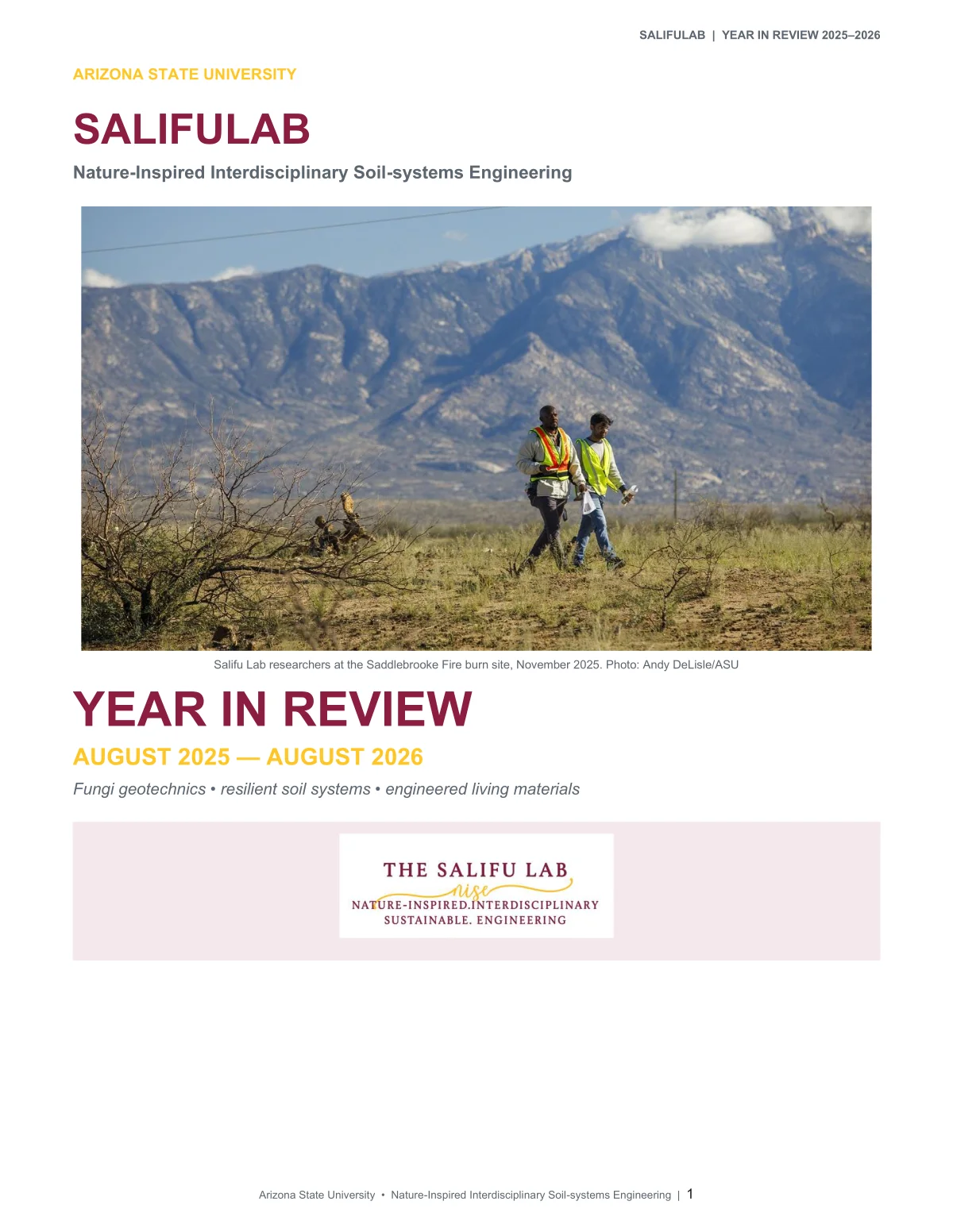
The research portfolio is organized into four connected fronts: fungi geotechnics, adaptive coupled soil systems, engineered living materials, and field translation. A detailed research focus section covers the lab's work on fighting fire damage with fungus, including field visits to the Saddlebrooke Fire burn site in November 2025 and published evidence of erosion-resistance gains in wildfire-impacted soil treated through engineered fungal-mycelium growth.
Subsequent sections cover fundamental science on coupled thermo-hydraulic behavior in fungal-treated soil, with a 2026 publication in Geosciences. The engineered materials section describes mycelium-based leather-like materials, fungi-MOF composites for nutrient-controlled release, mycochar sorbents for metal recovery, and exploratory mycelium-derived scaffolds. Field translation projects include a DoD ESTCP project on enzyme-induced carbonate precipitation with engineered biocrust…
The document concludes with people profiles, listing three doctoral researchers, two MS researchers, six active undergraduate projects, and two international visiting fellows. It also includes a retrospective of the 2024-2025 year and a preview of next year's activities. The review is described as selective, highlighting work that best represents the lab's trajectory and contributions of students and collaborators.