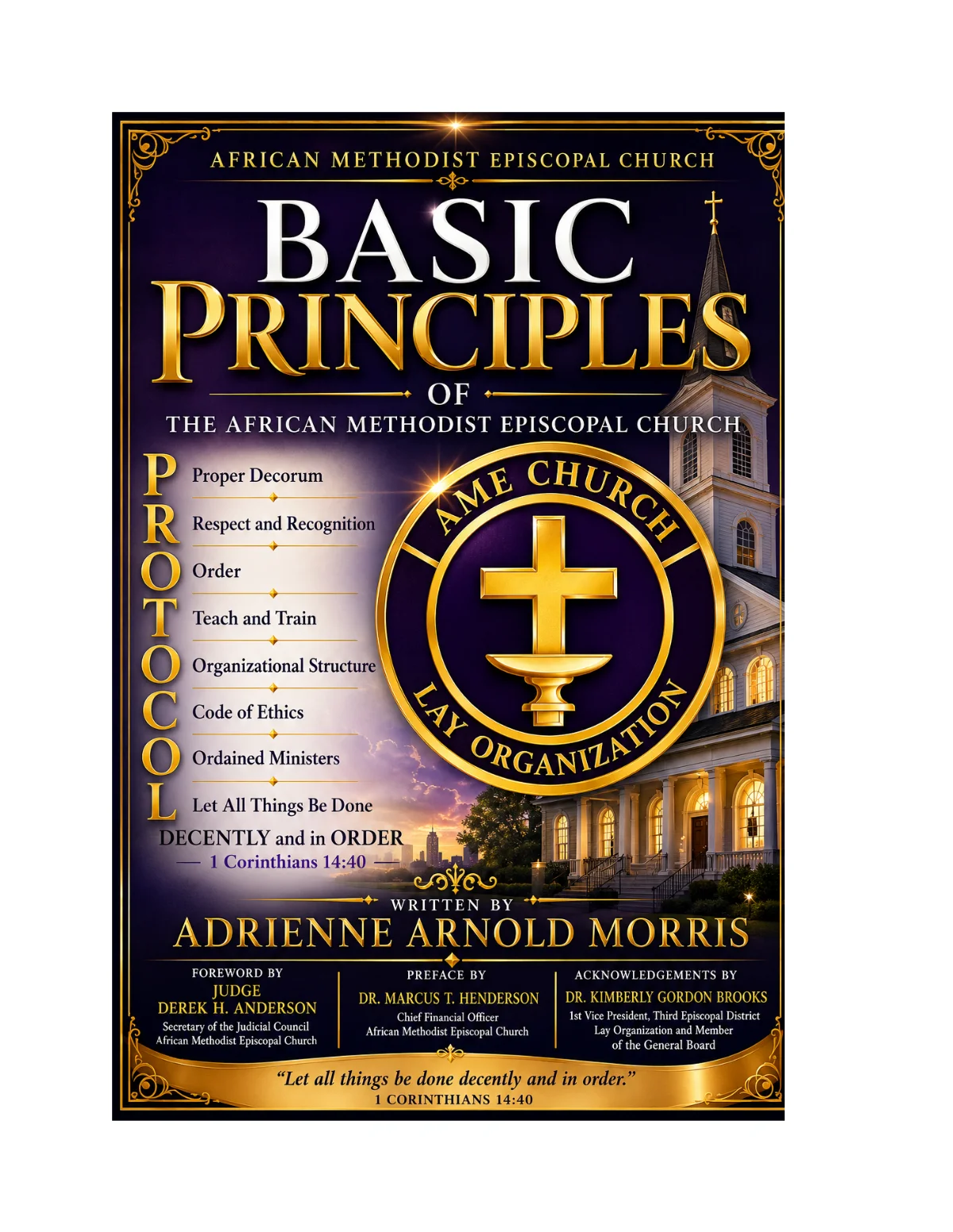
View AAM FINAL flipbook.
2 Copyright Basic Principle of the African Methodist Episcopal Church A Practical Guide to Protocol, Leadership, and Excellence Copyright © 2026 by Mrs. Adrienne Arnold Morris All rights reserved. No part of this publication may be reproduced, distributed, stored in a retrieval system, or transmitted in any form or by any means—electronic, mechanical, photocopying, recording, scanning, or otherwise—without the prior written permission of the copyright holder, except for brief quotations used in reviews, scholarly works, educational instruction, or other uses permitted under applicable copyright law. Scripture quotations are from the New King James Version® (NKJV) unless otherwise indicated. Scripture quotations are used by permission. All rights reserved. This publication is intended for educational, leadership development, and ministry training purposes. While every effort has been made to ensure the accuracy of the information contained herein, readers are encouraged to consult the current edition of The Doctrine and Discipline of the African Methodist Episcopal Church, applicable Constitutions and Bylaws, and official actions of the African Methodist Episcopal Church regarding matters of governance, polity, and protocol. The views and recommendations expressed in this publication are those of the author and are intended to promote excellence in Christian leadership, protocol, and organizational effectiveness. References to elected officers, bishops, clergy, or lay leaders are made with appreciation for their service and should not be construed as official endorsements of the publication unless expressly stated.
3 African Methodist Episcopal Church B a s i c P r i n c i p l e O f Proper Decorum Respect and Recognition Order Teach and Train Organizational Structure Code of Ethics Ordained Ministers Let All Things Be Done DECENTLY and in ORDER 1st Corinthians 14:40 “D and O” 101.com Written by Mrs. Adrienne A. Morris
4 Dedication "Let all things be done decently and in order." —1 Corinthians 14:40 Historically, we have praised God for the rich legacy of Religious Training at St. James African Methodist Episcopal Church in Atlantic City, New Jersey, under the faithful leadership of the First Episcopal District. It was there that I first learned the importance of Christian order, servant leadership, and the sacred responsibility of excellence in ministry. Those early lessons became the foundation upon which this work was built. This volume, Basic Principles of the African Methodist Episcopal Church, is lovingly dedicated to the Lay People of the African Methodist Episcopal Church. It is offered with the hope that it will become a practical resource for today's leaders and an enduring guide for the generations of lay servants who will follow. More importantly, I dedicate this book to the future leaders of our Zion—those women, men, and young people whom God is preparing to lead His Church with wisdom, humility, integrity, and excellence. It is my prayer that these pages will encourage every reader to embrace the principles of Christian protocol, servant leadership, and orderly ministry, remembering always that protocol is not about position, but about honoring God and serving His people. No work of this magnitude is accomplished alone. I am deeply indebted to the many faithful leaders whose encouragement, counsel, and example have shaped both my ministry and this publication. I extend my sincere gratitude to Dr. Marcus T. Henderson, General Officer and Chief Financial Officer of the African Methodist Episcopal Church, for graciously contributing the Preface, and to Judge Derek H. Anderson, Secretary of the Judicial Council, for authoring the Foreword. My heartfelt appreciation is also extended to Mr. Matikane Abednego Makiti, President of the Connectional Lay Organization, for sharing his inspiring reflections in the Postscript, and to Dr. Kimberly Gordon Brooks, First Vice President of the Third Episcopal District Lay Organization and member of the General Board Executive Committee, for her thoughtful Acknowledgment. This publication has been enriched through the collaboration of dedicated leaders within both the Lay and Connectional Women's Missionary Society. I am especially grateful to Dr. Deborah Taylor King, Connectional President, who appointed me as the Connectional Women's Missionary Society Protocol Commissioner, entrusting me with the responsibility of developing protocol training for our Connection. I am profoundly thankful for the many Episcopal leaders whose confidence, encouragement, and unwavering support have influenced my journey: Bishop Vinton R. Anderson and Supervisor Vivienne Anderson; Bishop Richard Allen and Supervisor Anna E. Hildebrand; Bishop Henry Allen Belin, Jr. and Supervisor Lucinda Crawford Belin; Bishop Robert Vaughn and Supervisor Carol Ogleton Webster; Bishop Cornal Garnett and Supervisor Ernestine Henning; Bishop McKinley Young and Dr. Dorothy Jackson Young; Bishop Frank Madison Reid III and
5 Supervisor Marlaa Hall Reid; Supervisor Patricia Russell McCloud, Esq.; and Bishop Stafford J. N. Wicker and Dr. Constance Belin Wicker. A very special expression of love and gratitude is reserved with Love of Sons, R. Eugene Morris and Scott K. Morris, Grandson Brian and Special Sisters Alma A. Walker (Boots ) and Charlane Morris (Chum), shared a plethora of thanks and appreciated and supported my commitment to serve our great Church. I am equally grateful to my family, friends, mentors, pastors, colleagues, and the countless members of the African Methodist Episcopal Church who have inspired, encouraged, and prayed for me throughout this journey. Each of you has left an imprint upon my life and ministry, and this work bears witness to your influence. Finally, I give all honor, glory, and praise to Almighty God, whose grace has sustained me, whose wisdom has guided me, and whose purpose has given meaning to every step of this journey. Apart from Him, none of this would have been possible. May this publication serve as a lasting gift to the Church we love. May it inspire excellence in leadership, unity in purpose, and faithfulness in service. And may every reader who opens these pages be challenged to preserve our rich heritage while preparing future generations to lead the African Methodist Episcopal Church with dignity, humility, and unwavering commitment. Mrs. Adrienne Arnold Morris 6th Connectional Young People's and Children's Division Director 7th Connectional Women's Missionary Society Historiographer Statistician Connectional Women's Missionary Society Protocol Commission Chair Member, AMEC Finance Department Meeting and Events Team
6 Foreword The African Methodist Episcopal Church has long been a church of order, discipline, and intentional Christian witness. Since its founding by Bishop Richard Allen in 1816, our Zion has understood that effective ministry requires more than passion alone—it requires principled leadership, mutual respect, and an unwavering commitment to conducting the business of the Church "decently and in order" (1 Corinthians 14:40). In every generation, God raises faithful leaders who preserve our traditions while equipping the Church for future service. Mrs. Adrienne A. Morris is one of those leaders. Basic Principle of the African Methodist Episcopal Church is more than a study guide; it is a practical resource for every lay member, minister, church officer, and leader who desires to better understand the foundational principles that govern our connectional Church. Drawing upon years of faithful service and leadership, Mrs. Morris presents the memorable acronym P.R.O.T.O.C.O.L. as a framework for cultivating excellence in Christian leadership: • P – Proper Decorum • R – Respect and Recognition • O – Order • T – Teach and Train • O – Organizational Structure • C – Code of Ethics • O – Ordained Ministers • L – Let All Things Be Done Decently and in Order These principles are not merely organizational guidelines; they are biblical values that strengthen our witness, protect the integrity of the Church, and promote unity throughout every level of our Connection. Throughout my years of service within the African Methodist Episcopal Church—as a lay leader, connectional officer, and member of the Judicial Council—I have witnessed firsthand the importance of understanding both our Discipline and the spirit in which it is to be applied. Many of the challenges faced by churches today stem not from a lack of commitment, but from a lack of understanding. This volume fills that need by offering practical instruction that is faithful to our heritage while remaining accessible to leaders at every stage of service. Mrs. Morris has written from the perspective of a servant leader. Her work reflects a deep appreciation for the traditions of the African Methodist Episcopal Church and a sincere desire to equip others for effective ministry. She reminds us that protocol is not about prestige or position; it is about honoring God, respecting one another, and ensuring that the work of the Church is conducted with excellence and integrity. I commend this book to pastors, presiding elders, bishops, lay organizations, missionary societies, church officers, seminarians, and every member who desires to serve more effectively. It is my hope that readers will not simply study these principles but embody them in their daily
7 ministry, thereby strengthening the witness of Christ through the African Methodist Episcopal Church. May this work inspire greater understanding, deeper unity, and renewed commitment to servant leadership as together we continue the sacred mission entrusted to our Church. Respectfully, Judge Derek H. Anderson, D.Min. Secretary, Judicial Council African Methodist Episcopal Church
8 Acknowledgment It is both an honor and a privilege to acknowledge the work of Mrs. Adrienne A. Morris in presenting this timely and meaningful resource to the African Methodist Episcopal Church. Throughout the history of our Church, the strength of our Connection has rested upon faithful men and women who have dedicated themselves to preserving our traditions while preparing future generations for leadership. Mrs. Morris exemplifies that commitment. Her years of faithful service, her passion for Christian education, and her unwavering dedication to the ministry of the Lay Organization are reflected on every page of this volume. Basic Principle of the African Methodist Episcopal Church is more than a handbook on protocol—it is a guide to servant leadership. Through the memorable P.R.O.T.O.C.O.L. framework, Mrs. Morris reminds us that effective leadership begins with respect, integrity, discipline, and a heart committed to serving Christ. She has skillfully woven together biblical principles, the traditions of the African Methodist Episcopal Church, and practical instruction into a resource that will benefit both seasoned leaders and those just beginning their journey of service. As educators, clergy, and lay leaders, we understand that knowledge shared is knowledge multiplied. This work reflects Mrs. Morris's desire not only to teach but to empower others to lead with confidence, humility, and excellence. Her emphasis on proper decorum, organizational structure, ethics, and Christian conduct provides an important foundation for every member who seeks to serve the Church faithfully. I extend my sincere appreciation to Mrs. Morris for her vision, perseverance, and willingness to share her knowledge with the broader Connection. Her contribution enriches the educational resources available to our Church and serves as a lasting investment in the development of future leaders. It is my hope that every reader will embrace the principles contained within these pages, apply them in their local congregations, and continue the legacy of orderly, Christ-centered leadership that has distinguished the African Methodist Episcopal Church since its founding. On behalf of all who will be strengthened by this work, thank you, Mrs. Morris, for your faithful witness, your scholarship, and your commitment to excellence in ministry. May God richly bless you and all who study and apply these principles in service to His Kingdom. With sincere appreciation, Dr. Kimberly Gordon Brooks First Vice President, Third Episcopal District Lay Organization Member, AME Church General Board Executive Committee Vice Chairperson, Publications Commission Chaplain, Lay Commission
9 Preface Since its founding in 1816, the African Methodist Episcopal Church has understood that faithful ministry flourishes where spiritual conviction is joined with disciplined leadership. Our Founder, Bishop Richard Allen, established a Church rooted not only in a passion for the Gospel, but also in sound governance, accountability, and a commitment to doing all things "decently and in order." The Holy Spirit empowers the mission of the Church, while thoughtful leadership and orderly administration provide the framework through which that mission is faithfully accomplished. It is in that spirit that I am pleased to commend this outstanding work by Mrs. Adrienne A. Morris, one of the African Methodist Episcopal Church's most respected and trusted servants. For decades, Mrs. Morris has distinguished herself through faithful service, exceptional professionalism, and an unwavering commitment to the life and ministry of our storied Zion. Her knowledge of the Church's traditions, practices, and governance has been cultivated through years of experience and service to leaders across our Connection. Those who have had the privilege of working alongside her know that this book reflects not only what she has learned, but how she has faithfully lived. Basic Principles of the African Methodist Episcopal Church arrives at a significant moment in the life of our denomination. As we prepare a new generation of leaders while preserving the traditions that have sustained us for more than two centuries, resources such as this are invaluable. Mrs. Morris reminds us that protocol is not simply about ceremony or formality. At its best, protocol reflects respect—for God, for one another, for the offices we hold, and for the sacred work entrusted to the Church. It promotes unity, brings clarity to our work, and allows the ministry of the Church to move forward with dignity and purpose. As Treasurer and Chief Financial Officer of the African Methodist Episcopal Church, I witness daily the importance of orderly governance and institutional accountability. Effective stewardship, organizational integrity, and responsible leadership all depend upon individuals who understand not only their responsibilities, but also the principles that guide their service. Protocol is not incidental to effective leadership; it is one of the disciplines that strengthens it. One of the many strengths of this book is its practical accessibility. Mrs. Morris has an exceptional ability to present important principles in a manner that is both clear and immediately applicable. Whether serving as a bishop, pastor, presiding elder, connectional officer, conference leader, local church officer, or lay servant, every reader will find wisdom that can be applied to strengthen both leadership and ministry. Perhaps most importantly, this book reminds us that excellence is never accidental. It is cultivated through preparation, consistency, humility, and a shared commitment to serving Christ and His Church with integrity. When leaders understand their roles, honor established processes, and lead with grace, the entire Church is strengthened and the Gospel is advanced. I encourage you not merely to read these pages, but to study them, teach them, and put their principles into practice. Share them with emerging leaders. Incorporate them into leadership development. Allow them to become part of the culture of excellence within your congregation, district, conference, and Connection. I offer my heartfelt congratulations to Mrs. Adrienne A. Morris for this significant contribution to the African Methodist Episcopal Church. Her scholarship, experience, and steadfast devotion to our Zion have produced a resource that will serve the Church well for many years to
10 come. I am confident this work will become an indispensable guide for leaders throughout our Connection as we continue to build upon the strong foundation entrusted to us by those who came before. May God bless both this work and all who are inspired by its pages to lead with wisdom, serve with humility, and uphold the rich legacy of excellence that has long distinguished the African Methodist Episcopal Church. Highest personal regards for all who embrace this Masterclass in foundational protocol and transcendent wisdom, Dr. Marcus T. Henderson, Sr. General Officer, Treasurer/Chief Financial Officer African Methodist Episcopal Church
11
12 "Let all things be done decently and in order." —1 Corinthians 14:40 Protocol is often misunderstood as a collection of formal rules, ceremonial customs, or traditions reserved for special occasions. Within the African Methodist Episcopal Church, however, protocol is far more significant. It is the practical expression of our Christian values, our connectional heritage, and our commitment to honoring God through orderly and respectful service. Protocol is not about elevating personalities; it is about preserving purpose. It teaches us how to interact with one another in ways that demonstrate respect for the offices we hold, appreciation for those who serve, and reverence for the God who calls us into ministry. When practiced correctly, protocol creates an atmosphere where ministry flourishes, relationships are strengthened, and the mission of the Church remains the central focus. The Apostle Paul instructed the Church at Corinth that "all things be done decently and in order." Those words continue to guide the African Methodist Episcopal Church today. As one of the oldest historically Black denominations in the world, our Church has developed traditions, customs, and organizational structures that have sustained us for more than two centuries. Understanding these practices is essential for every lay member, minister, steward, trustee, missionary, officer, and elected leader. Protocol is more than knowing where to sit or how to address an elected official. It is understanding the spirit of servant leadership. It is recognizing that every office carries responsibility before it carries privilege. It is learning to honor the dignity of others while conducting the business of the Church with excellence, fairness, and integrity. This section, Protocol 101, is designed to introduce the foundational principles that every church leader should know. Whether you are new to leadership or have served faithfully for many years, these lessons will reinforce the importance of proper decorum, effective communication, organizational awareness, ethical conduct, and respect for the connectional structure of the African Methodist Episcopal Church. As you study the chapters that follow, remember that protocol is not intended to limit ministry— it is intended to strengthen it. It provides a common framework that allows the Church to function with unity, consistency, and mutual respect across congregations, conferences, districts, and the Connection. May this section encourage you to embrace protocol not as a set of rigid rules, but as a ministry of excellence. When we honor one another, respect the offices entrusted to us, and conduct ourselves with humility and order, we reflect the character of Christ and strengthen the witness of His Church. Welcome to Protocol 101. May your study deepen your understanding, enrich your leadership, and inspire you to serve with wisdom, grace, and excellence.
13 "For God is not the author of confusion, but of peace..." —1 Corinthians 14:33 PROTOCOL 101 Levelized Protocol General Conference Connectional Level Annual Conference Episcopal Level District Conference Conference Level Quarterly Conference Area Level Church Conference Local Level Optional – Presiding Elder District HOSTING PROTOCOL Hospitality is one of the hallmarks of Christian service and reflects the spirit of excellence expected within the African Methodist Episcopal Church. Whether welcoming a bishop, clergy, elected official, guest speaker, or visitor, proper hosting demonstrates respect, intentional planning, and appreciation for those who have accepted an invitation to serve. Effective hosting ensures that every guest feels valued, informed, and cared for from arrival through departure. The following guidelines outline the essential responsibilities that contribute to a well-organized and memorable experience. Personal Hosting – Requested on Arrival Transportation (Arrival and Departure On-Site) Escort – Specific Notifications Welcome Gift Contact Information – Cell Phone / Hotel Room Number
14 ORGANIZATIONAL ATTIRE Professional appearance communicates respect for the office we hold, the organization we represent, and the occasion we are attending. Throughout the African Methodist Episcopal Church, attire often serves as a visible symbol of leadership, service, and organizational identity. Understanding the appropriate dress for various offices, auxiliaries, and ceremonial events promotes consistency, unity, and professionalism while honoring the traditions of our Connection. Council of Bishops – Robes General Officers – Robes Judicial Council – Robes University and College Presidents and Deans – Academic Robes Lay Organization – Blue and White (stoles if provided) Women’s Missionary Society – White with a touch of Blue / Life Member Stole (if applicable) Y.P.D. – Forest Green/White ~ Black/White C.E.D. – Red Sons of Allen – Burgundy Blazer TECHNOLOGY PROTOCOL Technology has become an essential part of ministry, worship, and Church administration. While electronic devices enhance communication and access to information, they should never distract from worship or diminish the reverence of sacred gatherings. Practicing good technology etiquette demonstrates courtesy to speakers, participants, and congregations while helping to maintain an atmosphere of respect and attentiveness. Reading a Scripture – phone or tablet permitted Worship Service – phone on vibrate Business Meeting – phone on vibrate Resources Too! SEATING – SIGNAGE PROTOCOL Seating and signage communicate order, honor, and organizational structure. Proper placement of guests and leaders reflects the customs and governance of the African Methodist Episcopal Church while ensuring that those serving in official capacities are recognized appropriately. Clear signage and thoughtful seating arrangements also contribute to the smooth flow of worship services, meetings, ceremonies, and special events.
15 Seating Pulpit – Platform – Staging Area – Dais Assigned Seating according to A.M.E. Hierarchy Signage Identifiable Name Signage placed on seats Name Tents Placecards Reserved Seating (PEW) (i.e.) Episcopal Supervisor • Note that your signage should be prepared prior to the event and be legible
16
17 Meeting Protocol and Constitutional Protocol Conducting the Business of the Church Decently and in Order "Let all things be done decently and in order." —1 Corinthians 14:40 The African Methodist Episcopal Church has flourished for more than two centuries because it has remained faithful not only to the Gospel of Jesus Christ, but also to the biblical principles of order, accountability, and disciplined leadership. From the General Conference to the smallest local congregation, the work of the Church is accomplished through meetings where leaders gather to pray, deliberate, discern God's will, and make decisions that advance the mission of Christ. Meetings are far more than administrative gatherings. They are sacred opportunities to practice Christian stewardship. Every agenda adopted, every motion presented, every vote taken, and every discussion held should reflect the highest standards of Christian character. Meetings are where visions become plans, ministries are strengthened, resources are stewarded, and the future of the Church is shaped. Consequently, every leader has a responsibility to ensure that these gatherings are conducted with dignity, fairness, and respect. Unfortunately, many church meetings become ineffective because participants have never been taught proper meeting protocol. Meetings often begin late, agendas are ignored, conversations become personal, parliamentary procedures are misunderstood, and decisions are questioned because established processes were not followed. These challenges are rarely the result of ill intent; more often they stem from inadequate training. The purpose of this section is to equip every leader with the knowledge necessary to participate confidently and responsibly in the governance of the Church. Protocol in meetings is not designed to create unnecessary formality or bureaucracy. Instead, it exists to protect the rights of every member, preserve order, encourage participation, and ensure that decisions are made fairly and transparently. Proper meeting protocol gives every member an opportunity to be heard while preventing disorder from overshadowing the work of the Church. One of the most important principles every leader must understand is that meetings belong to the organization—not to any individual. While the President or Chair presides over the meeting, that authority is exercised on behalf of the membership and within the limits established by the Constitution, Bylaws, and parliamentary authority. Effective presiding officers recognize that leadership is an act of service rather than control. They facilitate discussion, protect the rights of members, encourage participation, and ensure that business is conducted according to established rules. Likewise, members have responsibilities. Respect for the Chair is essential to maintaining order. Members should refrain from interrupting speakers, speaking out of turn, engaging in side conversations, or allowing disagreements to become personal. Every participant should remember that Christian courtesy is not suspended because opinions differ. Healthy discussion
18 strengthens organizations when conducted respectfully and with the common goal of advancing the mission of the Church. One of the simplest yet most overlooked expressions of respect is punctuality. Arriving on time communicates that we value the work of the Church and the time of fellow servants. Meetings should begin as scheduled whenever possible. Consistent punctuality establishes a culture of professionalism and accountability that reflects positively upon the organization and honors those who have prepared for the meeting. Preparation is equally important. Effective leaders do not wait until the meeting begins to understand the issues before them. They review agendas, committee reports, financial statements, minutes, and supporting documents beforehand. Preparation allows members to ask informed questions, contribute meaningful discussion, and make wise decisions rather than reacting impulsively to information presented for the first time during the meeting. An agenda serves as the roadmap for every meeting. It provides structure, establishes priorities, and helps the organization accomplish its objectives efficiently. A well-prepared agenda keeps discussion focused, prevents unnecessary delays, and ensures that important matters receive appropriate attention. When members follow the agenda and respect the authority of the Chair to guide the meeting, business proceeds with greater clarity and purpose. Meetings should also reflect Christian hospitality. Visitors should feel welcomed, new members should be treated with patience, and differing viewpoints should be heard respectfully. The goal of every meeting is not simply to complete business but to strengthen relationships while accomplishing the work God has entrusted to the Church. Closely connected to meeting protocol is an understanding of the Constitution and Bylaws that govern the organization. No organization can function effectively without clear governing documents. Constitutions establish the fundamental principles and organizational framework, while Bylaws provide the detailed procedures necessary for carrying out the organization's work. Together they provide consistency, accountability, and stability regardless of changes in leadership. Within the African Methodist Episcopal Church, constitutional governance is deeply rooted in our connectional system. Every level of the Church—from local churches to Connectional organizations—operates according to governing documents that derive their authority from The Doctrine and Discipline of the African Methodist Episcopal Church. These documents define membership, establish officer responsibilities, prescribe election procedures, regulate meetings, and provide processes for accountability and decision-making. For this reason, every officer, committee chair, pastor, and lay leader should own and regularly study the Constitution and Bylaws of every organization in which they serve. Far too often disagreements arise because leaders rely on assumptions, traditions, or past practices rather than consulting the governing documents. Good intentions can never substitute for informed leadership. The Constitution should be the first point of reference whenever questions arise
19 regarding authority, elections, officer responsibilities, meeting procedures, or organizational governance. Knowledge of the Constitution also protects organizations from unnecessary conflict. When decisions are grounded in the governing documents rather than personal preference, trust is strengthened, transparency is increased, and confidence in leadership grows. Members are more willing to support difficult decisions when they understand those decisions were made according to established constitutional authority rather than individual opinion. Every newly elected officer should make constitutional study a personal priority. Leadership training should include regular review of governing documents, parliamentary procedure, and organizational policies. Organizations that intentionally educate their leaders experience smoother transitions, stronger governance, and greater continuity from one administration to the next. As Lay leaders of the African Methodist Episcopal Church, we have a sacred obligation to model excellence in every aspect of leadership. We are ambassadors of our Church and representatives of a rich connectional heritage built upon discipline, accountability, and Christian order. Understanding meeting protocol and constitutional governance is not optional—it is a fundamental responsibility of effective leadership. Throughout this section, you will discover practical principles that will strengthen your ability to preside over meetings, participate responsibly in discussions, understand the authority of governing documents, and conduct the business of the Church with confidence and integrity. These lessons are designed not merely to improve organizational efficiency but to cultivate a culture of excellence that honors Christ and strengthens His Church. When meetings are conducted according to proper protocol, every voice has an opportunity to be heard. When constitutions are respected, every leader understands his or her responsibilities. When parliamentary procedures are followed, decisions are made fairly and consistently. And when Christian love governs every interaction, the Church demonstrates to the world that order and grace can exist together. For when our meetings are governed by Scripture, our constitutions honored, and our leadership characterized by humility and excellence, we preserve the integrity of the African Methodist Episcopal Church and faithfully prepare the generations of leaders who will carry our Zion forward.
20 MEETING PROTOCOL Meetings are an essential part of the governance and ministry of the African Methodist Episcopal Church. Whether conducted at the local, conference, district, or connectional level, meetings should reflect order, respect, and adherence to established parliamentary procedures. Effective meeting protocol encourages participation, protects the rights of members, and ensures that the business of the Church is conducted efficiently and with Christian decorum. Every presiding officer and participant shares the responsibility of maintaining an atmosphere that honors both the Church and its governing principles • Arrive on Time! • The President is the Presiding Officer o Presents a Meeting Agenda o Conduct an orderly meeting, recognizing membership and membership respecting the “Chair.” o Follow meeting guidelines CONSTITUTIONAL PROTOCOL The Constitution and Bylaws of the African Methodist Episcopal Church serve as the governing framework for the operation of our Connection. Every officer, minister, and lay member should have a working knowledge of these governing documents, as they provide the authority for organizational structure, decision-making, elections, and the administration of Church affairs. Familiarity with these foundational documents promotes consistency, accountability, and unity throughout every level of the Church. Original Content Per the Doctrine and Discipline of the African Methodist Episcopal Church, organizational Constitutional and By-Laws are published. Purchase and Study your Constitution.
21
22 Local Church Protocol, Worship Protocol, and Musical Protocol The Local Church: Where Order, Worship, and Ministry Begin "And they continued steadfastly in the apostles' doctrine and fellowship, in the breaking of bread, and in prayers." —Acts 2:42 The local church is the heartbeat of the African Methodist Episcopal Church. It is where lives are transformed, disciples are nurtured, families are strengthened, and communities encounter the saving grace of Jesus Christ. While the Connectional Church provides our identity, doctrine, and governance, it is within the local congregation that the mission of the Church is lived out every day. Every worship service, Bible study, prayer meeting, committee meeting, outreach ministry, and act of compassion begins within the life of the local church. Because the local church occupies such a sacred place within our Zion, it must function with purpose, organization, and biblical order. God has never intended for His Church to operate through confusion or uncertainty. Throughout Scripture, we find that God established order for His people—from the organization of Israel in the Old Testament to the leadership structure of the New Testament Church. The Apostle Paul reminded the Church at Corinth that "God is not the author of confusion, but of peace" (1 Corinthians 14:33), and concluded with the timeless instruction that "all things be done decently and in order." Those words remain the guiding principle of every African Methodist Episcopal congregation today. Understanding Local Church Protocol is essential for every member—not only those who hold elected office. Too often, members assume that protocol is the responsibility of pastors or church officers alone. In reality, protocol is the shared responsibility of every believer who serves within the household of faith. Whether serving as an usher, steward, trustee, missionary, choir member, stewardess, Christian educator, or Lay Organization member, each person contributes to the order, witness, and effectiveness of the congregation. One of the greatest strengths of the African Methodist Episcopal Church is its connectional system of government. Every office exists for a purpose. Every board has clearly defined responsibilities. Every ministry has an assigned mission. This organizational structure is not intended to create unnecessary bureaucracy; rather, it ensures that the work of Christ is accomplished efficiently, responsibly, and in harmony with the Discipline of the Church. At the center of every local congregation is the Pastor. Within the African Methodist Episcopal Church, the Pastor is appointed by the Presiding Bishop and serves as the spiritual leader of the congregation. This connectional appointment system reflects one of the distinctive characteristics of our denomination. The Pastor is not elected by the local church but appointed to serve according to the needs of the congregation and the direction of the Episcopal leadership. For this reason, members should understand and respect the office of the Pastor. The pastoral office carries enormous responsibility for preaching the Gospel, administering the Sacraments, shepherding the congregation, providing spiritual leadership, and guiding the ministries of the
23 church. While pastors welcome collaboration and shared leadership, the Discipline clearly establishes the pastoral office and its responsibilities. Respect for that office strengthens unity and promotes healthy relationships throughout the congregation. Likewise, the boards and organizations of the church exist to support—not compete with—the ministry of the Pastor. The Steward Board, Trustee Board, Stewardess Board, and the various commissions each have distinct responsibilities that contribute to the overall health of the congregation. When every board understands its role and faithfully performs its assigned duties, the church functions with harmony and effectiveness. The Steward Board serves as one of the principal leadership bodies of the local church. Beyond financial accountability, Stewards share responsibility for the spiritual welfare of the congregation and assist the Pastor in carrying out the ministry of the Church. Their work requires maturity, integrity, confidentiality, wisdom, and faithful stewardship. The Trustee Board serves as the legal custodian of the church's temporal affairs. Church buildings, property, equipment, and physical resources represent generations of sacrifice and faithful stewardship. Trustees are entrusted with preserving these assets not merely for the present congregation but for future generations who will continue the ministry of Christ. The Stewardess Board performs one of the most sacred ministries within the Church. Their preparation of Holy Communion and Baptism reminds us that protocol is never simply ceremonial—it is deeply spiritual. Every Communion table prepared with care, every altar properly adorned, and every sanctuary arranged according to the liturgical calendar reflects reverence for God's presence and respect for the sacred traditions of our faith. Beyond these governing boards, the seven commissions provide opportunities for members to exercise their spiritual gifts through ministry. Evangelism, Christian Education, Missions, Stewardship, Public Relations, Christian Social Action, and Health Ministries all represent the Church's commitment to ministering to the whole person—spiritually, emotionally, physically, and socially. Healthy churches encourage broad participation because ministry is the responsibility of the entire Body of Christ. Membership itself carries responsibility. Becoming a member of an African Methodist Episcopal Church is more than placing one's name on a roll. It is entering into a covenant relationship with God and the Church. Members are called to support the ministry through faithful worship, generous stewardship, participation in church organizations, and genuine hospitality toward others. Every member should strive to remain in good and regular standing through faithful attendance, consistent tithes and offerings, active service, and Christian conduct. One of the most visible expressions of Local Church Protocol is found within the worship experience itself. Worship should never appear disorganized or distracting. Every movement within the sanctuary should reflect reverence for God and respect for the sacredness of the service.
24 The pulpit, in particular, deserves special attention. Throughout Scripture, elevated places of proclamation symbolized the authority of God's Word. For that reason, the pulpit should never be viewed as merely another platform. It represents the place from which the Gospel is proclaimed and the Sacraments are administered. Access to the pulpit is granted by the Pastor, and those invited to participate should conduct themselves with humility, dignity, and appropriate decorum. Proper attire, thoughtful movement, and respectful behavior reinforce the solemnity of worship and prevent unnecessary distractions. Equally important is Worship Protocol. Worship is not entertainment; it is an encounter with the living God. Every element of the Order of Worship serves a purpose and contributes to preparing the congregation to receive God's Word. The Call to Worship, Opening Prayer, Scripture Reading, Decalogue, Hymns, and Sermon each build upon one another to create a meaningful worship experience. Participants should be prepared, attentive, and mindful that unnecessary movement during these sacred moments can distract worshippers and diminish the spirit of reverence. Readers of Scripture should approach the lectern having prayerfully prepared the assigned text. The reading of God's Holy Word deserves careful study, proper pronunciation, and heartfelt reverence. Likewise, those leading prayer should recognize that they are inviting the congregation into the presence of God rather than simply offering remarks. Music also occupies a sacred place in African Methodist Episcopal worship. From the earliest days of our denomination, hymns, spirituals, anthems, and Gospel music have strengthened our faith, preserved our history, and proclaimed the Gospel through song. Musical selections should support—not interrupt—the flow of worship. Every hymn should reinforce the message of the day, every anthem should inspire worship, and every musical offering should direct attention toward Christ rather than the performer. Understanding Musical Protocol enables musicians, choir directors, and worship leaders to appreciate the purpose of each musical selection. The Opening Hymn calls the congregation into worship. The Choral or Prayer Response supports prayer rather than becoming a performance. Selected music should complement the worship experience and prepare hearts to receive the preached Word. As Lay leaders, we bear a special responsibility to model these principles. Many visitors form their first impressions of the Church not by the sermon they hear, but by the order they observe. They notice whether members welcome one another warmly, whether worship begins on time, whether leaders conduct themselves professionally, and whether ministries operate in unity. Excellence in protocol becomes an expression of Christian hospitality and faithful stewardship. Protocol is not about prestige, titles, or personal recognition. It is about honoring God through excellence. It is about creating an environment where worship can flourish, ministry can thrive, and every person can encounter Christ without distraction or confusion. Order is not the enemy of the Holy Spirit; rather, it creates the environment in which the Spirit may work freely among God's people.
25 As you study this section, remember that Local Church Protocol is ultimately about discipleship. Every board, every ministry, every worship service, every hymn, every prayer, every Scripture reading, and every act of service should point people toward Jesus Christ. When each leader faithfully fulfills his or her responsibility according to the Discipline of the African Methodist Episcopal Church, the local congregation becomes what God intended it to be—a place where faith is nurtured, lives are transformed, and the Kingdom of God advances. May these principles strengthen your understanding of the local church, deepen your appreciation for its ministries, and inspire you to serve with greater humility, excellence, and purpose. For as faithful servants of the African Methodist Episcopal Church, we are called not merely to preserve the traditions of our Zion, but to model them with integrity so that future generations may continue to worship, lead, and serve decently and in order. LOCAL CHURCH PROTOCOL The local church is the foundation of the African Methodist Episcopal Church and serves as the primary place where ministry is carried out. Understanding the responsibilities of pastors, officers, boards, and commissions ensures that the work of the congregation is conducted according to the Discipline and in harmony with the Connectional Church. Clear organizational structure strengthens leadership, promotes accountability, and enables every ministry to function effectively in fulfilling the mission of the Church. Pastor – appointed by the Presiding Bishop One Pastor ~ No Co-Pastor ~ No Associate Pastor Steward Board – Chairperson ProTem • (3 – 19) Stewards • Member AME Church 2 years • Nominated by the Pastor and confirmed by the Quarterly Conference • Accurate account of Finances • Spiritual Needs of the Church • Negotiates Salary of the Pastor • Pastor may appoint a Junior Steward Board Trustee Board – Chairperson ProTem • (3 – 19) Trustees • Nominated by the Pastor and elected by the Members • 18 years of age • Church Member (6) months • Manage Church Properties Stewardess Board • Nominated by the Pastor and confirmed by the Steward Board • Two (2) Main Functions 1. Assist Stewards in their duties
26 2. Prepare the Major Sacraments a. Holy Communion b. Baptism • Dress the Pulpit and Altar according to the Liturgical Calendar Optional Local Church Structure (7) Seven Commissions • Membership, Evangelism and Discipleship • Christian Education • Missions and Welfare • Stewardship and Finance • Public Relations • Christian Social Action • Health Become a Member in Good and Regular Standing: • Tithes and Offerings • Join Church Organizations • Welcome New Members to our Church Family PULPIT ETIQUETTE • The Invitation to sit in the Pulpit is extended by the Pastor • Do not walk across the Pulpit. • Proper attire is expected. WORSHIP / BIBLICAL PROTOCOL • Worship Leader • Order of Service – Hymnal • Doxology – Do not walk • Hymn of Praise • Call to Worship – Do not walk • Opening Prayer – Invitation to Worship • Scripture – Do not walk o Review before reading o Bless the Holy Word • Decalogue – Do not walk MUSICAL PROTOCOL • Opening Hymn for Worship
27 • Choral / Prayer Response o Not a Choir Selection • Selected Music o Hymns o Anthems o Spirituals o Gospels Every successful worship service, procession, ceremony, and official event begins long before the program starts. One of the most overlooked, yet critically important, aspects of protocol is the proper organization of participants before they enter the sanctuary or meeting space. Line up protocol ensures that every person understands where they belong, when they enter, and in what order they participate. An orderly lineup reflects careful planning, respect for Church hierarchy, and a commitment to excellence. It minimizes confusion, prevents unnecessary delays, and allows worship and ceremonial events to proceed with dignity and reverence. Whether preparing for Holy Communion, Annual Conference worship, Episcopal services, funerals, ordinations, graduations, or official processions, proper lineup protocol contributes to an atmosphere worthy of the occasion. As lay leaders, we are often the individuals responsible for coordinating these moments behind the scenes. Our preparation directly affects the experience of those participating and those observing. For that reason, every lay leader should become familiar with lineup procedures and be prepared to assist pastors, bishops, presiding officers, and event coordinators in ensuring that all events are conducted "decently and in order." When everyone understands their role before the procession begins, attention can remain where it belongs—on worship, ministry, and the glory of God rather than on avoidable distractions. HIERARCHY PROTOCOL • Senior Bishop • President, Council Bishops • President, General Board • Bishop of the Church (Active) • Bishop of the Church (Retired) • General Officers (Active – Retired) • Judicial Council Members • University and College Seminary (Presidents and Deans) • Connectional Officers (Active – Retired) • Episcopal District Officers • Presiding Elder • Conference Officers
28 • Clergy – Laity and Young People • Program Participants LINE UP PROTOCOL • Program Participants • Clergy – Laity and Young People • Conference Officers • Presiding Elder • Episcopal District Officers • Connectional Officers (Active – Retired) • University and College Seminary (Presidents and Deans) • Judicial Council Members • General Officers (Active – Retired) • Bishop of the Church (Retired) • Bishop of the Church (Active) • President, General Board • President, Council Bishops • Senior Bishop SPOKEN /VERBAL – WRITTEN PROTOCOL Honoring the Office Through Respectful Communication "Render therefore to all their due: honor to whom honor is due." —Romans 13:7 Communication is one of the most visible expressions of protocol within the African Methodist Episcopal Church. Whether spoken from a podium, written in a program, announced during worship, published in correspondence, or communicated electronically, our words reveal our understanding of the Church, our appreciation for its leadership, and our respect for its connectional structure. Protocol is not merely demonstrated by where individuals sit or how processions are organized. It is equally reflected in how we address one another, introduce leaders, prepare written materials, and acknowledge those who serve. Every introduction, every announcement, every printed program, every letter, and every public greeting communicates something about our understanding of the offices within the Church. One of the defining characteristics of the African Methodist Episcopal Church is its Connectional System of Government. Every office within our Zion has been established through our Doctrine and Discipline and carries specific authority and responsibility. Because of this connectional structure, we recognize and honor leaders according to the offices they hold—not
29 because of personal status or individual preference, but because we respect the office entrusted to them by the Church. This distinction is critically important. Protocol is never about elevating personalities. It is about honoring the office. Offices may change. Individuals may come and go. But the offices themselves remain essential to the governance and ministry of the African Methodist Episcopal Church. For this reason, every lay leader should become thoroughly familiar with the organizational hierarchy of the Church. When introducing guests, recognizing dignitaries, preparing printed materials, or extending greetings, acknowledgments should always begin with the highest- ranking office present and proceed in descending order through the organizational hierarchy until the local leadership is recognized. This practice is not intended to diminish anyone's contribution. Rather, it demonstrates respect for the offices established by our Connection and promotes consistency throughout the Church. For example, if a Bishop, General Officer, Judicial Council member, Presiding Elder, Pastor, Conference Lay President, and Local Lay President are all present, protocol requires that recognition begin with the most senior connectional office and then continue in descending order until local leadership is acknowledged. In general, acknowledgments should flow from: • The Council of Bishops • General Officers • Judicial Council • Episcopal Leadership • Connectional Officers • Episcopal District Leadership • Annual Conference Leadership • Presiding Elders • Pastors • Conference Officers • Local Church Officers • Members and Guests This cascading order communicates unity within the Connection while honoring the responsibilities entrusted to each office. It also eliminates confusion and ensures that every
30 leader receives appropriate recognition according to the customs and traditions of the African Methodist Episcopal Church. The same principle applies to written communication. Programs, invitations, resolutions, memorials, correspondence, certificates, promotional materials, websites, and social media should accurately identify titles and offices. Names should be spelled correctly, titles should be current, and offices should be verified before publication. Carelessness in written communication can unintentionally diminish the dignity of an office or create unnecessary embarrassment for those involved. Whenever uncertainty exists regarding protocol, never assume. One of the wisest principles of protocol is simple: Ask if you do not know. There is no embarrassment in seeking clarification. In fact, experienced protocol officers understand that asking questions demonstrates professionalism and a sincere desire to honor the Church appropriately. A brief inquiry before an event can prevent unnecessary mistakes during the event. Likewise, spoken protocol requires preparation. Those assigned to introduce speakers, welcome guests, or present recognitions should review names, titles, pronunciations, and organizational affiliations well before the program begins. Mispronouncing a name or misstating a title can distract from the purpose of the event and unintentionally communicate a lack of preparation. Christian courtesy should also guide every conversation within the Church. Protocol is not limited to formal ceremonies. It is reflected in how we greet one another, conduct meetings, disagree respectfully, answer questions, and resolve conflict. Every conversation should demonstrate humility, patience, and grace worthy of those who serve Christ. As lay leaders, we often serve as the public face of the Church. We introduce bishops, welcome civic leaders, prepare conference programs, emcee worship services, conduct meetings, and represent the African Methodist Episcopal Church within our communities. Because of these responsibilities, we must become students of protocol and examples of excellence. Good protocol communicates confidence. Excellent protocol communicates preparation. Christian protocol communicates love. The goal is never to impress others with our knowledge of titles or hierarchy. Rather, our objective is to create an atmosphere where every person feels welcomed, every office is respected, and every event reflects the excellence worthy of the Kingdom of God.
31 Remember that every acknowledgment is an opportunity to teach our Connectional heritage. Every properly prepared program reinforces our organizational structure. Every thoughtful introduction reminds others that leadership within the African Methodist Episcopal Church is built upon service, accountability, and mutual respect. As you study this section, commit yourself to becoming intentional in every spoken and written communication. Learn the hierarchy of the Church. Verify titles. Practice proper introductions. Prepare carefully. And whenever uncertainty exists, seek guidance from those knowledgeable in protocol. Above all, remember that protocol is an expression of Christian hospitality and servant leadership. When we honor the offices of the Church, we honor the work God accomplishes through those called to serve. When we acknowledge leaders according to the established order of the Connection, we strengthen unity, preserve our traditions, and demonstrate respect for the governance of our beloved Zion. May every word we speak, every letter we write, every program we prepare, and every introduction we make reflect the Apostle Paul's admonition: "Render therefore to all their due… honor to whom honor is due." —Romans 13:7 And may our spoken and written communication always point beyond ourselves to Christ, who is the Head of the Church and the source of all true servant leadership.
32
33
34 Preserving the Legacy of Protocol "One generation shall praise Your works to another, and shall declare Your mighty acts." —Psalm 145:4 There comes a defining moment in the life of every church, organization, and leader when an important question must be asked: What will we leave for those who come after us? Will our legacy be measured only by the buildings we erected, the budgets we balanced, or the ministries we established? Or will it be remembered through something far more enduring—a culture of excellence, respect, order, and faithful leadership? Throughout the history of the African Methodist Episcopal Church, every generation has inherited a rich legacy because those who came before understood that leadership is not merely about serving in the present, but about preparing the future. They faithfully preserved our doctrine, our Discipline, our worship traditions, our organizational structure, and the protocol that has distinguished our Zion for more than two centuries. The responsibility for preserving that legacy now rests with us. Protocol must never become a dying art. It must remain a living tradition that is intentionally taught, faithfully practiced, and lovingly preserved. Unfortunately, in today's culture, protocol is often misunderstood. Some view it as outdated, unnecessary, or merely ceremonial. Others mistakenly believe that protocol only applies when bishops, dignitaries, or elected officials are present. Nothing could be further from the truth. Protocol is not about preserving traditions simply because they are old; it is about preserving the values that give an organization its identity. It teaches respect, establishes consistency, protects dignity, promotes unity, and provides stability during times of transition. Most importantly, protocol serves as the bridge connecting one generation of leaders to the next. Every tradition we enjoy today exists because someone before us chose to preserve it. Someone taught us how to conduct ourselves during worship. Someone explained why we recognize leaders according to the hierarchy of the Church. Someone showed us how to prepare the Communion Table, how to conduct a meeting, how to introduce dignitaries, and how to respect the offices established within the Connection. Those lessons did not happen accidentally. They were intentional investments made by faithful leaders who understood that knowledge not shared is eventually knowledge lost. Likewise, the generation following us deserves the same intentional investment. If we fail to teach protocol, we create leaders who may know how to occupy an office but never fully understand how to honor it. Traditions that are not taught will eventually disappear, and leadership that is not modeled cannot be duplicated. Ironically, while many people question the relevance of protocol within the Church, they rarely question it anywhere else. In reality, protocol exists in nearly every successful institution in society. We simply know it by different names. Consider the military. A newly enlisted soldier salutes not because someone is older or more popular, but because they recognize and respect the office and rank that individual holds. Uniforms identify responsibility, ceremonies follow established traditions, and everyone understands the chain of command. No one questions why a General is acknowledged before a Captain because protocol ensures that the organization functions with discipline and effectiveness.
35 The same principle exists within the judicial system. When a judge enters the courtroom, everyone rises. Attorneys address the Court with respect. Proceedings follow a carefully established order. No one interrupts the judge, speaks without recognition, or disregards courtroom procedures. These customs are not viewed as unnecessary formalities; they preserve the dignity of the court and reinforce public confidence in the judicial system. Higher education offers another familiar example. Every year, colleges and universities conduct commencement ceremonies that have remained remarkably consistent for centuries. Academic regalia distinguish earned degrees, faculty members process according to rank, honorary guests are recognized in proper order, and the president of the institution presides over the ceremony. Most graduates never stop to think about these customs because they simply understand that this is how commencement is conducted. Protocol quietly communicates honor, tradition, and excellence without requiring explanation. Even hospitals depend upon protocol. Every member of a surgical team understands his or her role before entering the operating room. Physicians, nurses, anesthesiologists, and technicians follow precise procedures designed to eliminate confusion and protect lives. No one considers these established practices unnecessary; they recognize them as essential to professionalism and patient care. Likewise, major corporations rely on organizational charts, reporting structures, board procedures, executive introductions, and established chains of responsibility. Sporting events, civic ceremonies, governmental functions, and military observances all operate according to carefully established protocol. We rarely notice these practices because they have become expected. Protocol quietly accomplishes its purpose. The same reality exists within religious communities throughout the world. The Roman Catholic Church has preserved centuries of liturgical tradition. The Eastern Orthodox Church carefully maintains worship practices that date back generations. Jewish congregations continue customs rooted in biblical history. Islamic communities observe established traditions governing prayer, worship, and leadership. Even many non-denominational churches, while less formal, develop customs that regulate worship, leadership, and ministry. Every faith tradition preserves something because every faith tradition understands that identity is strengthened through continuity. The African Methodist Episcopal Church is no different. Our protocol reflects our theology, our history, our connectional government, and our collective identity as the first independent Black denomination in the United States. When we preserve protocol, we preserve our story. One of the greatest threats to protocol is the assumption that someone else will teach it. We assume young leaders already know. We assume new members understand our customs. We assume future generations will naturally continue the traditions we inherited. History demonstrates otherwise. Anything that is not intentionally preserved eventually disappears. The next generation deserves more than correction after mistakes are made; they deserve instruction before those mistakes ever occur. Rather than saying, "They should already know," experienced leaders should ask themselves, "Who is teaching them?" Young leaders rarely reject tradition because they dislike it. More often, they abandon traditions because no one has taken the time to explain their meaning or significance. People naturally protect what they understand.
36 Every new leader, whether they recognize it or not, becomes a protocol officer. The moment someone observes how they introduce a speaker, conduct a meeting, welcome a guest, prepare a worship service, or acknowledge church leadership, they begin teaching others. Leadership is always instructional. People learn more from what we model than from what we merely say. Every act of professionalism teaches. Every expression of respect teaches. Every carefully prepared meeting teaches. Every thoughtful introduction teaches. Every display of humility teaches. Therefore, each of us must ask ourselves an important question: If someone followed my example, would they learn proper protocol? Would they understand the importance of preparation? Would they appreciate our traditions? Would they strengthen the Church or unknowingly weaken it? Protocol should never become a barrier between generations; instead, it should become a bridge connecting them. Experienced leaders should intentionally mentor those who are coming behind them. Invite young adults to assist with conference planning. Allow them to prepare programs, arrange seating, coordinate processions, and observe leadership meetings. Teach them how to recognize bishops, general officers, and elected officials. Explain why introductions follow the hierarchy of the Church. Allow them to ask questions without embarrassment. Correct them privately and encourage them publicly. Celebrate their progress. This is how traditions survive— not through criticism, but through mentoring. No one is born understanding protocol. Bishops were taught Episcopal protocol. Judges learned courtroom procedure. Physicians mastered operating room practices through years of instruction. Corporate executives learned organizational leadership from experienced mentors. Likewise, protocol within the African Methodist Episcopal Church must be intentionally taught. It should become a regular part of Lay Organization meetings, leadership retreats, officer orientations, Christian education classes, conference workshops, youth leadership conferences, and new member instruction. Protocol should never be reserved only for special occasions or moments of crisis. It should become woven into the everyday culture of the Church. Years from now, another generation will stand where we stand today. They will preside over meetings, welcome bishops, organize conferences, conduct worship services, prepare Holy Communion, lead organizations, and mentor still another generation. The question is not whether that generation will come; it certainly will. The question is, what will they inherit? Will they inherit confusion or confidence? Disorder or excellence? Uncertainty or understanding? The answer depends largely upon what we choose to teach today. As you conclude this section, I challenge you to become more than a student of protocol. Become its guardian. Become its teacher. Become its ambassador. Study the Doctrine and Discipline. Learn the Constitution. Understand the hierarchy of the Church. Honor every office. Prepare thoroughly. Lead humbly. Correct graciously. Mentor intentionally. Never allow protocol to become a forgotten chapter in our history. Instead, ensure that it remains a living testimony to who we are as African Methodists. The groundwork upon which we now stand was laid by faithful women and men who believed that excellence mattered. They understood that the Church deserves our very best. They believed that leadership is stewardship and that protocol protects unity. Because they faithfully passed
37 these principles to us, we have inherited a Church distinguished by order, dignity, and respect. The responsibility now belongs to us to preserve that inheritance and strengthen it for those who will follow. May future generations one day look back upon our service and say of us: They honored those who came before them. They served faithfully in their own generation. And they prepared us well for ours. That is the true purpose of protocol. That is the essence of servant leadership. That is how the African Methodist Episcopal Church will continue to do all things decently and in order for generations yet to come.
38
39 Closing Thoughts Protocol Is Ministry "For God is not the author of confusion, but of peace..." —1 Corinthians 14:33 As you close this book, I pray you have discovered that protocol is much more than ceremony, titles, seating charts, or organizational customs. It is a ministry. Protocol is the visible expression of invisible values. It demonstrates respect before a word is spoken. It communicates honor before an introduction is made. It creates order before business begins. It reflects excellence before anyone notices. When practiced correctly, protocol allows Christ—not confusion—to become the center of every worship service, meeting, conference, and gathering. Throughout this book we have explored principles that govern hosting, attire, technology, constitutional understanding, organizational hierarchy, meetings, local church leadership, seating, signage, and ceremonial order. While these subjects may appear administrative, they are deeply spiritual. Every act of preparation becomes an act of ministry when done for the glory of God. The greatest compliment that can be given to a protocol officer or lay leader is often never spoken. When everything runs smoothly... When every guest is welcomed... When every participant knows where to stand... When every introduction is correct... When every meeting begins and ends with dignity... When every worship service flows without unnecessary interruption... Then protocol has fulfilled its purpose.
40 True protocol never seeks attention. It quietly serves others. Remember These Fundamental Principles As you continue your service within the African Methodist Episcopal Church, remember these simple truths: • Always honor the office, regardless of the individual. • Preparation is the highest form of respect. • Never assume—always verify. • Arrive early. • Dress appropriately for the occasion. • Learn the organizational structure of the Church. • Study the Doctrine and Discipline regularly. • Know the Constitution and Bylaws of the organizations in which you serve. • Communicate clearly and professionally. • Be courteous to everyone—from the newest member to the senior bishop. • Protect confidential information. • Be flexible when circumstances require adjustments. • Never embarrass a guest publicly. • Correct mistakes graciously. • Be a servant before becoming a leader. • Be teachable throughout your lifetime. These principles will serve you well, not only within the Church, but also in your profession, your community, and your family. The Ministry of Excellence Excellence is never accidental. It is the result of preparation. Preparation becomes confidence. Confidence inspires trust. Trust strengthens leadership. Leadership builds unity. Unity advances ministry. And ministry glorifies God.
41 Every lay leader has the opportunity to influence the culture of the Church. Whether serving as a steward, trustee, missionary, choir member, YPD advisor, Lay Organization officer, church secretary, conference officer, or connectional leader, your commitment to excellence elevates the ministry of everyone around you. Never underestimate the influence of doing small things well. Someone notices. A young person watching your example notices. A new member notices. A first-time visitor notices. Your pastor notices. Your bishop notices. More importantly... God notices. Leave the Church Better Than You Found It One of the greatest responsibilities entrusted to every leader is stewardship. We are merely caretakers of a Church that existed before us and, by God's grace, will continue long after we have finished our service. Therefore... Leave every ministry stronger than you found it. Leave every organization more united than you found it. Leave every meeting better organized than you found it. Leave every conference more professional than you found it. Leave every worship service more meaningful than you found it. Leave every generation more prepared than the one before. Do not simply preserve our traditions.
42 Understand them. Teach them. Model them. Pass them on. The Legacy of a Lay Leader Titles are temporary. Positions change. Committees dissolve. Appointments expire. Elections come and go. But character remains. Integrity remains. Service remains. The influence of faithful leadership remains. Long after your name has disappeared from meeting minutes and conference journals, someone will remember how you treated people. Someone will remember your professionalism. Someone will remember your kindness. Someone will remember your integrity. Someone will remember that you helped them become a better leader. That is the true legacy of protocol. A Final Charge I charge every reader of this book to become not merely a student of protocol, but an ambassador of excellence.
43 Teach what you have learned. Correct with compassion. Lead with humility. Serve with integrity. Honor the traditions of our Church. Respect every office. Protect the unity of Zion. Never confuse authority with arrogance. Never confuse protocol with pride. Never forget that every act of leadership is ultimately an act of Christian service. The African Methodist Episcopal Church has endured for more than two centuries because faithful men and women chose discipline over disorder, unity over division, service over self, and Christ over personal ambition. Now it is your turn. May your leadership inspire confidence. May your service reflect humility. May your example strengthen the Church. May your ministry honor Christ. And may every meeting, every worship service, every conference, every procession, every greeting, every introduction, every decision, and every act of service declare to the world that the African Methodist Episcopal Church continues to do all things decently and in order. "Let all things be done decently and in order." 1 Corinthians 14:40 May God bless you, guide you, and use you mightily in His service.
44 Postscript As I reflect upon the principles presented in this remarkable work, I am reminded that the strength of the African Methodist Episcopal Church has never rested solely upon its history, its polity, or even its remarkable legacy. Rather, its enduring strength has always been found in faithful people—lay and clergy alike—who have committed themselves to serving God with excellence, integrity, humility, and love. The Lay Organization has long been recognized as the teaching and training arm of the laity within our Zion. We are called not merely to occupy positions, but to prepare people. We are charged not simply with preserving tradition, but with equipping disciples and developing leaders who understand both the spirit and the structure of the African Methodist Episcopal Church. That is why this publication is so important. Mrs. Adrienne A. Morris has provided the Church with more than a handbook on protocol. She has provided a roadmap for effective Christian leadership. Throughout these pages, she reminds us that protocol is not about prestige, privilege, or personal recognition. It is about creating an environment where ministry can flourish, worship can proceed with reverence, leadership can function with clarity, and every person can serve with confidence and dignity. As President of the Connectional Lay Organization, I have had the privilege of witnessing the remarkable gifts and talents of lay persons throughout Africa, the Caribbean, Europe, North America, and every Episcopal District of our global Connection. Regardless of culture, language, or geography, one principle remains constant: when God's people understand their purpose and respect the order of the Church, ministry becomes stronger and the mission of Christ advances more effectively. Protocol is, therefore, a ministry of unity. It teaches us to respect one another. It teaches us to honor the offices of the Church. It teaches us to value preparation over improvisation. It teaches us that excellence is an act of stewardship. Most importantly, it reminds us that everything we do should point people to Christ rather than ourselves. I encourage every reader to make this book more than a personal resource. Use it as a teaching tool in your local Lay Organization. Study it in leadership workshops. Incorporate it into officer training sessions. Share it with young adults who are preparing for leadership. Introduce it to church officers, conference leaders, and ministry teams. Let it become a living resource that shapes the culture of excellence within every congregation and every level of our Connection.
45 To the emerging generation of leaders, I offer this word of encouragement: Never underestimate the value of preparation. Learn the Discipline. Understand the Constitution. Respect the hierarchy of the Church. Honor those who have served before you, and never stop learning. Leadership is not measured by how many people follow you; it is measured by how faithfully you serve those whom God has entrusted to your care. To seasoned leaders, I offer a challenge: Mentor someone. Pass on your knowledge. Teach protocol with patience. Correct with grace. Lead by example. Our greatest legacy will not be the offices we have held but the leaders we have helped prepare for tomorrow. I commend Mrs. Adrienne A. Morris for her vision, scholarship, and faithful commitment to strengthening the African Methodist Episcopal Church through education and leadership development. Her work reflects the very best of the Lay Organization's mission to equip God's people for effective service. May we continue to serve with humble hearts, disciplined minds, and willing hands. May our conduct reflect the Christ we profess, our leadership inspire those who follow, and our service strengthen the Church we love. Together, let us build a legacy where every generation of lay leaders is more knowledgeable than the last, more committed than the last, and even better prepared to carry the mission of the African Methodist Episcopal Church into the future. For when the history of our Church is written by generations yet unborn, may it be said of us that we were faithful stewards of our calling, unwavering in our commitment, and intentional in ensuring that all things were done decently and in order. With gratitude and confidence in the future of our Zion, Mr. Matikane Abednego Makiti President Connectional Lay Organization African Methodist Episcopal Church
46