View Revamped V3 Year 3 Impact Report flipbook.
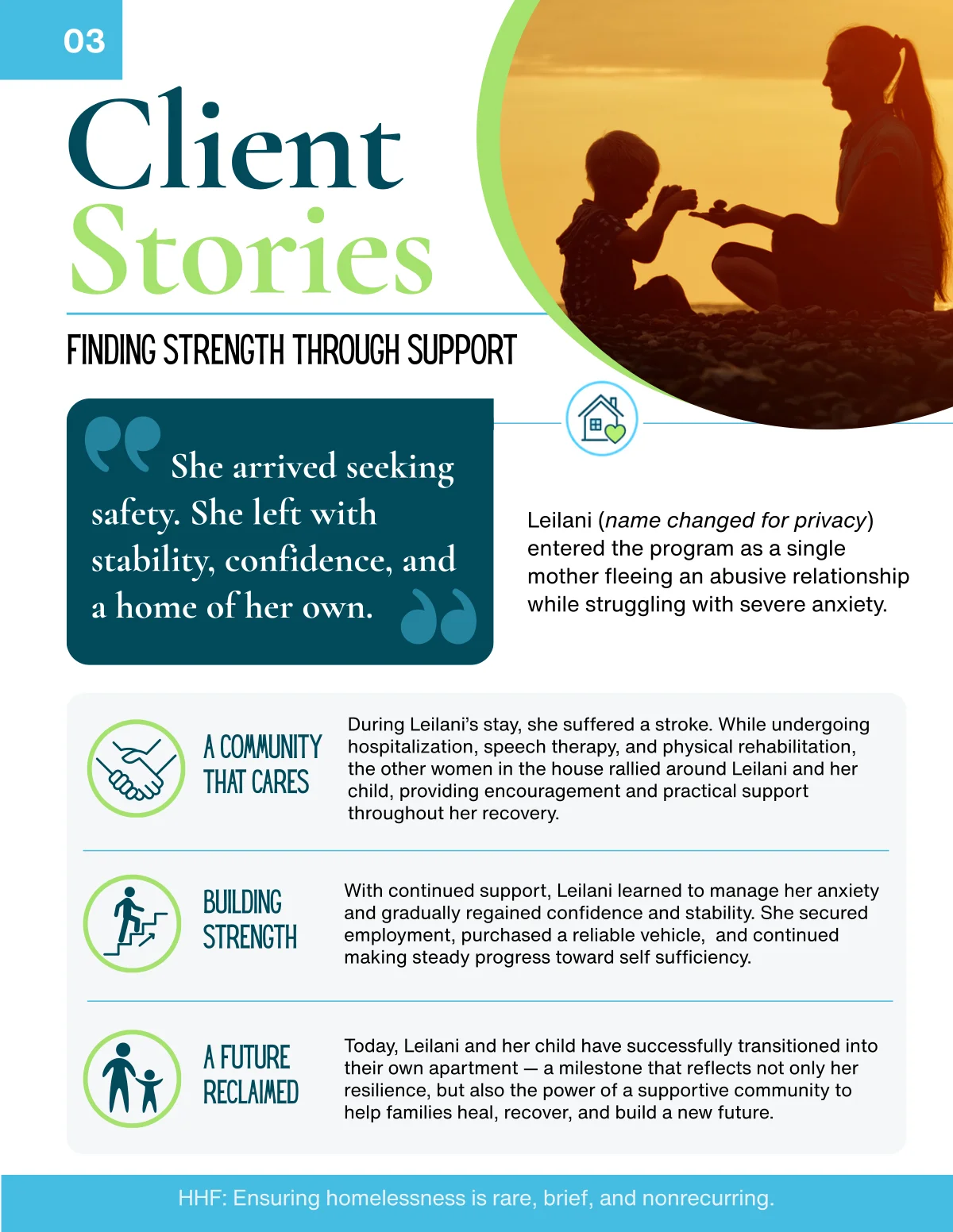
Client Stories She arrived seeking safety. She left with stability, confidence, and a home of her own. FINDING STRENGTH THROUGH SUPPORT During Leilani’s stay, she suffered a stroke. While undergoing hospitalization, speech therapy, and physical rehabilitation, the other women in the house rallied around Leilani and her child, providing encouragement and practical support throughout her recovery. Leilani (name changed for privacy) entered the program as a single mother fleeing an abusive relationship while struggling with severe anxiety. A COMMUNITY THAT CARES BUILDING STRENGTH A FUTURE RECLAIMED With continued support, Leilani learned to manage her anxiety and gradually regained confidence and stability. She secured employment, purchased a reliable vehicle, and continued making steady progress toward self sufficiency. Today, Leilani and her child have successfully transitioned into their own apartment — a milestone that reflects not only her resilience, but also the power of a supportive community to help families heal, recover, and build a new future. 03 HHF: Ensuring homelessness is rare, brief, and nonrecurring.
Client Stories Support, stability, and opportunity helped build a future beyond the challenges. FROM LOSS TO POSSIBILITY Through a connection with a peer and support from Liliʻuokalani Trust, Noa received guidance and resources to complete high school, enroll at Hawaiʻi Community College, and secure housing near campus. Noa (name changed for privacy) entered the program after losing his mother and facing housing instability while preparing to graduate high school. A PATH FORWARD BUILDING CONFIDENCE CHARTING A FUTURE With stable housing and continued support, Noa balanced college, work, and independent living. Within weeks, he secured full-time employment and began building greater independence. After successfully completing the housing program, Noa continued renting independently while pursuing his education and future goals. His journey highlights how housing, relationships, and opportunity can create lasting stability. 03 HHF: Ensuring homelessness is rare, brief, and nonrecurring.
Client Stories Sometimes the greatest barriers are the ones that prevent people from accessing help. STAYING THE COURSE PAYS OFF Because Kimo was born outside the United States, obtaining his records required navigating complex documentation requirements and coordinating with multiple agencies. The process created significant challenges, but James remained committed to moving forward. Kimo (name changed for privacy) spent years without the documents needed to unlock access to essential resources. A BARRIER TO OVERCOME COMMITMENT THAT LASTED A FUTURE WITHIN REACH For nearly five years, staff worked with Kimo through each step, helping complete paperwork, communicating with partner agencies, and overcoming administrative barriers that repeatedly delayed progress. This year, Kimo received his official birth certificate, marking a major milestone toward independence. With this critical document, he can now pursue a State of Hawaiʻi identification card and access resources that were unavailable to him. 03 HHF: Ensuring homelessness is rare, brief, and nonrecurring.
Client Stories Choosing change became the first step toward recovery and a new future. A TURNING POINT TOWARD RECOVERY Kaleo began his recovery journey through medically supported detox and continued into the Therapeutic Living Program, where he received support to address trauma and develop healthier coping strategies. Kaleo (name changed for privacy) entered the program after nearly five years of homelessness, ready to begin his recovery journey. BEGINNING RECOVERY TURNING THE PAGE A FUTURE RECLAIMED Through coordinated care and ongoing support, Kaleo built a sober support network, strengthened recovery skills, and began reconnecting with loved ones. These connections helped create a foundation for continued healing and stability. Kaleo is preparing to transition into clean and sober housing while building stability through recovery supports. His journey demonstrates how integrated treatment, housing pathways, and supportive services help individuals move beyond crisis and create lasting stability. 03 HHF: Ensuring homelessness is rare, brief, and nonrecurring.
Client Stories With the right support, new beginnings become possible, one step at a time. A PLACE TO CALL HOME With ongoing case management and encouragement, Nani successfully transitioned into permanent housing, where she has remained for more than six months. Her journey shows how dignity, persistence, and the right support can help people overcome significant challenges and build a more stable future. FOUNDATION FOR CHANGE Through compassionate, trauma-informed care, Nani reconnected with her goals of living independently and rebuilding family relationships. Staff helped her obtain vital documents, open a bank account, secure SSI benefits, and reconnect with healthcare and peer support. At first, Nani struggled with trust and had difficulty imagining a future beyond survival. Years of chronic homelessness had made stability feel out of reach, but she took the first step toward a new beginning by enrolling in the program. A HOPE REIGNITED FROM CRISIS TO A PLACE TO CALL HOME Nani (name changed for privacy) entered the program after years of chronic homelessness, unsure if lasting stability was possible. 03 HHF: Ensuring homelessness is rare, brief, and nonrecurring.
Client Stories Recovery takes root when people have the support and stability to move forward. STABLE HOUSING, LASTING RECOVERY Through coordinated case management, supportive services, and strong community partnerships, Akoni was connected to emergency shelter and continued care. These connections provided the support needed to transition from homelessness into stable housing. Akoni (name changed for privacy) entered the program while experiencing homelessness, with limited income and barriers to consistent treatment. CONNECTING TO SUPPORT BUILDING STABILITY PATH TO RECOVERY With a safe and consistent place to live, Akoni was able to engage more regularly in treatment and supportive services. Stable housing created the foundation to strengthen provider relationships, maintain progress, and continue working toward recovery goals. Throughout the grant period, Akoni remained housed and built stability through recovery provider connections. This outcome highlights the importance of pairing housing with supportive services to reduce barriers and create pathways toward long- term wellness. 03 HHF: Ensuring homelessness is rare, brief, and nonrecurring.
Client Stories A safe space, a trusted relationship, and an opportunity to grow can change a life. FROM CONNECTION TO STABILITY Lopaka first came to APYC for basic needs and a safe, supportive space. Through ongoing engagement with staff and programming, he built trust, strengthened connections, and began taking steps toward stability. Lopaka (name changed for privacy) found connection and support at Anchor Point Youth Center (APYC) while navigating homelessness. A COMMUNITY OF SUPPORT A PATH FORWARD A FUTURE TAKING SHAPE Through job skills workshops, Lopaka gained employment skills and confidence. Soon after, he secured employment, an important milestone toward greater independence. With continued encouragement and support, Lopaka transitioned into his own housing. His journey demonstrates how connection, opportunity, and consistent support can help youth build stability and move forward. 03 HHF: Ensuring homelessness is rare, brief, and nonrecurring.
Client Stories The right connection can open the door to lasting stability and new opportunities. THE POWER OF CONNECTION Malia connected with outreach staff while facing limited access to consistent services. Through continued engagement and case management, she began building a path toward greater stability. Malia (name changed for privacy) connected with the Homeless Engagement Team during a time of homelessness and uncertainty. A NEW CONNECTION A STEP FORWARD GREATER STABILITY With support, Malia relocated to Hilo, accessed ongoing services, secured SSI benefits, and reconnected with a previously inaccessible bank account containing personal savings. These connections helped Malia overcome barriers and establish greater financial security. Her journey demonstrates the impact of consistent outreach, coordinated services, and compassionate support. 03 HHF: Ensuring homelessness is rare, brief, and nonrecurring.
Impact Report HHF Year 3 Homelessness and Housing Fund FY 2024-25 County of Hawaiʻi Office of Housing and Community Development Community Engagement Division July 2026 Office of Housing and Community Development
This page intentionally left blank.
Letter from Leadership
About OHCD The County of Hawaiʻi Office of Housing and Community Development (OHCD) plans, administers, and oversees the County’s housing and community development programs. OHCD’s Community Engagement Division administers the Homelessness and Housing Fund, collaborating with government and community partners to expand equitable access to housing, services, and opportunities for Hawaiʻi Island residents. About the Homelessness and Housing Fund Established by County Ordinance 22-26 in 2022, the Homelessness and Housing Fund (HHF) is a County investment that strengthens Hawaiʻi Island's coordinated response to homelessness. HHF works toward a future where homelessness is rare, brief, and nonrecurring. By investing in outreach, prevention, shelter, housing, and supportive services, HHF helps people move from crisis to stability while building the long-term capacity of Hawaiʻi Island's homeless response system. Table of Contents HHF: Ensuring homelessness is rare, brief, and nonrecurring. Executive Summary 01 Year 3 Recap 02 HHF Timeline 02 Projects and Funding Recap 03 Total Households Served 04 Funding Breakdown 05 Merging Capital with Infrastructure 02 Program Management08 Strengthening the System 08 Grant Monitoring & Management 09 Year 3 Reach and Outcomes 06-07 Countywide Reach 06 From Crisis to Stability 07 Strengthening the System 08 Grant Monitoring & Management 09
Table of Contents, cont. Big Island Substance Abuse Council — Hulihia Ke Ola Detox Center Big Island Substance Abuse Council — Mohala Family Resource Center Messages from Year 3 Grantees XX AppendixXX Appendix A: County Homeless Management Information System XX Appendix B: Kuawa Project XX Appendix C: OHCD Funding Ecosytem XX A Deeper Understanding of Homelessness08 Rare, Brief, and Nonrecurring 08 A Systems View of Homelessness 09 Closing and A Look Forward08 Continuation of the Fund 08 Closing 09 HHF: Ensuring homelessness is rare, brief, and nonrecurring. Bridge House, Inc. — Recovery Housing Program XX XX XX Going Home Hawaiʻi — Reentry and Recovery Housing Program XX HOPE Services Hawaiʻi, Inc. — Hale Maluhia Shelter XX HOPE Services Hawaiʻi, Inc. — Keolahou ES & Hale Kulike PSH Programs XX HOPE Services Hawaiʻi, Inc. — West Hawaiʻi Emergency Housing Program XX Lōkahi Treatment Centers — Recovery and Housing Stability Program XX Men of PAʻA — Hoʻokanaka Reentry Program XX Neighborhood Place of Puna — Anchor Point Youth Program XX Neighborhood Place of Puna — Coordination Center XX Neighborhood Place of Puna — Homeless Engagement Team XX Neighborhood Place of Puna — ʻOhana Homelessness Prevention & Support Program XX The Salvation Army — East Hawaiʻi Emergency Cot Sleeping Program XX The Salvation Army — TSA-FIS Transitional Housing Program XX Project Vision Hawaiʻi — Street Outreach from Hilo to Kona XX Coordinated Homeless Response System 09 Strengthening the Social Safety Net 08 What’s Working Well 09 Supporting Nonprofits to Deliver Services 08
County of Hawai’i photo 01 Homelessness on Hawaiʻi Island remains a complex and growing challenge. Local data shows that for every person who secures stable housing, two to three more experience homelessness, underscoring the need for sustained, community-wide solutions. Established by County Ordinance 22-26 in 2022, the Homelessness and Housing Fund (HHF) is a County-led investment that supports a coordinated response to homelessness. Guided by the Strategic Roadmap for Homelessness and Housing, HHF works toward a future where homelessness is rare, brief, and nonrecurring. From the outset, the goal has been to strengthen the administration and impact of the fund year over year. Building on lessons from the first two years, Year 3 (February 1, 2025 – March 31, 2026) marked a significant point of maturation for HHF, in which key systems, staffing, data capabilities, and overall strategy came into alignment, allowing the fund to gain its footing and operate more effectively. During this period, HHF invested approximately $10.9 million across 19 programs; supporting a network of nonprofit providers that delivered critical services across the continuum of care. These investments reached 2,894 households, comprised of 4,166 unduplicated individuals. Of these, the HHF Year 3 investments helped: 299 households (448 individuals) move into housing 315 households (449 individuals) move from unsheltered conditions into shelter 470 households (1,217 individuals) at risk were stabilized and prevented from entering homelessness Continues on Page 02 HHF: Ensuring homelessness is rare, brief, and nonrecurring. 448 1.2 8.6
HHF measures success through a combination of individual, programmatic, and system- level outcomes. Successful outcomes for the fund include increasing exits to permanent housing, expanding shelter and housing inventory, reducing the length of time individuals experience homelessness, ensuring services are equitable and accessible across populations and geographic regions, strengthening data and evaluation systems to better measure impact, and incorporating the voices of individuals with lived experience into service delivery and decision-making. Together, these outcomes help advance HHF's goal of making homelessness rare, brief, and nonrecurring on Hawai‘i Island. The impact of the HHF investment extends beyond individuals served and housing placements. HHF awards expanded community capacity, strengthened coordination among providers, supported program accreditation and sustainability, and improved data systems that allow for more accurate tracking of outcomes and system performance. HHF is a critical component of Hawai‘i Island’s homelessness response system. While broader systemic factors including rising housing costs, healthcare access, and economic pressures continue to increase housing instability, HHF serves as a vital intervention that mitigates these impacts and builds the infrastructure necessary for long-term progress. Continued investment in this infrastructure is essential to sustain the progress made, protect system capacity, and build on the foundation established over the HHF’s first three years. Without it, the County risks losing critical services, destabilizing the coordinated homeless response system, and reversing hard-won gains in addressing homelessness across Hawai‘i Island. While $10.9 million represents a substantial investment, the financial and human costs of inaction would have been far greater. HHF: Ensuring homelessness is rare, brief, and nonrecurring. 02 Continued from Page 01
WHY HHF MATTERS The Homelessness and Housing Fund was created to strengthen Hawaiʻi Island’s response system and move toward a future where homelessness is:Preventing Homelessness Providing early support and resources to help residents remain safely housed. Creating Pathways to Housing Connecting individuals with services and resources to exit homelessness. Building Long-term Stability Strengthening the supports needed for residents to remain housed. RARE Prevent homelessness before it begins. Early intervention, prevention assistance, and stabilization services help individuals and families remain safely housed. Beyond What We See Homelessness on Hawaiʻi Island is often unseen. Behind every number are individuals and families navigating housing loss, limited resources, and barriers that can take months or years to overcome. For every person who exits homelessness into housing, an estimated 2-3 additional individuals enter homelessness.A SYSTEM BUILT FOR SOLUTIONS No single agency can end homelessness alone. Rising housing costs, limited affordable housing, healthcare barriers, and economic pressures continue to impact residents across Hawaiʻi Island. HHF provides a critical layer of support by: “The flow into homelessness continues to outpace the available pathways out.” Billy-Jo Pike Executive Director, Neighborhood Place of Puna HHF: Ensuring homelessness is rare, brief, and nonrecurring. BRIEF Reduce the time people experience homelessness. Accessible shelter, outreach, rental assistance, and supportive services create pathways back to housing. NONRECURRING Support lasting housing stability. Resources such as financial support, life skills, behavioral health services, and continued connections help prevent returns to homelessness.
WHY HHF MATTERS The Homelessness and Housing Fund was created to strengthen Hawaiʻi Island’s response system and move toward a future where homelessness is: RARE Prevent homelessness before it begins. Early intervention, prevention assistance, and stabilization services help individuals and families remain safely housed. BRIEF Reduce the time people experience homelessness. Accessible shelter, outreach, rental assistance, and supportive services create pathways back to housing. NONRECURRING Support lasting housing stability. Resources such as financial support, life skills, behavioral health services, and continued connections help prevent returns to homelessness.
HHF: Ensuring homelessness is rare, brief, and nonrecurring.HHF Year 3 Timeline Words 2024June HHF Program Manager hired July FY24-25 “Year 3” begins July Start of Kuawa Project August SAS Services contracted Year 3 RFP released East Hawai'i Emergency Cot Sleeping Program opens October HHF team down to 1 person November 14 Kuawa residents moved into long-term housing December HHF Data Manager hired (team size now 2 staff)January Year 3 Awards approved at Council February Year 3 grants executed April HHF team expanded to 3 staff May Bill 50 passed, altering annual fund amount and allowing for carryover from FY to FY June Began build out of County Homeless Management Information System (CHMIS) data systemJanuary Twelve of 15 Year 3 grant contracts completed February Res. 445-26 Requesting HHF Audit Fourteen of 15 Year 3 grant contracts completed March Launched CHMIS data system Year 3 East Hawai'i Emergency Cot Sleeping contract ended July All Year 3 grant contracts completed Words 20262025
HHF: Ensuring homelessness is rare, brief, and nonrecurring.Note: Category totals overlap because some households received services across multiple program areas. Overall totals reflect an unduplicated count of households and individuals. * Staff Utilized: HHF supports nonprofit partners with funding for direct service staff who deliver critical programs and help advance housing stability across Hawaiʻi Island. Targeted Investment The outcomes presented reflect 16 of the 19 HHF-funded projects detailed on page 03, including the 15 projects awarded through the County Council-approved grant process and The Salvation Army's Emergency Cot Sleeping program in Hilo. Due to project structure, the Clarity CHMIS data system build-out, Hawaiian Community Assets’ Financial Empowerment Services, and the Kuawa Project are not included in these performance metrics. 2,894 Households Served Islandwide $11.01M Total Awarded $10.36M Expended 122 Staff Utilized * Achieving Outcomes Support Programs3 Resource Centers Behavioral Health Treatment8 Detox Beds Rental Assistance6 Projects FundedSupporting$3.74M Awarded $3.55M Expended 1,668 Households Served 43 Direct Service StaffCase Management & Housing Navigation Shelter / Short Term3 County Facilities 126 Emergency Shelter Beds 48 Therapeutic Living Beds2 Resource Centers 41 Permanent Supportive Beds5 Projects FundedSupporting$3.73M Awarded $3.73M Expended 857 Households Served 42 Direct Service Staff Long-Term HousingMobile Hygiene Trailer Coordinated Field Engagement Street Medicine37 Permanent Supportive Beds 121 Reentry & Recovery Beds Outreach / Engagement2 Projects Funded3 Projects FundedSupportingSupporting$1.58M Awarded $1.52M Expended 752 Households Served 20 Direct Service Staff$1.92M Awarded $1.55M Expended 156 Households Served 17 Direct Service StaffMaster Leasing1 First-time HHF Grantee 03
HHF: Ensuring homelessness is rare, brief, and nonrecurring. Year 3 HHF Investments HHF invested $10.9 million across 19 projects to strengthen Hawaiʻi Island's homeless response system in Year 3. The chart reflects actual expenditures.Outreach / Engagement$1,523,977.79Neighborhood Place of PunaHomeless Engagement Team$1,156,839.79Project Vision HawaiʻiStreet Outreach from Hilo to Kona$367,138.00Shelter / Short-Term$2,852,945.48Big Island Substance Abuse CouncilMohala Family Resource Center$250,000.00HOPE Services Hawaiʻi, Inc.Hale Maluhia Shelter$575,205.17HOPE Services Hawaiʻi, Inc.Keolahou Emergency Shelter & Hale Kulike Permanent Supportive Housing$885,196.31HOPE Services Hawaiʻi, Inc.West Hawaiʻi Emergency Housing Program$1,142,544.00Long-Term Housing$1,550,514.53Bridge House, Inc.Recovery Housing Program$537,061.00Going Home HawaiʻiRe-entry and Recovery Housing$828,589.01Men of PAʻAHoʻokanaka Reentry Program$184,864.52Support Programs$3,554,665.11Big Island Substance Abuse CouncilHulihia Ke Ola Detox Center$1,200,000.00Lokahi Treatment CentersRecovery and Housing Stability Program$261,000.00Neighborhood Place of PunaAnchor Point Youth Program$372,077.26Neighborhood Place of PunaCoordination Center$754,506.16Neighborhood Place of PunaʻOhana Homelessness Prevention and Support Program$542,406.29The Salvation Army FISTSA-FIS Transitional Housing Program$424,675.40 Year 3 RFP Total $9,482,102.91 Total Year 3 Expenditures $10,916,867.61 In addition to the annual RFP grant programs, HHF supported four projects through other procurement methods.Other Programs$1,434,764.70Clarity Human Services Data SystemCounty Homeless Management Information System (CHMIS) *$128,340.00Hawaiian Community AssetsFinancial Empowerment Services$125,000.00OHCD Community EngagementKuawa Project **$300,000.00The Salvation Army Hilo Temple CorpsEast Hawai'i Emergency Cot Sleeping Program$881,424.70 04*Refer to Appendix A for more information about the Clarity Human Services CHMIS Data System. **Refer to Appendix B for more information about the Kuawa Project.
HHF: Ensuring homelessness is rare, brief, and nonrecurring.
HHF: Ensuring homelessness is rare, brief, and nonrecurring. 15Emergency Response Emergency Cot Sleeping Emergency Shelter Safe Parking Basic Needs Street Outreach Food and Supplies Showers Health Services Street MedicineBehavioral Health Detox Services Housing Services Housing Navigation Case Management Rental Assistance Master Leasing Recovery Housing Therapeutic Living Transitional HousingPermanent Supportive Housing Stabilization and System Navigation Drop-In Center Safe Day Space Justice Navigation Application Assistance Information and Referrals Vital Documents AssistanceHouseholds Identified as Native Hawaiian Single Individual Households 2,351 Individuals Multiple Adult Households, No Children 215 (511 Individuals) Households with Children 328 (1,304 Individuals) Services DeliveredKūpuna (62+) Population: 14% HHF-supported providers served 2,894 unique households across Hawaiʻi Island during Year 3. This page highlights who was served and the range of services that helped households move toward housing stability. Who HHF Served and HowYoungest HHF Participant: NewbornRepresenting 1,549 Individuals including 337 Keiki & 106 KūpunaOldest HHF Participant: 95 Years992 2,894 Households Served
HHF: Ensuring homelessness is rare, brief, and nonrecurring. 16Years Lived in Hawaiʻi County 0 200 400 600 800 1,000 <1 Year 1-5 Years 6-10 Years 11+ Years Refused Unknown Household Count 45 122 91 897 64 20District Unknown: 29272% lived in Hawaiʻi County 11+ Years263 452 256 1,351 18928% Keiki24KonaKaʻūPunaKohalaHāmākuaHilo3732562164929Unique Households by District HHF investments reached residents in every district through a coordinated network of local providers. During Year 3, 1,239 households (2,511 individuals) were enrolled in longer-term stabilization programs. The charts below provide a snapshot of participant demographics, geographic distribution, and length of residency in Hawaiʻi County. Countywide Reach Households by District Participants by Age GroupKeiki (under 5)Keiki (6-17)TAY * (18-24)Adults (25-61)Kūpuna (62+)*TAY = Transitional Aged YouthNew Households Enrolled in Year 3: 924
50% of HHF Participants39% of HHF Participants5% of HHF ParticipantsHHF: Ensuring homelessness is rare, brief, and nonrecurring. Housing Status at Entry Individuals served through HHF were experiencing varying levels of housing instability at the time they received services. 14
HHF: Ensuring homelessness is rare, brief, and nonrecurring. 17 Most of the 1,239 enrolled households improved their housing stability and overall well-being through longer-term stabilization services supported by HHF in Year 3.417 174 141 149 66 16 482 331 65 382 68 134 36 18Start End Unsheltered Sheltered Imminent Risk Unstably Housed Newly Housed Unknown Moved Off-Island OtherStart EndStart EndStart EndStart EndStart EndStart EndStart End 69% of newly housed households remained housedHousehold Count Housing Status at Start and End of HHF Year 3 Grant Period Household Count Including: 520 Keiki 130 KūpunaImproving housing conditions for 784 Households representing 1,727 Hawaiʻi County Residents396 353 35 197 54 18 186Change in Housing Status From Start to End of HHF Year 3 Grant Period Improved Remained Housed Moved Off-Island Same Decline Other Unknown 63% Improved their housing situation From Crisis to Stability
Metric Year 2 Year 3 Change Households Served 2,447 2,894 ▲ 18.3% Households Receiving One-Time Transactional Services 1,199 1,998 ▲ 66.6% Households Receiving Longer Term Program Services 1,248 1,239 ▼ 0.7% Families with Children Served 316 328 ▲ 3.8%Year 2 Year 3 0 50 100 150 200 Unsheltered Homeless Sheltered Homeless Imminent Risk Unstably Housed Newly Housed Unknown 97 85 33 19 31 17 127 187 20 13 8 7Year Over Year HHF expanded its reach in Year 3, serving 18% more households than the previous year while substantially increasing one-time transactional assistance — reflecting a growing emphasis on upstream homelessness prevention. Longer-term services remained stable, ensuring continued support for households with the highest needs. 18% Increase in Total Households Served Family service needs shifted in Year 3, with more families seeking assistance before losing their housing. The share of families enrolling in long-term services while already experiencing homelessness declined from 61% in Year 2 to 46.5% in Year 3, while 31% more families received homelessness prevention assistance. This trend aligns with the 19.5% reduction in family homelessness observed in the 2026 Hawaiʻi County Point-in- Time Count compared with 2024. Changing Needs Among Families with Children 31% more families entering services received homelessness prevention assistance in Year 3 than Year 2. 61% Year 2 Year 3 46.5% vs HHF: Ensuring homelessness is rare, brief, and nonrecurring. 18
Below is a breakdown of funding and households served across the four project categories: Outreach, Support Programs, Shelter/Short-Term Housing, and Long-Term Housing. Each total reflects an unduplicated count of households served. Because some households received services in multiple categories, category totals do not equal the overall total.CategoryAwardedActual SpentTotal Households ServedPrograms FundedOutreach$1,582,226.00$1,523,977.79752 Unique HouseholdsNPP - Homeless Engagement Team Project Vision - Street OutreachSupport Programs$3,740,868.40$3,554,665.111,668 Unique HouseholdsBISAC - Hulihia Ke Ola Detox Lokahi - Recovery and Housing Stability NPP - Anchor Point Youth Program NPP - Coordination Center NPP - Ohana Homeless Prevention The Salvation Army FIS - Transitional Housing ProgramShelter/Short Term$3,734,370.18$3,734,370.18857 Unique HouseholdsBISAC - Mohala Family HOPE Services - Hale Maluhia HOPE Services - Keolahou Shelter HOPE Services - West Hawai'i Shelter The Salvation Army - Hilo Cot SleepingLong-Term Housing$1,962,469.60$1,550,514.53156 Unique HouseholdsBridge House - Recovery Housing Going Home Hawai'i - Reentry & Recovery Housing Men of PA’A - Ho’okanaka Reentry HousingTotals:$11,019,934.18$10,363,527.612,894 Unique Households representing 4,166 unduplicated Individuals16 total programs across 9 organizations, requiring ~122 staff to achieve these outcomesTotal Households ServedPlease note: These numbers only reflect 16 of the 19 total projects outlined on Pgs. 7-8. The projects include the 15 grant awarded projects approved by County Council in January 2025, as well as The Salvation Army’s Emergency Cot Sleeping program in Hilo. Due to different project structures, excluded projects are the Clarity CHMIS data system build-out, Hawaiian Community Assets - Financial Empowerment Services, and the Kuawa Project. 09 HHF: Ensuring homelessness is rare, brief, and nonrecurring.
LIVES CHANGED?
IMPLEMENTED COUNTY HOMELESS MANAGEMENT INFORMATION SYSTEM HHF: Ensuring homelessness is rare, brief, and nonrecurring. Strengthening the System In Year 3, OHCD completely redesigned the HHF Request for Proposals, creating clearer funding priorities, stronger performance expectations, and more transparent evaluation criteria. The updated process better aligns funded programs with HHF's goal of supporting measurable, data-driven pathways to housing. New Performance Scorecard Evaluates: Program outcomes Use of awarded funds Timely reporting Data quality Participation in required trainings Communication and responsiveness Overall program performance Future funding recommendation These score cards will be incorporated into the review and selection process of future grant awards. Modernized HHF Request for Proposals Another major advancement during Year 3 was the procurement and buildout of the County Homeless Management Information System (CHMIS), a shared data platform for homeless service providers across Hawaiʻi Island. The CHMIS will improve data quality, accessibility, and transparency while enabling real-time reporting across HHF-funded programs. The system will allow OHCD to better measure program impact using de-identified service-level data aligned with program goals, capacity, geographic reach, and service delivery strategies. A public-facing dashboard is targeted for launch in 2026. What CHMIS Will Measure: Housing placements and housing stability Program enrollment and service utilization Time from enrollment to housing Income, employment, and self-sufficiency outcomes Connections to health and supportive services Returns to homelessness, prevention efforts, and geographic trends
HHF: Ensuring homelessness is rare, brief, and nonrecurring. 22 Strong oversight ensures public investments translate into measurable community outcomes. Through ongoing contract monitoring, HHF promotes accountability, compliance, and consistent program performance across all funded providers. These practices strengthen service delivery, improve data quality, support the effective use of public funds, and measure progress toward program outcomes. HHF contract monitoring includes the following: Accountability in Action Monthly Expense Reports: Detailed review of all expenditures against Council-approved budgets, with each line item examined for accuracy and compliance. Monthly Staff Training (Excellence in Practice program): Required for all funded agencies, these sessions were delivered by a leading industry expert, supported through HHF funding. Quarterly Site Visits: Conducted in the field, both announced and unannounced. Quarterly Community of Practice: Required gatherings for HHF grantees bring nonprofit leaders together for coordination, problem-solving, collaboration, and shared learning. Non-grantee organizations may also participate on a rotating basis. Quarterly Progress Reports: Agencies report on progress toward proposed outcomes and overall program status. Ongoing Monitoring of Data Entries: Continuous review of service-level data entries to ensure accuracy, completeness, and compliance. Regular Communication and Check-ins: Ongoing engagement with agencies, including virtual meetings as needed and daily engagement with funded agencies. End-of-Year Evaluations and Scoring: Comprehensive assessment of program performance.
HHF staff have a significant amount of contact with the programs and the clients they serve. Not only does the HHF team act as program managers behind the desk, but they're also doing outreach in the bushes, serving hot meals, getting to know residents at housing sites, coordinating emergency response efforts before natural disasters, and standing alongside the program participants and service providers on their journeys. 23 Grant Monitoring and Management HHF: Ensuring homelessness is rare, brief, and nonrecurring.
Category Actual Spent Details Admin $1,087,077 10% maximum of grant award allowed per County Code Chapter 2, Article 25 Personnel $6,417,633 Wages, Taxes, Fringe for ~122 staff across 9 agencies Lease of Space $887,948 $662,573 to privately owned residential housing, $225,375 to offices and program facilities Direct Client Support $438,548 Rental Assistance, Utilities Assistance, Supplies, Food, Application Fees Other Expenses $1,532,321 Insurance, Mileage, Postage, Printing, Software, Training, Utilities, Vehicle Maintenance Total $10,363,527Funding Breakdown Below is a high level breakdown of the actual expenditures in key categories, across 16 of the 19 overall HHF Year 3 programs listed in the table on Pages 7-8. The projects include the 15 grant awarded projects approved by County Council in January 2025, as well as The Salvation Army’s Emergency Cot Sleeping program in Hilo. Due to different project structures, excluded projects are the Clarity CHMIS data system build-out, Hawaiian Community Assets - Financial Empowerment Services, and the Kuawa Project. 11 HHF: Ensuring homelessness is rare, brief, and nonrecurring.
Try make the chart about how muchit wuld cost to do it in house
Strengthening the Social Safety NetThe community focus on HHF is often centered around how many people are housed; however, there is much more involved in delivering effective human services. Progress is often complex and takes time, and the data that tells this story is layered and nuanced. The most meaningful goal and outcome of HHF is not limited to the number of individuals housed, but rather the strengthened social safety net and coordinated system of care that this fund has helped build. The fund has expanded community capacity and infrastructure, created pathways to housing, and improved coordination across agencies so that individuals can move through an effective continuum of care. Key examples of system-level impact include: 25 Supporting organizations in obtaining accreditations that enable billing for services, thereby attracting additional external funding, increasing sustainability, and reducing reliance on a single funding source. Enabling organizations to expand their reach, enhance service offerings, and build staff expertise and training capacity. Strategically leveraging County-owned properties to increase the bed and units inventory in the community, combined with braided funding sources for the operation of these facilities. Developing shared databases and reporting systems to improve service delivery, program evaluation, and overall understanding of homelessness within the county. Strengthening partnerships among service providers through regular Community of Practice convenings. Hosting national experts, including a recent engagement with Dr. Margot Kushel, Director of the Benioff Homelessness and Housing Initiative. Dr. Kushel shared with OHCD, “I don’t know if you realize … how exceptional this is” in response to the level of coordination, growth, strategy, and collaboration within the Hawai’i County system — an achievement made possible through HHF investment. KUSHEL HHF: Ensuring homelessness is rare, brief, and nonrecurring.
How Homelessness Prevention WorksHHF: Ensuring homelessness is rare, brief, and nonrecurring. Only 1 in 4 eligible households nationwide receive rental assistance. Providing assistance early can help households avoid eviction, maintain housing stability, and prevent homelessness before it begins. Source: HUD Office of Policy Development and Research, Worst Case Housing Needs 2023 Report to Congress (2023). 19
Merging Capital with InfrastructureCounty-owned facilities continued to support Year 3 programs, including the Old Memorial Hospital on Rainbow Drive in Hilo, the West Hawaiʻi Friendly Place Campus, and several OHCD single-family homes throughout Hilo that contributed to the broader continuum of care. OHCD plans to expand County facilities in 2026 and 2027 with the Kukuiola Emergency Shelter and Assessment Center in Kailua-Kona, providing 16 shelter units, safe overnight parking, and a resource center, as well as Dolphin Bay Hotel, which will offer 18 affordable housing units. An additional eight single-family homes aquired by OHCD will also provide permanent housing for vulnerable households at or below 50% AMI. Together, these projects increase local housing capacity while maximizing available funding. The graphic above illustrates the braided funding structure for homelessness and housing initiatives within the Office of Housing and Community Development. See the full scale image in Appendix C. Alongside ʻOhana Zones, Hawai’i Homeless Programs Office (HPO) and other state funding, HUD Continuum of Care (CoC) resources, HUD Emergency Solutions Grants (ESG), private contributions, faith- based organizations, and Medicaid reimbursement programs such as Community Integration Services (CIS) and Community Care Services (CCS), HHF funding — together with OHCD-owned facilities and other OHCD and County programs — forms a strategic symphony. Each component plays a distinct but essential role within a coordinated, interdependent system of care. Together, these aligned investments create a comprehensive response that addresses immediate needs, strengthens housing stability, and builds a more effective and sustainable pathway from homelessness to permanent housing. 12 HHF: Ensuring homelessness is rare, brief, and nonrecurring.
HHF: Ensuring homelessness is rare, brief, and nonrecurring.381 BEDS HHF INFRASTRUCTURE 126 Energency Shelter 78 Permanent Housing 169 Reentry and Recovery Housing 8 Detox 5 RESOURCE CENTERS 4 in East Hawai’i 1 in West Hawai’i 1 MOBILE HYGIENE TRAILER Operating 5 days/week throughout Hilo, Kona, & Pahoa ISLANDWIDE STREET OUTREACH In all districts, including rural communities 3 COUNTY FACILITIES West Hawai’i Emergency Shelter Hale Kikaha Permanent Housing Old Memorial Hospital @ 34 Rainbow Drive, Hilo 122 DIRECT SERVICE STAFF Required to achieve the outcomes of Year 3 HHF 1 HOMELESS MANAGEMENT INFORMATION SYSTEM Clarity Human Services; to be utilized by all homeless service providers county-wide, regardless of funding $10.9 Million 19 PROJECTS 3 HHF STAFF Including 4 pilot projects and 1 first time HHF grantee
During the third funding cycle of HHF, the Office of Housing and Community Development (OHCD) used a portion of HHF funding to respond to an urgent need involving about 40 individuals living unsheltered in and around a canal in Hilo. A scheduled drainage assessment by the U.S. Army Corps of Engineers required the area to be cleared, creating an immediate need for relocation. On July 5, 2024, OHCD partnered with the Mayor's Office, the Department of Parks and Recreation, and the Housing Administrator to establish the Ponahawai Temporary Respite Area as the first step toward permanent housing. Individuals who agreed to relocate were provided a tent, access to case management, and a safer temporary place to stay while a longer-term solution was developed. As OHCD staff recalled, "We were given a month to figure out the next plan." After securing a temporary lease on a property along Kuawa Street, OHCD offered residents the opportunity to relocate again—this time to a more private setting with a clear expectation that participants remain focused on achieving permanent housing. Of the approximately 40 individuals at the respite area, 15 chose to make the move. They became known to staff as "the residents of Kuawa." Over the following four months, OHCD and its nonprofit partners worked closely with these residents to identify permanent housing opportunities and connect them with the services needed to remain housed. By November 27, 2024, 14 of the 15 residents had successfully transitioned into permanent housing with ongoing case management support. In August 2024, OHCD contracted SAS Services, LLC to provide planning, evaluation, training, and technical assistance for the Homelessness and Housing Fund. As part of that work, SAS prepared a comprehensive case study of the Kuawa project, which is included in Appendix B. 07 HHF: Ensuring homelessness is rare, brief, and nonrecurring. Kuawa Project County of Hawai’i photo
In many municipalities, homeless services are administered directly by local government. In Hawaiʻi County, that is not the case. While HHF has largely operated as a grant program, the County has effectively contracted nonprofit organizations to carry out the work of delivering these essential services. These organizations form the backbone of Hawaiʻi County’s homelessness response infrastructure.Supporting Nonprofits to Deliver Services The programs supported through HHF operate as an interconnected system of care. Outreach teams rely on emergency shelter capacity. Shelter providers depend on housing navigation and case management services. Housing programs depend on behavioral health support, prevention services, and coordinated community partnerships to help individuals remain stably housed. Each component plays a role in maintaining the effectiveness of the larger system. “Bridge House did not come to this work on its own. We answered a call. The County identified a need, created this fund, and asked organizations like ours to step up. We did. And what we have learned through this experience is that this work is real, it is hard, it is necessary, and it cannot be done by providers alone. It requires a true and sustained partnership between the County and the organizations on the ground doing the work every day.” Executive Director Bridge House, Inc. 28 HHF: Ensuring homelessness is rare, brief, and nonrecurring.
As one HHF grantee shared in their HHF Year 3 final report:“Our community is just getting started. Homelessness on this island will not be reduced by federal programs, state funding, or outside solutions alone. If we want to see real change in our community, we have to be the ones to make it happen. That means sustained investment, real commitment, and the willingness to stay in this for the long haul even when progress feels slow. No one is coming to save us. What this fund represents is this community deciding to take ownership of its own problem.”Continued investment in homelessness and housing is essential not only to fund essential services, but also to sustain the operational infrastructure through which Hawaiʻi County responds to homelessness. If even one key provider is forced to significantly reduce services or close operations, the impacts extend far beyond a single program and can destabilize the broader response network. This risk is especially significant at a time when nonprofit organizations across Hawaiʻi are facing increasing financial strain due to rising operational costs, workforce shortages, and reductions in federal funding. Many providers delivering frontline homelessness services are operating with limited financial reserves while attempting to meet growing community need. If HHF funding sunsets in 2027 with no alternative funding plan in place, the impacts on Hawaiʻi County would be substantial, setting the community back years in hard won momentum, infrastructure development, and systems coordination, while also placing County-owned facilities where critical programs operate at risk of closure. 29Supporting Nonprofits to Deliver Services
A newly released report from the Hawaiʻi Alliance of Nonprofit Organizations (HANO) highlights the essential role nonprofit organizations play as part of Hawaiʻi’s community infrastructure.¹ Nonprofit organizations provide many frontline services that government systems alone are not equipped to deliver, including homelessness outreach, emergency shelter, behavioral health services, food security programs, youth services, and housing stabilization supports. In many communities, particularly rural, nonprofit organizations function as the primary safety net connecting vulnerable residents to care and essential resources. The report also notes that Hawaiʻi’s nonprofit sector employs more than one in ten workers of the total workforce statewide, underscoring both its economic significance and its critical role in maintaining community well-being. Yet despite this essential role, many nonprofit organizations remain financially vulnerable. Only 27% of Hawai’i nonprofits report being able to pay staff a living wage.¹ Additionally, 52% report having less than six months of cash on hand, 46% report having no reserve funds at all, and 73% report difficulty raising unrestricted funding necessary to cover core operational expenses¹- something that HHF specifically helps alleviate. This highlights the growing instability facing the nonprofit sector at a time when community needs continue to increase and federal funding continues to decrease. Investments such as HHF therefore serve a dual purpose: supporting individuals and families experiencing housing instability while also sustaining the nonprofit infrastructure that the community relies upon. 27% Able to pay staff a living wage 52% Have less than 6 months cash on hand 46% Have no reserve fundsReferences 1. Hawaiʻi Alliance of Nonprofit Organizations (HANO) Hawaiʻi Alliance of Nonprofit Organizations. (2026). 2026 State of the Sector Report: The View From Here. Insights from Hawaiʻi’s Nonprofits 2026. https://heyzine.com/flip-book/d93e7a2a16.html Community needs continue to increase Federal funding continues to decrease The HHF investment is increasingly critical to sustaining nonprofit delivery of essential services in an already strained environment. Of Hawai’i Nonprofits Statewide 73% Struggle securing unrestricted funding 28 Supporting Nonprofits to Deliver Services
A Systems View of Homelessness448 individuals housed means 1.2 people housed every day of the grant year, or nearly 8.6 people per week. But these housing outcomes represent only one dimension of HHF's impact. This was not simply $10.9M spent to house 1,660 people. It was $10.9M invested in a full countywide homelessness response system that supported 4,166 total residents while helping reduce pressure on local emergency systems. Housing 448 people was just one outcome of a larger impact. If success is only measured by housing placements, it overlooks the 1,214 individuals prevented from falling into homelessness, the 454 placed in shelter from the streets, and the thousands of supportive engagements and incremental wins that helped stabilize many households across Hawaiʻi island. These outcomes are even more significant against the backdrop of an increasingly challenging housing market. Housing affordability is one of the strongest predictors of homelessness and a 2020 U.S. Government Accountability Office (GAO) study found that every $100 increase in median rent is associated with an estimated 9% increase in the rate of homelessness.² Rising rents place greater financial strain on low-income households and make exits from homelessness even more difficult for those already experiencing it. This relationship is particularly relevant on Hawaiʻi Island, where HUD Fair Market Rents increased across all unit sizes between 2024 and 2025.³ Studio rents increased from $1,458 to $1,575 per month, a $117 increase that could correspond to an approximate 10.5% increase in homelessness risk based on the GAO estimate. Three-bedroom rents increased by $115, representing a similar potential increase of 10.4%. Even one- and two- bedroom units experienced increases of $64 and $65 per month, respectively, equating to an estimated 5.8% increase in homelessness risk. These rising housing costs underscore the growing affordability challenges facing Hawaiʻi Island residents, increasing vulnerability to homelessness, and creating greater barriers to exiting it. The HHF investment directly responded to these pressures by expanding bed and unit inventory, funding rental assistance, and investing in housing stabilization services. While $10.9 million in taxpayer dollars is a significant investment, the cost of inaction is far greater.References 2. United States Government Accountability Office (GAO) Homelessness; Better HUD Oversight of Data Collection Could Improve Estimates of Homeless Population (2020). Report to the Committee on Financial Services. https://hcsoc.Hawai'i.gov/wp-content/uploads/2026/02/2025-HCSOC-Annual-Report.pdf 3. United States Department of Housing and Urban Development (HUD) HUD Fair Market Rents (FY 2024 and FY 2025). Hawaii County. https://www.huduser.gov/portal/datasets/fmr.html 33
These same dynamics are reflected across the healthcare system, where housing instability frequently manifests as avoidable emergency department visits and crisis-level care. Individuals experiencing homelessness are more likely to rely on emergency departments, placing additional strain on already limited healthcare capacity. This is particularly concerning given the state’s well-documented physician shortage; a 2026 Physician Workforce Annual Report submitted to the State Legislature identified Hawai’i County as experiencing the most severe physician shortage in the state.⁵ The HHF Year 3 investment helped reduce pressure on emergency services, healthcare systems, and law enforcement system alike. In addition to housing 1,660 individuals and stabilizing thousands more, the HHF-funded street medicine program delivered hundreds of medical services, often preventing the need for costly emergency room visits and ambulance transport. The benefits of homeless programs and housing investments extend far beyond the individuals served, generating meaningful public benefit across healthcare, public safety, emergency response, and the broader community. $1,000,000 to incarcerate 10 individuals in Hawai’i annually $1,000,000 to house 139 justice-involved individuals during the HHF grant yearReferences 4. Hawaiʻi Correctional System Oversight Commission (HCSOC) Hawaiʻi Correctional System Oversight Commission. (2025). 2025 annual report. State of Hawaiʻi. https://hcsoc.Hawai'i.gov/wp- content/uploads/2026/02/2025-HCSOC-Annual-Report.pdf 5. University of Hawaiʻi, John A. Burns School of Medicine University of Hawaiʻi at Mānoa, John A. Burns School of Medicine. (2026). Physician workforce annual report. Prepared for the Hawaiʻi State Legislature. https://www.Hawai'i.edu/govrel/docs/reports/2026/act18-sslh2009_2026_physician-workforce_annual- report_508.pdf Housing affordability is not the only system-wide strain. These pressures extend beyond housing markets into emergency response system, healthcare providers, and the criminal justice system. Housing instability often contributes to repeated interactions with law enforcement and incarceration-an especially costly outcome in Hawai’i, where the annual cost to incarcerate one individual is nearly $100,000.⁴ By comparison, $1,013,453 in HHF funding supported housing interventions for 139 justice- involved individuals across two programs during the grant year, demonstrating the cost- effectiveness of housing stabilization as an alternative to incarceration. 34
HHF: Ensuring homelessness is rare, brief, and nonrecurring. 26 What a Coordinated System Looks Like Multiple Access Points / No Wrong Door Approach Centralized Resource Hubs Street Outreach Creating Pathways Out of Homelessness Through Shelter and Housing Investments Balancing Investment Across Project Types Early Intervention Supportive Housing Public Education and Awareness Shelter Bed Prioritization Processes Supportive Services and Behavioral Health Treatment Overnight Cot Sleeping Targeted Programs for Specific Populations HHF Year 3 investments reinforced a coordinated system in which programs, services, and access points work together to move households toward housing stability.
Many access points / No wrong door approachWhat’s Working Well? A Coordinated System Centralized Resource Hubs Street Outreach Balancing funding across project types Creating pathways out of homelessness through bed and housing investments Supportive services & behavioral health treatment Supportive housing Shelter bed prioritization processes Early Intervention Public education and awareness Overnight Cot Sleeping When asked what’s working well within HHF, the answer isn’t any singular program, but a set of coordinated efforts and the collective functioning across the system. Key strengths include:25
Targeted programs for specific populations Tireless efforts to expand services to support all populations- including women, couples, families, gender nonconforming individuals, kūpuna and youth- have proven effective and necessary to address service gaps. These efforts are largely driven by nonprofit leadership, with notable examples including: BISAC’s continued proactivity to establish the island’s first and only women’s detox program, alongside ongoing support for mothers and infants. Going Home Hawai’i opening the first nonbinary house in the state. HOPE Services providing emergency shelter for all populations including men, women, kupuna, couples, and families, even without consistent County funding. Operations at Kihei Pua family shelter- the only family shelter in Hilo- and Hale Maluhia- the only emergency shelter for women in East Hawai’i- are not currently funded through HHF. Bridge House adapting its model to serve families in response to emerging community need. The Salvation Army’s Family Intervention Services continuing to serve transitional-aged youth (18-26) experiencing housing instability. Neighborhood Place of Puna’s ongoing work to strengthen and support healthy families and youth. What’s Working Well?26
Continuation of the Fund2026 marks a pivotal year for determining the future of the fund Extending HHF beyond 2027 OHCD will submit the FY27-28 budget in December 2026. Prior to that, a determination must be made whether to continue the Homelessness and Housing Fund beyond its initial five year term, which sunsets June 30, 2027. This initial pilot period has focused on testing, refining, and scaling effective strategies with the expectation that the work would extend beyond the original timeline. Although the continuation of this fund is not the primary purpose of this report, it’s important to note that the fifth, and currently final, funding cycle will be issued later this fall. We respectfully request the County Council to introduce a resolution to continue the fund, allowing the necessary and significant impact of this county investment to continue. This work is hard. -Iain De Jong“ 37 36
HHF: Ensuring homelessness is rare, brief, and nonrecurring.22 38 What the HHF Investment Made Possible HHF investments strengthened Hawaiʻi Island's homelessness response system by expanding housing capacity, supporting service providers, leveraging outside funding, and increasing access to services for households experiencing or at risk of homelessness throughout the Year 3 grant performance period.HHF InvestmentCritical Programs Funded19 Master Leased Sites Supported29 Resource Centers Activated53 County Facilities In ServiceBeds Sustained or Expanded381Households Prevented From or Moved Out of Homelessness Leveraged in Federal, State and Private FundingMillions 1,082
ClosingIn Year 3 of the Homelessness and Housing Fund, 1,660 individuals successfully transitioned to housing, while 454 individuals took initial steps toward stability by moving from unsheltered conditions into emergency shelter. Another 1,214 individuals at risk of homelessness were stabilized and prevented from entering homelessness through HHF-funded programs. Thousands of others embarked on their housing stabilization journey, with outcomes that we hope to report in future reports. Though measuring success solely by the number of individuals housed does not capture the full scope of impact. Beyond housing placements, this investment supported more than 4,160 residents, helping to stabilize households, reunite families, prevent the escalation of crises, and establish the foundational pathways that make long-term housing outcomes possible. The funds also supported 381 total beds, several County owned properties, master leasing, rental assistance, and beyond. The breadth of these efforts reflects a system that reaches individuals at multiple stages of housing instability. While there is no definitive finish line or endpoint to this work, the need for homelessness and housing services remains ongoing and requires sustained, long-term investment, consistent with other essential social services such as Section 8, SSDI, SNAP, and others. Following several years of program development, OHCD has now established the systems and reporting infrastructure necessary to more clearly measure and communicate program outcomes and system-wide impact. 37
Mahalo43OHCD wants to thank the nonprofits doing the work. They are bravely stepping into unchartered territories, stretching themselves to become the solutions needed in our community. This work is big, bold, and challenging and they inspire us every day with their compassion, resiliency, and dedication to community. OHCD also wants to thank the County Council for partnering with us on this journey. Your feedback and commitment along the way has been instrumental. We ask Council to continue leaning into the big, bold, and challenging by continuing to support this necessary work. 34
Messages from HHF Year 3 Grantees to the Community37
Bridge House, IncWhat we want County Council to understand is what this fund has made possible through the services we provide. This past year we housed 47 people, including children. These are community members who had a safe, sober, and stable place to live with the right supports around them to work on themselves. When people are given that kind of stability, they can shift. They can transform. That is what this investment produces. Without this fund, those 47 people, among them 13 children, would not have had a place to live. They would not have had the stability, the supports, or the chance to begin moving forward. That is not a statistic. That is 47 members of this community who got a chance they would not otherwise have had. And if this fund closed tomorrow, our community would have to put 23 people out without stable, appropriate, and safe housing. Among them, two children, and one woman who is pregnant. Not because they failed, but because they simply have not yet had enough time to complete their transition to independent living. That is what is at stake. Our community is just getting started. Homelessness on this island will not be reduced by federal programs, state funding, or outside solutions alone. If we want to see real change in our community, we have to be the ones to make it happen. That means sustained investment, real commitment, and the willingness to stay in this for the long haul even when progress feels slow. No one is coming to save us. What this fund represents is this community deciding to take ownership of its own problem. That is the right instinct and it needs to continue. That is part of why we stepped up into an area we barely knew, feeling at first like we did not belong, and now knowing that we do and that we need to be here and be part of the solution. We are early in this work. The infrastructure is being built, the partnerships are forming, and the lessons are being learned. Walking away now would be walking away before we have even had the chance to see what this commitment can really do. As we move forward we need to get smarter about where and how these dollars are used, making better and more strategic decisions about investment so that every dollar has the greatest possible impact. And we should be thinking bigger. Growing this fund, not pulling back from it, is how we begin to match the scale of the problem we are trying to solve. Recovery Housing Program 34
Big Island Substance Abuse CouncilHulihia Ke Ola Detox Center represents a critical entry point into recovery and housing stabilization for some of Hawai‘i County’s most vulnerable residents. During this grant period, the program exceeded its projected service goals, serving 191 individuals many of whom were experiencing homelessness and supporting 140 successful detox completions. Most importantly, 64 individuals transitioned into long-term treatment and 25 moved into supportive housing, demonstrating meaningful movement along the continuum of care. What County Council and the broader community should understand is that detox services are not simply short-term medical interventions they are life-saving stabilization points that interrupt cycles of crisis, emergency room utilization, incarceration, and chronic homelessness. For many individuals, Hulihia Ke Ola is the first safe, structured environment where medical stabilization, trauma-informed care, and housing planning begin simultaneously. This grant period also revealed increasing medical and behavioral health complexity among those entering detox, particularly individuals experiencing long-term unsheltered homelessness. The program adapted by strengthening medical protocols, expanding nursing capacity, and implementing structured interdisciplinary case review processes to ensure safe and clinically sound care. These enhancements reflect responsible stewardship of County investment and a commitment to continuous quality improvement. Additionally, we have seen growing community trust, including an increase in self- referrals, indicating that individuals are seeking help voluntarily rather than through court mandate alone. This reflects the program’s credibility and the value of maintaining accessible, compassionate detox services on Hawai‘i Island. The broader impact of this program extends beyond individual stabilization. By serving as Hawai‘i Island’s only social detox facility for individuals experiencing homelessness, Hulihia Ke Ola strengthens the entire behavioral health and housing ecosystem. It reduces strain on emergency departments, supports probation and reentry systems, and creates reliable pathways into treatment and stable housing. The County’s investment in Hulihia Ke Ola has produced measurable outcomes, strengthened clinical infrastructure, expanded partnerships, and built a durable continuum of care. Continued support ensures that individuals facing the intersection of homelessness, substance use, and medical vulnerability have a safe place to begin again. Hulihia Ke Ola Detox Center 37
The Mohala Family Center demonstrates that homelessness, substance use, and mental health challenges cannot be addressed in isolation. Families experiencing instability require coordinated, trauma-informed, and housing-centered care. During this grant period, HHF funding allowed us to stabilize 119 individuals and families, transition 88 individuals into housing or continued care, and prevent homelessness for 62 individuals. Beyond the numbers, the program has helped parents reunify with children, supported veterans in restoring benefits and housing, and provided immediate stabilization for individuals reentering the community from incarceration. The broader message to County Council and the community is this: when housing support, treatment services, and mental health care operate as an integrated system, families move from crisis to stability more effectively. Investment in comprehensive stabilization services produces measurable outcomes, strengthens community partnerships, and supports long-term recovery. The impact of this program extends beyond individual participants it strengthens families, reduces community strain, and contributes to a more coordinated homelessness response system for Hawai‘i County.Big Island Substance Abuse Council Mohala Family Resource Center 34
During this grant period, Going Home Hawai'i has served some of the most vulnerable individuals in our community, including justice-involved people exiting homelessness. Our programs do more than provide housing; they deliver stability, accountability, and coordinated support at moments when failure would otherwise be likely. Participants who remain engaged in our programs demonstrate strong outcomes, including increased employment, access to healthcare and public benefits, reduced justice-system involvement, and improved stability for themselves and their families. Many individuals transition from crisis to productivity, securing jobs, reuniting families, and becoming positive contributors to their communities. At the same time, our work reflects the realities facing Hawai'i County. We are increasing serving people coming directly from unsheltered homelessness with complex mental health, medical, and substance use needs, often without identification, insurance, or service connections. Housing shortages and limited treatment availability remain the primary barrier to faster progress, not a lack of participation.Going Home Hawai'i Reentry and Recovery Housing 37
During this grant period, Hale Maluhia provided shelter and stabilization services primarily to women, and at times adult couples without children, many of whom were experiencing chronic homelessness and significant health vulnerabilities. The program served 27 chronically homeless households, underscoring its role in supporting individuals with long histories of housing instability. Participants presented with high levels of medical need, including 38 individuals with chronic health conditions, 35 with physical disabilities, and 11 with developmental disabilities - requiring intensive case management and coordinated care. Despite these barriers, 15 households exited to permanent housing destinations, including 9 who secured units with ongoing rental subsidies. The program supported income stability through connections to SSI, SSDI, and employment income, helping participants strengthen their financial footing as they transitioned from shelter. County Council and the broader community should understand that Hale Maluhia serves residents with complex, overlapping health and housing challenges, and that sustained investment is essential to providing safe shelter and viable pathways to long-term stability.HOPE Services Hawai'i, Inc Hale Maluhia Shelter 34
During this grant period, KES primarily served individuals experiencing significant and long-term vulnerability, including 39 households identified as chronically homeless and 5 veteran households. A substantial portion of participants lived with complex health conditions, including 36 individuals with physical disabilities, 32 with chronic health conditions, and 19 with developmental disabilities. These data underscore that the program is not serving individuals with short-term housing instability alone, but community members with high medical and behavioral health needs requiring intensive, coordinated support. Despite these barriers, the program supported successful housing exits and income stabilization, reflecting the effectiveness of housing-focused case management paired with strong community partnerships. County Council and the broader community should understand that this work involves stabilizing residents with some of the highest service needs in our system of care. Continued investment ensures that individuals facing chronic homelessness and disability have a viable pathway to housing, dignity, and long-term stability.HOPE Services Hawai'i, Inc Keolahou Emergency Shelter 37
During this grant period, Hale Maluhia provided shelter and stabilization services primarily to women, and at times adult couples without children, many of whom were experiencing chronic homelessness and significant health vulnerabilities. The program served 27 chronically homeless households, underscoring its role in supporting individuals with long histories of housing instability. Participants presented with high levels of medical need, including 38 individuals with chronic health conditions, 35 with physical disabilities, and 11 with developmental disabilities - requiring intensive case management and coordinated care. Despite these barriers, 15 households exited to permanent housing destinations, including 9 who secured units with ongoing rental subsidies. The program supported income stability through connections to SSI, SSDI, and employment income, helping participants strengthen their financial footing as they transitioned from shelter. County Council and the broader community should understand that Hale Maluhia serves residents with complex, overlapping health and housing challenges, and that sustained investment is essential to providing safe shelter and viable pathways to long-term stability.HOPE Services Hawai'i, Inc West Hawai'i Emergency Housing Program 34
We want the County Council and the broader community to understand that this program is not just about providing services, it is about stabilizing lives, restoring dignity, and strengthening our entire community. During the grant period, the Recovery and Housing Stability Program helped prevent homelessness for individuals and families who were at risk, and it also helped move people out of homelessness and into safe, stable housing. These are not abstract outcomes; they are real people who now have a foundation for recovery, health, and hope. This work is only possible because of strong partnerships and the County’s investment in proven, community-based solutions. The collaboration between agencies created a coordinated system of care that connects substance abuse treatment, mental health services, and housing stability into one integrated response. That approach does more than address immediate crises, it creates pathways to long-term stability and reduces the long-term social and economic costs of homelessness. Most importantly, this program demonstrates that when the County invests in prevention, treatment, and housing together, the results are real and lasting. Continued support for this work means safer communities, stronger families, and better outcomes for some of our most vulnerable neighbors. The impact of this program reaches far beyond the individuals served, it strengthens the health and resilience of the entire community.Lokahi Treatment Centers Recovery and Housing Stability Program 37
We would like County Council and the broader community to understand that Men of PAʻA operates a high accountability, culturally grounded reentry model designed for long term reintegration, not short-term placement. We serve formerly incarcerated Native Hawai'ian men transitioning directly from the justice system, many of whom face legal constraints, substance use histories, and significant barriers to employment and housing stability. Our program is not a Housing First model. Residents commit to sobriety, weekly testing, active participation in recovery programming, workforce development, and engagement in the Hoʻokanaka process rooted in cultural stewardship and community service. This structured approach requires commitment from participants, but it is designed to produce lasting behavioral change and reduce recidivism. During this grant period, residents achieved measurable sobriety milestones, secured stable employment, and remained actively engaged in recovery and cultural programming. We also strengthened our internal systems and reporting capacity to ensure greater accountability and transparency moving forward. The work is complex and often involves serving individuals at critical transition points in their lives. However, when participants commit to the structure, the outcomes demonstrate that culturally grounded accountability can support both housing stability and long term personal transformation. We remain committed to protecting program integrity while continuing to improve operational efficiency and community impact.Men of PA’A Ho’okanaka Reentry Program 34
Working with youth experiencing homelessness or housing instability comes with unique challenges. Many young people have experienced trauma and systems that have not always felt safe or consistent, which means engagement takes time, trust, and patience. What youth need most are safe, trusted adults and spaces where they are not pressured, but supported—where they can show up as they are and take steps forward when they are ready. That is exactly what APYC was able to provide during this grant period. Through a relationship-centered, low-barrier approach, we built trust with youth and saw consistent engagement and meaningful progress toward stability. The outcomes we achieved are a direct result of that foundation. We believe this model works, and we are confident that this success can be replicated in youth-centered spaces across East Hawaiʻi to expand access and impact.Neighborhood Place of Puna Anchor Point Youth Program 37
We understand the call center component has raised questions around cost and impact. It’s important to recognize that the call center is not a standalone service—it is a critical front door into the broader system of care. For many individuals and families, making a phone call is the first and safest step in asking for help. During this grant period, the call center provided real-time support, problem solving, and connection to appropriate resources. Notably, 68% of callers were successfully connected to the referral provided, demonstrating meaningful engagement beyond initial contact. We have also seen that when access points like the call center are responsive, people reach out earlier—creating opportunities for prevention and reducing the need for crisis response. Ultimately, the impact of the call center is not just in call volume, but in its ability to connect people to the right support at the right time and strengthen coordination across the system.Neighborhood Place of Puna Coordination Center 34
The Homeless Engagement Team is often the most visible part of the homelessness response system, but it is important to understand the broader context in which this work is happening. For as many individuals as we are able to encounter, connect to case management, and support into shelter, there are more people falling into homelessness. This is not a reflection of a lack of effort or impact—it reflects the increasing pressure of larger systemic factors such as housing affordability, limited housing inventory, and economic instability, which are outside the control of nonprofit providers. HET plays a critical role in ensuring that individuals experiencing homelessness are not left unseen. We meet people where they are, build trust, and connect them to available resources as quickly as possible. However, the flow into homelessness continues to outpace the available pathways out. What this program demonstrates is both impact and reality: outreach works, connection works, and people do move toward stability—but without increased housing options and system-wide investment, the demand will continue to grow.Neighborhood Place of Puna Homeless Engagement Team 37
Families are working hard to stay housed, but in the current economic climate, many are one unexpected expense away from losing their housing. What we are seeing through this program is not just homelessness—it is a growing number of families struggling to maintain stability despite doing everything they can. The impact of this program is in prevention. By connecting with families early and providing housing-focused case management and targeted financial assistance, we are able to stabilize households before they enter homelessness. This not only keeps families together and reduces trauma for children, but also reduces the long-term strain on the homelessness system. This work shows that when families have access to timely support, they can regain stability and maintain it. Continued investment in prevention is critical to addressing the broader housing crisis and reducing the number of families entering homelessness in the first place.Neighborhood Place of Puna Ohana Homeless Prevention and Support Program 34
The Salvation Army Hilo Corps’ low-barrier shelter has become a critical resource for Hawaiʻi County, providing a safe, consistent, and compassionate environment for individuals experiencing homelessness. Through HHF support, we have been able to meet both immediate and ongoing needs by offering basic necessities such as meals, showers, and a safe place to sleep, while also creating a pathway toward stability and connection. Homelessness remains complex, with barriers such as limited affordable housing, unemployment, and lack of access to vital documents. The program also highlights the changing face of homelessness in our community. We are seeing an increase in seniors entering homelessness, often due to eviction or loss of family support. These situations require more intensive services and longer stabilization periods, underscoring the need for sustained investment in programs like this.Through HHF support, we have been able to provide individualized case management, assist with housing readiness, connect individuals to benefits, and partner with community providers to bring services directly onsite. These wraparound services are essential to helping individuals move toward long-term stability. Equally important is the program’s role in strengthening community engagement. By opening our doors to partners, donors, and community members, we have increased awareness and built stronger collaboration around addressing homelessness on Hawaiʻi Island. Ultimately, this program is not just about providing shelter—it is about creating opportunities for transformation. Stories like one participant, who moved from homelessness and unemployment to completing his GED and gaining employment, demonstrate the real and lasting impact of this work when individuals are given the right support and resources. HHF funding has allowed us to not only respond to immediate needs but to build a sustainable, community-centered approach to addressing homelessness—one that continues to adapt, grow, and serve those most in need.The Salvation Army Overnight Safe Space Cot Sleeping Program 37
This page intentionally left blank.
Appendix60
61Appendix ACounty Homeless Management Information System (CHMIS) Goal 1: Maintain a Centralized HMIS 1.Equip providers with the full suite of professional tools in the data system. 2.Strengthen data security, privacy, and compliance standards. 3.Integrate real-time bed and unit inventory with the prioritization list to reduce wait times. 4.Promote cross-agency collaboration through shared data. Goal 2: Understand the Landscape of Homelessness 1.Collect comprehensive, real-time data on individuals and families experiencing homelessness, including demographics and service use. 2.Track new entries, duration, and exits from homelessness. 3.Identify key contributors, risk factors, and trends driving homelessness. 4.Map resource availability and gaps in housing, shelter, support services and outreach. 5.Measure outcomes and patterns of repeated homelessness. Goal 3: Improve Program Delivery 1.Standardize data collection methods. 2.Deduplicate data and integrate multiple data sources. 3.Improve data quality and accessibility. 4.Use data to evaluate and strengthen program effectiveness. Goal 4: Inform Funding, Policy, and Increase Public Awareness 1.Produce user-friendly dashboards, reports, and visualizations to monitor system performance and identify system gaps. 2.Use data to guide resource allocation, strategy, and targeted interventions. 3.Support transparency and accountability through shared insights. 4.Dispel myths and reduce stigma through evidence-based data. In June 2025, the County of Hawaiʻi procured and initiated the development of a countywide Homeless Management Information System (CHMIS) to be utilized by all homeless service providers, regardless of funding source. The system is intended to strengthen coordination, improve data quality and transparency, enhance service delivery, and support data-driven decision-making across Hawaiʻi Island’s homeless response system through the following four goals.
Report prepared by SAS Services, LLC May 202562Appendix B Kuawa Project
Homelessness & Housing Fund Kuawa Project Background In 2022, the County of Hawai'i launched the Homeless & Housing Fund (HHF) to address homelessness and enhance housing solutions. The fund appropriates annually 75% of tier two property tax revenues to address homelessness and housing on Hawaiʻi Island through 2027. This fund is overseen by the County’s Community Engagement Department of the Office of Housing and Community Development (OHCD). In 2024, during the third year of this grant, OHCD used a portion of HHF funds to accommodate roughly 40 unsheltered individuals who had been residing in and around a canal in Hilo. The urgent need to relocate the individuals who had inhabited this area for some time was due to a scheduled assessment of the drainage system by the U.S. Army Corps of Engineers. Process of Capturing and Evaluation The County of Hawai’i has contracted SAS Services, LLC (SAS) to provide planning, evaluation, training, and technical assistance for administering and evaluating the HHF. Capturing, understanding, and evaluating the Kuawa Project is part of this larger scope of process evaluation. To do so, the SAS team has met and gathered insights from OHCD staff during the course of this project from inception to completion. At the completion of the Kuawa Project, 6 former residents also agreed to meet in-person with members of the SAS team to share their own stories and insights. These conversations serve as the data that has been used to evaluate this project. The Kuawa Project was 100% funded by HHF. This is with the exception of the salaries of nonprofit agency providers who provided supplemental services to Kuawa residents. The complete fiscal data was not available at the time of this evaluation, and as such is only briefly touched on in this report. It is recommended that a complete fiscal audit of this project be completed to further understand funding spent, return on investment, and to inform any future attempts to mirror this project. Process Summary & Evaluation Overview & Timeline The Kuawa Project was characterized by OHCD staff as "very fluid, very on the fly" “learning adventure for us all”. With an awareness that “homeless sweeps” often incite grave trauma onto homeless individuals and a strong desire to prevent that, OHCD took it upon themselves to find an alternative option for the 40 individuals residing in and around the canal. There were no formal agreements about leadership. Despite this, OHCD staff reported being motivated by compassion and understanding that, “to be a true partner, you got to sometimes step in and be part of the solution.” To do so, OHCD worked alongside nonprofit partners, “swinging right and left to make [the project] work”.63
On July 5, 2024, in partnership with the Mayor’s Office, Department of Parks and Recreations, and the Housing Administrator, OHCD facilitated the first of a three-stage move toward permanent housing for these individuals. Those residing in around the canal were offered a tent and case manager, if they would agree to move to an empty parking lot - which became known as the Ponahawai Temporary Respite Area. OHCD staff shared, “We were given a month to figure out the next plan.” On July 31, 2024, these individuals were again presented with an opportunity to move their tents to a more private property, one mile away, on Kuawa Street. This property was temporarily leased by the County of Hawaiʻi. This opportunity came with one general rule for residents, that individuals must be “housing focused” and “committed to being willing to work toward that goal”. Of the 40 individuals staying at the Ponahawai Temporary Respite Area, 15 chose to move. These 15 individuals became affectionately known by OHCD staff as “the residents of Kuawa”. Coordination of Kuawa was centralized through OHCD and funded by HHF. While the approaches to addressing the needs of the residents while still at the Ponahawai Temporary Respite Area varied greatly between OHCD and the Department of Parks and Recreation, a more consistent and unified approach was able to be taken once residents moved to Kuawa. Nonprofit agency partners provided supplemental case management and support services. Over the course of four months, these 15 individuals, OHCD, and nonprofit partners worked together to identify viable permanent housing opportunities. Ultimately, 14 of the 15 individuals were successful in transitioning to permanent housing with on-going case management services by November 27, 2025. As of two months post move, all 14 remain stably housed. Keys to Success Trust, Transparency & Relationships At its core, the Kuawa Project was community-informed and built, with trust and relationship- building as its foundation. The significance of trust and relationships were identified on four levels: stakeholders, nonprofits, community, and most importantly the residents themselves. Relationships between OHCD, the Mayor’s Office, Department of Parks and Recreations, and the Housing Administrator, were foundational to identifying and securing both Ponahawai Temporary Respite and Kuawa areas. Stakeholder and community member expertise was also necessary to provide logistical advice on the creation and operation of Kuawa. Nonprofit alliances were essential to provide case management and supplemental support services to ensure the residents of Kuawa continued on the pathway to permanent housing. OHCD also looked to nonprofit providers who already had established relationships with residents to foster trust between residents and OHCD. Some of the most pivotal relationships were those OHCD established with the residents of Kuawa. What started as a power dynamic between County and homeless individuals, evolved into a mutually beneficial, respectful, and caring relationship between equals. Kuawa residents acknowledged there was initial uncertainty about “why [OHCD] was doing what they were doing” and fear that even providing their names would lead to their arrest. Several Kuawa residents reported they were surprised by the genuine interest and lack of punitive approach taken by OHCD. This expectation was informed by many more negative than positive prior interactions with County employees. Instead, OHCD’s approach became a turning point that allowed all of64
the Kuawa residents spoken to be willing to trust. This shift was acknowledged by both OHCD staff and Kuawa residents - and was foundational to the success of the project. One Kuawa resident shared, “We're all very very different. But there are a few things that we all do share in common. Most of us, almost all of us, are the type of people where, if we're gonna do anything, we need to want to do it.” OHCD sought to identify individual motivators for each resident and asked nonprofit partners to approach these unique needs as they arose for each individual resident. Some of these included assessing income, obtaining identification, obtaining health insurance, reconnecting with medical providers, reconnecting with family, or finding a pet-friendly permanent housing option. Former Kuawa residents reported the following to be key to them being able to trust and see OHCD as “good people”: ● Consistent interactions. “We knew they were going to come everyday and bring us things. [This] took our attention away and relieved [our] survival mindset.” “Interactions with people who are housing, who don’t live on the streets, [they] socialized us - reminded us what it is to be people, to remember what we were like before we were on the street - its a different mindset. ● Saw us as people. “They knew our names.” “They make a point to say ‘hi’ to each and everyone of us.”“They didn’t look down on us, or treat us any different.” “They didnʻt say ʻus’ or ‘you guys’. We were all part of the same community.” “They didn’t question the things we did like washing clothes in the faucet.” Safety. “It was realizing that they weren’t going after arrest warrants or going to turn us in for anything, that was part of the trust building process.”“They allowed us to keep our dogs. The dogs were our security and [OHCD staff] knew all of the dogs by name and the dogs liked them.” “They got us security.” ● ● Supported their needs and pathways to housing. “They brought me applesauce and protein shakes.” “They helped us get IDs.” OHCD also did not impose any “arbitrary rules” and “gave [the residents the] freedom to operate in their home how they would without rules from elsewhere in place.” OHCD respected that “this was their temporary home”. OHCD staff listened to the needs of the residents and provided consistent response to those needs, such as through daily phone charger drop-off and pick-ups and weekly ice delivery. They also initiated “Bento Tuesdays” and weekly dinners. When unexpected changes arose, OHCD invited open conversation that was inclusive of figuring out how to adapt to the change. These consistent interactions of mutual positive regard became the stepping stones for all other success of the Kuawa project. As one OHCD staff reported, “Without that, this project wouldnʻt have gone the same way.” It was fostered through consistent daily interactions between OHCD staff and Kuawa residents on property. The “buy-in” of local neighbors near the Kuawa site and the general public was also top of mind. While initial resistance to having Kuawa “in my backyard” was strong among neighbors, intentional steps were taken to foster trust. This included encouraging neighbors to reach out directly to OHCD through a direct contact with any concerns. Any concerns that arose were responded to quickly and efficiently. Kuawa residents were also encouraged to practice “being neighborly” by ensuring the area was kept clean and orderly, and that there was no alcohol or65
substance use on site. With time, this allowed for a shift away from the “not in my backyard” perspective to more trust between neighbors, OHCD, and Kuawa residents. Community stays together While OHCD provided a safe space, a trusting relationship, and ensured the basic needs of each individual were met (i.e., shelter, food, water); the residents themselves created the next key element of their success - community. While most of the Kuawa residents reported knowing each other prior to becoming a resident of Kuawa, their relationships with each other depended as they moved together from the canal, to Ponahawai Temporary Respite Area, to Kuawa, and later to permanent housing. With each move, they had to “negotiate the rules of how [they] wanted to be together, motivate each other”. Protecting and motivating each other has also provided some former residents with a sense of purpose. Kuawa residents agreed that this sense of community, commitment to each other, and their ability to stay together was a major contributing factor to the project’s success. They also acknowledged that walking the pathway to housing all together and ultimately finding permanent housing that allowed them to stay together supported their own success throughout this process. Housing-focused pathway to rehabilitation The one general rule OHCD asked Kuawa residents to abide by was that they must remain “housing focused” and “committed to being willing to work toward that goal”. OHCD staff was upfront with the residents that Kuawa was not a permanent solution, and only the next step on the pathway to permanent housing. They acknowledged that they were rarely able to provide the residents a specific timeline, but were honest and transparent about this and asked for their trust and partnership in working together. Prior to moving to Kuawa, each resident was asked, “Are you willing to make the change, to get off the streets; or will you go back?” One former Kuawa resident acknowledged, “There are people who can adjust and be rehabilitated to home living and people who cannot. This whittled the group down.” The transition from unsheltered living to the Ponahawai Temporary Respite Area to Kuawa was described by one former resident and agreed on by several as a “rehabilitation process to get us used to living in housing again”. It allowed the residents to take steps to “shedding the old ways of life for a new opportunity”. While many might assume that returning to stable housing would be an easy and welcomed change, the former residents described how important it was that OHCD “slowly made us feel more comfortable” with having “cold food be available”, electricity, toilets, and the safety of being able trust their belongings would be safe. Without this, several acknowledged, the transition from unsheltered living to permanent housing, with indoor plumbing, a bed, walls, and locks would have been a more challenging transition - as these have not been available to them for many years. Throughout, OHCD also “ kept [the residents] on track, reminded us that we got this part of the process done and this is the next step to reach the goal.”66
Barriers & Challenges Kuawa Project While all involved in the Kuawa Project reported the experience to be overwhelming positive, barriers and challenges did exist. The following challenges were reported by Kuawa residents: Homelessness While not directly related to the process and evaluation of the Kuawa project, most of the barriers and challenges shared by former residents was related to their experiences of homelessness in Hawaiʻi County in general. Given that this is an experience that was shared by all of the residents and the relevance these experiences to how we approach those we serve, these challenges are uplifted below. ● The swiftness and chaotic nature of each move. The resident reported each move was rushed and often gave them little opportunity to pack up belongings. This was especially true during the move out of Kuawa when residents were asked to take only essentials and leave their remaining belongings at the Kuawa site to be picked up at a later time. One former resident reported, “It takes time to pack all your things up, because think about it, it's your house. Imagine cleaning out every single junk drawer, every single cupboard. When people move out of their houses, they get at least 30 to 45 day notice. We live on the streets. The stuff that we're packing is not going into a moving truck. It's not sitting safe in our house. It is sitting in boxes outside.” In the eyes of the community, this ultimately reflected poorly on the residents themselves. Residents reported being humiliated by community members on social media for “leaving the place a mess”. “That stuff is not really rubbish though, it's our stuff.” All former residents reported this to be an unfortunate closure to an otherwise successful project. ● Security and utilities. Former residents reported having to build their own shower facility out of a garden hose. While incredibly utilitarian and comical to many, shower facilities and porta potties closer to sleeping quarters would have appreciated. ● Frequency of interactions. Former residents reported having case managers with high case loads, limiting their ability to connect on as frequently as they would have liked. Several residents also reported that more interactions with OHCD prior to the transition to the Kuawa site would have allowed for trust to be built more quickly. ● No choice but to go, but nowhere to go. The former residents spoke openly about the ongoing challenge of “sweeps”. They reported they are increasingly being told they “cannot camp anywhere”, that businesses are “putting alarms outside their buildings”, and “they’re cracking down”. When they are told to “clear out of a place”. They reported they are typically given only one day notice and offered no options of where to go. “So we move, and after a while they say ʻoh you guys gotta move againʻ”, one resident shared. Another asked, “How does that make any sense? To keep pushing us all over the island?” ● Survival Mindset & Belongings. “You are putting your body and mind in constant survival mode. I cannot be worrying about what I have to do in a couple weeks. I can only focus on what is right here, right now. Focus is on food, water, shelter.” When an67
The Kuawa project successfully housed 14 individuals within six months through the collaboration between OHCD, nonprofit partners, and the residents themselves. At a cost estimated to be under $300,000, this pilot is a model for future effective and affordable initiatives that seek to support homeless individuals on the pathway to permanent housing. The foundational elements of success included a strengths-based, community-forward approach; consistent positive interactions that led to trusting relationships; communication based in transparency and safety; and a steady focus on the goal of permanent housing. The experience also provided OHCD valuable insight into the daily challenges faced by nonprofits and stronger partnerships between them. It is recommended that any future attempts to duplicate this model of approach take into consideration methods for improving the speed and nature of each move; additional utilities; and increased interactions at initial stages. It is also recommended OHCD consider ways of utilizing the more general challenges of homelessness shared by the residents to improve services county-wide, which might include methods of communication, community education, and approaches to addressing the paradox of homelessness. individual’s system is in a constant state of stress such as described by this resident, there is no room for anything else. Given this state of instability, many residents reported feeling particularly protect of their belongings. Being homeless presents a situation where it is different to keep and maintain belongings. They get lost, stolen, and destroyed by the elements. Equally as challenging is being forced to make decisions about what belongings to take and which to leave in order to be accepting into many shelter options. “These belongings mean more to us.” Former residents provided several examples of the paradoxical situation that leave them trapped and unable to escape being homeless. One example is seeking and maintaining employment. “To maintain a job, you cannot be leaving every five minutes to check on your belongings because you're scared something will get stolen. Being on the street, you cannot wash yourself and get ready for work. You cannot keep the money you earn on you, which means you need an account, so you need an ID.” But to be housed, you need income. One cannot be achieved without the success of the other happening first. Peoplesʻ perceptions. Former residents encounter daily interactions from neighbors and community members who respond with either, “Ick” (disgust) or “Aw” (pity). Even those who say they want to help, “do not want to see the hard parts of my life”. ● ● Homeless Paradox. Conclusion68